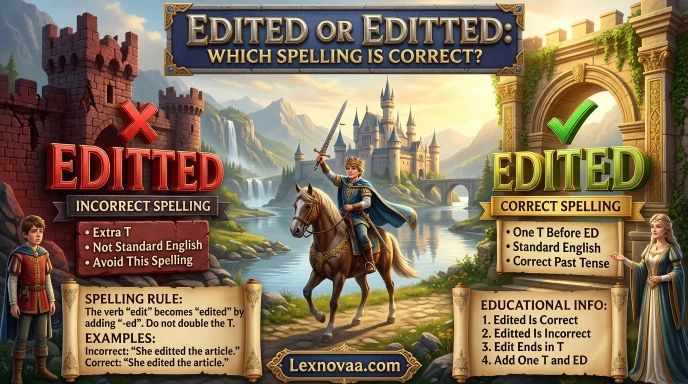
Have you ever typed editted and wondered if it looks right? The correct spelling is edited, with only one t. Editted is a common spelling mistake and is not accepted in standard modern English.
The confusion comes from a spelling rule that doubles the final consonant in some verbs when adding -ed.
For example, stop becomes stopped, and plan becomes planned. It may seem logical to apply the same rule to edit, but this verb follows a different pattern.
The word edited is the past tense and past participle of edit. You use it when someone has revised, corrected, or changed a piece of writing, a document, a video, or another form of content.
In this guide, you will learn why edited has one t, how to use it in sentences, and how it differs from other words that follow similar spelling rules. You will also find practical examples and simple tips to remember the correct form.
Edited or Editted: The Correct Spelling
Edited is the correct spelling. It is the past tense and past participle of the verb edit, meaning to revise, correct, or make changes to something. Editted is incorrect because the final t is not doubled when adding -ed to edit. For example: “She edited the article yesterday.”
Edited or Editted: Quick Answer
Use edited, not editted, in standard English.
- Edited: Correct spelling.
- Editted: Incorrect spelling.
- Edit: The base form of the verb.
- Editing: The present participle.
- Editor: A person who edits written or other content.
Examples:
- I edited my essay before submitting it.
- She has edited the video.
- The report was edited by a professional.
The spelling stays the same in British English and American English. There is no regional variation between the two forms.
What Does Edited Mean?
Edited is the past tense and past participle of the verb edit. It means that someone has reviewed, corrected, revised, or changed something to improve it or prepare it for use.
People use the word in writing, publishing, education, film, photography, and digital media.
1. Edited Means Revised or Corrected
The most common meaning of edited is to make changes to written content.
These changes may include:
- Correcting spelling mistakes
- Fixing grammar errors
- Improving sentence structure
- Removing unnecessary words
- Making ideas clearer
- Checking facts and details
Examples:
- The teacher edited my essay.
- I edited the email before sending it.
- The writer edited the article to make it easier to read.
2. Edited Means Changed or Improved
The word can also describe changes made to images, videos, audio, and other digital content.
Examples:
- She edited the photo before posting it.
- He edited the video for his website.
- The audio was edited to remove background noise.
3. Edited as a Past Tense
Use edited when the action happened in the past.
Examples:
- I edited the document last night.
- They edited the final version yesterday.
- She edited the presentation before the meeting.
4. Edited as a Past Participle
Use edited with helping verbs such as has, have, had, and was.
Examples:
- He has edited the report.
- We had edited the file before the deadline.
- The article was edited by an experienced writer.
Why Is Edited Spelled With One T?
The spelling of edited follows a common English rule for adding endings to verbs.
The base word is edit. When you add -ed, you simply attach the ending:
Edit + ed = Edited
The final t is not doubled.
Why Isn’t It Editted?
English does double the final consonant in some verbs before adding -ed. However, this rule depends on the word’s ending and stress pattern.
For many short verbs that end in a single consonant after a single vowel, the final consonant is doubled.
Examples:
| Base Verb | Past Tense | Spelling Pattern |
| Stop | Stopped | Double the final consonant |
| Plan | Planned | Double the final consonant |
| Drop | Dropped | Double the final consonant |
| Edit | Edited | Keep one final t |
| Visit | Visited | Keep one final t |
| Open | Opened | Keep one final n |
The word edit has stress on its first syllable: ED-it. It does not meet the usual stress condition for doubling the final consonant in this pattern.
That is why edited is correct, while editted is not.
Compare Edit, Edited, and Editing
These forms all come from the same verb.
| Word Form | Correct Spelling | Example |
| Base form | Edit | I edit articles. |
| Third-person singular | Edits | She edits reports. |
| Past tense | Edited | He edited the file. |
| Past participle | Edited | I have edited the document. |
| Present participle | Editing | She is editing a video. |
| Noun | Editor | The editor checked the article. |
Notice that the spelling uses one t in every form.
The Origin of Edited or Editted
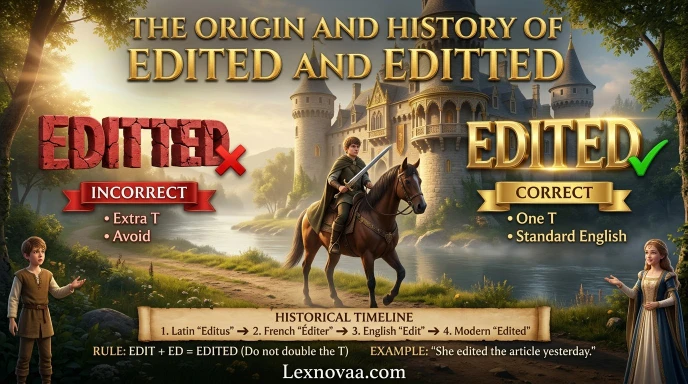
The word edit has a history connected with preparing written material for publication.
It entered English in the late 18th century. It developed from the Latin word editus, the past participle of edere, meaning to publish or bring forth. The word became linked to preparing and revising written work.
As publishing developed, edit became a common verb for reviewing and improving books, newspapers, articles, and other material.
Later, its meaning expanded. Today, people also edit:
- Videos
- Photographs
- Audio recordings
- Websites
- Presentations
- Digital documents
The past tense follows the regular spelling pattern for this verb:
Edit → Edited
The spelling does not change between British and American English.
British English vs American English
Unlike words such as travelled and traveled, edited has the same spelling in British and American English.
Both varieties use one t. Writing editted is not the standard form in either variety.
| British English | American English | Example |
| Edited | Edited | She edited the article. |
| Editing | Editing | He is editing the video. |
| Editor | Editor | The editor reviewed the report. |
| Edit | Edit | Please edit this paragraph. |
| Edited | Edited | The document was edited yesterday. |
Is Edited British or American?
It is both. British and American writers use edited with one t.
Does the Spelling Change in Other English Varieties?
No. The standard spelling is also edited in Canadian, Australian, and other major varieties of English.
What Do Style Guides Recommend?
Modern English spelling references use edited. There is no standard British or American style rule that recommends editted.
If you are writing for a school, publisher, or company, use edited in every context.
Which Version Should You Use?
There is no need to choose between British and American spellings for this word. Edited is correct in both varieties.
United States
Use edited in American English.
Example: I edited the report before sending it to my manager.
United Kingdom
Use edited in British English.
Example: She edited the article before submitting it to the publisher.
Canada
Use edited in Canadian English. The spelling is the same as in both British and American English.
Example: The team edited the final document.
Australia
Use edited in Australian English.
Example: He edited the video for the school project.
International Writing
Use edited for international readers. It is the standard spelling across major English varieties.
Academic Writing
Use edited in essays, research papers, assignments, and academic reports.
Examples:
- The researcher edited the final manuscript.
- The paper was edited before publication.
- The author has edited the introduction.
Business Writing
Use edited in emails, reports, presentations, and company documents.
Examples:
- I have edited the attached file.
- The proposal was edited by the marketing team.
- Please review the edited version before approval.
Common Mistakes When Using Edited or Editted
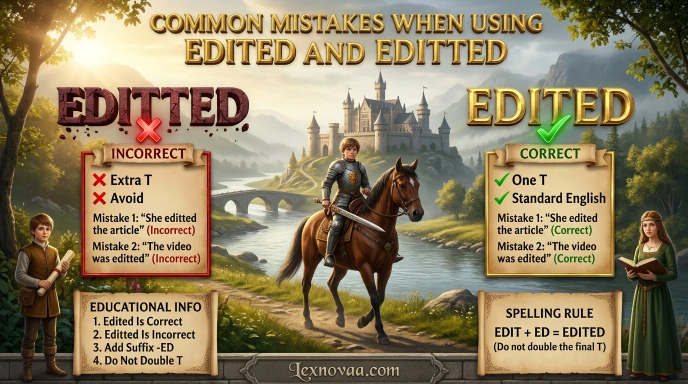
The main mistake is doubling the final t. This happens because some English verbs double their last consonant before adding -ed.
Here are common errors and their corrections.
Mistake 1: Writing Editted Instead of Edited
Incorrect: I editted the document yesterday.
Correct: I edited the document yesterday.
Explanation: The verb edit does not double its final t when adding -ed.
Mistake 2: Using Editted in a Professional Email
Incorrect: I have editted the report and attached it.
Correct: I have edited the report and attached it.
Explanation: The past participle is edited. It is used with have in the present perfect tense.
Mistake 3: Writing Editted in Academic Work
Incorrect: The student editted the essay before submission.
Correct: The student edited the essay before submission.
Explanation: The spelling is the same in academic writing and everyday English. Always use one t before the -ed ending.
Mistake 4: Confusing Edited With Editing
Incorrect: She is edited the article now.
Correct: She is editing the article now.
Use edited for a completed past action or with a suitable helping verb.
Mistake 5: Confusing Edited With Editor
Incorrect: The edited checked my article.
Correct: The editor checked my article.
Explanation: An editor is a person who reviews or improves content. Edited describes an action or a completed change.
Easy Memory Tip
Remember this simple rule:
Edit + ed = Edited
Think of visited and opened. They also keep one final consonant when adding -ed.
Whenever you are unsure, remember that edited is the only standard spelling.
Everyday Examples of Edited
The word edited appears in many daily situations. Here are examples from different types of writing.
1. Email Examples
- I edited the document and attached the new version.
- She has edited the email for clarity.
- Please check the edited file before sending it.
2. Business Writing Examples
- The manager edited the proposal before approval.
- The report was edited by the communications team.
- We have edited the presentation to include the latest information.
3. News Headline Examples
- Government Report Edited Before Publication
- Video Edited After New Information Emerges
- Newspaper Article Edited for Accuracy
4. Blog Examples
- I edited my blog post to improve readability.
- The article was edited to remove repeated information.
- She edited the introduction before publishing the guide.
5. Social Media Examples
- Edited my photo before posting it.
- I have edited the caption. Check it out!
- This video was edited on my phone.
6. Academic Writing Examples
- The student edited the essay before submitting it.
- The research paper was edited for grammar and clarity.
- The final draft has been edited by the supervisor.
7. Daily Conversation Examples
- Have you edited the file?
- I edited it this morning.
- The document needs to be edited again.
Google Trends and Modern Usage
The extra t may seem natural to writers who know that some verbs double their final consonant before adding -ed.
However, standard modern English uses only edited.
Which Spelling Is More Common?
Edited is the correct and widely used spelling. Editted is generally a typing or spelling error.
This rule applies in the United States, United Kingdom, Canada, Australia, and other English-speaking regions.
Why Do People Search for Edited or Editted?
Common reasons include:
- Checking the past tense of edit
- Learning English spelling rules
- Writing school assignments
- Editing professional documents
- Using online grammar checkers
- Confusing edited with words such as stopped and planned
How Is Edited Used Today?
The word is common in modern digital communication. People use it when talking about changes to documents, photos, videos, websites, and social media posts.
For example, a person may say:
- I edited the video.
- The photo was edited.
- The article has been edited.
What About Google Trends?
No live Google Trends figures have been checked for this article, so no exact search-volume numbers or regional rankings are claimed.
The general usage pattern is clear: edited is the standard spelling everywhere, while editted is a common misspelling. Search interest in this pair is likely driven by uncertainty about consonant doubling.
Edited vs Editted: Quick Comparison Table
| Version | Meaning | Correct? | Region | Example |
| Edited | Past tense of edit | Yes | All major English varieties | She edited the article. |
| Editted | Intended as past tense of edit | No | Not standard | She editted the article. |
| Editing | Present participle of edit | Yes | All major English varieties | He is editing the file. |
| Editor | A person who edits content | Yes | All major English varieties | The editor reviewed the story. |
| Edit | Base form of the verb | Yes | All major English varieties | Please edit this document. |
Key Takeaways
- Edited is the correct spelling.
- Editted is incorrect in standard English.
- Edited is the past tense and past participle of edit.
- The word keeps one t when adding -ed.
- British and American English use the same spelling.
- Use editing for an action in progress.
- Use editor for a person who reviews or changes content.
- Remember: Edit + ed = Edited.
FAQs
1. Is it edited or editted?
Edited is correct. It is the past tense and past participle of edit. Editted is a common spelling mistake because the final t is incorrectly doubled. In standard English, always write edited in emails, essays, reports, and other forms of writing.
2. Why is edited spelled with one t?
The word edit does not follow the consonant-doubling pattern used by verbs such as stop and plan. Its stress falls on the first syllable, so the final t is not doubled when adding -ed. The correct form is edited.
3. Is editted ever correct?
No. Editted is not an accepted standard spelling of the past tense of edit. It may appear in informal online writing or as a typing error, but dictionaries and standard writing conventions use edited. Choose edited in both formal and informal writing.
4. What is the past tense of edit?
The past tense of edit is edited. For example, “I edited the document yesterday.” The past participle is also edited, as in “I have edited the document.” The spelling stays the same in British and American English.
5. Is edited British or American English?
Edited is used in both British and American English. Unlike words such as travelled and traveled, this word does not have separate regional spellings. Writers in the UK, US, Canada, and Australia all use edited.
6. What is the difference between edit and edited?
Edit is the base form of the verb. Edited is its past tense and past participle. For example, “I edit articles every day” describes a regular action, while “I edited the article yesterday” describes a completed action in the past.
7. Is it editing or editting?
Editing is correct. It is the present participle of edit and describes an action in progress. For example, “She is editing a video.” The spelling uses one t, just like edited. Editting is not a standard spelling.
8. How do you use edited in a sentence?
Use edited to describe something that someone revised, corrected, or changed. For example, “The teacher edited my essay before submission.” You can also use it with helping verbs: “I have edited the report” or “The video was edited yesterday.”
9. What is the noun form of edited?
The related noun is editing, which refers to the process of reviewing and changing content. Another related noun is editor, which means a person who edits. For example, “The editor completed the editing before the article was published.”
10. How can I remember the correct spelling of edited?
Remember the simple formula: edit + ed = edited. Do not add another t. You can also compare it with visited, which keeps one final consonant before -ed. If you see editted, correct it to edited.
Conclusion: Edited or Editted?
When choosing between edited or editted, always use edited. It is the correct past tense and past participle of the verb edit. The spelling uses one t, followed by the letters -ed.
The word has the same spelling in British, American, Canadian, and Australian English. There is no regional variation to remember.
if you are writing an email, editing an essay, preparing a business report, or describing changes to a video, edited is the right choice.
The confusion often comes from verbs such as stopped and planned, which double their final consonants before adding -ed. But edit follows a different pattern because of its stress and spelling structure.
Remember this simple rule: Edit becomes edited, never editted.
For more easy explanations of confusing English words, spelling rules, and grammar comparisons, visit Lexnovaa.com.
EXPLORE MORE ARTICLE CLICK HERE NOW!
- Sofa or Couch: What’s the Difference and Which Is Correct?
- Weather or Whether: Meaning, Difference, and Correct Usage
- Period Inside or Outside Parentheses? The Rules Explained

I’m Orin Blake, a writer with a passion for making English grammar simple, practical, and easy to understand. I enjoy breaking down confusing words, spelling differences, and everyday language questions into clear, reader-friendly guides. My goal is to help students, professionals, and curious learners write with greater confidence and accuracy.