Have you ever wondered whether to write weather or whether? These two words sound exactly alike, but they have very different meanings.
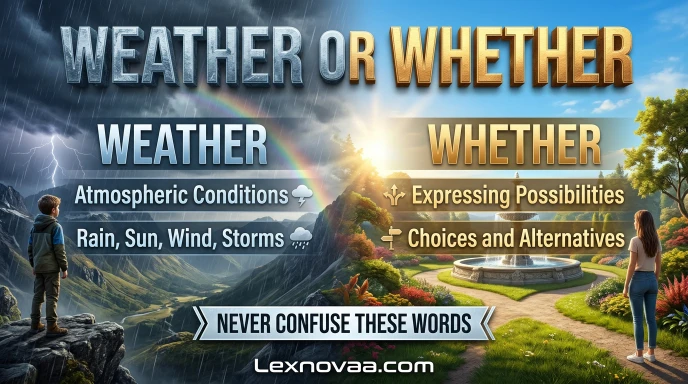
Weather refers to conditions in the air, such as rain, sunshine, wind, and snow. Whether introduces a choice, doubt, or possibility.
For example, “The weather is beautiful today” talks about the conditions outside. However, “I don’t know whether it will rain” expresses uncertainty about something that may happen.
This confusion is common because both words are pronounced the same way. Their different spellings can also be easy to miss when typing quickly. Choosing the wrong word may change the meaning of your sentence or make your writing look less polished.
In this guide, you will learn the meaning of weather and whether, understand their grammar rules, and see how to use them in everyday situations.
You will also discover common mistakes, practical examples, and a simple memory trick to help you choose the correct word every time.
Weather or Whether: The Difference Explained
Weather is a noun that describes outdoor conditions, including temperature, rain, wind, and sunshine. Whether is a conjunction that introduces a choice, alternative, or uncertainty. For example, “The weather is cold” describes the climate, while “I wonder whether it will snow” expresses uncertainty.
Weather or Whether: Quick Answer
The correct word depends on what you want to say.
- Weather: Use it when talking about rain, sunshine, temperature, wind, or other atmospheric conditions.
- Whether: Use it when introducing a choice, possibility, or indirect yes-or-no question.
Examples:
- The weather is sunny today.
- I don’t know whether she will come.
- We stayed home because of the bad weather.
- He asked whether I was ready.
Easy memory trick: If you are talking about rain or sunshine, use weather. If you are talking about a choice or possibility, use whether.
What Does Weather or Whether Mean?
Although weather and whether sound alike, they have different meanings and grammatical roles. Understanding how each word works will help you use them correctly.
What Does Weather Mean?
Weather is a noun that describes the condition of the atmosphere at a particular time and place.
It includes things such as:
- Temperature
- Rain and snow
- Wind
- Clouds
- Sunshine
- Storms
- Humidity
Common uses of weather include:
1. Describing daily conditions
Use weather when talking about the conditions outside.
- The weather is warm today.
- I love sunny weather.
- The weather looks cloudy this morning.
2. Talking about forecasts
Use weather when discussing predictions about future atmospheric conditions.
- The weather forecast says it will rain.
- We should check the weather before traveling.
- The news reported severe weather for tomorrow.
3. Describing difficult conditions
The word can also describe challenging atmospheric conditions.
- The stormy weather delayed our flight.
- The ship continued sailing in rough weather.
- The match was canceled because of bad weather.
4. Using weather as a verb
Weather can also work as a verb. It means to endure or survive a difficult experience or condition.
- The company managed to weather the financial crisis.
- The old building has weathered many storms.
- Their friendship weathered several difficult years.
What Does Whether Mean?
Whether is a conjunction. It introduces alternatives, possibilities, or uncertainty.
It often appears when someone is unsure about something or needs to consider two or more options.
Common uses of whether include:
1. Introducing a choice
Use whether when discussing two or more possibilities.
- I cannot decide whether to stay or leave.
- She asked whether I wanted tea or coffee.
- We must choose whether to travel by car or train.
2. Expressing uncertainty
Use whether when you are unsure about something.
- I don’t know whether he is coming.
- She wondered whether the shop was open.
- They are unsure whether the plan will work.
3. Introducing an indirect yes-or-no question
Use whether when reporting a question without asking it directly.
- He asked whether I needed help.
- Please tell me whether you agree.
- I wonder whether they received the message.
4. Using “whether or not”
The expression whether or not emphasizes that something is true regardless of the outcome.
- I will attend whether or not it rains.
- She must finish the task whether or not she feels ready.
- We will continue whether or not they support us.
Weather vs Whether: A Simple Grammar Difference
| Word | Part of Speech | Main Meaning | Example |
| Weather | Noun | Atmospheric conditions | The weather is cold. |
| Weather | Verb | To survive or endure | They weathered the crisis. |
| Whether | Conjunction | Choice or uncertainty | I wonder whether he knows. |
The Origin of Weather and Whether

Weather and whether have different historical roots. Their spellings and meanings developed over time, even though their modern pronunciation is the same.
The Origin of Weather
The word weather comes from Old English weder, which referred to air, sky, or atmospheric conditions.
Over time, its meaning became more closely linked to the condition of the atmosphere, including wind, rain, temperature, and storms.
Today, weather is used in everyday conversation, science, travel, and news reporting.
The Origin of Whether
The word whether comes from Old English hwæther, which was used to express a choice between alternatives.
Its meaning developed around ideas of uncertainty and alternatives. Today, it commonly introduces indirect questions and statements involving different possibilities.
Why Do People Confuse These Words?
There are three main reasons:
- Same pronunciation: Both words are pronounced alike in modern English.
- Similar spelling: They differ by only a few letters.
- Frequent use: Both appear in everyday conversation, emails, news, and online writing.
Their meanings are different, so the best way to choose the correct spelling is to look at the sentence’s context.
British English vs American English
There is no major spelling or meaning difference between British and American English for weather and whether. Both words are used in the same way in standard English.
| Usage | British English | American English | Example |
| Atmospheric conditions | Weather | Weather | The weather is sunny. |
| Weather forecast | Weather forecast | Weather forecast | Check the weather forecast. |
| Choice between options | Whether | Whether | I don’t know whether to go. |
| Indirect question | Whether | Whether | She asked whether I was ready. |
| Alternative with or not | Whether or not | Whether or not | I will go whether or not it rains. |
Regional Differences
British and American English follow the same rules for these words.
For example:
- British English: I wonder whether the weather will improve.
- American English: I wonder whether the weather will improve.
The spelling and meaning remain unchanged in both varieties.
Style Guides and Publishing Preferences
Major English dictionaries and style guides recognize both spellings. Writers should use weather for atmospheric conditions and whether for alternatives or uncertainty.
Professional editors usually check the meaning of the sentence rather than applying a regional spelling preference.
Which Version Should You Use?
You do not need to choose a British or American version. Both weather and whether are correct in all major English varieties. The important thing is to use each word according to its meaning.
| Writing Context | Correct Usage | Example |
| United States | Weather or whether | I wonder whether the weather will change. |
| United Kingdom | Weather or whether | The weather is pleasant today. |
| Canada | Weather or whether | We don’t know whether it will snow. |
| Australia | Weather or whether | The weather is warm this afternoon. |
| International writing | Choose by meaning | Check whether the weather is safe for travel. |
| Academic writing | Use precise grammar | The study examines whether temperature affects growth. |
| Business writing | Use the correct word for context | Please confirm whether the event will proceed. |
For Academic Writing
Use weather when discussing atmospheric conditions in scientific or research contexts.
- The study examines changes in extreme weather.
- Researchers recorded the local weather conditions.
Use whether when discussing a research question or possibility.
- The study investigates whether temperature affects plant growth.
- Researchers examined whether rainfall influenced the results.
For Business Writing
Both words can appear in professional emails, reports, and meetings.
- Please check the weather before confirming the outdoor event.
- Let us know whether you can attend the meeting.
- We need to decide whether the event should be postponed.
Using the correct word makes your message clear and professional.
Common Mistakes When Using Weather and Whether

Because these words sound alike, people sometimes choose the wrong spelling. Here are common errors and their correct forms.
Mistake 1: Using Whether When Talking About Atmospheric Conditions
Incorrect: The whether is beautiful today.
Correct: The weather is beautiful today.
Explanation: The sentence describes outdoor conditions, so weather is correct.
Memory tip: If the sentence mentions sunshine, rain, wind, or temperature, use weather.
Mistake 2: Using Weather When Expressing Uncertainty
Incorrect: I don’t know weather she is coming.
Correct: I don’t know whether she is coming.
Explanation: The sentence expresses uncertainty about a possible event. Use whether.
Memory tip: If you could replace the word with “if,” whether may be the correct choice.
Mistake 3: Confusing Weather or Whether in Questions
Incorrect: Tell me weather you agree.
Correct: Tell me whether you agree.
Explanation: The sentence asks someone to confirm a choice or possibility. Therefore, use whether.
Mistake 4: Using Weather in “Whether or Not”
Incorrect: I will go weather or not it rains.
Correct: I will go whether or not it rains.
Explanation: The phrase whether or not expresses that something will happen regardless of the outcome.
Mistake 5: Forgetting the Difference in Long Sentences
Incorrect: We need to check weather the weather will improve.
Correct: We need to check whether the weather will improve.
Explanation: The first word introduces uncertainty. The second refers to atmospheric conditions. Both words are correct in the same sentence.
A Simple Memory Tip
Remember these two rules:
- Weather = rain, sunshine, wind, and temperature.
- Whether = choice, possibility, or uncertainty.
You can also remember that whether often works in a sentence where you could use if.
For example:
- I don’t know whether he will come.
- I don’t know if he will come.
Both sentences express uncertainty.
Everyday Examples of Weather and Whether
The best way to understand these words is to see how people use them in different situations.
1. Weather and Whether in Emails
- Please check the weather before leaving for the event.
- Let me know whether you can attend the meeting.
- I am not sure whether the outdoor event will continue.
- The bad weather may delay our delivery.
2. Weather and Whether in Business Writing
- The company will monitor the weather during the outdoor project.
- We need to decide whether to change the meeting date.
- The report examines the effects of extreme weather.
- Please confirm whether the client approved the proposal.
3. Weather and Whether in News Headlines
- Severe Weather Expected Across the Region
- Officials Unsure Whether Roads Will Reopen
- New Report Examines Extreme Weather Events
- Questions Remain Whether the Event Will Continue
4. Weather and Whether in Blogs
- How to Prepare for Bad Weather
- Does Weather Affect Your Daily Routine?
- How to Decide Whether to Travel
- What to Know Before You Plan an Outdoor Event
5. Weather and Whether on Social Media
- Beautiful weather calls for a long walk!
- I wonder whether it will rain tomorrow.
- Not sure whether I should go out today.
- This weather makes me want to stay home.
6. Weather and Whether in Academic Writing
- The research examines how weather affects crop production.
- Scientists studied whether temperature changes influence plant growth.
- Extreme weather can affect transport systems.
- The experiment tested whether humidity changed the results.
7. Weather and Whether in Daily Conversation
- How is the weather today?
- Do you know whether the shop is open?
- I hope the weather stays sunny.
- I can’t decide whether to walk or take a bus.
- We should check the weather before going outside.
Google Trends and Modern Usage
People search for weather or whether because these words sound alike but serve different purposes. The confusion is common among students, English learners, and writers who want to avoid spelling mistakes.
Both words are widely used in modern English. Weather appears in forecasts, travel discussions, science, and everyday conversation. Whether appears in questions, decisions, reports, and sentences that express uncertainty.
Why Do People Search for Weather or Whether?
Common search questions include:
- Is it weather or whether?
- How do you use weather and whether?
- Is it whether or not or weather or not?
- What is the difference between weather and whether?
- How can I remember weather vs whether?
These searches show that people want a simple way to distinguish the two words.
Regional Popularity
Both words are standard in British, American, Canadian, and Australian English. There is no major regional difference in their spelling or meaning.
Exact current Google Trends figures have not been verified for this article. This discussion is based on general English usage patterns, not measured search-volume data.
Why the Confusion Continues
Three factors explain why people mix up these words:
- Homophones: They sound the same when spoken.
- Similar spelling: Their written forms are almost identical.
- Different grammar roles: One mainly names atmospheric conditions, while the other connects ideas and introduces alternatives.
The easiest way to avoid mistakes is to read the whole sentence and identify its meaning before choosing a word.
Quick Comparison Table: Weather vs Whether
| Version | Meaning | Correct? | Region | Example |
| Weather | Atmospheric conditions | Yes | All major varieties | The weather is cold. |
| Whether | Choice or uncertainty | Yes | All major varieties | I wonder whether he knows. |
| Weather | To endure or survive | Yes | All major varieties | They weathered the storm. |
| Whether or not | Regardless of the outcome | Yes | All major varieties | I will go whether or not it rains. |
| Weather or not | Incorrect form for this expression | No | None in standard English | Use “whether or not.” |
Key Takeaways
- Weather refers to atmospheric conditions such as rain, wind, and sunshine.
- Whether introduces a choice, possibility, or uncertainty.
- Both words sound the same but have different meanings.
- Weather can also be used as a verb meaning to endure or survive.
- Whether or not is a common expression used to show that an outcome does not change a decision.
- British and American English use both words in the same way.
- Check the meaning of your sentence before choosing the spelling.
FAQs
1. What is the difference between weather and whether?
Weather is a noun that describes atmospheric conditions, such as rain, wind, sunshine, and temperature.
Whether is a conjunction that introduces a choice or uncertainty. For example, “The weather is cold” describes the conditions outside, while “I wonder whether it will snow” expresses uncertainty.
2. Is it weather or whether or not?
The correct expression is whether or not. It means that something will happen or remain true regardless of the outcome.
For example, “I will attend whether or not it rains.” The spelling weather or not is incorrect when expressing this meaning.
3. How do you remember weather vs whether?
Remember that weather is related to rain, sunshine, wind, and temperature. Whether is related to choices and possibilities.
If your sentence discusses atmospheric conditions, use weather. If it expresses uncertainty or introduces alternatives, use whether.
4. Can whether be used instead of if?
Yes. Whether can often replace if when introducing an indirect yes-or-no question. For example, “I don’t know whether she is coming” and “I don’t know if she is coming” are both correct. However, whether is needed in some constructions, such as “whether or not.”
5. Is weather a noun or a verb?
Weather is most commonly used as a noun for atmospheric conditions. It can also be a verb meaning to survive or endure something difficult.
For example, “The weather is cold” uses a noun, while “The company weathered the crisis” uses a verb.
6. Is whether a conjunction?
Yes. Whether is a conjunction that introduces alternatives, possibilities, or indirect questions. For example, “She asked whether I was ready.”
It can also appear in expressions such as “whether or not,” which shows that a result does not change a decision.
7. Are weather and whether pronounced the same?
Yes. Weather and whether are homophones in standard English. This means they have the same pronunciation but different meanings and spellings.
You cannot always tell which word someone means by hearing it, so the context helps identify the correct one.
8. Is it “I don’t know whether” or “I don’t know weather”?
The correct expression is “I don’t know whether.” It introduces uncertainty about something. For example, “I don’t know whether he will arrive today.” Use weather only when you are talking about atmospheric conditions or the verb meaning to endure.
9. Does whether always need “or not”?
No. Whether can be used alone without or not. For example, “I don’t know whether she is coming” is complete and correct. You can add or not for emphasis: “I don’t know whether or not she is coming.”
10. Is weather or whether different in British and American English?
No. British and American English use weather for atmospheric conditions and whether for choices or uncertainty. Their spelling, meaning, and basic grammar rules are the same in both varieties.
Conclusion
The difference between weather and whether is easy to understand once you focus on meaning.
Use weather when discussing rain, sunshine, wind, temperature, or atmospheric conditions. Use whether when introducing a choice, possibility, or indirect question.
For example, “I wonder whether the weather will improve” uses both words correctly. The first word expresses uncertainty, while the second describes the conditions outside.
Remember that weather can also be a verb meaning to survive a difficult situation. Meanwhile, whether often appears in phrases such as whether or not and in sentences that present different options.
The same rules apply in British, American, Canadian, and Australian English. You do not need to memorize regional variations. Simply check what your sentence means before choosing the spelling.
Remember: Weather is what happens outside; whether is about what might happen. For more simple explanations of confusing English words and grammar comparisons, visit Lexnovaa.com.
EXPLORE MORE ARTICLE CLICK HERE NOW!
- Me Either or Me Neither: Which Is Correct?
- Whose or Who’s: The Simple Rule That Gets It Right
- Everyday or Every Day: Meaning, Difference, and Examples

I’m Orin Blake, a writer with a passion for making English grammar simple, practical, and easy to understand. I enjoy breaking down confusing words, spelling differences, and everyday language questions into clear, reader-friendly guides. My goal is to help students, professionals, and curious learners write with greater confidence and accuracy.