Is it then or than? These two words look almost the same, but they have different meanings and uses. Choosing the wrong one can change the meaning of a sentence and make your writing less clear.
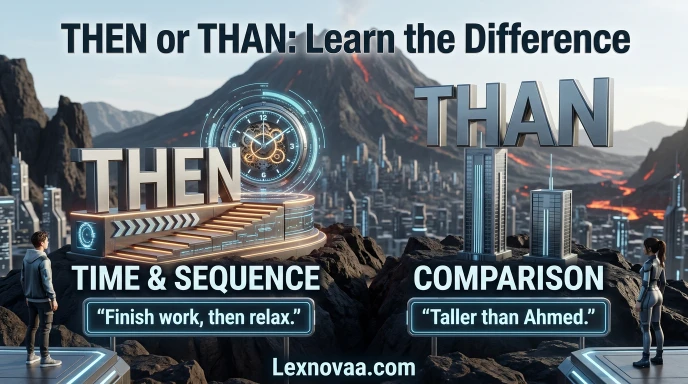
The simple rule is this: then refers to time, order, or what happens next, while than is used to compare two people, things, or ideas.
For example, “We ate dinner, then watched a movie” describes two events in order. However, “This movie is better than the last one” compares two movies.
People often confuse then and than because they differ by only one letter and can sound similar in fast speech. This mistake appears in emails, school assignments, social media posts, and everyday writing
Understanding the difference is easy once you know what each word does in a sentence. In this guide, you will learn their meanings, origins, grammar rules, regional usage.
and common mistakes. You will also find practical examples to help you choose the correct word with confidence.
Then or Than: The Difference Explained
Then refers to a time, a sequence of events, or a result. Than introduces a comparison between two people, things, actions, or ideas.
- Use then when you mean next, after that, or at that time.
- Use than when comparing things, as in bigger than, better than, or more than.
Examples:
- Finish your homework, then you can play.
- My sister is taller than me.
- We lived there then, but we live here now.
Remember: Then is about time; than is about comparison.
Then or Than: Quick Answer
The correct choice depends on the meaning of your sentence.
Use then to describe when something happens or what happens next:
- First, wash the vegetables. Then cut them.
- I was younger then.
- If you are ready, then let’s begin.
Use than to compare two things:
- This bag is cheaper than that one.
- She works faster than I do.
- I would rather read than watch television.
A simple memory trick is to connect then with when and than with comparison. If your sentence discusses time or order, choose then. If it compares two things, choose than.
What Does Then Mean?
Then is an adverb that usually refers to time, order, or a result. It helps readers understand when something happened or what should happen next.
It can serve several purposes in English.
1. Then Means Next or After That
This is one of the most common uses of then. It connects events in the order they happen.
Examples:
- Add the flour, then mix everything together.
- She finished her work and then went home.
- We visited the museum, then had lunch.
In each sentence, then tells the reader what happened after the first action.
2. Then Refers to a Past or Future Time
Then can also refer to a particular time.
Examples:
- I was living in London then.
- Things were different then.
- We will discuss the results then.
Here, then means at that time or refers to a time already mentioned.
3. Then Shows a Result or Conclusion
Then can introduce a result, decision, or logical conclusion. It often appears in conditional sentences.
Examples:
- If you need help, then call me.
- If the weather improves, then we can go outside.
- You have completed the task, so then you can take a break.
In these examples, then connects a condition or situation with its result.
4. Then Means in That Case
In conversation, then can mean in that case.
Examples:
- You are not hungry? Then save your food for later.
- If that is your decision, then I respect it.
- You have already read the book? Then you know how the story ends.
Key point: Then helps explain time, sequence, or the result of a situation.
What Does Than Mean?
Than is a word used to introduce the second part of a comparison. It helps show how one person, thing, action, or idea differs from another.
It commonly appears after comparative adjectives, comparative adverbs, and words such as more, less, better, and rather.
1. Than After Comparative Adjectives
Use than after an adjective that compares two things.
Examples:
- This road is longer than the other one.
- My new phone is lighter than my old phone.
- The blue dress is more expensive than the black dress.
The word than introduces the second item in each comparison.
2. Than After Comparative Adverbs
Than can also follow adverbs that compare how actions happen.
Examples:
- He runs faster than his brother.
- She speaks more clearly than before.
- I arrived earlier than expected.
These sentences compare actions or the way they are performed.
3. Than With More, Less, and Better
Many common comparisons use than after words such as more, less, and better.
Examples:
- I need more time than I expected.
- This option is less expensive than the other one.
- Your explanation is better than mine.
4. Than With Rather
The phrase rather than expresses a preference or choice between two options.
Examples:
- I would walk rather than take a taxi.
- She chose tea rather than coffee.
- We decided to stay home rather than go out.
Key point: Than is used to compare, contrast, or express a preference between alternatives.
The Origin of Then and Than

The words then and than have old Germanic roots. Their spellings and uses developed over many centuries of English.
Although they look and sound similar today, they developed different roles in modern English.
The History of Then
Then comes from Old English forms such as þænne and þonne. These forms were used to express ideas related to time, including at that time, afterward, and next.
As English developed through the Middle English period, the spelling gradually changed. The modern form then became established.
Its main purpose remains closely connected to time and sequence. Today, it helps speakers describe when something happens, what follows an event, or what result comes from a situation.
The History of Than
Than also has roots in Old English. Historical forms included þanne, which was used in comparative expressions.
Over time, its spelling and grammatical role developed into the modern word than. It became the standard word used to introduce the second part of a comparison.
Today, it appears in common expressions such as bigger than, more than, better than, and rather than.
Why Are Then and Than So Similar?
Their similar appearance comes from their shared historical background and the development of English spelling.
However, modern English gives them different grammatical jobs:
- Then relates to time, sequence, and results.
- Than introduces comparisons and alternatives.
Knowing their modern meanings is more useful for everyday writing than memorizing their historical spellings.
British English vs American English
The difference between then and than is the same in British English and American English. Both varieties use then for time and sequence and than for comparisons.
There is no standard regional spelling change between these words.
| Usage | British English | American English | Example |
| Time or sequence | Then | Then | We ate, then left. |
| Referring to a past time | Then | Then | I lived there then. |
| Comparison | Than | Than | She is older than me. |
| Preference | Rather than | Rather than | I would walk rather than drive. |
| Conditional result | Then | Then | If you agree, then we can start. |
Regional Differences
British and American writers follow the same basic grammar rules for these words.
For example:
- British English: This route is shorter than the old one.
- American English: This route is shorter than the old one.
- British English: We will eat then leave.
- American English: We will eat then leave.
The spelling and meaning remain unchanged.
Style Guides and Publishing Preferences
Major English style guides do not treat then and than as regional alternatives. Writers should select the word based on its meaning.
In academic, business, and professional writing, using the correct word is important because it keeps comparisons and sequences clear.
Which Version Should You Use?
You do not need to choose between a British and an American version of then or than. Both words are standard in all major English varieties.
The important thing is to use each word correctly.
United States
American English uses then for time and sequence and than for comparisons.
Example: The new model is faster than the old one. We tested it, then published the results.
United Kingdom
British English follows the same rule.
Example: She finished her lesson, then went home. Her new result was better than the previous one.
Canada
Canadian English also uses both words in the same way.
Example: This option costs less than the other one. We can decide then.
Australia
Australian English follows the same standard distinction.
Example: He arrived earlier than expected and then waited outside.
International Writing
For international readers, use then for time and than for comparisons. This distinction is widely understood and accepted.
Academic Writing
In essays, reports, and research papers, use than when comparing evidence, results, or ideas. Use then when explaining a process or the order of events.
Example: The second method was more effective than the first. The researchers then reviewed the results.
Business Writing
In emails, reports, and presentations, choose the word that matches your meaning.
Example: Please review the proposal, then send your feedback. This option is more affordable than the previous one.
Common Mistakes When Using Then and Than
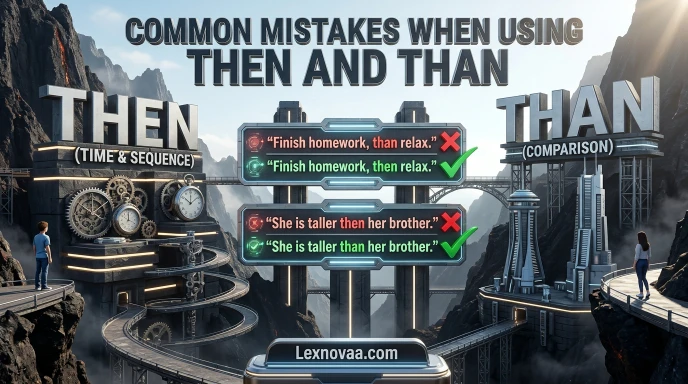
The most common mistake is using then when a sentence needs than, or using than when the sentence refers to time.
Here are examples to help you avoid this error.
| Incorrect Sentence | Correct Sentence | Explanation |
| She is taller then me. | She is taller than me. | Use than for comparisons. |
| We ate dinner, than watched a movie. | We ate dinner, then watched a movie. | Use then for the next event. |
| This book is better then that one. | This book is better than that one. | Better than introduces a comparison. |
| Finish your work, than go home. | Finish your work, then go home. | Then shows the order of actions. |
| He runs faster then I do. | He runs faster than I do. | Faster than compares speed. |
| I was happier than. | I was happier then. | Then refers to a past time. |
Mistake 1: Using Then for Comparisons
Incorrect: My laptop is newer then yours.
Correct: My laptop is newer than yours.
Why? The sentence compares two laptops. Therefore, than is the correct choice.
Mistake 2: Using Than for Events in Order
Incorrect: We had breakfast, than went shopping.
Correct: We had breakfast, then went shopping.
Why? The sentence describes two events. Then shows that shopping happened after breakfast.
Mistake 3: Confusing Then With Than in Conditional Sentences
Incorrect: If you study hard, than you may pass.
Correct: If you study hard, then you may pass.
Why? The sentence describes a possible result. Then introduces what may happen if the condition is met.
Mistake 4: Forgetting Than After Comparative Words
Incorrect: This task is easier then the last one.
Correct: This task is easier than the last one.
Why? The word easier compares two tasks, so it needs than.
An Easy Memory Tip
Use these simple reminders:
- Then = Time: Think of when something happens.
- Than = Comparison: Think of compare.
- If you can replace the word with next or after that, you probably need then.
- If you are comparing two things, you probably need than.
Everyday Examples of Then and Than
Seeing these words in real situations makes their differences easier to remember.
1. Emails
- Please read the attached document, then reply to this email.
- The new deadline is earlier than the original one.
2. Business Writing
- Review the budget, then share your recommendations.
- Our new service is more affordable than the previous plan.
3. News Headlines
- Officials Announce New Rules, Then Release Further Details
- New Study Finds Sleep More Important Than Previously Thought
4. Blogs
- Learn the basic rules, then practice with examples.
- Writing clearly is more important than using difficult words.
5. Social Media
- First, take a picture, then add a caption.
- This is better than anything I expected!
6. Academic Writing
- The researchers collected the data and then analyzed the results.
- The second method produced more accurate results than the first.
7. Daily Conversation
- “What did you do then?”
- “My brother is younger than me.”
- “Finish your lunch, then we can leave.”
- “This place is quieter than the other one.”
These examples show that the correct choice depends on the sentence’s meaning, not its spelling or sound.
Google Trends and Modern Usage
Then and than are both common words in modern English. They appear in everyday conversation, online writing, educational content, news articles, emails, and academic work.
People often search for then or than because the words look similar and are sometimes difficult to distinguish when spoken quickly.
Why Do People Confuse Them?
There are three main reasons:
- Similar spelling: The words differ by only one letter.
- Similar pronunciation: Their sounds can be difficult to distinguish in fast or informal speech.
- Different grammar roles: Writers may remember the words but forget when to use each one.
Regional Popularity
Both words are used throughout the United States, United Kingdom, Canada, Australia, and other English-speaking regions.
There is no major regional difference in their standard meanings. Their search popularity may change over time and across locations, but exact regional search figures should be checked directly through Google Trends rather than assumed.
Modern Usage
The distinction remains important in digital communication. A small spelling mistake can make a sentence confusing, especially when a writer is explaining a process or comparing two options.
For clear modern writing, remember:
- Use then for time and sequence.
- Use than for comparisons.
- Read the whole sentence before choosing.
Then or Than: Quick Comparison Table
| Version | Meaning | Correct? | Usage | Example |
| Then | At that time | Yes | Refers to time | I lived there then. |
| Then | After that | Yes | Shows sequence | Eat first, then rest. |
| Then | In that case | Yes | Shows a result | If so, then let’s go. |
| Than | Comparison | Yes | Compares two things | She is taller than me. |
| Than | Greater or smaller amount | Yes | Shows a difference | I need more than five minutes. |
| Than | Preference | Yes | Used in rather than | I would walk rather than drive. |
| Then | Comparison | No | Incorrect substitute for than | Incorrect: Better then yours. |
| Than | Sequence | No | Incorrect substitute for then | Incorrect: Eat, than rest. |
Key Takeaways
- Then refers to time, order, or a result.
- Than introduces a comparison between two things.
- Use then in sentences that mean next or after that.
- Use than after comparative words such as better, faster, and more.
- The phrase rather than expresses a preference or choice.
- British and American English follow the same rules.
- Remember: Then = Time; Than = Comparison.
FAQs About Then or Than
1. What is the difference between then and than?
Then refers to time, sequence, or a result. Than is used to compare two people, things, or ideas. For example, “We ate, then left” shows the order of events. “She is taller than me” compares two people.
The easiest way to remember the difference is to connect then with time and than with comparison.
2. When should I use then instead of than?
Use then when talking about what happens next, what happened at a particular time, or what follows from a condition.
For example, “Finish your homework, then watch television.” The word then shows that watching television comes after finishing homework. If your sentence is about time or sequence, then is usually the correct choice.
3. When should I use than instead of then?
Use than when comparing two things or expressing a preference. It often follows comparative words such as better, faster, taller, more, and less.
For example, “This car is cheaper than that one.” The word than introduces the second part of the comparison.
4. Is it better then or better than?
Better than is correct when comparing two things. For example, “This book is better than the one I read last week.”
Better then is not correct for a normal comparison. However, then can appear in a different sentence about time, such as “Things were better then,” meaning things were better at that time.
5. Is it first then or first than?
First, then is the correct expression when describing the order of actions. For example, “First, prepare the ingredients, then cook the meal.” The word then means after that. Than is used for comparisons, so it does not fit this sequence.
6. Is then a time word?
Yes. Then is commonly used as an adverb of time. It can mean at that time, next, or after that. For example, “I lived in that city then” refers to a past time. In “We finished dinner, then went home,” it shows the order of events.
7. Can than be used at the end of a sentence?
Yes. Than can appear at the end of a sentence or clause in natural English. For example, “She is more talented than I thought she was.”
In informal conversation, people may also say, “He is taller than I am.” The comparison remains clear even when the sentence ends with a than-clause.
8. Do British and American English use then and than differently?
No. British and American English use then and than in the same standard way. Then refers to time, order, or a result, while than introduces comparisons.
For example, both varieties use “We ate, then left” and “This option is better than the other one.”
9. How can I remember the difference between then and than?
Use a simple memory trick: Then = Time; Than = Comparison. If you can replace the word with next or after that, use then.
If you are comparing two people, objects, amounts, or ideas, use than. Practicing with short sentences will help you remember the difference.
10. Is it more then or more than?
More than is correct when expressing a comparison or an amount greater than something. For example, “The trip took more than two hours.” More then is incorrect in this context.
However, then can appear separately in a sentence about sequence, such as “We needed more time, then we continued.”
Conclusion
Understanding then or than is simple once you know what each word means. Then refers to time, sequence, or a result.
Than is used to compare people, objects, amounts, actions, and ideas. Although the words look and sound similar, they cannot replace each other in standard English.
Use then when you mean next, after that, or at that time. Choose than when comparing two things or using expressions such as better than, more than, and rather than. These rules apply to British, American, Canadian, and Australian English.
The best way to avoid mistakes is to check the meaning of the sentence before choosing a word. With regular practice, you will recognize the correct form naturally.
Remember: Then tells you when; than helps you compare.
For more simple explanations of confusing English words and grammar comparisons, visit Lexnovaa.com and improve your writing one word at a time.
EXPLORE MORE ARTICLE CLICK HERE NOW!
- In Effect or In Affect: Meaning and Correct Usage
- Whoever or Whomever: The Subject and Object Rule Explained
- Choose or Chose? Stop Confusing These Two English Words

I’m Orin Blake, a writer with a passion for making English grammar simple, practical, and easy to understand. I enjoy breaking down confusing words, spelling differences, and everyday language questions into clear, reader-friendly guides. My goal is to help students, professionals, and curious learners write with greater confidence and accuracy.