Choose and chose are both correct English words, but they are used in different tenses. Choose is the present-tense form of the verb, while chose is its simple past-tense form.
For example, you might say, “I choose a book every week” when talking about a regular action. If you selected a book yesterday, you would say, “I chose a book yesterday.”
The confusion between choose and chose is common because the words look similar and have related meanings.
However, their vowel sounds and verb forms are different. Using the wrong one can make a sentence grammatically incorrect or confusing.
The good news is that the rule is simple. Use choose for the present, future, and base form of the verb. Use chose when the action happened in the past.
In this guide, you will learn the meanings, pronunciation, spelling rules, and differences between choose and chose. You will also find practical examples, common mistakes, and answers to frequently asked questions.
Choose or Chose: Quick Answer
Choose is the present-tense form of the verb choose. Chose is the simple past-tense form. Both mean to select someone or something from available options.
- Choose: I choose the blue shirt every time.
- Chose: She chose the blue shirt yesterday.
- Will choose: We will choose a new team leader tomorrow.
Easy rule: Use choose for an action happening now or in the future. Use chose for an action that has already happened.
What Do Choose and Chose Mean?
What Does Choose Mean?
Choose is a verb that means to select, pick, or make a decision between two or more options.
It is the base form of the verb and is also used in the present tense.
Examples:
- I choose healthy meals whenever possible.
- You can choose any color you like.
- They choose their own subjects at school.
- We need to choose a date for the meeting.
The word choose is also used after helping verbs such as will, can, may, and should.
Examples:
- I will choose a new laptop.
- You can choose your favorite option.
- She should choose carefully.
In each example, choose refers to selecting or making a decision.
What Does Chose Mean?
Chose is the simple past-tense form of choose. It describes an action that happened and finished in the past.
Examples:
- I chose the red dress last week.
- He chose a different career.
- They chose the best candidate.
- We chose a quiet place for dinner.
Use chose when the selection happened at an earlier time.
For example:
- Present: I choose my clothes every morning.
- Past: I chose my clothes before leaving yesterday.
What Is the Difference Between Choose and Chose?
The main difference is verb tense.
| Word | Verb Form | Meaning | Example |
| Choose | Base form / present tense | To select | I choose this option. |
| Chose | Simple past tense | Selected in the past | I chose this option yesterday. |
| Chosen | Past participle | Selected, used with a helping verb | I have chosen this option. |
Remember that chosen is another form of the same verb. It is used with helping verbs such as have, has, and had.
Choose, Chose, and Chosen: Understanding All Three Forms
Learning all three forms makes it easier to use this verb correctly.
1. Choose: Present and Base Form
Use choose for present habits, general facts, instructions, and after modal verbs.
Examples:
- I choose my words carefully.
- You may choose one answer.
- We choose a new topic every week.
- She wants to choose her own path.
2. Chose: Simple Past Form
Use chose when an action happened in the past.
Examples:
- I chose the wrong answer.
- She chose a new school last year.
- They chose to stay at home.
- He chose a different route.
3. Chosen: Past Participle
Use chosen with helping verbs such as have, has, and had. It is also used in passive sentences.
Examples:
- I have chosen my favorite subject.
- She has chosen a new name.
- They had chosen the winner before the event.
- He was chosen for the position.
Quick memory tip: Choose, chose, chosen. These are the three main forms of the verb.
The Origin of Choose and Chose

The verb choose comes from Old English cēosan, which meant to choose, select, or make a decision. It has Germanic roots and is related to similar words in other Germanic languages.
Over time, the spelling and pronunciation of the verb changed as English developed. The modern forms choose, chose, and chosen reflect different stages and grammatical forms of the same verb.
The spelling chose developed as the simple past form. English often changes the vowel inside a verb to show past tense. This is known as an irregular verb pattern.
Other examples include:
- Speak → Spoke → Spoken
- Break → Broke → Broken
- Write → Wrote → Written
- Choose → Chose → Chosen
Unlike regular verbs, choose does not form its past tense by simply adding -ed. You must learn its three forms.
British English vs American English
There is no spelling difference between choose and chose in British and American English. Both varieties use the same spelling, meanings, and basic tense rules.
| English Variety | Present Form | Past Form | Example |
| American English | Choose | Chose | I chose a new course. |
| British English | Choose | Chose | She chose a different route. |
| Canadian English | Choose | Chose | We choose our own subjects. |
| Australian English | Choose | Chose | They chose the best option. |
The pronunciation and grammar rules are also broadly the same across these varieties.
However, the choice of vocabulary may differ in some situations. For example, a British writer may use holiday, while an American writer may use vacation. These regional preferences do not change the forms of choose and chose.
Style guides generally expect writers to use the correct tense consistently, regardless of region.
Which Version Should You Use?
The correct word depends on when the selection happens, not where you are writing.
United States
Use choose for present or future actions and chose for completed past actions.
- I choose this brand because it is reliable.
- I chose this brand last year.
United Kingdom
The same rule applies in British English.
- You can choose your preferred seat.
- We chose the earlier train.
Canada
Canadian English follows the same verb forms.
- Students choose their own subjects.
- She chose mathematics last semester.
Australia
Australian English also uses choose and chose in the same way.
- I choose the smaller size.
- They chose a different location.
International Writing
For international readers, use the standard forms:
- Choose = present or base form.
- Chose = simple past.
- Chosen = past participle.
Academic Writing
Use the form that matches the time of the action.
- Present: Researchers choose suitable methods for their studies.
- Past: The researchers chose a sample of 100 participants.
- Present perfect: The researchers have chosen a different approach.
Business Writing
Choose the form based on the timing of the decision.
- Present: We choose suppliers based on quality.
- Past: The company chose a new supplier last month.
- Future: The team will choose a project manager next week.
Common Mistakes With Choose and Chose
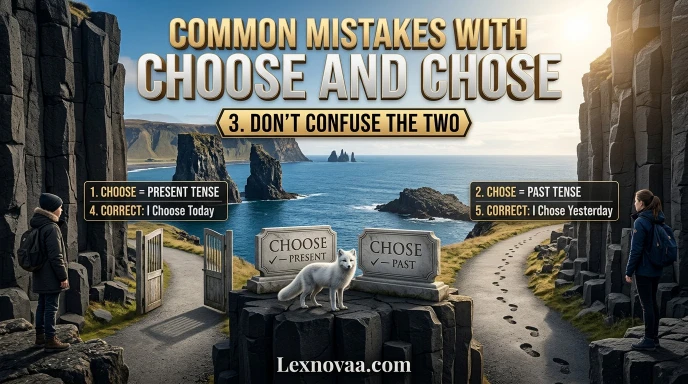
Writers often confuse these words because they have similar spellings. The following examples show how to avoid the most common errors.
| Incorrect Example | Correct Example | Explanation |
| I chose this option every day. | I choose this option every day. | A regular present habit needs choose. |
| She choose the red one yesterday. | She chose the red one yesterday. | A completed past action needs chose. |
| I have chose a new course. | I have chosen a new course. | Use chosen after have. |
| He will chose the winner. | He will choose the winner. | Use the base form after will. |
| They has chose a location. | They have chosen a location. | The sentence needs have chosen. |
Mistake 1: Using Chose for a Present Habit
Incorrect: I chose the same seat every morning.
Correct: I choose the same seat every morning.
The sentence describes a regular habit, so use the present form choose.
Mistake 2: Using Choose for a Past Action
Incorrect: She choose a blue bag yesterday.
Correct: She chose a blue bag yesterday.
The word yesterday shows that the action happened in the past. Use chose.
Mistake 3: Confusing Chose With Chosen
Incorrect: We have chose a new plan.
Correct: We have chosen a new plan.
Use chosen after have, has, or had.
Mistake 4: Using Chose After Will
Incorrect: I will chose the winner tomorrow.
Correct: I will choose the winner tomorrow.
After will, use the base form of the verb.
An Easy Memory Trick
Think of the three forms as a simple sequence:
- Choose: Now or later.
- Chose: Before now.
- Chosen: Used with a helping verb such as have or has.
You can also remember this example:
“I choose today, I chose yesterday, and I have chosen already.”
Everyday Examples of Choose and Chose
Here are practical examples from common situations.
1. Emails
- Please choose a suitable time for the meeting.
- We chose your proposal after reviewing all the options.
2. Business Writing
- Customers can choose from several payment methods.
- The company chose a new marketing agency last month.
3. News Headlines
- Voters Choose Their Next Local Leader.
- City Council Chose a New Development Plan.
4. Blogs
- How to Choose the Right Laptop for Your Needs
- Why I Chose to Learn a New Language
5. Social Media
- Choose kindness whenever you can.
- I chose this photo because it captures a special moment.
6. Academic Writing
- Students choose their research topics at the start of the term.
- The researchers chose a different method for the experiment.
7. Daily Conversation
- “Which movie should we choose?”
- “I chose the comedy yesterday.”
- “You can choose whatever you like.”
These examples show that the correct form depends on the time of the action.
Choose or Chose: Google Trends and Modern Usage
People search for choose or chose because the words look almost identical but have different grammatical roles.
The confusion often appears in school assignments, emails, social media posts, and everyday messages.
Both words remain common in modern English. Choose is used when discussing decisions in the present, giving instructions, or talking about future selections. Chose is used when describing decisions made in the past.
For example, a person might search for “choose or chose in a sentence” to check which form belongs in a particular sentence.
This is especially useful when a sentence contains time words such as yesterday, today, tomorrow, or last year.
No live Google Trends figures have been verified for this article. Therefore, exact search volumes or regional popularity rankings should not be assumed.
The best way to understand modern usage is to focus on verb tense. If the action happened in the past, use chose. If it is happening now or will happen later, use choose.
Quick Comparison Table: Choose vs Chose
| Version | Meaning | Correct? | Region | Example |
| Choose | Present or base form | Yes | All varieties | I choose this book. |
| Chose | Simple past form | Yes | All varieties | I chose this book yesterday. |
| Chosen | Past participle | Yes | All varieties | I have chosen this book. |
| Choosed | Incorrect past form | No | None | I choosed this book. |
FAQs
1. Is it choose or chose?
Both words are correct, but they have different uses. Choose is the present or base form of the verb, while chose is its simple past form. Use choose for present or future actions and chose for actions completed in the past.
2. What is the difference between choose and chose?
The difference is verb tense. Choose means to select and is used in the present or base form. Chose means selected and describes an action that happened in the past. For example, “I choose a book today” and “I chose a book yesterday.”
3. Is chose past tense of choose?
Yes. Chose is the simple past-tense form of choose. For example, “She chooses a new dress every year” becomes “She chose a new dress last year.”
4. Is it choose or chose yesterday?
Use chose with yesterday because the word refers to a completed past action. The correct sentence is “I chose the blue shirt yesterday.” Writing “I choose the blue shirt yesterday” would be incorrect in standard English.
5. Is it choose or chose today?
It depends on the timing. Use choose if the decision is happening now or is a general action. For example, “I choose this option today.” If you are describing a decision already made earlier today, chose may be correct.
6. What is the past participle of choose?
The past participle of choose is chosen. It is used with helping verbs such as have, has, and had. For example, “I have chosen a new subject” is correct, while “I have chose a new subject” is not.
7. Is it I have choose or I have chosen?
The correct phrase is “I have chosen.” The present perfect tense uses have followed by the past participle. Since chosen is the past participle of choose, it is the correct form in this sentence.
8. Is choose a regular or irregular verb?
Choose is an irregular verb. It does not form its past tense by adding -ed. Its three main forms are choose, chose, and chosen. You need to learn these forms to use the verb correctly.
9. Is it will choose or will chose?
Use will choose. After the helping verb will, English uses the base form of the main verb. For example, “They will choose a new leader tomorrow” is correct.
10. What are the three forms of choose?
The three main forms are choose, chose, and chosen. Choose is the base or present form, chose is the simple past, and chosen is the past participle. For example: “I choose,” “I chose,” and “I have chosen.”
Key Takeaways
- Choose is the present and base form of the verb.
- Chose is the simple past form of choose.
- Chosen is the past participle.
- Use choose for present habits, instructions, and future actions.
- Use chose for completed past actions.
- Use chosen with helping verbs such as have, has, and had.
- Choose is an irregular verb, so it does not take -ed to form its past tense.
- British and American English follow the same rules.
Conclusion
The difference between choose and chose is simple once you understand verb tense. Choose is the present or base form of the verb.
while chose is the simple past form. Both words mean to select or make a decision, but they describe actions at different times.
Use choose when talking about a current habit, giving instructions, or discussing a future decision.
Use chose when the selection happened in the past. Remember that chosen is the past participle, so it follows helping verbs such as have, has, and had.
For example, “I choose a book today,” “I chose a book yesterday,” and “I have chosen a book” are all correct sentences.
The easiest way to avoid mistakes is to remember this simple rule: Choose now, chose before, chosen with have.
For more clear explanations, useful examples, and easy English grammar comparisons, visit Lexnovaa.com.
DISCOVER MORE ARTICLE CLICK HERE NOW!
- In Effect or In Affect: Meaning and Correct Usage
- Yours or Your’s? The Grammar Rule Explained Simply
- Home In or Homein? Avoid This Common Spelling Mistake

I’m Orin Blake, a writer with a passion for making English grammar simple, practical, and easy to understand. I enjoy breaking down confusing words, spelling differences, and everyday language questions into clear, reader-friendly guides. My goal is to help students, professionals, and curious learners write with greater confidence and accuracy.