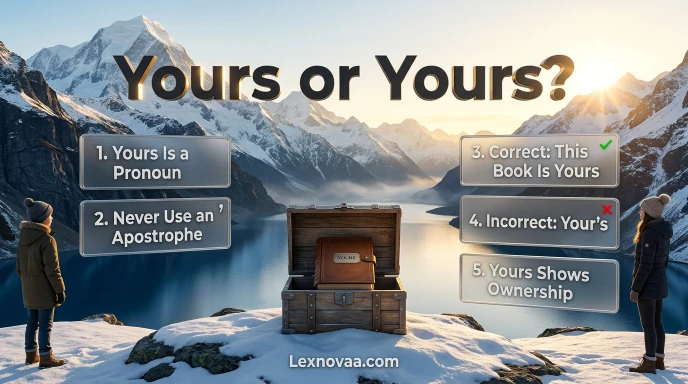
One small apostrophe can make a spelling mistake in an email, essay, or social media post. When choosing between “yours” and “your’s,” the correct spelling is “yours.”
The word “your’s” is incorrect in standard English because possessive pronouns do not use apostrophes.
The confusion makes sense. English uses apostrophes to show possession in words such as “Sarah’s book” and “the dog’s toy.”
Since “yours” also shows ownership, some writers assume it needs an apostrophe. However, English possessive pronouns follow a different rule.
“Yours” means something belongs to the person or people you are speaking to. You might write, “This book is yours,” or end a letter with “Yours sincerely.” In both cases, the spelling has no apostrophe.
In this guide, you will learn the meaning of “yours,” why “your’s” is incorrect, and how to use the word in everyday writing.
You will also see examples from emails, school assignments, business messages, and formal letters. By the end, you will have a simple rule to help you avoid this common spelling mistake.
Yours or Your’s: The Correct Answer
Examples:
- This seat is yours.
- The final decision is yours.
- Yours sincerely, Alex.
Remember that “your” usually comes before a noun, as in “your book.” “Yours” can stand alone, as in “The book is yours.”
Yours or Your’s: Quick Answer
Use yours whenever you mean “belonging to you.” Do not add an apostrophe.
- Correct: This phone is yours.
- Incorrect: This phone is your’s.
- Correct: Is this bag yours?
The key rule is simple: possessive pronouns such as yours, ours, hers, and theirs do not use apostrophes.
What Does Yours or Your’s Mean?
To understand why “yours” is correct, it helps to know how possessive words work in English.
What Does Yours Mean?
“Yours” is a possessive pronoun. It shows that something belongs to the person being spoken to. It can refer to one person or more than one person, depending on the context.
Examples:
- This jacket is yours.
- The choice is yours.
- Is that notebook yours?
- Our room is larger than yours.
In these sentences, “yours” replaces a noun phrase such as “your jacket,” “your choice,” or “your room.” It avoids repeating the noun.
For example:
- With a noun: This is your seat.
- Without repeating the noun: This seat is yours.
Both sentences express ownership, but they use different grammatical structures.
What Does Your’s Mean?
“Your’s” is a common spelling mistake. It is not the standard possessive form of “your.”
Writers often add the apostrophe because they know that apostrophes can show ownership. For example, “the teacher’s desk” means the desk belongs to the teacher. However, “yours” follows the possessive-pronoun rule and does not need an apostrophe.
Incorrect: That pen is your’s.
Correct: That pen is yours.
What Is the Difference Between Your and Yours?
“Your” and “yours” both relate to ownership, but they work differently in a sentence.
| Word | Grammatical role | Example |
| Your | Possessive determiner used before a noun | Your bag is here. |
| Yours | Possessive pronoun that can stand alone | The bag is yours. |
| Your’s | Incorrect spelling in standard English | Avoid “your’s.” |
A simple way to remember the difference is to look at the word that follows.
- Use your before a noun: “your answer.”
- Use yours when the noun does not need to be repeated: “The answer is yours.”
Why Does Yours Have No Apostrophe?
English has a special group of words called possessive pronouns. These include “mine,” “yours,” “his,” “hers,” “ours,” and “theirs.”
They already show possession without an apostrophe. Adding one to “yours” does not make it more correct.
Compare these examples:
- This is my book. The book is mine.
- That is your book. The book is yours.
- These are their seats. The seats are theirs.
Notice that none of the possessive pronouns in the second part of these examples needs an apostrophe.
The Origin of Yours and Your’s
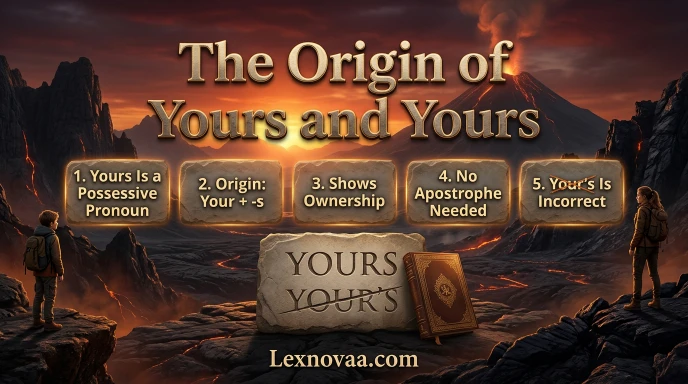
The word “yours” developed from the possessive form of “you.” Its history reflects changes in English pronouns and the way English expresses ownership.
In older forms of English, pronouns had different forms depending on their role in a sentence. Over time, the modern forms became established.
“Your” came to be used before a noun, while “yours” became the form that can stand alone to show possession.
The apostrophe also has a history in English. It came into wider use in writing to mark omissions and, later, to show possession in many nouns.
For example, “the student’s book” uses an apostrophe to show that the book belongs to the student.
However, English does not use apostrophes in every possessive form. Words such as “mine,” “hers,” “ours,” and “yours” already express possession without one. That is why “your’s” is not the correct spelling.
The extra apostrophe in “your’s” is usually the result of applying a noun rule to a possessive pronoun. Learning the difference between these word types helps prevent similar mistakes.
British English vs American English
There is no spelling difference between British and American English for “yours.” Both varieties use “yours” without an apostrophe.
| British English | American English | Example |
| yours | yours | This book is yours. |
| your | your | Your coat is on the chair. |
| yours sincerely | yours sincerely / Yours sincerely | Yours sincerely, Alex. |
| your’s | your’s is incorrect | Do not write “your’s.” |
British English Usage
British English uses “yours” in everyday writing, emails, and letters. A traditional letter closing may use “Yours sincerely” or “Yours faithfully,” depending on the context and the recipient.
Example:
“Thank you for your message. The final choice is yours.”
American English Usage
American English also uses “yours” without an apostrophe. Letter closings may include “Sincerely,” “Yours truly,” or other forms depending on the level of formality.
Example:
“I have shared the document with you. The next step is yours.”
What About Canada and Australia?
Canadian and Australian English follow the same standard spelling. “Yours” is correct in both countries, while “your’s” is treated as a spelling error in standard writing.
Do Style Guides Treat Them Differently?
No major British-American spelling rule changes “yours” to “your’s.” Standard grammar references agree that the possessive pronoun does not take an apostrophe.
If you are writing for a school, business, newspaper, or website, use “yours.” The same rule applies across formal and informal contexts.
Which Version Should You Use?
There is no regional choice to make. Use “yours” in every variety of standard English.
United States
Write “yours” in schoolwork, emails, reports, and casual messages.
Example: “The final choice is yours.”
United Kingdom
Use “yours” in all standard writing, including formal letters.
Example: “Yours sincerely, Morgan Lee.”
Canada
Use “yours” without an apostrophe in professional and personal writing.
Example: “The spare key is yours.”
Australia
The correct form is also “yours.”
Example: “I believe this parcel is yours.”
International Writing
For readers around the world, “yours” is the correct standard spelling. You do not need a different form for international English.
Academic Writing
Use “yours” when the sentence needs a possessive pronoun. In academic writing, it is often better to avoid direct address unless the assignment allows it, but the spelling rule remains the same.
Example: “The final interpretation is yours to make.”
Business Writing
Use “yours” in professional emails and letters.
Examples:
- The next step is yours.
- Please confirm that this copy is yours.
- Yours sincerely, Jordan Lee.
Never use “your’s” in a formal message. It may look like a proofreading error.
Common Mistakes with Yours and Your’s

Here are the most common errors and ways to correct them.
Mistake 1: Adding an Apostrophe to Yours
Incorrect: The choice is your’s.
Correct: The choice is yours.
Explanation: “Yours” is a possessive pronoun, so it does not need an apostrophe.
Memory tip: If you mean “belonging to you,” write “yours.”
Mistake 2: Confusing Your and Yours
Incorrect: Yours car is outside.
Correct: Your car is outside.
Explanation: “Your” comes before a noun. “Yours” replaces a noun phrase and can stand alone.
Memory tip: If a noun follows, you usually need “your.” If the word stands alone to show ownership, use “yours.”
Mistake 3: Confusing Yours with You’re
Incorrect: I think your’s going to win.
Correct: I think you’re going to win.
Explanation: “You’re” means “you are.” “Yours” shows ownership. They have different meanings.
Memory tip: Try replacing “you’re” with “you are.” If the sentence still makes sense, “you’re” may be correct.
Mistake 4: Using an Apostrophe in Other Possessive Pronouns
Incorrect: The seats are their’s.
Correct: The seats are theirs.
Explanation: “Theirs” is a possessive pronoun, just like “yours.” It does not take an apostrophe.
Memory tip: Mine, yours, his, hers, ours, and theirs do not need apostrophes to show possession.
Mistake 5: Thinking Every Possessive Word Needs an Apostrophe
Incorrect rule: All words that show ownership need an apostrophe.
Correct rule: Nouns often use apostrophes to show possession, but possessive pronouns do not.
Examples:
- The student’s book. (noun showing possession)
- The book is yours. (possessive pronoun)
Memory tip: Learn possessive pronouns as a group rather than adding apostrophes by habit.
Everyday Examples of Yours
These examples show how to use “yours” correctly in different situations.
1. Emails
- The attached file is yours to review.
- I believe this message was intended for you.
- Yours sincerely, Alex Morgan.
2. Business Writing
- The final decision is yours.
- Please check if this copy is yours.
- The responsibility for the next step is yours.
3. News Headlines
- The Final Decision Is Yours
- Is This Lost Property Yours?
- The Choice Is Yours: How to Pick the Right Plan
4. Blogs
- Make Your Workspace Truly Yours
- Your Writing Style Is Yours to Develop
- Is This Advice Right for You, or Is the Choice Yours?
5. Social Media
- This win is yours!
- The next move is yours.
- Is this water bottle yours?
6. Academic Writing
- The final interpretation is yours to develop.
- The choice of method is yours, within the study rules.
- The conclusion is yours to write based on the evidence.
7. Daily Conversation
- Is this seat yours?
- That bag is yours.
- I think this jacket is yours.
- The last slice is yours if you want it.
8. Letters and Sign-Offs
“Yours” also appears in common letter closings.
Examples:
- Yours sincerely,
- Yours faithfully,
- Yours truly,
The right closing depends on the type of letter and the style you follow. The word “yours” itself never needs an apostrophe.
Google Trends & Modern Usage
People search for “yours or your’s” because the apostrophe rule can seem confusing. Many English nouns use apostrophes to show ownership, such as “the girl’s bag” or “the manager’s office.” This leads some writers to add an apostrophe to “yours.”
However, standard modern English uses “yours” without an apostrophe. The same rule applies to “hers,” “ours,” and “theirs.” These forms are established possessive pronouns, not ordinary possessive nouns.
Exact Google Trends figures have not been checked for this article, so no search-volume statistics or regional rankings are claimed.
In general, the question is a common type of spelling and grammar query because the incorrect form looks plausible to learners.
If you want to study search interest, compare “yours or your’s” and related queries in Google Trends. Remember that search interest does not determine correctness. A frequently searched spelling can still be wrong.
For practical writing, the answer remains the same across regions and platforms: write “yours.” Proofreading tools may flag “your’s,” but it is useful to understand the rule rather than rely on software alone.
Quick Comparison Table
| Version | Meaning | Correct? | Region | Example |
| Yours | Belonging to you | Yes | All major English varieties | This book is yours. |
| Your | Belonging to you, used before a noun | Yes | All major English varieties | Your book is here. |
| Your’s | Intended to show possession | No | Not standard | Incorrect: It is your’s. |
| You’re | Short for “you are” | Yes, in the right context | All major English varieties | You’re ready. |
| Theirs | Belonging to them | Yes | All major English varieties | The seats are theirs. |
Key Takeaways
- Yours is the correct spelling.
- Your’s is incorrect in standard English.
- “Yours” is a possessive pronoun that shows ownership.
- “Your” comes before a noun, as in “your book.”
- “You’re” means “you are,” so it has a different meaning.
- Possessive pronouns such as mine, yours, hers, ours, and theirs do not use apostrophes.
- The spelling rule is the same in British, American, Canadian, and Australian English.
FAQs
Is it yours or your’s?
The correct spelling is “yours.” It is a possessive pronoun that means something belongs to the person you are speaking to.
“Your’s” is not standard English. For example, write “This bag is yours,” not “This bag is your’s.” The word never needs an apostrophe to show possession.
Why does yours not have an apostrophe?
“Yours” is a possessive pronoun, and possessive pronouns already show ownership without an apostrophe.
Words such as “mine,” “hers,” “ours,” and “theirs” follow the same rule. Apostrophes are used in many possessive noun forms, such as “the teacher’s desk,” but not in “yours.”
Is your’s ever correct?
“Your’s” is not correct in standard English when you mean “belonging to you.” You may see it in informal posts or as a typing error, but that does not make it a standard spelling. Use “yours” in essays, emails, letters, and published writing.
What is the difference between your and yours?
“Your” is used before a noun, as in “your phone” or “your idea.” “Yours” stands alone and replaces a noun phrase, as in “The phone is yours.”
Both relate to ownership, but they have different grammatical roles. Choosing the right one depends on how the sentence is built.
Is yours a possessive pronoun?
Yes. “Yours” is a possessive pronoun. It shows that something belongs to the person or people being addressed.
For example, in “This seat is yours,” the word “yours” replaces the phrase “your seat.” It does not need a noun after it and never takes an apostrophe in standard English.
Is yours correct in British and American English?
Yes. “Yours” is correct in both British and American English. Canadian and Australian English use the same spelling too.
There is no regional spelling variation that makes “your’s” acceptable in standard writing. You can use “yours” confidently in international communication.
Should I write yours sincerely or your’s sincerely?
Write “Yours sincerely,” without an apostrophe. This is a common sign-off in formal letters, especially in British English conventions.
“Your’s sincerely” is incorrect. Other sign-offs, such as “Yours faithfully” and “Yours truly,” also use “yours” without an apostrophe.
What is the difference between yours and you’re?
“Yours” shows ownership, while “you’re” is a contraction of “you are.” For example, “This seat is yours” means the seat belongs to you.
“You’re sitting in my seat” means “You are sitting in my seat.” The words are not interchangeable.
Do possessive pronouns ever use apostrophes?
No. Standard possessive pronouns such as “mine,” “yours,” “his,” “hers,” “ours,” and “theirs” do not use apostrophes.
Do not confuse them with possessive nouns, such as “the student’s book,” or contractions, such as “it’s” for “it is.” Each form follows its own rule.
How can I remember the spelling of yours?
Remember this group of possessive pronouns: mine, yours, his, hers, ours, and theirs. None needs an apostrophe. If you mean “belonging to you,” write “yours.”
If you mean “you are,” write “you’re.” This quick check helps prevent two common spelling mistakes.
Conclusion
When choosing between “yours” and “your’s,” the answer is clear: “yours” is correct, and “your’s” is incorrect in standard English.
The word “yours” is a possessive pronoun that shows ownership. It works in everyday conversation, school assignments, business emails, and formal letters.
The mistake often happens because writers know that apostrophes can show possession in nouns. For example, “the student’s notebook” uses an apostrophe.
But possessive pronouns follow a different rule. Words such as “mine,” “yours,” “hers,” “ours,” and “theirs” do not need apostrophes.
Also, remember the difference between “your” and “yours.” Use “your” before a noun, as in “your answer.” Use “yours” when the noun does not need to be repeated, as in “The answer is yours.”
This rule is the same in British, American, Canadian, and Australian English, so there is no need to learn different regional spellings.
Remember: If you mean “belonging to you,” write “yours,” never “your’s.”
For more clear English grammar comparisons, spelling guides, and practical examples, visit Lexnovaa.com.
DISCOVER MORE ARTICLE CLICK HERE NOW!
- Clearer or More Clear: Which Form Is Correct in English?
- Family’s or Families? Learn the Difference With Clear Examples
- Use To or Used To? Grammar Rule That Clears Up the Confusion

I’m Orin Blake, a writer with a passion for making English grammar simple, practical, and easy to understand. I enjoy breaking down confusing words, spelling differences, and everyday language questions into clear, reader-friendly guides. My goal is to help students, professionals, and curious learners write with greater confidence and accuracy.