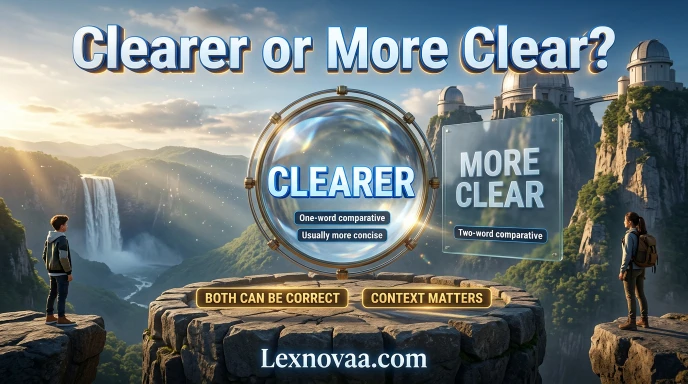
“Clearer” and “more clear” are both correct, but “clearer” is usually the more natural choice in everyday English. Both forms are comparative forms of the adjective clear. They help you compare how easy something is to understand, see, or hear.
For example, “Your explanation is clearer now” and “Your explanation is more clear now” are both grammatically acceptable.
The main difference is how people commonly use them. Clearer is the usual choice in most situations because it is shorter and sounds natural.
More clear can also be used, especially when a writer wants to emphasize clarity or create a particular rhythm in a sentence.
You may see both forms in books, articles, emails, school assignments, and everyday conversations. The best choice often depends on the sentence and the style you want. However, you do not need to overthink it: in most cases, clearer is a safe and natural option.
In this guide, you will learn the meanings, grammar rules, common mistakes, and everyday examples of clearer and more clear.
You will also find answers to common questions to help you choose the right form when writing or speaking English.
Clearer or More Clear : Quick Answer
Both “clearer” and “more clear” are grammatically correct. However, “clearer” is usually more natural and common.
- Clearer: Your instructions are clearer now.
- More clear: Your instructions are more clear now.
Both sentences mean that the instructions are easier to understand than before.
Easy rule: Use clearer in most everyday sentences. Use more clear when it better suits your emphasis, sentence structure, or writing style.
Definition and Meaning
What Does Clearer Mean?
Clearer is the comparative form of the adjective clear. It means easier to understand, see, hear, or recognize than something else.
Examples:
- Your handwriting is clearer today.
- This picture looks clearer.
- Her explanation became clearer.
- We need a clearer plan.
In each sentence, clearer compares one thing with another or describes an improvement in clarity.
What Does More Clear Mean?
More clear also means clearer or easier to understand, see, hear, or recognize. It uses more before the adjective clear to form a comparison.
Examples:
- Your explanation is more clear now.
- The new instructions are more clear.
- The message became more clear after the meeting.
- We need a more clear description of the problem.
These sentences are grammatically acceptable. However, in many contexts, clearer sounds smoother and more concise.
What Is the Main Difference Between Clearer and More Clear?
The main difference is not their meaning but their form and style. Both can express a comparison, but clearer is generally preferred in everyday English.
| Form | Meaning | Example |
| Clearer | Easier to understand or see | This diagram is clearer. |
| More clear | Easier to understand or see | This diagram is more clear. |
| Much clearer | A stronger comparison | Your answer is much clearer now. |
| More clearly | Comparative adverb phrase | Please explain it more clearly. |
Remember that clearer and more clear are adjective forms, while more clearly is an adverb phrase used to describe an action.
The Origin of Clearer and More Clear
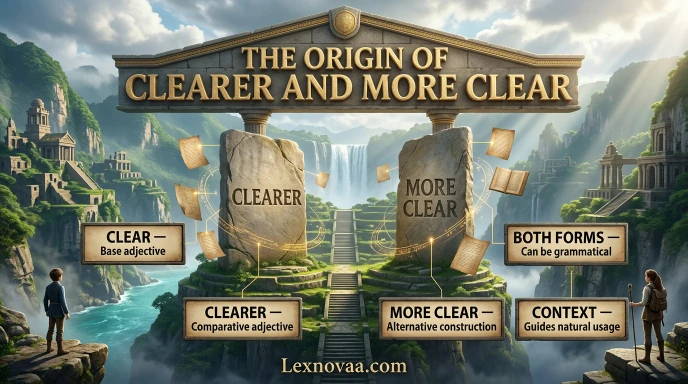
The word clear entered English through French, with roots in Latin clarus, meaning bright, distinct, or easy to understand.
English commonly forms comparisons by adding -er to short adjectives. This is how clear becomes clearer, just as fast becomes faster and small becomes smaller.
English can also form comparisons by placing more before an adjective. This pattern is common with longer adjectives, such as more important and more comfortable. It can also be used with some shorter adjectives, including clear, although the -er form is usually more natural here.
That is why both clearer and more clear exist, even though one is generally preferred.
British English vs American English Spelling
There is no spelling difference between British and American English for clearer and more clear. Both forms are understood in both varieties.
| English variety | Common form | Example |
| American English | Clearer | The new directions are clearer. |
| British English | Clearer | Your point is clearer now. |
| American English | More clear | The message is more clear now. |
| British English | More clear | The rules are more clear than before. |
In both varieties, clearer is generally the more concise and natural choice. More clear remains grammatically possible, depending on the context.
Which Form Should You Use?
Choosing between clearer and more clear is easy once you know the usual pattern.
Use Clearer in Most Situations
Choose clearer for everyday writing, schoolwork, emails, and general communication.
Examples:
- Can you make the instructions clearer?
- This version is clearer than the first one.
- The teacher gave a clearer explanation.
- We need a clearer answer.
This form is concise and natural, so it works well in most sentences.
Use More Clear When It Fits Your Style
You can use more clear when you want to emphasize the comparison or when it fits the rhythm of the sentence.
Examples:
- The new policy is more clear about the steps employees must follow.
- His position became more clear after the discussion.
- The purpose of the exercise is more clear when you read the final section.
These sentences are acceptable, but many editors would prefer clearer in the same places. The choice may depend on tone, emphasis, or the wording around the adjective.
What About “Clearer Than” and “More Clear Than”?
Both patterns can be grammatical:
- This explanation is clearer than the previous one.
- This explanation is more clear than the previous one.
The first is generally more natural and concise. In most everyday situations, choose clearer than.
What About “More Clearly”?
Use more clearly when you are describing how someone performs an action, rather than describing a person or thing.
Examples:
- Please speak more clearly.
- She explained the rules more clearly this time.
- Write your answer more clearly.
Here, clearly is an adverb that describes the action of speaking, explaining, or writing. Do not replace it with clearer in these sentences.
Common Mistakes with Clearer and More Clear
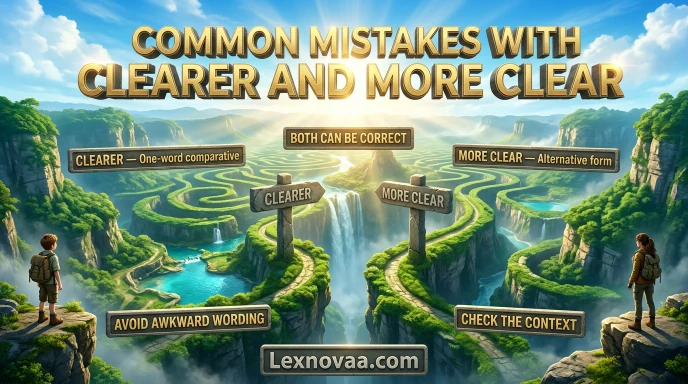
Both forms are possible, but some mistakes happen when writers confuse adjectives and adverbs or use awkward comparisons.
| Less suitable or incorrect | Better choice | Why? |
| This explanation is more clearer. | This explanation is clearer. | Do not combine more with the comparative ending -er here. |
| Please speak clearer. | Please speak more clearly. | An adverb is preferred to describe how someone speaks. |
| This is more clear than before. | This is clearer than before. | Both can be correct, but clearer is usually more natural. |
| Can you explain it clearer? | Can you explain it more clearly? | More clearly describes the action of explaining. |
Mistake 1: Writing “More Clearer”
Incorrect: Your answer is more clearer now.
Correct: Your answer is clearer now.
In standard usage, avoid using more with clearer because both already express comparison.
Mistake 2: Confusing Clearer and More Clearly
Incorrect in standard formal writing: Please explain it clearer.
Better: Please explain it more clearly.
The word clearly describes how the person should explain something, so the adverb phrase more clearly is the better choice.
Mistake 3: Assuming More Clear Is Always Wrong
Incorrect claim: “More clear” is never grammatically correct.
Correct explanation: Both “more clear” and “clearer” can be correct. However, clearer is generally more common and natural in everyday English.
Mistake 4: Using a Comparative Without a Clear Comparison
A comparative form often compares two things or describes a change.
Example: This version is clearer than the old one.
You can also use it when the comparison is understood from context.
Example: The picture looks clearer now.
Everyday Examples of Clearer and More Clear
Here are practical examples to help you understand how both forms work.
1. At School
- “Your essay is clearer than the first draft.”
- “The teacher’s explanation is more clear now.”
2. At Work
- “We need a clearer project plan.”
- “The new instructions are more clear about the deadline.”
3. In Everyday Conversation
- “Can you give me a clearer answer?”
- “Your point is more clear after that example.”
4. In Writing
- “This paragraph is clearer than the previous one.”
- “The purpose of the message is more clear now.”
5. When Giving Instructions
- “Please make the steps clearer.”
- “The directions are more clear in the new guide.”
6. When Discussing Pictures or Videos
- “The image looks clearer in daylight.”
- “The details are more clear in the second picture.”
In most of these examples, you can use clearer without changing the meaning. It is usually the simpler choice.
Clearer or More Clear: Google Trends and Modern Usage
People may search for “clearer or more clear” because both forms appear in English writing and speech. The question is often about which version sounds more natural, rather than if one is always correct.
Clearer is widely used in everyday comparisons, such as “a clearer explanation,” “a clearer picture,” and “a clearer answer.”
More clear also appears, particularly when a writer wants to emphasize a comparison or when the surrounding sentence makes that phrasing feel suitable.
No live Google Trends figures have been verified for this article, so exact search volumes or popularity rankings should not be assumed. You can explore current interest in the phrases using Google Trends.
Search popularity alone does not establish a grammar rule. The practical advice is simple: use clearer as your default adjective comparison, use more clearly when describing an action, and remember that more clear can also be correct in suitable contexts.
FAQs
1. Is it clearer or more clear?
Both are grammatically correct. However, clearer is usually the more natural and concise choice.
2. Is “more clear” grammatically correct?
Yes. More clear can be used as a comparative form of clear, although clearer is generally preferred in everyday English.
3. Which is more common, clearer or more clear?
Clearer is generally the more common and natural choice in ordinary comparisons, such as “a clearer explanation.”
4. Is it clearer than or more clear than?
Both can be correct, but clearer than is usually the more natural choice. For example, “This version is clearer than the old one.”
5. Is “more clearer” correct?
In standard English, avoid more clearer. Use clearer or, where suitable, more clear instead.
6. Should I say “explain clearer” or “explain more clearly”?
“Explain more clearly” is preferred in standard writing because clearly describes the action of explaining.
7. Is clearer correct in British English?
Yes. Clearer is correct in British English and American English, and the same general preference applies in both.
8. Can I use “more clear” in formal writing?
Yes, when it suits the sentence. However, clearer is often more concise and is a good default choice in formal writing.
9. What is the comparative form of clear?
The usual comparative form is clearer. The alternative phrase more clear is also possible.
10. What is the difference between clearer and more clearly?
Clearer is an adjective form used to describe a noun, as in “a clearer answer.” More clearly is an adverb phrase used to describe an action, as in “speak more clearly.”
Key Takeaways
- Clearer: Usually the most natural comparative form of clear.
- More clear: Also grammatically correct in suitable contexts.
- More clearer: Avoid this form in standard English.
- More clearly: Use it to describe how an action is performed.
- British and American English: Both use the same forms and general rules.
- Best everyday choice: Use clearer unless the sentence gives you a reason to choose more clear.
Conclusion
Both clearer and more clear are correct English forms, but clearer is usually the better choice for everyday writing and speech.
It is concise, natural, and easy to use in comparisons. For example, “This explanation is clearer than the previous one” sounds smooth and direct.
You do not need to treat more clear as a spelling or grammar error. It can be appropriate in some sentences, depending on emphasis and style. The key is to choose the form that makes your sentence easy to understand.
Also, remember the difference between clearer and more clearly. Use clearer to describe something, such as a picture or explanation.
Use more clearly to describe an action, such as speaking or writing. Avoid combinations like more clearer in standard English.
For more simple English grammar comparisons, useful examples, and clear explanations, visit Lexnovaa.com.
DISOCOVER MORE ARTICLE CLICK HERE NOW!
- Family’s or Families? Learn the Difference With Clear Examples
- OK or Okay: Which Spelling Is Correct in Everyday English?
- Ordinance or Law Coverage: What It Means, Covers,Why It Matters

I’m Orin Blake, a writer with a passion for making English grammar simple, practical, and easy to understand. I enjoy breaking down confusing words, spelling differences, and everyday language questions into clear, reader-friendly guides. My goal is to help students, professionals, and curious learners write with greater confidence and accuracy.