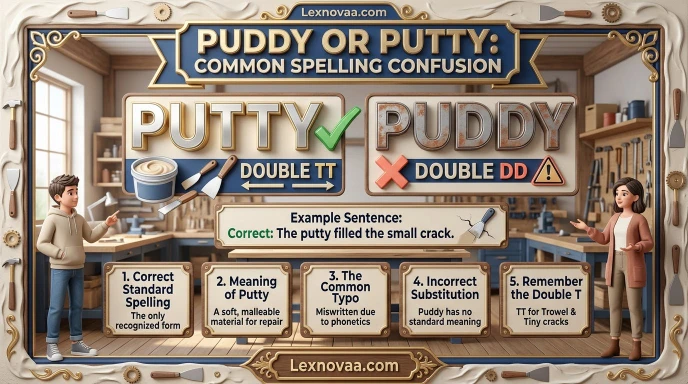
Have you ever come across the words puddy or putty and wondered which one is correct? The standard English word is putty, not puddy.
Putty is a soft, thick material used to fill holes, seal gaps, repair surfaces, or hold glass in window frames.
The confusion often happens because the letters t and d can sound similar in some accents and fast speech.
This may lead people to write puddy when they mean putty. However, the two spellings are not standard alternatives for the same word.
You may see putty in home repair guides, construction instructions, painting advice, and craft projects.
It also appears in expressions such as putty in someone’s hands, which means being easily controlled or influenced.
In this guide, you will learn the correct spelling, meaning, pronunciation, word origin, and everyday uses of putty.
You will also see common mistakes, practical examples, and easy ways to remember the correct word.
Puddy or Putty: Which Spelling Is Correct?
Putty is the correct spelling in standard English. It refers to a soft material used to fill cracks, seal gaps, repair surfaces, or secure glass in frames.
Puddy is not a standard spelling of this word. For example, “The worker used putty to fill the hole in the wall.”
Puddy or Putty: Quick Answer
The correct word is putty, not puddy.
- Putty: A soft material used for filling, sealing, or repairing surfaces.
- Puddy: A nonstandard spelling when someone intends to write putty.
Examples:
- The painter applied putty to the damaged wall.
- We need window putty to repair the frame.
- She used putty to fill the small cracks.
Easy rule: Remember that putty has the letter t, not d.
What Does Putty Mean?
Putty is a soft, paste-like material that people use to fill small holes, cracks, and gaps. It can also help seal joints or hold glass in certain window frames.
Different types of putty are made for different jobs. Some are used for home repairs, while others are made for plumbing, woodworking, glazing, or crafts.
Definition of Putty
As a noun, putty refers to a thick, soft substance that can be shaped or pressed into a space before it hardens or dries.
Common uses include:
- Filling small holes in walls and wood.
- Sealing gaps around windows.
- Repairing damaged surfaces.
- Securing glass in traditional window frames.
- Smoothing surfaces before painting.
Examples:
- The carpenter used wood putty to fill the holes.
- The old window needed fresh putty.
- Apply the putty before painting the surface.
Putty as a Verb
Putty can also be used as a verb. It means to fill, cover, or seal something with putty.
Examples:
- The worker will putty the cracks before painting.
- She puttied the holes in the wooden door.
- They are puttying the damaged window frame.
The verb forms are:
| Form | Word | Example |
| Base form | Putty | We need to putty the holes. |
| Third-person singular | Putties | He putties the small gaps. |
| Past tense | Puttied | She puttied the damaged surface. |
| Present participle | Puttying | They are puttying the window frame. |
Common Types of Putty
The word putty can describe several materials. The exact type depends on the job.
| Type | Common Use | Example |
| Wall putty | Preparing walls before painting | The painter applied wall putty. |
| Wood putty | Filling small holes in wood | The table needed wood putty. |
| Window putty | Sealing glass in traditional window frames | The old window putty had cracked. |
| Glazing putty | Holding or sealing glass in frames | The glazier replaced the glazing putty. |
| Plumber’s putty | Sealing certain plumbing fittings | The plumber used plumber’s putty. |
| Epoxy putty | Repairing or filling certain surfaces | The repair required epoxy putty. |
Important: These products are not all interchangeable. Always follow the product instructions and choose a material made for the surface and job.
The Origin of Puddy or Putty

The word putty has a long history in English. It is generally traced through French forms, including potée, a word associated with a paste or prepared mixture.
The word entered English with a meaning connected to a soft substance used for filling and sealing. Over time, putty became the familiar name for materials used in glazing and repair work.
Today, the word covers several types of filling and sealing compounds. Their ingredients and uses can differ, but the central idea remains the same: putty is a material that can be pressed into a space or shaped to repair a surface.
Why Do People Write Puddy Instead of Putty?
The mistake may come from the way people hear or pronounce the word.
In some accents, the sounds of t and d can seem similar, especially when a word is spoken quickly. Someone may then guess the spelling and write puddy.
However, pronunciation does not change the standard spelling. The correct form remains putty.
British English vs American English
There is no spelling difference between British and American English for this word. Both use putty.
| British English | American English | Example |
| Putty | Putty | The worker used putty to fill the gap. |
| Wall putty | Wall putty | The wall needs a smooth layer of putty. |
| Wood putty | Wood putty | He used wood putty to repair the table. |
| Window putty | Window putty | The window putty needs replacing. |
| Puttied | Puttied | She puttied the holes before painting. |
| Puttying | Puttying | They are puttying the frame. |
Are There Any Regional Differences?
The spelling is the same in major English varieties.
- British English: Putty.
- American English: Putty.
- Canadian English: Putty.
- Australian English: Putty.
- International English: Putty.
There may be differences in product names, building terms, and the types of putty commonly used in different regions. However, puddy is not a standard British or American spelling of the material.
Style guides do not normally treat puddy as an accepted alternative. Use putty in formal writing, product descriptions, instructions, and everyday messages.
Which Version Should You Use?
The answer is simple: use putty in every major variety of standard English.
United States
American English uses putty for filling, sealing, and repair materials.
Example: The contractor used wood putty to repair the damaged cabinet.
United Kingdom
British English also uses putty.
Example: The painter applied putty before painting the wall.
Canada
Canadian English follows the same spelling.
Example: The window frame needs new putty.
Australia
Australian English also uses putty.
Example: The carpenter filled the small holes with wood putty.
International Writing
If you are writing for an international audience, choose putty. It is the recognized spelling and is understood in different English-speaking regions.
Academic Writing
Use putty when discussing building materials, repair methods, materials science, or construction.
Example: The study examined the properties of different putty compounds used in surface repair.
If your subject involves a specific product, use its exact technical name.
Business Writing
Use putty in product descriptions, repair reports, construction documents, invoices, and professional emails.
Examples:
- Please order two containers of wall putty.
- The contractor used putty to seal the window frame.
- The repair team replaced the damaged glazing putty.
Best advice: Do not use puddy as a spelling alternative. Choose putty regardless of your audience or location.
Common Mistakes When Using Puddy or Putty
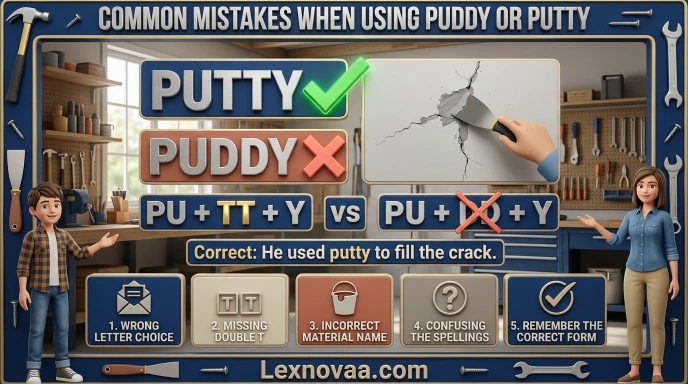
The main mistake is writing puddy instead of putty. This often happens when people rely on the sound of the word rather than its standard spelling.
Here are some examples.
| Incorrect Sentence | Correct Sentence | Explanation |
| The painter used puddy on the wall. | The painter used putty on the wall. | Putty is the correct spelling. |
| We need puddy for the window. | We need putty for the window. | Use putty for the sealing material. |
| He applied puddy to the wood. | He applied putty to the wood. | The word has a t, not a d. |
| She pudtied the holes. | She puttied the holes. | The past tense is puttied. |
| They are puddying the frame. | They are puttying the frame. | The present participle is puttying. |
Mistake 1: Writing Puddy Instead of Putty
Incorrect: The worker used puddy to fill the crack.
Correct: The worker used putty to fill the crack.
Why? Putty is the recognized spelling for the repair material. Puddy is not a standard alternative.
Mistake 2: Misspelling the Past Tense
Incorrect: She pudtied the holes in the door.
Correct: She puttied the holes in the door.
Why? The past tense of the verb putty is puttied. The spelling changes from y to i before adding -ed.
Mistake 3: Confusing Putty With Other Repair Materials
Putty is not the same as every filler, sealant, or adhesive.
For example:
- Putty: A soft compound used for filling or sealing certain gaps.
- Caulk: A flexible material used to seal joints and gaps.
- Wood filler: A product designed to fill holes or damage in wood.
- Adhesive: A substance used to join materials together.
Some products may have overlapping uses, but their properties are not always the same.
Easy Memory Tip
Remember this simple sentence:
“Putty fills a pretty little gap.”
The word putty has two t letters. Think of those two letters whenever you are unsure about the spelling.
You can also remember the word family:
- Putty
- Putties
- Puttied
- Puttying
All these forms use t, not d.
Everyday Examples of Putty
The word putty appears in home repair, construction, product descriptions, business communication, and everyday conversation.
Here are examples from different situations.
1. Emails
- Please order more wall putty for the repair work.
- The window needs fresh putty before we finish the job.
- Can you confirm the type of putty required for this surface?
2. Business Writing
- The company supplies putty for building and repair projects.
- The contractor used wood putty to fill the damaged areas.
- Please include the cost of glazing putty in the estimate.
3. News Headlines
- New Wall Putty Product Introduced for Home Repairs
- Builders Use Modern Putty Compounds for Surface Preparation
- Window Repair Project Includes Replacement of Old Putty
4. Blogs
- How to Choose the Right Putty for Wall Repairs
- Wall Putty vs Paint: What Is the Difference?
- Common Uses of Wood Putty Around the Home
- What Is Window Putty Used For?
5. Social Media
- A smooth wall starts with good surface preparation.
- Small repairs can make a big difference.
- Choosing the right putty matters for a lasting finish.
6. Academic Writing
- Putty compounds are used in several surface repair applications.
- The research compared the properties of different filling materials.
- The study examined the performance of glazing putty in window frames.
7. Daily Conversation
- Do we have any putty left?
- I need putty to fill this small hole.
- Which putty is suitable for wood?
- The old window putty is cracked.
- Can you buy a container of wall putty?
These examples show that putty is the correct word in both formal and informal writing.
Google Trends & Modern Usage
People search for puddy or putty because they want to confirm the correct spelling of a word they may have heard in conversation or seen in repair instructions.
The confusion often comes from pronunciation. When people are unsure if a word contains t or d, they may search for both spellings.
Is Putty More Common Than Puddy?
In standard English, putty is the established spelling. Puddy is generally a misspelling when someone intends to refer to the repair material.
Putty appears in several common topics:
- Home improvement.
- Wall finishing and painting.
- Window repair.
- Woodworking.
- Construction materials.
- Plumbing and surface repair.
Why Do People Search for Puddy or Putty?
Common reasons include:
- They are unsure about the correct spelling.
- They hear the word but do not know how to write it.
- They are looking for wall putty or wood putty.
- They are reading repair instructions.
- They want to improve their English spelling.
Exact Google Trends figures have not been checked for this article. Therefore, no numerical search-volume or regional popularity claims are made.
Is Puddy Ever Correct?
Puddy may appear as a name, nickname, brand, or intentional creative spelling in a particular context. However, it is not the standard spelling of the repair material called putty.
If you are writing about wall putty, window putty, or wood putty, always use putty.
Quick Comparison Table: Puddy vs Putty
| Version | Meaning | Correct? | Region | Example |
| Putty | Soft material used for filling or sealing | Yes | All major English varieties | The worker applied putty. |
| Puddy | Nonstandard spelling when intended to mean putty | No | None as a standard variant | Incorrect: I need puddy. |
| Puttied | Past tense of the verb putty | Yes | All major English varieties | She puttied the holes. |
| Puttying | Present participle of the verb putty | Yes | All major English varieties | He is puttying the frame. |
| Putties | Third-person singular form of the verb putty | Yes | All major English varieties | The worker putties the gaps. |
Key Takeaways
- Putty is the correct spelling in standard English.
- Puddy is a misspelling when referring to the repair material.
- Putty is used to fill holes, cracks, and gaps.
- It can also be used as a verb.
- British and American English both use putty.
- The past tense is puttied.
- The present participle is puttying.
- Remember: Putty has two t’s, not a d.
FAQs
1. Is it puddy or putty?
Putty is the correct spelling in standard English. It refers to a soft material used to fill holes, seal gaps, or repair surfaces.
Puddy is not a standard spelling of this word. If you are talking about wall putty, wood putty, or window putty, always write putty.
2. What does putty mean?
Putty is a soft, paste-like material used to fill small holes, cracks, and gaps. It is common in construction, painting, woodworking, and window repair. Different types are made for different jobs, so the right product depends on the surface and purpose.
3. Is puddy a real word?
Puddy may appear as a name, nickname, brand, or creative spelling. However, it is not the standard English spelling of the material used for filling and sealing surfaces. When you mean that material, the correct word is putty.
4. Is putty the same in British and American English?
Yes. British and American English both use the spelling putty. There is no regional spelling difference.
The word has the same general meaning in both varieties, although particular products and building terms may vary by region.
5. What is wall putty used for?
Wall putty is commonly used to help prepare wall surfaces before painting. Depending on the product, it can help fill small imperfections and create a smoother surface. Always follow the manufacturer’s instructions to make sure the product is suitable for the wall and finish.
6. What is the past tense of putty?
The past tense of putty is puttied. For example: “The worker puttied the holes before painting.” The present participle is puttying, as in “She is puttying the damaged frame.” These forms keep the two t letters.
7. How do you spell putty correctly?
The correct spelling is P-U-T-T-Y. It has one p, two t letters, and ends with y. A simple memory tip is to remember that putty has two t’s. Avoid writing puddy when you mean the repair material.
8. Can putty be used as a verb?
Yes. Putty can be used as a verb meaning to fill or cover something with putty. For example: “They will putty the holes in the wooden door.” Its other forms include putties, puttied, and puttying.
9. What is the difference between putty and filler?
Putty is a type of filling or sealing material, while filler is a broader term for products used to fill holes, gaps, or damaged areas.
Some putties are fillers, but not every filler is putty. Choose a product based on the surface and repair task.
10. Is putty the same as caulk?
No. Putty and caulk are different types of repair and sealing materials. Putty is often used for filling or glazing, while caulk is commonly used to seal joints and gaps.
Their flexibility, drying behavior, and suitable uses can differ, so they should not be treated as interchangeable.
Conclusion: Always Use Putty, Not Puddy
When choosing between puddy or putty, always use putty if you mean the soft material used for filling, sealing, and repairing surfaces. Puddy is not a standard spelling of this word.
Putty is used in many settings, including home improvement, construction, painting, woodworking, and window repair. It can also work as a verb, with forms such as putties, puttied, and puttying.
The spelling stays the same in British, American, Canadian, and Australian English. You do not need to choose a regional version. Just remember that the correct word contains two t letters.
if you are writing a repair guide, sending a work email, describing a product, or talking about home improvements, putty is the spelling you should choose.
Remember: Putty fills the gap, and its spelling has two t’s.
For more simple explanations of confusing English words, spelling differences, and grammar questions, visit Lexnovaa.com.
EXPLORE MORE ARTICLE CLICK HERE NOW!
- Booty or Bootie: Meaning, Spelling, and Usage
- Dialled or Dialed: Which Spelling Is Correct?
- Its or It’s: The Simple Grammar Rule That Makes the Difference

I’m Orin Blake, a writer with a passion for making English grammar simple, practical, and easy to understand. I enjoy breaking down confusing words, spelling differences, and everyday language questions into clear, reader-friendly guides. My goal is to help students, professionals, and curious learners write with greater confidence and accuracy.