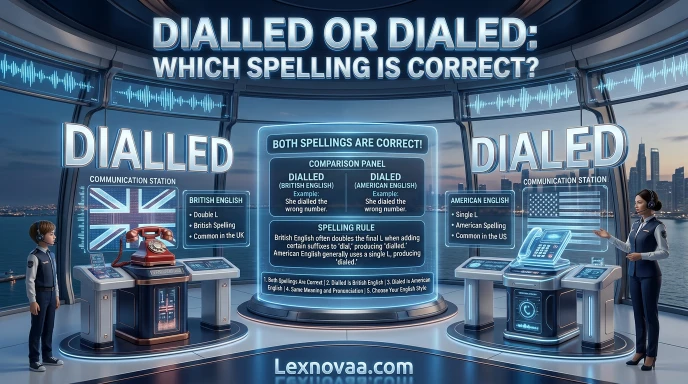
Have you ever wondered if to write dialled or dialed? Both spellings are correct, but the right choice depends on the type of English you are using.
Dialled is the preferred spelling in British English, while dialed is the standard spelling in American English.
The difference comes from a common spelling pattern. British English often doubles the final consonant when adding endings such as -ed to certain verbs.
American English usually keeps one consonant in these cases. The same pattern appears in words such as travelled and traveled.
This small spelling difference can cause confusion when writing emails, articles, school assignments, or business documents for readers in different countries. You may also see both forms in books, websites, and online conversations.
In this guide, you will learn the meaning of dialled and dialed, why the spellings differ, which version to use in each region, and how to avoid common mistakes. Let’s look at the simple rule.
Dialled or Dialed: The Quick Answer
Both dialled and dialed are correct past-tense forms of dial. Use dialled in British English, including most UK writing, and dialed in American English. \
Both mean that someone used a phone or keypad to enter a number or that someone selected a setting by turning a dial.
Dialled or Dialed: Quick Answer
The main difference is regional spelling:
- Dialled: British English spelling.
- Dialed: American English spelling.
Both forms are the past tense and past participle of the verb dial.
Examples:
- British English: She dialled the wrong number.
- American English: She dialed the wrong number.
- Both varieties: I have dialled/dialed the number already.
The meaning does not change. Choose one spelling based on your audience, and use it consistently throughout your writing.
What Do Dialled and Dialed Mean?
The words dialled and dialed are forms of the verb dial. They describe the action of entering a telephone number or using a control with numbered or marked settings.
The two spellings have the same meaning. Only the spelling changes between major varieties of English.
1. Meaning of Dial
The verb dial has several common uses.
To enter a phone number
This is the most familiar meaning. It describes entering a telephone number to make a call.
Examples:
- I dial the office number every morning.
- She dialled the emergency number.
- He dialed his friend’s number after work.
To turn or adjust a control
A dial can also be a round control with numbers or marks. To dial something can mean turning that control to a chosen setting.
Examples:
- He dialled the radio to the correct frequency.
- She dialed the temperature to 20 degrees.
- The technician dialled the machine to the required setting.
2. Dialled and Dialed as Past Tense
Both spellings describe an action that happened in the past.
| Verb Form | British English | American English |
| Base form | Dial | Dial |
| Third-person singular | Dials | Dials |
| Present participle | Dialling | Dialing |
| Past tense | Dialled | Dialed |
| Past participle | Dialled | Dialed |
Examples:
- I dialled the number yesterday. (British)
- I dialed the number yesterday. (American)
- She has dialled the number twice. (British)
- She has dialed the number twice. (American)
3. Is Dialled a Verb or an Adjective?
Dialled and dialed are mainly used as verb forms. They can also appear in compound expressions or descriptive phrases.
For example:
- The number was dialled incorrectly.
- The radio was dialed to the right frequency.
In both examples, the word describes an action or the result of that action.
The Origin of Dialled and Dialed

The difference between dialled and dialed comes from the spelling rules that developed in British and American English.
Where Does the Word Dial Come From?
The word dial has a long history. It entered English through French and Latin forms associated with the word for a sundial. Its meaning later expanded to include numbered or marked controls.
As telephones developed, dial became widely used for the action of selecting a telephone number with a rotary dial. The word remained in use even after push-button phones and digital devices became common.
Today, people still use dial even when they enter a number on a touchscreen.
Why Does British English Use Dialled?
British English commonly doubles the final consonant in certain verbs when adding endings such as -ed or -ing.
This pattern applies when a verb ends in a single consonant after a vowel and follows the relevant spelling rule. For example:
- Dial → Dialled
- Travel → Travelled
- Cancel → Cancelled
- Label → Labelled
The doubled consonant is part of the standard British spelling pattern for these words.
Why Does American English Use Dialed?
American English usually keeps one final l in words of this type when adding -ed or -ing.
Examples include:
- Dial → Dialed
- Travel → Traveled
- Cancel → Canceled
- Label → Labeled
This is a spelling convention, not a difference in pronunciation or meaning.
British English vs American English
The main difference is simple: British English generally doubles the final l in dialled, while American English uses one l in dialed.
| British English | American English | Example |
| Dialled | Dialed | She dialled/dialed the number. |
| Dialling | Dialing | He is dialling/dialing the office. |
| Travelled | Traveled | We travelled/traveled yesterday. |
| Cancelled | Canceled | They cancelled/canceled the event. |
| Labelled | Labeled | The box was labelled/labeled clearly. |
Is Dialled British or American?
Dialled is the standard British English spelling. It is also common in other varieties that follow British spelling conventions, including Australian and New Zealand English.
Is Dialed British or American?
Dialed is the standard American English spelling. It is the preferred form in US newspapers, books, websites, and many American style guides.
Do the Two Spellings Sound Different?
No. Dialled and dialed have the same pronunciation and meaning. The difference appears only in writing.
What About Canadian English?
Canadian English often uses British-style spelling for some words, but it also follows American conventions in other cases. Both forms may appear in Canadian writing.
If you are writing for a Canadian publisher, employer, or school, follow its preferred style guide. If no preference is given, choose one form and use it consistently.
Which Version Should You Use?
Your choice should depend on your audience and the spelling style you want to follow.
United States
Use dialed in American English.
Examples:
- I dialed the number this morning.
- She dialed customer service for help.
- He had already dialed the wrong extension.
United Kingdom
Use dialled in British English.
Examples:
- I dialled the number this morning.
- She dialled the office before leaving.
- He had already dialled the wrong extension.
Canada
Both spellings can be found in Canadian English. Canadian spelling preferences vary by publisher and style guide.
For formal writing, check the requirements of your school, workplace, or publication. Consistency matters more than mixing the two forms.
Australia
Use dialled in standard Australian English, which generally follows British spelling conventions for this word.
Example: She dialled the number from her mobile phone.
International Writing
If your readers come from several countries, either spelling is understandable. However, choose one spelling system and apply it throughout the article or document.
For example, if you use dialled, it is sensible to use other British forms such as travelling and cancelled where appropriate.
Academic Writing
Follow your university’s or publisher’s preferred English style.
- Use dialled if the required style follows British English.
- Use dialed if the required style follows American English.
Do not switch between the two forms in the same paper unless you are quoting a source or discussing spelling differences.
Business Writing
Use the spelling preferred by your company or target audience.
For a US customer, dialed is usually the natural choice. For a UK customer, use dialled.
The same rule applies to reports, instructions, websites, customer emails, and company documents.
Common Mistakes When Using Dialled or Dialed
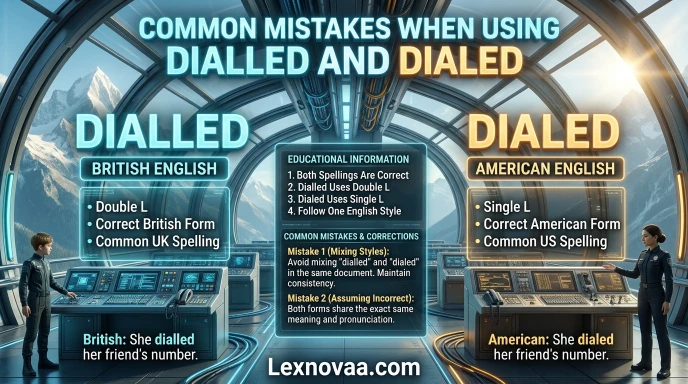
Although both spellings are correct, writers sometimes mix them or use the wrong verb form. These examples will help you avoid those problems.
Mistake 1: Mixing British and American Spellings
Incorrect: She dialled the number and then traveled to the office.
Better in British English: She dialled the number and then travelled to the office.
Better in American English: She dialed the number and then traveled to the office.
Explanation: The original sentence mixes two spelling systems. This is not always a serious grammar error, but it can make a document look inconsistent.
Mistake 2: Writing Dialed in British English
Less suitable for standard British English: He dialed the emergency number.
Preferred British spelling: He dialled the emergency number.
Explanation: British English normally doubles the final l in this word before adding -ed.
Mistake 3: Writing Dialled in American English
Less suitable for standard American English: She dialled the office number.
Preferred American spelling: She dialed the office number.
Explanation: American English normally uses one l in the past-tense form.
Mistake 4: Confusing Dialed With Dialling
Incorrect: He is dialled the number now.
Correct: He is dialling the number now. (British)
Correct: He is dialing the number now. (American)
Explanation: After is, use the present participle form, not the past tense.
Mistake 5: Using the Wrong Past Participle
Incorrect: She has dial the number already.
Correct: She has dialled the number already. (British)
Correct: She has dialed the number already. (American)
Explanation: The present perfect uses has or have followed by the past participle.
Easy Memory Tip
Use this simple trick:
- British English: Dialled, with two ls.
- American English: Dialed, with one l.
Think of the British spelling pattern in travelled and the American pattern in traveled. The same regional difference applies to dialled and dialed.
Everyday Examples of Dialled and Dialed
Here are practical examples from different types of writing. The first form in each pair follows British English, and the second follows American English.
1. Email Examples
- I dialled/dialed your number earlier but could not reach you.
- The customer dialled/dialed the support line this morning.
- Please confirm if you dialled/dialed the correct extension.
2. Business Writing Examples
- The employee dialled/dialed the client’s office number.
- The support team dialled/dialed the emergency contact.
- The operator had already dialled/dialed the number before the call ended.
3. News Headline Examples
- Police Say Caller Dialled/Dialed Emergency Number
- Customer Dialled/Dialed Wrong Number During Service Call
- New Phone System Allows Users to Dial Numbers Faster
4. Blog Examples
- Learn how to dial a phone number correctly.
- She dialled/dialed the number but received no answer.
- Older phones required users to turn a rotary dial.
5. Social Media Examples
- I dialled/dialed the wrong number again!
- Have you ever dialled/dialed a number by mistake?
- Remember when people had to use rotary phones?
6. Academic Writing Examples
- Participants dialled/dialed the assigned telephone number.
- The system recorded the number of calls dialled/dialed during the test.
- Each participant was asked to dial a specific sequence.
7. Daily Conversation Examples
- I dialled/dialed you twice yesterday.
- She dialled/dialed the wrong number.
- Have you dialled/dialed your parents yet?
- He dialled/dialed the office as soon as he arrived.
These examples show that the meaning stays the same in both spelling systems.
Google Trends and Modern Usage
People search for dialled or dialed because they want to know which spelling is correct. The confusion often appears when someone reads British and American websites or uses a spelling checker set to a different English variety.
Which Spelling Is More Common?
The spelling dialed is standard in American English, while dialled is standard in British English and other varieties that generally follow British spelling conventions.
Neither form is universally correct for every audience. The preferred form depends on the region and the style guide.
Why Do People Search for Dialled or Dialed?
Common reasons include:
- Checking British and American spelling differences
- Writing school assignments or professional documents
- Editing articles for an international audience
- Using grammar and spell-checking tools
- Learning the past tense of the verb dial
What About Modern Phone Usage?
The word dial is still used even though many people no longer use rotary phones.
Today, you can dial a number by entering it on a mobile phone, office phone, or other communication device. The word also appears in expressions such as dial a number and dial an extension.
What Does Google Trends Show?
No live Google Trends figures have been checked for this article, so no exact search-volume numbers or regional rankings are claimed.
The general usage pattern is clear: dialed is associated with American spelling, while dialled is associated with British spelling. Search interest in the pair is mainly about choosing the correct regional form.
Dialled vs Dialed: Quick Comparison Table
| Version | Meaning | Correct? | Region | Example |
| Dialled | Past tense of dial | Yes | British English | She dialled the number. |
| Dialed | Past tense of dial | Yes | American English | She dialed the number. |
| Dialling | Present participle of dial | Yes | British English | He is dialling now. |
| Dialing | Present participle of dial | Yes | American English | He is dialing now. |
Key Takeaways
- Dialled is the standard British English spelling.
- Dialed is the standard American English spelling.
- Both words are correct and have the same meaning.
- Both are past-tense and past-participle forms of dial.
- The difference is spelling, not pronunciation.
- British English also uses dialling, while American English uses dialing.
- Canadian usage can vary, so follow the relevant style guide.
- Choose one spelling system and use it consistently.
FAQs
1. Is it dialled or dialed?
Both spellings are correct. Dialled is preferred in British English, while dialed is standard in American English.
They have the same meaning and pronunciation. Choose the spelling that matches your audience or the style guide you are following.
2. Is dialled British or American?
Dialled is the standard British English spelling. It is also used in Australian and New Zealand English.
The spelling follows the British convention of doubling the final l in certain verbs when adding endings such as -ed.
3. Is dialed American or British?
Dialed is the standard American English spelling. American English usually keeps one final l in this word when adding -ed. It is common in US books, newspapers, websites, and professional documents.
4. What is the past tense of dial?
The past tense of dial is dialled in British English and dialed in American English. For example, a British writer might say, “I dialled the number,” while an American writer would write, “I dialed the number.” Both sentences are correct.
5. Is it dialling or dialing?
Both forms are correct. Dialling is the standard British English spelling, while dialing is the standard American English spelling.
Both are present participles of dial. For example, “She is dialling the number” and “She is dialing the number” mean the same thing.
6. Is dialled still used in modern English?
Yes. Dialled is still used in British English, even though modern phones often use touchscreens rather than rotary dials.
The verb dial remains common because people still use it to describe entering a phone number or selecting a setting.
7. Does dialled mean the same as dialed?
Yes. The two forms have exactly the same basic meaning. Both describe the past action of entering a telephone number or using a dial control.
The only difference is regional spelling. Neither form changes the pronunciation or meaning of the sentence.
8. Which spelling should I use in Canada?
Canadian English may use both British and American spelling patterns, depending on the word and the publication.
For dialled or dialed, check your organization’s style guide. If you are writing for a particular Canadian publisher or employer, follow its preferred form throughout.
9. Is dialed a valid spelling in British English?
Dialed is understandable, but dialled is the usual standard form in British English. A British publication that follows UK spelling conventions will generally prefer dialled. However, an organization may follow a different house style, so its rules should take priority.
10. How do I remember the difference between dialled and dialed?
Remember that British English usually doubles the final l in this word, giving dialled. American English keeps one l, giving dialed.
The same pattern appears in travelled/traveled and cancelled/canceled. This simple comparison makes the spelling easier to remember.
Conclusion: Dialled or Dialed?
The choice between dialled or dialed depends on the variety of English you are using. Both spellings are correct, and both are forms of the verb dial. The difference is a regional spelling convention, not a change in meaning or pronunciation.
Use dialled when writing in British English, including most UK and Australian contexts. Use dialed when writing in American English.
In Canada and international writing, check the preferred style guide or choose one form and use it consistently.
The same pattern appears in other words, such as travelled/traveled, cancelled/canceled, and labelled/labeled.
Learning these patterns can help you make better spelling choices across many common English words.
Remember: British English uses dialled, while American English uses dialed.
For more clear explanations of confusing English words, spelling differences, and grammar rules, visit Lexnovaa.com.
EXPLORE MORE ARTICLE CLICK HERE NOW!
- Acception or Exception: Which Spelling Is Correct?
- Then or Than: What’s the Difference and When to Use Each?
- To or Too: Meaning, Difference, and How to Use Them Correctly

I’m Orin Blake, a writer with a passion for making English grammar simple, practical, and easy to understand. I enjoy breaking down confusing words, spelling differences, and everyday language questions into clear, reader-friendly guides. My goal is to help students, professionals, and curious learners write with greater confidence and accuracy.