Have you ever typed “prepair” and wondered whether it is the right spelling? You are not alone.
Many English learners and writers confuse prepair or prepare because the two words look and sound similar. However, only one is correct in standard English.
The correct spelling is prepare. It is a verb that means to get ready for something, make plans, or put something in a suitable condition.
Prepair is a common spelling mistake, not an accepted alternative in British or American English.
This confusion often happens when people write words based on how they sound. The ending of prepare can make its spelling less obvious, especially for students and people learning English as a second language.
In this guide, you will learn the correct spelling, meaning, pronunciation, word origin, and practical usage of prepare.
You will also see common mistakes, everyday examples, and simple ways to remember the correct form.
Prepair or Prepare: The Correct Spelling at a Glance
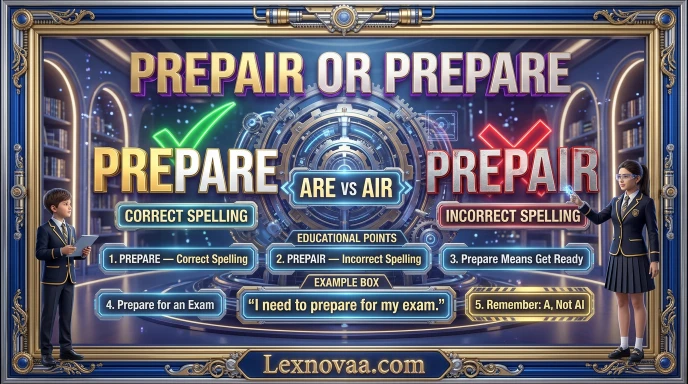
Prepare is the correct spelling in standard English. It means to get ready for an event, task, or situation. Prepair is incorrect and should not be used in formal or informal writing. For example: “I need to prepare for my exam.” Remember: the correct word has one p after the first three letters.
Prepair or Prepare: Quick Answer
The correct choice is prepare, not prepair.
- Prepare: Correct. It means to get ready or make something ready.
- Prepair: Incorrect. It is a misspelling of prepare.
Examples:
- Correct: She needs to prepare for the interview.
- Incorrect: She needs to prepair for the interview.
- Correct: We will prepare dinner tonight.
Use prepare whenever you want to describe getting ready, making arrangements, or creating something for use.
What Does Prepare Mean?
Prepare is a verb. It means to make yourself or something ready for a particular purpose, activity, or event.
You can use it when you study for an exam, plan a meeting, cook a meal, arrange a presentation, or get ready for a journey.
Definition of Prepare
According to its common dictionary meaning, prepare means:
- To make something ready for use.
- To get ready for an event or activity.
- To make plans or arrangements in advance.
- To create or organize something before it is needed.
The word can describe both personal preparation and practical work.
How to Use Prepare in a Sentence
Here are a few examples:
- Study: I must prepare for my English test.
- Work: The manager will prepare a report.
- Cooking: My father will prepare lunch.
- Travel: We need to prepare for our trip.
- Business: The team is preparing a new proposal.
In each sentence, prepare describes an action that makes someone or something ready.
Common Word Forms of Prepare
The word prepare has several related forms. Learning them can help you use it correctly.
| Word Form | Meaning | Example |
|---|---|---|
| Prepare | Base verb | I prepare my lessons every day. |
| Prepares | Third-person singular | She prepares breakfast. |
| Prepared | Past tense or past participle | They prepared the room. |
| Preparing | Present participle | He is preparing for an exam. |
| Preparation | Noun | Good preparation takes time. |
| Preparedness | State of being ready | Preparedness is important during emergencies. |
| Unprepared | Not ready | I was unprepared for the question. |
Remember: These words all come from the correct spelling prepare. None uses the incorrect spelling prepair.
The Origin of Prepair or Prepare

The word prepare has a long history in English. It comes through Old French preparer from Latin praeparare.
The Latin word combines prae, meaning “before,” and parare, meaning “to make ready” or “prepare.” Its original sense was therefore connected to making something ready beforehand.
Over time, the word entered English and developed its modern meaning. Today, people use prepare in many settings, including education, cooking, business, travel, and everyday conversation.
Why Do People Spell It as Prepair?
The mistake usually comes from pronunciation. Some people hear the final sound and assume the word should end in pair.
However, English spelling does not always follow sound patterns in a simple way. The correct spelling is prepare, with the letter sequence pare at the end.
A useful way to remember it is to connect prepare with preparation. Both words share the same prepar- spelling.
British English vs American English
There is no spelling difference between British and American English for this word. Both varieties use prepare.
| British English | American English | Example |
|---|---|---|
| Prepare | Prepare | We need to prepare for the meeting. |
| Prepared | Prepared | She prepared a presentation. |
| Preparing | Preparing | He is preparing dinner. |
| Preparation | Preparation | Preparation is important. |
| Preparedness | Preparedness | The school discussed emergency preparedness. |
Are There Any Regional Differences?
No. The spelling and basic meaning of prepare remain the same across major English varieties.
- British English: Use prepare.
- American English: Use prepare.
- Canadian English: Use prepare.
- Australian English: Use prepare.
- International English: Use prepare.
Different publishers may have their own style preferences for punctuation or other spelling choices. However, they do not normally treat prepair as an alternative spelling.
Which Version Should You Use?
The answer is simple: use prepare in every region and type of writing.
United States
American English uses prepare in schoolwork, business documents, emails, and everyday communication.
Example: I need to prepare my presentation before Monday.
United Kingdom
British English also uses prepare. There is no British spelling such as prepair.
Example: The students are preparing for their final exams.
Canada
Canadian writers use prepare in both formal and informal writing.
Example: We should prepare a list of questions.
Australia
Australian English follows the same spelling.
Example: The chef will prepare the meal shortly.
International Writing
If you write for readers around the world, choose prepare. It is widely understood and accepted.
Academic Writing
Use prepare in essays, reports, assignments, research papers, and examination answers.
Example: Researchers must prepare their findings before presenting them.
Business Writing
Use prepare when discussing reports, budgets, meetings, proposals, or plans.
Example: Please prepare the monthly sales report by Friday.
Best advice: You do not need to choose between British and American spelling for this word. Prepare is correct in both.
Common Mistakes When Using Prepair or Prepare
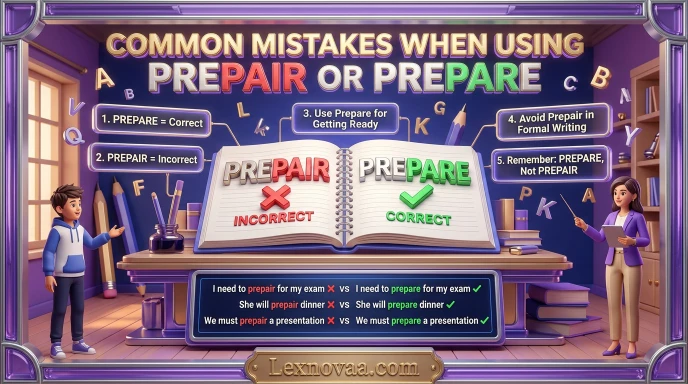
The most common mistake is writing prepair instead of prepare. This usually happens when someone relies on the sound of the word instead of remembering its spelling.
Here are some examples to help you avoid this error.
| Incorrect Sentence | Correct Sentence | Explanation |
|---|---|---|
| I need to prepair for school. | I need to prepare for school. | Prepair is a misspelling. |
| She will prepair dinner. | She will prepare dinner. | Use prepare for making food ready. |
| He is prepairing for the test. | He is preparing for the test. | The correct form is preparing. |
| They prepaired the documents. | They prepared the documents. | The past tense is prepared. |
| Good prepairation is important. | Good preparation is important. | The correct noun is preparation. |
Mistake 1: Writing Prepair Instead of Prepare
Incorrect: We must prepair for the meeting.
Correct: We must prepare for the meeting.
Why? The standard spelling is prepare. The spelling prepair is not accepted in standard English.
Mistake 2: Writing Prepairing Instead of Preparing
Incorrect: She is prepairing for her interview.
Correct: She is preparing for her interview.
Why? The present participle is formed by adding -ing to prepare after dropping the final e.
Mistake 3: Using Prepaired Instead of Prepared
Incorrect: I prepaired everything yesterday.
Correct: I prepared everything yesterday.
Why? The past tense of prepare is prepared, not prepaired.
Easy Memory Tip
Think of this word family:
- Prepare
- Prepared
- Preparing
- Preparation
All these forms begin with the same spelling pattern: prepar-.
You can also remember this sentence:
“Prepare before you appear.”
Both words help remind you of the correct spelling pattern.
Everyday Examples of Prepare
The word prepare appears in many parts of daily life. Here are examples from different writing situations.
1. Emails
- Please prepare the documents before our meeting.
- I am preparing the information you requested.
- We will prepare a response by tomorrow.
2. Business Writing
- The finance team will prepare the annual budget.
- Please prepare a summary of the project.
- Our staff is preparing a new marketing plan.
3. News Headlines
- Schools Prepare for the New Academic Year
- Local Teams Prepare for the Final Match
- Officials Prepare a Report on Road Safety
4. Blogs
- How to Prepare for Your First Job Interview
- Five Ways to Prepare for an English Exam
- How to Prepare Healthy Meals at Home
5. Social Media
- Take time to prepare before starting something new.
- Preparing for a big day!
- A little preparation can make a big difference.
6. Academic Writing
- Students should prepare their research materials in advance.
- The experiment was prepared according to the instructions.
- Teachers prepare lessons to support student learning.
7. Daily Conversation
- Have you prepared for the test?
- I need to prepare breakfast.
- We should prepare before leaving.
- Are you prepared for the journey?
These examples show that prepare works in many situations. The spelling does not change between formal and informal contexts.
Google Trends & Modern Usage
People search for prepair or prepare because they want to know which spelling is correct. This is a common type of spelling question, especially among English learners, students, and people writing quickly.
The confusion is easy to understand. The two forms look similar, and the sound of prepare may lead some writers to use pair at the end.
However, modern standard English recognizes prepare as the correct spelling. The misspelling prepair may appear in online searches, messages, or user-generated content, but that does not make it an accepted spelling.
Is Prepare More Common Than Prepair?
In standard written English, prepare is the established form. Prepair is an error rather than a competing regional spelling.
Exact Google Trends figures have not been verified for this article, so no numerical search-volume or popularity claims are made.
Why Do People Search for Prepair or Prepare?
Common reasons include:
- Uncertainty about the correct spelling.
- Confusion between pronunciation and spelling.
- English spelling practice.
- School assignments and examinations.
- Writing emails, reports, and other documents.
The simplest solution is to remember that prepare is always the correct choice in standard English.
Quick Comparison Table: Prepair vs Prepare
| Version | Meaning | Correct? | Region | Example |
|---|---|---|---|---|
| Prepare | To get ready or make ready | Yes | US, UK, Canada, Australia | I will prepare for the exam. |
| Prepair | No standard English meaning as a spelling of prepare | No | None as a standard variant | Incorrect: I will prepair for the exam. |
| Prepared | Past tense of prepare | Yes | All major varieties | She prepared the report. |
| Preparing | Present participle of prepare | Yes | All major varieties | He is preparing dinner. |
| Preparation | The act or process of getting ready | Yes | All major varieties | Preparation is essential. |
Key Takeaways
- Prepare is the correct spelling in standard English.
- Prepair is a common spelling mistake.
- Prepare means to get ready or make something ready.
- British and American English both use prepare.
- The past tense is prepared.
- The present participle is preparing.
- The noun form is preparation.
- Remember the spelling pattern in prepare, prepared, and preparation.
FAQs
1. Is it prepair or prepare?
Prepare is correct. Prepair is a misspelling and is not accepted as a standard English alternative.
Use prepare when you mean to get ready for something or make something ready. For example: “I need to prepare for my examination.”
2. Is prepair a real English word?
No. Prepair is not a standard English spelling of the verb prepare. You may see it in online messages or informal writing, but it is considered an error.
The correct spelling is prepare, whether you are writing in British, American, Canadian, or Australian English.
3. What does prepare mean?
Prepare means to get ready for something or make something ready for use. You can prepare for an exam, prepare a meal, prepare a report, or prepare for a journey. It is a verb used in both everyday conversation and formal writing.
4. How do you spell prepare correctly?
The correct spelling is P-R-E-P-A-R-E. It begins with pre and ends with pare. A helpful way to remember it is through the related word preparation. Both contain the same prepar- spelling pattern.
5. Is prepare British or American English?
Prepare is used in both British and American English. There is no regional spelling difference. Writers in the United Kingdom, United States, Canada, and Australia all use the same spelling.
6. What is the past tense of prepare?
The past tense of prepare is prepared. For example: “She prepared the presentation yesterday.” The same form is also used as the past participle, as in “The documents have been prepared.”
7. Is it preparing or prepairing?
Preparing is correct. Prepairing is incorrect because it comes from the misspelling prepair. When adding -ing to prepare, remove the final e and add -ing: prepare becomes preparing.
8. What is the noun form of prepare?
The most common noun form is preparation. It describes the act or process of getting ready. For example: “Good preparation can help students feel more confident before an exam.”
9. Can I use prepare in formal writing?
Yes. Prepare is suitable for formal and informal writing. You can use it in academic essays, business reports, professional emails, instructions, and everyday messages. It is a standard verb with the same spelling across major English varieties.
10. How can I remember the spelling of prepare?
Connect prepare with prepared and preparation. These related words share the spelling pattern prepar-.
You can also remember the sentence “Prepare before you appear.” Most importantly, avoid spelling the ending as pair.
Conclusion: Always Choose Prepare
When deciding between prepair or prepare, always choose prepare. It is the correct spelling in standard English and is used in the United States, United Kingdom, Canada, Australia, and other English-speaking regions.
The word prepare means to get ready for an event, task, or activity, or to make something ready for use.
Its related forms include prepared, preparing, and preparation. None of these standard forms uses the incorrect spelling prepair.
The confusion often comes from pronunciation, but remembering the word family makes the correct spelling easier.
Whether you are writing an email, completing a school assignment, preparing a business report, or having a daily conversation, use prepare.
The easiest rule to remember is this: You prepare with care, never prepair.
For more clear explanations of commonly confused English words, spelling differences, and grammar questions, visit Lexnovaa.com.
EXPLORE MORE ARTICLE CLICK HERE NOW!
- Its or It’s: The Simple Grammar Rule That Makes the Difference
- Lying or Laying: Which Word Is Correct and Why?
- Weather or Whether: Meaning, Difference, and Correct Usage

I’m Orin Blake, a writer with a passion for making English grammar simple, practical, and easy to understand. I enjoy breaking down confusing words, spelling differences, and everyday language questions into clear, reader-friendly guides. My goal is to help students, professionals, and curious learners write with greater confidence and accuracy.