Its or It’s: Meaning, Difference, and Example Is it its or it’s? These two forms look almost identical, but they have different meanings.
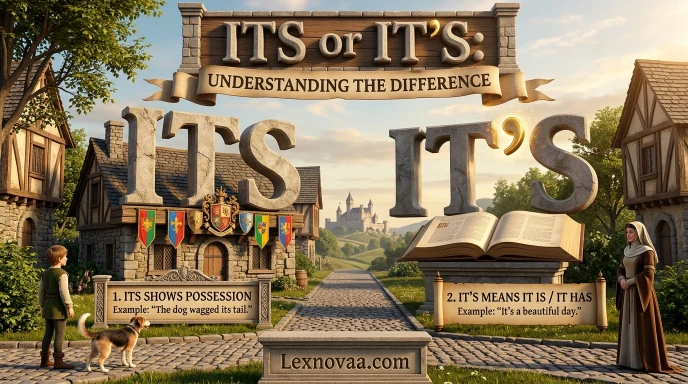
The main rule is simple: its shows possession, while it’s is a contraction of “it is” or “it has.” For example, “The dog wagged its tail” shows ownership. “It’s raining outside” means “It is raining outside.”
Many writers confuse these words because apostrophes often show possession in English. However, personal pronouns follow a different rule.
Words such as his, hers, ours, and yours do not use apostrophes to show ownership. The same rule applies to its.
This small difference matters in school assignments, emails, business documents, blog posts, and everyday messages.
A wrong apostrophe can make otherwise clear writing look careless. The good news is that you can learn the rule in just a few minutes.
In this guide, you will discover the meaning of its and it’s, their grammar rules, historical background, common mistakes, and practical examples. You will also learn a quick test that helps you choose the correct form every time.
Its or It’s: The Difference Explained
Its is a possessive pronoun that shows something belongs to or is connected with an animal, object, place, or other thing. It’s is a contraction of it is or it has.
Examples:
- The cat cleaned its paws. (Possession)
- It’s a beautiful day. (It is)
- It’s been a long week. (It has)
A simple way to check your choice is to replace it’s with it is or it has. If the sentence still makes sense, it’s is correct. If not, you probably need its.
Its or It’s: Quick Answer
The correct form depends on what you want to say.
Use its when showing possession:
- The company changed its name.
- The bird spread its wings.
- The house has its own garden.
Use it’s when you mean it is or it has:
- It’s cold today. (It is cold today.)
- It’s a good idea. (It is a good idea.)
- It’s been raining all morning. (It has been raining all morning.)
Remember: Its means belonging to it. It’s means it is or it has.
What Does Its Mean?
Its is a possessive form of the pronoun it. It shows that something belongs to, comes from, or is connected with an animal, object, organization, place, or idea.
Unlike many English possessive nouns, its does not use an apostrophe.
1. Its Shows Ownership
Use its when something belongs to an animal, object, or other thing.
Examples:
- The dog hurt its leg.
- The school updated its rules.
- The phone lost its connection.
In each example, its connects something with the person or thing that owns it.
2. Its Shows a Relationship
Its does not always mean physical ownership. It can also show that something is a part, feature, or quality of something else.
Examples:
- The book is known for its clear writing.
- The city is famous for its old buildings.
- The company improved its customer service.
Here, its connects a quality or feature with the subject.
3. Its Before a Noun
Its usually appears before a noun because it tells us who or what something belongs to.
Examples:
- The bird moved its wings.
- The computer restarted its system.
- The tree lost its leaves.
4. Its Does Not Need an Apostrophe
This is the rule that causes the most confusion. Many English possessive forms use an apostrophe, such as the girl’s bag or the dog’s food. However, possessive pronouns work differently.
Compare these forms:
| Possessive Pronoun | Correct Form |
| He | His |
| She | Hers |
| They | Theirs |
| We | Ours |
| You | Yours |
| It | Its |
None of these possessive pronouns needs an apostrophe.
Key point: Use its to show possession. Never write it’s when you mean belonging to it.
What Does It’s Mean?
It’s is a contraction. A contraction joins two words and replaces one or more letters with an apostrophe.
It’s has two meanings:
- It is
- It has
The meaning depends on the sentence.
1. It’s Means It Is
Use it’s when you can replace it with it is without changing the meaning.
Examples:
- It’s sunny today. (It is sunny today.)
- It’s time to leave. (It is time to leave.)
- It’s difficult to understand. (It is difficult to understand.)
This is the most common use of it’s.
2. It’s Means It Has
It’s can also replace it has, especially when has is part of a perfect tense or a phrase.
Examples:
- It’s been a busy day. (It has been a busy day.)
- It’s already started. (It has already started.)
- It’s become more popular. (It has become more popular.)
In these sentences, it’s represents it has, not it is.
3. It’s in Everyday Questions
It’s also appears in questions and informal conversation.
Examples:
- It’s your turn, isn’t it?
- It’s a good time to start, right?
- It’s getting late, isn’t it?
These examples use it’s as a contraction of it is.
4. It’s in Common Expressions
You will often see it’s in familiar expressions.
Examples:
- It’s no problem.
- It’s up to you.
- It’s worth trying.
- It’s not too late.
Key point: If it’s means it is or it has, the apostrophe is necessary.
The Origin of Its and It’s

The words its and it’s developed from the English pronoun it. Their history helps explain why modern English treats the two forms differently.
The History of Its
The pronoun it comes from Old English hit, which was used as a neuter pronoun. Early English also used forms such as his to show possession.
Over time, English developed the separate possessive form its. This form became established in the early modern period and helped distinguish possession from other uses of the pronoun.
Today, its is the standard possessive form of it.
The History of It’s
The apostrophe in it’s marks the omission of letters in a contraction.
It’s developed as a shortened form of it is and later also represented it has. Apostrophes became widely used in English to show omitted letters and certain possessive forms.
The modern contraction remains common in speech and informal writing. It also appears in many forms of standard writing when a conversational tone is suitable.
Why Do People Confuse Its and It’s?
The confusion comes from a common English pattern. Apostrophes often show possession in nouns, as in the teacher’s desk. This can lead writers to assume that it’s must also show possession.
However, possessive pronouns do not follow that pattern.
Compare:
- The dog’s collar is blue. (Possessive noun)
- The dog wagged its tail. (Possessive pronoun)
- It’s a friendly dog. (It is)
The key is to remember that its is already a possessive pronoun, so it does not need an apostrophe.
British English vs American English
The difference between its and it’s is the same in British and American English. Both varieties use its for possession and it’s as a contraction of it is or it has.
There is no standard regional spelling difference.
| Usage | British English | American English | Example |
| Possession | Its | Its | The dog wagged its tail. |
| It is | It’s | It’s | It’s a lovely day. |
| It has | It’s | It’s | It’s been a long time. |
| Formal possessive use | Its | Its | The company changed its policy. |
| Contraction in conversation | It’s | It’s | It’s getting late. |
Regional Differences
British and American writers follow the same grammar rule.
Examples:
- British English: The school updated its website.
- American English: The school updated its website.
- British English: It’s been a difficult week.
- American English: It’s been a difficult week.
The meaning and spelling do not change between these varieties.
Style Guides and Publishing Preferences
Most major English style guides accept both forms. However, some formal documents may prefer expanded forms such as it is and it has instead of contractions.
For example:
- Conversational: It’s important to check the details.
- More formal: It is important to check the details.
The possessive form remains its in both styles.
Which Version Should You Use?
You do not need to choose a British or American version. Both forms are used worldwide. The correct choice depends on the meaning of your sentence and the tone of your writing.
United States
American English uses its for possession and it’s for it is or it has.
Example: The organization changed its name because it’s expanding.
United Kingdom
British English follows the same rule.
Example: The museum updated its website because it’s preparing for a new exhibition.
Canada
Canadian English also follows the standard distinction.
Example: The company improved its service because it’s receiving more customers.
Australia
Australian English uses both forms in the same way.
Example: The bird spread its wings because it’s ready to fly.
International Writing
For international readers, use its for possession and it’s for contractions. These forms are understood across major English-speaking regions.
Academic Writing
In academic work, use its when showing possession. You may choose it is or it has instead of it’s if your institution or style guide prefers a more formal tone.
Example: The study explains its findings. It is important to review the results.
Business Writing
Use its to show ownership or connection in reports, emails, and company documents. Use it’s when a contraction suits the tone.
Examples:
- The business updated its privacy policy.
- It’s important to review the new terms.
Common Mistakes When Using Its and It’s

The most common mistake is adding an apostrophe to its when showing possession. Another common error is leaving out the apostrophe when the writer means it is or it has.
The following examples show how to avoid both problems.
| Incorrect Sentence | Correct Sentence | Explanation |
| The dog wagged it’s tail. | The dog wagged its tail. | Its shows possession. |
| Its raining outside. | It’s raining outside. | It’s means it is. |
| The company changed it’s name. | The company changed its name. | The name belongs to the company. |
| Its been a long day. | It’s been a long day. | It’s means it has. |
| The phone lost it’s signal. | The phone lost its signal. | Its shows a connection. |
| Its a beautiful place. | It’s a beautiful place. | It’s means it is. |
Mistake 1: Using It’s to Show Possession
Incorrect: The cat cleaned it’s paws.
Correct: The cat cleaned its paws.
Why? The paws belong to the cat. Use the possessive pronoun its without an apostrophe.
Mistake 2: Forgetting the Apostrophe in It’s
Incorrect: Its getting dark outside.
Correct: It’s getting dark outside.
Why? The sentence means It is getting dark outside. The apostrophe marks the missing letters in the contraction.
Mistake 3: Confusing It’s With Its Before a Noun
Incorrect: The company changed it’s policy.
Correct: The company changed its policy.
Why? The policy belongs to the company. This is possession, not a contraction.
Mistake 4: Using Its Instead of It’s With It Has
Incorrect: Its been a wonderful experience.
Correct: It’s been a wonderful experience.
Why? The sentence means It has been a wonderful experience. Therefore, it’s is correct.
An Easy Memory Tip
Use the replacement test:
- Replace it’s with it is.
- If that does not work, try it has.
- If neither replacement makes sense, use its.
For example:
- The bird spread its wings. (It is wings does not make sense.)
- It’s raining. (It is raining makes sense.)
- It’s been a good day. (It has been a good day makes sense.)
Remember: If you cannot replace it’s with it is or it has, use its.
Everyday Examples of Its and It’s
These examples show how both forms appear in common types of writing.
1. Emails
- The company has updated its contact details.
- It’s important to reply before Friday.
2. Business Writing
- The business increased its sales this year.
- It’s helpful to review the report before the meeting.
3. News Headlines
- Company Announces Its New Expansion Plan
- It’s Time for a New Approach to Education
4. Blogs
- Every website has its own audience.
- It’s easy to learn this rule with practice.
5. Social Media
- The puppy is playing with its toy.
- It’s such a beautiful morning!
6. Academic Writing
- The research explains its main findings.
- It’s clear that further study is needed.
For a more formal academic tone, you can write It is clear instead.
7. Daily Conversation
- “The phone has lost its battery charge.”
- ” It’s getting late.”
- “The restaurant is known for its food.”
- ” It’s been a great day.”
These examples show that both forms are useful. The correct one depends on if you mean possession or a contraction.
Google Trends and Modern Usage
Its and it’s are both common in modern English. They appear in books, websites, emails, social media posts, news articles, and everyday communication.
People often search for its or it’s because the apostrophe changes the word’s grammatical function. The difference is small, but it can affect the meaning of a sentence.
Why Do People Search for Its or It’s?
There are several reasons:
- Apostrophe confusion: Writers often use apostrophes to show possession in nouns.
- Similar appearance: Both forms contain the same letters, with only an apostrophe separating them.
- Pronunciation: In normal speech, both forms sound the same.
- Writing mistakes: The error is easy to make when typing quickly.
Regional Popularity
The distinction is the same in the United States, United Kingdom, Canada, Australia, and other English-speaking regions.
There is no standard regional preference for one spelling over the other. Both are necessary because they serve different grammatical purposes.
Exact search interest by country or over time should be checked directly in Google Trends. Without a live Trends comparison, no numerical popularity claims should be made.
Modern Usage
In digital writing, both forms appear frequently. Its is common when describing features, ownership, and relationships. It’s appears in conversational sentences and shortened forms of it is and it has.
For clear writing, always check if the sentence expresses possession or a contraction.
Its or It’s: Quick Comparison Table
| Version | Meaning | Correct? | Region | Example |
| Its | Possession | Yes | All major English varieties | The dog wagged its tail. |
| It’s | It is | Yes | All major English varieties | It’s a sunny day. |
| It’s | It has | Yes | All major English varieties | It’s been a long week. |
| Its | It is | No | None | Incorrect: Its a good idea. |
| Its | It has | No | None | Incorrect: Its been raining. |
| It’s | Possession | No | None | Incorrect: The cat moved it’s paws. |
Key Takeaways
- Its is a possessive pronoun.
- It’s is a contraction of it is or it has.
- Use its when something belongs to or is connected with something.
- Use it’s when you can replace it with it is or it has.
- Possessive pronouns such as yours, hers, ours, and theirs do not use apostrophes.
- British and American English follow the same rule.
- Remember the replacement test to avoid mistakes.
FAQs About Its or It’s
1. What is the difference between its and it’s?
Its is a possessive pronoun that shows something belongs to or is connected with something. It’s is a contraction of it is or it has. For example, “The dog wagged its tail” shows possession, while “It’s raining” means “It is raining.” The apostrophe changes the grammatical meaning.
2. When should I use its instead of it’s?
Use its when you want to show possession or a connection. For example, “The company changed its logo” means the logo belongs to the company. Do not add an apostrophe to its. If you are not expressing possession, check if the sentence needs it is or it has instead.
3. When should I use it’s instead of its?
Use it’s when you mean it is or it has. For example, “It’s cold outside” means “It is cold outside.”
Similarly, “It’s been a long day” means “It has been a long day.” If neither expanded form fits the sentence, you probably need its.
4. Is its ever correct with an apostrophe?
Yes, but only when the apostrophe is part of a different construction, such as a contraction or a quotation.
The standard possessive pronoun is always its, without an apostrophe. For example, “The dog wagged its tail” is correct. “The dog wagged it’s tail” is incorrect.
5. Why does its not have an apostrophe?
Its is a possessive pronoun, and English possessive pronouns do not use apostrophes. Words such as his, hers, yours, ours, and theirs follow the same pattern. This differs from possessive nouns, such as the dog’s toy, which normally use an apostrophe.
6. Is it’s short for it is or it has?
It’s can stand for both it is and it has. The surrounding words tell you which meaning is intended.
For example, “It’s raining” means “It is raining.” “It’s finished” can mean “It has finished” when the context supports that meaning.
7. Are its and it’s pronounced the same?
Yes. In standard English, its and it’s are generally pronounced the same way. This makes them easy to confuse when listening or speaking.
The difference appears in writing, where the apostrophe shows that it’s is a contraction. You must use the sentence’s meaning to choose the correct form.
8. Do British and American English use its and it’s differently?
No. British and American English follow the same rules. Both use its to show possession and it’s as a contraction of it is or it has.
For example, “The company updated its website” and “It’s a good idea” are correct in both varieties.
9. Is it its own or it’s own?
The correct phrase is its own. For example, “Every country has its own traditions.” Here, its shows possession or association.
Writing “it’s own” is incorrect because it is own does not make sense. Remember that its does not need an apostrophe when it shows possession.
10. How can I remember if to use its or it’s?
Use the replacement test. Try replacing it’s with it is or it has. If the sentence still makes sense, use it’s.
If neither replacement works and the sentence shows possession, use its. For example, “The dog wagged its tail” needs its because neither expanded form makes sense.
Conclusion
The difference between its or it’s comes down to one simple grammar rule. Its shows possession or a connection, while it’s is a contraction of it is or it has. Although they look almost the same and sound alike, they cannot replace each other.
Use its in sentences such as “The company changed its name.” Choose it’s in sentences such as “It’s a beautiful day” or “It’s been a long time.” The same rules apply in British, American, Canadian, and Australian English.
When you are unsure, try replacing it’s with it is or it has. If the sentence still makes sense, the apostrophe belongs there. Otherwise, use its when showing possession.
For more clear explanations of confusing English words and grammar comparisons, visit Lexnovaa.com. You can find simple guides to help make your everyday writing more accurate and confident.
EXPLORE MORE ARTICLE CLICK HERE NOW!
- Then or Than: What’s the Difference and When to Use Each?
- Weather or Whether: Meaning, Difference, and Correct Usage
- Lying or Laying: Which Word Is Correct and Why?

I’m Orin Blake, a writer with a passion for making English grammar simple, practical, and easy to understand. I enjoy breaking down confusing words, spelling differences, and everyday language questions into clear, reader-friendly guides. My goal is to help students, professionals, and curious learners write with greater confidence and accuracy.