A single letter can make a difference in English spelling. If you have ever wondered if to write shovelling or shoveling, the answer depends on the variety of English you are using.
Both spellings are correct, but shovelling is the standard British spelling, while shoveling is the standard American spelling.
Both words come from the verb shovel, which means to move or lift something with a shovel. The confusion happens because British and American English follow different rules.
when adding endings such as -ing to certain verbs. Some English speakers double the final consonant, while others do not.
You may see these spellings in writing about clearing snow, moving soil, gardening, construction, or other outdoor tasks.
Choosing the right form helps keep your writing clear and consistent. This guide explains the difference, the spelling rule, the word’s origin, and how to use both forms in everyday sentences.
Shovelling or Shoveling: The Difference Explained
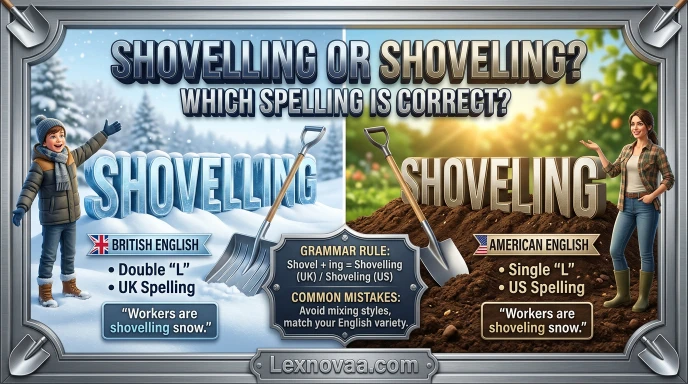
Shovelling is the British English spelling, while shoveling is the American English spelling. Both are present participles of the verb shovel. They describe the same action: moving or lifting material with a shovel.
- British English: He is shovelling snow.
- American English: He is shoveling snow.
Neither spelling is wrong. The difference is regional spelling preference.
Shovelling or Shoveling: Quick Answer
Both shovelling and shoveling are correct. Use shovelling in British English and shoveling in American English. The difference comes from how each variety handles the final consonant when adding -ing to the verb shovel.
Examples:
- British: She is shovelling soil into the garden bed.
- American: She is shoveling soil into the garden bed.
- British: They spent the morning shovelling snow.
- American: They spent the morning shoveling snow.
Easy rule: British English usually doubles the final l in this word; American English usually uses one l.
What Does Shovelling or Shoveling Mean?
The two spellings have the same meaning. They are forms of the verb shovel.
What Does Shovelling Mean?
Shovelling is the British English present participle of shovel. It means using a shovel to lift, move, or remove material.
People commonly use the word when talking about:
- Clearing snow from a path
- Moving soil in a garden
- Removing sand or gravel
- Loading coal or other materials
- Moving loose material during construction
Examples:
- The workers are shovelling gravel into a truck.
- He was shovelling snow from the driveway.
- She is shovelling compost into the flower beds.
The spelling doubles the final l before adding -ing.
What Does Shoveling Mean?
Shoveling is the American English present participle of shovel. It describes the same action of moving or lifting material with a shovel.
Examples:
- The workers are shoveling dirt into the wheelbarrow.
- He spent an hour shoveling snow.
- She is shoveling sand into a bucket.
American English generally keeps one l in this form.
What Is the Base Verb?
The base verb is shovel.
It can be used as a verb or a noun:
- Verb: Please shovel the snow away from the entrance.
- Noun: He picked up a shovel from the shed.
When you add an ending, the spelling may change depending on the form and the English variety.
| Verb Form | British English | American English |
| Base form | Shovel | Shovel |
| Third-person singular | Shovels | Shovels |
| Present participle | Shovelling | Shoveling |
| Past tense | Shovelled | Shoveled |
| Past participle | Shovelled | Shoveled |
The meaning stays the same in both varieties.
The Origin of Shovelling and Shoveling

The word shovel has a long history in English. It comes from Old English scofl, a word for a tool used to lift or move loose material. It is related to the modern word shovel.
The verb developed from the name of the tool. It came to describe the action of moving material with that tool.
The spelling difference between shovelling and shoveling is part of a wider pattern in British and American English.
Why Does British English Double the L?
British English commonly doubles the final l when adding certain endings to verbs ending in l.
For example:
- Travel → Travelling
- Cancel → Cancelling
- Label → Labelling
- Shovel → Shovelling
This pattern is common in British spelling.
Why Does American English Use One L?
American English often keeps a single l in these forms when the final syllable is not stressed.
For example:
- Travel → Traveling
- Cancel → Canceling
- Label → Labeling
- Shovel → Shoveling
This is a spelling convention, not a difference in pronunciation or meaning.
Is This Rule Used With Every Verb?
No. English spelling rules have exceptions, and not every verb ending in l follows exactly the same pattern.
For example, fulfil is commonly written fulfilment in British English and fulfillment in American English. It is best to check a reliable dictionary when a word is unfamiliar.
British English vs American English
The main difference is the doubled l in British English and the single l in American English.
| British English | American English | Example |
| Shovelling | Shoveling | He is shovelling/shoveling snow. |
| Shovelled | Shoveled | They shovelled/shoveled the soil. |
| Travelling | Traveling | She is travelling/traveling abroad. |
| Cancelled | Canceled | The event was cancelled/canceled. |
| Labelling | Labeling | He is labelling/labeling the boxes. |
Regional Differences
British English: The preferred forms are shovelling and shovelled. These spellings are also common in other English varieties that follow British conventions.
American English: The preferred forms are shoveling and shoveled. American dictionaries and publications generally use one l in these forms.
Canadian English: Canadian spelling often follows British conventions for doubling the l, so shovelling and shovelled are common. However, publishers and style guides may differ.
Australian English: Australian English generally follows British spelling conventions, so shovelling and shovelled are preferred.
What About Pronunciation?
There is no meaningful pronunciation difference between shovelling and shoveling. Both forms are pronounced in essentially the same way.
The difference appears in writing, not in the action or meaning.
What Do Style Guides Recommend?
Style guides usually recommend following one spelling system consistently.
- British publications generally prefer shovelling.
- American publications generally prefer shoveling.
- Canadian and Australian publications often prefer shovelling.
If you are writing for a specific publication, follow its spelling guide.
Which Version Should You Use?
The best spelling depends on your audience and the style of English you are following.
United States
Use shoveling in American English.
Example: The neighbors are shoveling snow from their driveway.
This is the standard spelling in most American newspapers, books, websites, and educational materials.
United Kingdom
Use shovelling in British English.
Example: The council workers are shovelling snow from the pavement.
This spelling follows the usual British convention of doubling the final l.
Canada
Use shovelling in most Canadian English writing.
Example: He spent the morning shovelling gravel.
Canadian spelling often follows British-style l doubling, although you should follow the style guide used by your school, employer, or publisher.
Australia
Use shovelling in Australian English.
Example: She was shovelling soil into the garden.
Australian English generally follows British spelling conventions for this word.
International Writing
If your audience includes readers from several countries, choose one spelling system and use it consistently.
You can use either form, but avoid switching between shovelling and shoveling in the same article without a clear reason.
Academic Writing
Follow the spelling convention required by your university, instructor, or academic style guide.
If your institution uses British English, write shovelling. If it uses American English, write shoveling.
Business Writing
Use the spelling preferred by your company or target market.
For example, a US-based business should generally use shoveling, while a UK-based business should use shovelling. Consistency makes reports, emails, and website content look more professional.
Common Mistakes When Using Shovelling and Shoveling
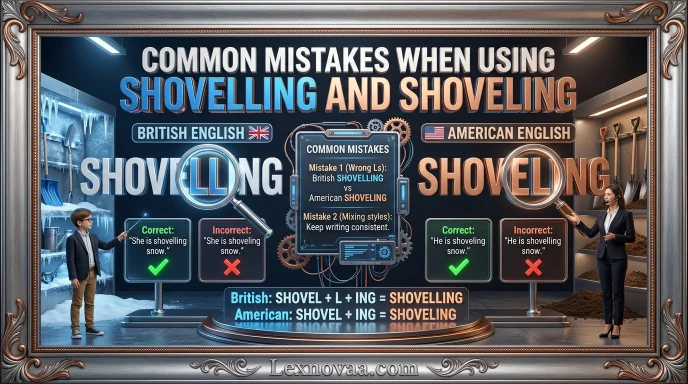
These mistakes often happen when writers mix British and American spelling rules.
Mistake 1: Mixing Both Spellings in One Article
Incorrect: The workers were shovelling snow yesterday, and today they are shoveling soil.
Correct in British English: The workers were shovelling snow yesterday, and today they are shovelling soil.
Correct in American English: The workers were shoveling snow yesterday, and today they are shoveling soil.
Explanation: Both spellings are correct, but mixing them in the same piece of writing can look inconsistent.
Memory tip: Choose British or American spelling and stay with it.
Mistake 2: Using Shoveling in British English Writing
Less suitable for standard British English: He is shoveling snow.
Preferred British form: He is shovelling snow.
Explanation: British English generally doubles the final l in this word before adding -ing.
Memory tip: British spelling usually adds another l.
Mistake 3: Using Shovelling in American English Writing
Less suitable for standard American English: He is shovelling snow.
Preferred American form: He is shoveling snow.
Explanation: American English generally uses one l in this form.
Memory tip: American spelling usually keeps one l.
Mistake 4: Confusing Shovelling With Shovelled
Incorrect: She is shovelled snow.
Correct: She is shovelling snow.
Explanation: Shovelling is the present participle. Shovelled is the British past tense and past participle.
Memory tip: Use is shovelling for an action happening now.
Mistake 5: Thinking One Spelling Is Wrong
Incorrect: Shovelling is always incorrect.
Correct: Shovelling is standard in British English, while shoveling is standard in American English.
Explanation: This is a regional spelling difference. Neither form is universally wrong.
Memory tip: The audience decides which spelling is preferred.
Everyday Examples of Shovelling and Shoveling
Here are examples from different writing situations.
1. Email Examples
British English:
Subject: Snow Removal
Hello,
The maintenance team will be shovelling snow from the entrance early tomorrow morning.
Regards,
American English:
Subject: Snow Removal
Hello,
The maintenance team will be shoveling snow from the entrance early tomorrow morning.
Regards,
2. Business Writing
British English: The construction team is shovelling gravel into the storage area.
American English: The construction team is shoveling gravel into the storage area.
3. News Headlines
- British: Workers Begin Shovelling Snow After Heavy Winter Storm
- American: Workers Begin Shoveling Snow After Heavy Winter Storm
4. Blog Examples
- British: Five Tips for Shovelling Snow Safely
- American: Five Tips for Shoveling Snow Safely
- British: How to Make Garden Work Easier When Shovelling Soil
- American: How to Make Garden Work Easier When Shoveling Soil
5. Social Media Examples
- British: We spent the morning shovelling snow from the driveway.
- American: We spent the morning shoveling snow from the driveway.
- British: Time to start shovelling the garden soil!
- American: Time to start shoveling the garden soil!
6. Academic Writing
British English: The study examined the physical effort involved in shovelling loose soil.
American English: The study examined the physical effort involved in shoveling loose soil.
7. Daily Conversation
British English:
Person A: What are you doing outside?
Person B: I’m shovelling snow from the path.
American English:
Person A: What are you doing outside?
Person B: I’m shoveling snow from the walkway.
The spelling changes, but the meaning stays the same.
Google Trends and Modern Usage
Both shovelling and shoveling are used in modern English. Their popularity often reflects regional spelling preferences.
Shoveling is the usual form in the United States. It is common in American writing about snow removal, gardening, construction, and outdoor work.
Shovelling is preferred in British English and is also common in countries such as Australia and Canada, where British-style spelling conventions are widely used.
People search for shovelling or shoveling for several reasons:
- They are unsure if to double the final l.
- They are writing for a British or American audience.
- They want to check the spelling of shovel with an -ing ending.
- They have seen both forms in online articles.
- They want to understand the difference between shovelling, shoveling, shovelled, and shoveled.
Search interest may also change with the seasons. For example, searches related to shoveling or shovelling snow may rise during winter in regions that experience snowfall.
No exact Google Trends figures are claimed here because a live comparison has not been verified. These observations describe general spelling and usage patterns.
The key point is simple: both forms are correct, but each belongs to a different spelling convention.
Quick Comparison Table: Shovelling vs Shoveling
| Version | Meaning | Correct? | Region | Example |
| Shovelling | Moving material with a shovel | Yes | British English | He is shovelling snow. |
| Shoveling | Moving material with a shovel | Yes | American English | He is shoveling snow. |
| Shovelled | Past tense or past participle | Yes | British English | She shovelled the soil. |
| Shoveled | Past tense or past participle | Yes | American English | She shoveled the soil. |
| Shoveling | British spelling preference | Not standard | British English | Use shovelling. |
| Shovelling | American spelling preference | Not standard | American English | Use shoveling. |
Key Takeaways
- Shovelling is the standard British English spelling.
- Shoveling is the standard American English spelling.
- Both words describe moving material with a shovel.
- British English doubles the final l in this form.
- American English generally keeps one l.
- The past forms are shovelled in British English and shoveled in American English.
- Both spellings have the same pronunciation and meaning.
- Choose one spelling system and use it consistently.
FAQs
1. Is it shovelling or shoveling?
Both spellings are correct. Shovelling is the standard British English form, while shoveling is the standard American English form.
Both come from the verb shovel and describe the action of moving material with a shovel. Choose the spelling that matches your audience.
2. Is shovelling British or American?
Shovelling is the preferred British English spelling. It is also common in Australian and Canadian English.
The word doubles the final l before adding -ing. American English generally uses shoveling with one l.
3. Is shoveling American English?
Yes. Shoveling is the standard American English spelling. It follows the American convention of keeping one l in this form.
For example, an American writer would normally write, “He is shoveling snow from the driveway.”
4. What is the past tense of shovel?
The past tense is shovelled in British English and shoveled in American English. Both forms describe an action that happened in the past.
For example, a British writer might say, “She shovelled the soil,” while an American writer would write, “She shoveled the soil.”
5. Is it shovelled or shoveled?
Both are correct regional spellings. Shovelled is preferred in British English, while shoveled is preferred in American English.
The two forms have the same meaning and pronunciation. Use the version that matches the spelling style of your document.
6. Why does British English use two Ls in shovelling?
British English commonly doubles the final l when adding endings such as -ing to certain verbs. This produces forms such as travelling, cancelling, and shovelling.
American English generally does not double the l in these same forms when the final syllable is unstressed.
7. Is shovelling snow correct?
Yes. Shovelling snow is correct in British English and other varieties that follow British spelling conventions.
In American English, the usual form is shoveling snow. Both phrases describe removing or moving snow with a shovel.
8. Do shovelling and shoveling sound the same?
Yes. The two spellings have essentially the same pronunciation. The difference is only in writing. Both are forms of the verb shovel, and neither spelling changes the meaning or the action being described.
9. Is shovelling correct in Canadian English?
Yes. Shovelling is a common and generally preferred Canadian spelling. Canadian English often follows British-style consonant doubling in words such as travelling and shovelling. However, always check the style guide used by your school, employer, or publisher.
10. Which spelling should I use in an international article?
Choose the spelling system that best fits your main audience. Use shoveling if you are following American English and shovelling if you are following British English. If your article targets international readers, consistency is more important than mixing regional forms.
Conclusion
The difference between shovelling or shoveling is a simple British and American spelling rule. Both words are correct and describe the same action.
moving or lifting material with a shovel. The British spelling doubles the final l, giving us shovelling, while the American spelling keeps one l, giving us shoveling.
The same pattern appears in their past forms. British English uses shovelled, while American English uses shoveled. Neither form changes the meaning or pronunciation.
If you are writing for readers in the United Kingdom, Australia, or most Canadian contexts, shovelling is usually the better choice.
For an American audience, choose shoveling. In academic and business writing, follow the spelling guide required by your institution or organization.
Remember: British English writes shovelling, while American English writes shoveling.
For more clear explanations of confusing English spellings and grammar comparisons, visit Lexnovaa.com.
EXPLORE MORE ARTICLE CLICK HERE NOW!
- Edited or Editted: Which Spelling Is Correct?
- Dialled or Dialed: Which Spelling Is Correct?
- Sofa or Couch: What’s the Difference and Which Is Correct?

I’m Orin Blake, a writer with a passion for making English grammar simple, practical, and easy to understand. I enjoy breaking down confusing words, spelling differences, and everyday language questions into clear, reader-friendly guides. My goal is to help students, professionals, and curious learners write with greater confidence and accuracy.