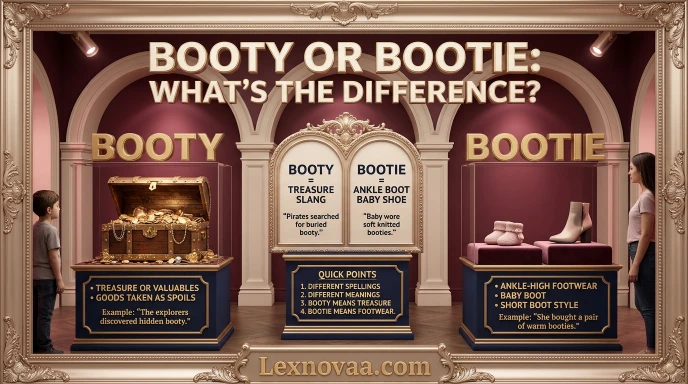
Is the correct spelling booty or bootie? Both words are correct, but they do not always mean the same thing.
Booty commonly refers to treasure or someone’s buttocks, while bootie often refers to a small boot or a soft shoe, especially one made for a baby.
People often confuse these words because they sound almost identical. Their meanings, however, depend on the context.
You might read about pirates searching for booty, see a baby wearing knitted booties, or find a fashion store selling ankle booties. Choosing the wrong spelling can change the meaning of your sentence.
This difference matters in everyday conversations, online shopping, fashion writing, social media, and formal writing.
In this guide, you will learn what booty and bootie mean, where the words came from, how English speakers use them, and which spelling fits different situations. Let’s look at the simple rules that make the choice easy.
Booty or Bootie: The Difference Explained
Booty usually means treasure, stolen goods, or informal slang for a person’s buttocks. Bootie commonly means a small boot or soft shoe, especially footwear for babies. Both spellings are correct, but they have different common uses. Context helps you choose the right word.
Booty or Bootie : Quick Answer
Use booty when you mean treasure or use the informal slang term for buttocks. Use bootie when you mean a small boot or soft shoe.
Examples:
- The pirates found hidden booty. (treasure)
- The baby wore warm knitted booties. (small shoes)
- She bought a pair of black ankle booties. (short boots)
Easy memory tip: Booty often means treasure or buttocks; bootie often means footwear.
What Does Booty or Bootie Mean?
The words booty and bootie have separate meanings. Although they sound alike, their spelling helps readers understand what you mean.
What Does Booty Mean?
Booty is a noun with two common meanings.
1. Treasure or valuable goods
In this sense, booty refers to money, treasure, or goods taken during a war, raid, or attack. It is often used in stories about pirates, soldiers, and historical battles.
Examples:
- The pirates divided the booty among themselves.
- The soldiers returned with valuable booty.
- The explorers searched for buried booty.
This meaning is often found in adventure stories, historical writing, and discussions of stolen or captured goods.
2. Informal slang for buttocks
In informal English, booty can also refer to a person’s buttocks. This meaning is common in casual conversation, entertainment, music discussions, and popular culture.
Examples:
- He fell on his booty while playing.
- The song uses the word booty as slang.
- The joke included a reference to booty.
This use is informal. It is not usually suitable for formal academic or professional writing.
What Does Bootie Mean?
Bootie is a noun that usually refers to a small boot or soft shoe.
It is especially common when talking about:
- Baby footwear
- Knitted or fabric baby shoes
- Short boots
- Ankle-high fashion footwear
- Certain types of protective footwear
Examples:
- Grandma knitted a pair of wool booties for the baby.
- She wore black leather booties with her outfit.
- The shop sells waterproof booties for cold weather.
The word can refer to different kinds of footwear depending on the product and context. In baby clothing, it often describes a soft shoe that keeps a baby’s feet warm. In fashion, it can describe a short boot that covers the foot and ankle.
Are Booty and Bootie Interchangeable?
No. Although the words sound alike, they are not interchangeable in their usual meanings.
| Word | Main Meaning | Example |
| Booty | Treasure or valuable goods | The pirates found hidden booty. |
| Booty | Informal slang for buttocks | The word appeared in a casual song. |
| Bootie | A small boot or soft shoe | The baby wore knitted booties. |
| Bootie | A short fashion boot | She bought leather ankle booties. |
If you are writing about treasure, use booty. If you are writing about footwear, bootie is usually the better choice.
The Origin of Booty and Bootie
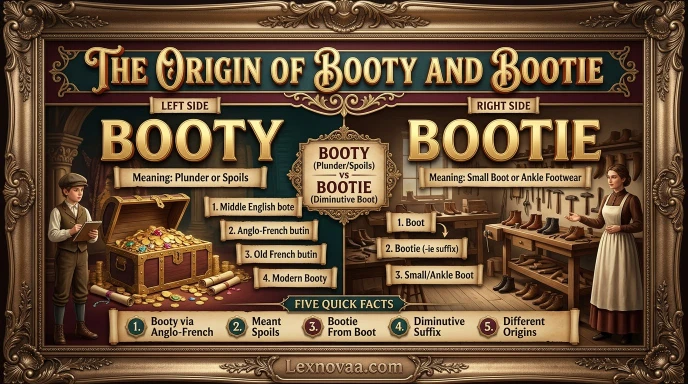
The words have different histories, which helps explain why their meanings are not the same.
Origin of Booty
The word booty has roots in Middle English and came through forms related to the Old French word butin, meaning spoils or goods taken in war. Its history is also linked to Germanic language forms.
Over time, booty became established in English as a word for valuable goods captured during war, raids, or other acts of seizure.
Later, the word developed an informal slang meaning referring to buttocks. This modern use became more familiar through popular speech, entertainment, and music.
Origin of Bootie
Bootie is a diminutive form related to the word boot. A diminutive is a word form that suggests something small or sometimes expresses affection.
The word developed as a name for a small boot or soft shoe. It became especially familiar in phrases such as baby booties and ankle booties.
The spelling with ie helps distinguish this footwear word from booty, although context remains important.
Why Do People Confuse These Words?
There are three main reasons:
- Similar pronunciation: In many accents, booty and bootie sound the same.
- Similar spelling: Only the final vowel spelling changes.
- Different contexts: Both words appear in casual conversation, shopping, entertainment, and online content.
Remembering their separate origins makes their meanings easier to understand.
British English vs American English
Both booty and bootie are used in British and American English. Their main meanings remain similar, but spelling preferences for footwear can vary.
In particular, booty is the usual spelling for treasure and informal slang, while bootie is common for small footwear. The related spelling booty is not normally used to describe a small shoe.
| Context | British English | American English | Example |
| Treasure | Booty | Booty | The pirates discovered the booty. |
| Informal slang | Booty | Booty | The word appeared in a casual conversation. |
| Baby footwear | Booties | Booties | The baby wore soft booties. |
| Short fashion boots | Ankle boots or ankle booties | Ankle boots or ankle booties | She bought black ankle booties. |
Regional Differences
The basic meanings are understood in both varieties of English. However, the words used to describe footwear can vary by retailer, product category, and fashion style.
British retailers may use ankle boots more often in general product descriptions. American retailers also commonly use ankle booties.
These are usage preferences, not strict grammar rules.
What About Dictionaries and Style Guides?
Major dictionaries recognize booty and bootie as separate words with different meanings. General writing style guides usually focus on choosing the correct meaning and using spelling consistently.
For professional writing, check the dictionary and style guide used by your publication. For shopping descriptions, follow the product’s actual category and the retailer’s terminology.
Which Version Should You Use?
The right spelling depends on what you want to describe, not simply where you live.
United States
Use booty for treasure and informal slang. Use bootie for small footwear, including baby shoes and short fashion boots.
Example: The baby wore soft booties.
United Kingdom
The same distinction applies. Use booty for treasure or slang and bootie for a small boot. In fashion writing, ankle boots may be a more familiar general term.
Example: The pirates searched for buried booty.
Canada
Canadian English follows the same basic distinction. Use booty for treasure and bootie for small footwear.
Example: She bought a pair of winter booties.
Australia
Australian English speakers also understand both terms. Choose booty for treasure or slang and bootie for footwear.
Example: The baby received a pair of knitted booties.
International Writing
For an international audience, choose the word that clearly matches the meaning. If the context could be unclear, add a short explanation.
For example, write soft baby booties rather than simply booties when discussing infant footwear.
Academic Writing
In academic writing, use booty only when discussing its historical, literary, or linguistic meaning. Avoid the slang meaning unless it is relevant to the subject.
Use bootie when discussing footwear, but choose a more precise term if the type of shoe matters.
Business Writing
In product descriptions, use bootie for footwear when that is the product category. Be specific about materials, height, and purpose.
For example:
- Women’s leather ankle booties
- Soft knitted baby booties
- Waterproof outdoor booties
Avoid using booty in a footwear product description because readers may understand it as treasure or slang.
Common Mistakes When Using Booty and Bootie
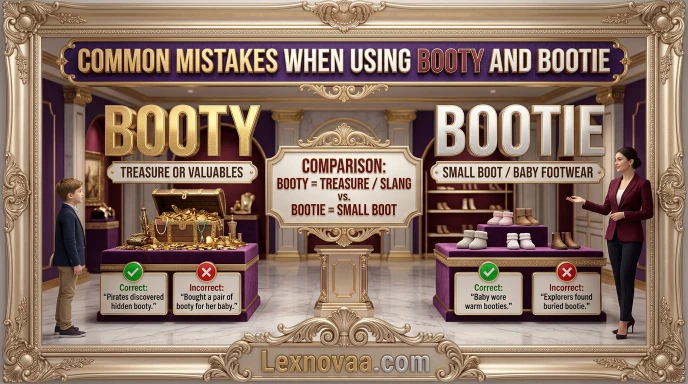
These words are easy to mix up. Here are common mistakes and ways to avoid them.
Mistake 1: Using Booty for Baby Shoes
Incorrect: She bought a pair of wool baby booty.
Correct: She bought a pair of wool baby booties.
Explanation: Booties is the plural form commonly used for small shoes. Booty does not normally mean baby footwear.
Memory tip: Baby shoes are booties.
Mistake 2: Using Bootie for Pirate Treasure
Incorrect: The pirates divided the bootie.
Correct: The pirates divided the booty.
Explanation: Booty is the established word for treasure or valuable goods captured during a raid or war.
Memory tip: Pirates search for booty.
Mistake 3: Assuming Booty Is Always Slang
Incorrect: Booty only means a person’s buttocks.
Correct: Booty can mean treasure or, informally, a person’s buttocks.
Explanation: The word has more than one meaning. The surrounding sentence tells readers which meaning is intended.
Memory tip: Think of treasure first, then remember the informal slang meaning.
Mistake 4: Using Booty in a Fashion Product Title
Incorrect: Women’s Black Leather Booty
Correct: Women’s Black Leather Booties
Explanation: When describing short boots, booties is the appropriate footwear term. A product title should make the item clear to shoppers.
Memory tip: If it is a shoe, use bootie.
Mistake 5: Treating the Words as Different Regional Spellings
Incorrect: Booty is American English, while bootie is British English.
Correct: Both spellings are used in British and American English, but their common meanings differ.
Explanation: This is a difference in meaning, not a simple US-versus-UK spelling rule.
Memory tip: Choose by meaning, not by country.
Everyday Examples of Booty and Bootie
Here are examples that show how both words work in different situations.
1. Email Examples
Footwear:
Subject: Baby Clothing Order
Hello,
I have ordered two pairs of knitted baby booties. Please confirm the delivery date.
Thank you.
Treasure:
The historical report describes the booty recovered after the battle.
2. Business Writing
The footwear company has added leather ankle booties to its autumn collection.
The historical report explains how soldiers divided the booty after the conflict.
3. News Headlines
- History: Researchers Discover Valuable Booty From an Old Shipwreck
- Fashion: New Collection Features Stylish Ankle Booties
- Retail: Baby Booties Become a Popular Gift for New Parents
4. Blog Examples
- How to Choose Comfortable Ankle Booties for Everyday Wear
- The History of Pirate Booty in Adventure Stories
- A Simple Guide to Knitting Baby Booties
5. Social Media Examples
- These knitted baby booties make a lovely handmade gift.
- A new pair of ankle booties can complete a casual outfit.
- The adventure story follows pirates searching for hidden booty.
6. Academic Writing
The term booty has historically referred to goods captured during war or raids.
The article examines the design and practical use of traditional baby booties.
7. Daily Conversation
A: What did the pirates find?
B: They found a chest full of booty.
A: What did you buy for the baby?
B: A pair of soft booties.
These examples show why the context matters. The words may sound alike, but the meaning changes with the spelling.
Google Trends and Modern Usage
Both booty and bootie remain in modern English, but they appear in different contexts.
Booty is used in historical stories, pirate-themed entertainment, and informal speech. Its slang meaning also appears in music, popular culture, and casual conversation.
Bootie is common in fashion and shopping, especially in phrases such as baby booties, ankle booties, and winter booties.
People search for booty or bootie because:
- The two words sound almost identical.
- They want to describe footwear correctly.
- They have seen both spellings online.
- They are unsure which spelling belongs in a sentence.
- They want to understand the slang and historical meanings of booty.
Search interest may vary by region and season. For example, searches for baby or winter footwear can change with shopping seasons, while searches about slang or treasure may be linked to entertainment and general vocabulary.
No exact Google Trends figures are claimed here because a live comparison has not been verified. The discussion above reflects general English usage rather than measured search-volume data.
The simplest rule remains useful: booty usually means treasure or buttocks, while bootie usually means a small boot.
Quick Comparison Table: Booty vs Bootie
| Version | Meaning | Correct? | Region | Example |
| Booty | Treasure or captured goods | Yes | British, American, and international English | The pirates found booty. |
| Booty | Informal slang for buttocks | Yes | British, American, and international English | The word is used as slang. |
| Bootie | Small boot or soft shoe | Yes | British, American, and international English | The baby wore booties. |
| Booties | Small boots or soft shoes | Yes | British, American, and international English | She knitted baby booties. |
| Booty | Small shoe | Not the usual meaning | All major varieties | Use bootie instead. |
| Bootie | Pirate treasure | Not the usual meaning | All major varieties | Use booty instead. |
Key Takeaways
- Booty and bootie are both correct English words.
- Booty commonly means treasure or valuable goods.
- Booty can also mean buttocks in informal slang.
- Bootie usually means a small boot or soft shoe.
- Baby booties is a common phrase for soft infant footwear.
- Both words are used in British and American English.
- The difference is mainly about meaning, not regional spelling.
- Always use the surrounding context to choose the right word.
FAQs
1. Is it spelled booty or bootie?
Both spellings are correct, but they have different common meanings. Booty usually refers to treasure, valuable goods, or buttocks in informal slang.
Bootie usually refers to a small boot or soft shoe. Choose the spelling that matches the meaning you want to express.
2. What is the difference between booty and bootie?
Booty commonly means treasure or is used as informal slang for buttocks. Bootie generally means a small boot, such as a baby shoe or a short fashion boot. The words sound similar, but they are not interchangeable in these meanings.
3. Does booty mean buttocks?
Yes. In informal English, booty can mean a person’s buttocks. This meaning is common in casual conversation and popular culture. However, the word also has an older meaning: treasure or valuable goods captured during a raid or war. The intended meaning depends on the context.
4. Is bootie another word for a baby shoe?
Yes. Bootie is commonly used for a small, soft shoe worn by a baby. Baby booties are often made from wool, cotton, or other soft materials. The plural form is booties. The word can also describe short fashion boots.
5. Is booty or bootie correct in American English?
Both are correct in American English. Use booty for treasure or informal slang, and use bootie for small footwear.
American retailers often use ankle booties to describe short boots. The correct spelling depends on what you are talking about.
6. Is booty or bootie correct in British English?
Both words are used in British English with similar meanings to their American English uses. Booty means treasure or informal slang for buttocks, while bootie refers to a small boot or soft shoe. British fashion retailers may also use the phrase ankle boots.
7. What is the plural of bootie?
The standard plural of bootie is booties. For example, “She knitted two pairs of baby booties.” The plural of booty is usually booties when referring to separate examples of the slang meaning, but the treasure meaning is generally used as an uncountable or collective noun in ordinary sentences.
8. Is booty a formal or informal word?
It depends on the meaning. Booty can be used in historical or formal writing to describe treasure or goods captured during war.
Its meaning as slang for buttocks is informal and is usually unsuitable for professional or academic writing unless the slang itself is being discussed.
9. What are ankle booties?
Ankle booties are short boots that generally cover the foot and reach around the ankle. They are sold in different styles, materials, and heel heights.
The term is common in fashion and retail writing, especially in American English. In other contexts, the simpler term ankle boots may be preferred.
10. How can I remember the difference between booty and bootie?
Use this simple memory trick: pirates look for booty, while babies wear booties. The first word usually means treasure or informal slang for buttocks.
The second usually means small footwear. Connecting each spelling with a familiar example makes the difference easier to remember.
Conclusion
The difference between booty or bootie comes down to meaning. Booty is the usual spelling when you mean treasure, valuable goods, or buttocks in informal slang.
Bootie is the usual spelling when you mean a small boot or soft shoe, such as baby footwear or a short fashion boot.
Both words are correct in British and American English. Neither is simply the regional spelling of the other.
The best way to choose is to consider the subject of your sentence. If you are writing about pirates or treasure, choose booty. If you are describing shoes, choose bootie.
Once you learn these meanings, the choice becomes easy. Pirates find booty, and babies wear booties.
For more simple explanations of confusing English words, spelling differences, and grammar comparisons, visit Lexnovaa.com.
EXPLORE MORE ARTICLE CLICK HERE NOW!
- Franchisor or Franchisee: What’s the Difference?
- Acception or Exception: Which Spelling Is Correct?
- Then or Than: What’s the Difference and When to Use Each?

I’m Orin Blake, a writer with a passion for making English grammar simple, practical, and easy to understand. I enjoy breaking down confusing words, spelling differences, and everyday language questions into clear, reader-friendly guides. My goal is to help students, professionals, and curious learners write with greater confidence and accuracy.