Starting a franchise business can be an exciting way to enter the world of business. But before signing an agreement or investing money, it is important to understand the roles of a franchisor and a franchisee.
Although these words look and sound similar, they describe two different parties in a business relationship.
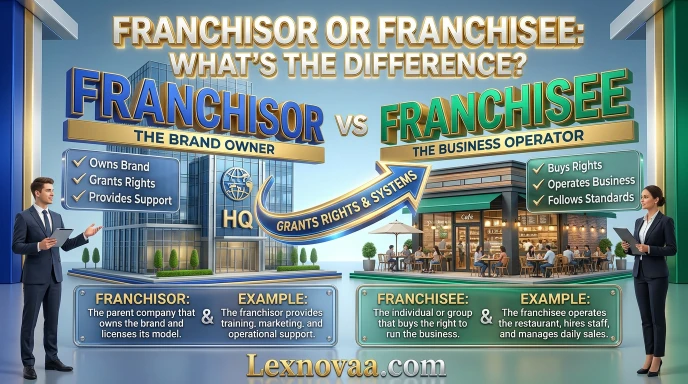
The main difference between a franchisor or franchisee is that the franchisor owns the brand and grants another person or business permission to use its business model, while the franchisee pays for that right and operates a business under the franchisor’s brand.
In simple terms, the franchisor provides the franchise opportunity, and the franchisee runs the local business.
People often confuse these terms because both are involved in the same franchise agreement. However, they have different rights, duties, costs, and responsibilities.
Understanding the distinction can help business owners, students, investors, and anyone researching franchise opportunities use these terms correctly.
This guide explains what each word means, how the relationship works, and how to remember which party does what.
Franchisor or Franchisee: The Difference Explained
A franchisor is the company or person that owns a brand, business system, or trademark and allows others to operate using it under a franchise agreement.
A franchisee is the person or company that receives those rights, pays the required fees, and operates a business according to the agreement.
For example, if a restaurant company allows an independent business owner to open a restaurant using its name, recipes, and operating system, the company is the franchisor and the business owner is the franchisee.
Franchisor or Franchisee: Quick Answer
The words franchisor and franchisee describe opposite sides of a franchise relationship.
- Franchisor: The brand owner that grants franchise rights.
- Franchisee: The individual or business that receives those rights and operates the franchise.
For example:
- A company that allows others to open stores under its brand is a franchisor.
- A person who pays to open one of those stores is a franchisee.
- The franchise agreement explains the rights and responsibilities of both parties.
Easy way to remember: The franchisor gives the franchise opportunity; the franchisee receives it.
What Does Franchisor or Franchisee Mean?
Although the two words share the same root, their meanings are different. The endings help identify each party’s role.
What Does Franchisor Mean?
A franchisor is a person or company that owns a business brand or franchise system and gives another party permission to operate under it.
The franchisor usually provides access to important business assets, such as:
- Brand name and trademarks
- Business methods and operating systems
- Training and guidance
- Marketing materials
- Product or service standards
- Ongoing support, as agreed
The franchisor may also set rules about how the franchise location should operate. These rules help keep the brand consistent across different locations.
Example: A company owns a chain of coffee shops. It allows another business owner to open a location using its name and business model. The company is the franchisor.
What Does Franchisee Mean?
A franchisee is a person or business that receives permission to operate using the franchisor’s brand and business system.
The franchisee normally pays an initial franchise fee and may also pay ongoing royalties or other charges. In return, the franchisee receives the rights and support described in the franchise agreement.
A franchisee’s responsibilities may include:
- Paying franchise fees and royalties
- Managing daily business operations
- Hiring and supervising staff
- Following brand standards
- Maintaining product or service quality
- Meeting the terms of the franchise agreement
Example: A business owner pays a coffee shop company for the right to open a location under its brand. That owner is the franchisee.
Franchisor vs Franchisee: Main Roles
| Feature | Franchisor | Franchisee |
| Main role | Grants franchise rights | Receives franchise rights |
| Brand ownership | Owns or controls the brand rights | Uses the brand under permission |
| Business system | Develops or controls the system | Follows the agreed system |
| Initial fee | May receive the fee | Usually pays the fee |
| Royalties | May collect royalties | May pay royalties |
| Training | Often provides training | Usually receives training |
| Daily operations | Sets standards and provides support | Usually manages the location |
| Agreement | Grants rights under the contract | Accepts contractual duties |
The exact arrangement depends on the franchise agreement and the laws that apply.
The Origin of Franchisor and Franchisee

Both words come from the word franchise, which has a long history in English.
The word franchise entered English through Old French. It is linked to the idea of freedom, privilege, or a special right. Over time, its meaning developed to include the granting of certain rights or permissions.
In modern business, a franchise is a commercial arrangement in which one party grants another party the right to use a brand, business model, or operating system under agreed conditions.
The words franchisor and franchisee developed to identify the two sides of this relationship:
- Franchisor: The party that grants the rights.
- Franchisee: The party that receives the rights.
The endings also follow a familiar pattern in English. The suffix -or often identifies a person or organization that performs an action, while -ee often identifies the person who receives the action or is involved as its recipient.
You can see a similar pattern in other word pairs:
| Word | Meaning |
| Employer | The person or company that hires |
| Employee | The person who is hired |
| Lessor | The party that leases property to another |
| Lessee | The party that receives the lease |
| Franchisor | The party that grants franchise rights |
| Franchisee | The party that receives franchise rights |
This pattern is a useful memory aid, although the exact legal meaning of each term depends on its context.
British English vs American English
There is no meaningful spelling or definition difference between franchisor and franchisee in British and American English.
Both terms are used in the United States, the United Kingdom, Canada, Australia, and other English-speaking markets. Their business meanings remain the same.
| Language or Region | Franchisor | Franchisee | Example |
| British English | Correct | Correct | The franchisor approved a new franchisee. |
| American English | Correct | Correct | The franchisee signed the agreement. |
| Canadian English | Correct | Correct | The franchisor provides training. |
| Australian English | Correct | Correct | The franchisee manages the store. |
| International English | Correct | Correct | Both parties must follow the contract. |
Are There Any Regional Differences?
No major regional differences affect the meaning of these words. A franchisor in the United States performs the same basic role as a franchisor in the United Kingdom.
However, franchise laws and disclosure requirements can differ between countries. For example, the United States has federal franchise disclosure rules, while other countries may use different legal frameworks.
These legal differences do not change the basic definitions of the two terms.
Which Version Should You Use?
You should use franchisor when referring to the party that grants franchise rights. Use franchisee when referring to the party that receives those rights and operates the business.
Your choice does not depend on your country. It depends on the role of the person or company.
United States
Both terms are standard in American business writing. Use franchisor for the brand owner and franchisee for the business operator.
For legal and investment matters, consult the relevant franchise disclosure documents and applicable federal and state requirements.
United Kingdom
Both terms are also standard in British English. British business documents use them to describe the two parties in a franchise arrangement.
The British spelling does not change either word.
Canada
Canadian businesses use franchisor and franchisee in the same way. However, franchise laws and disclosure requirements can vary by province.
Australia
Both terms are commonly used in Australian franchise agreements and business discussions. The franchisor grants the rights, while the franchisee operates under the agreed system.
International Writing
For international readers, use both terms consistently. Explain each role the first time it appears, especially if your audience is unfamiliar with franchise businesses.
Academic Writing
In academic work, define both terms clearly before discussing franchise systems, business ownership, or commercial relationships. Use reliable legal and business sources.
Business Writing
In contracts, reports, emails, and business proposals, choose the term that correctly identifies the party’s role. Avoid using the words as if they mean the same thing.
Common Mistakes When Using Franchisor and Franchisee
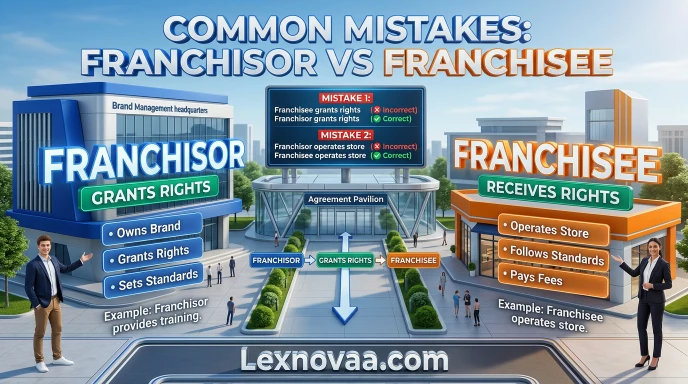
Because these words look similar, people sometimes switch them by mistake. Here are common errors and how to correct them.
Mistake 1: Calling the Business Owner the Franchisor
Incorrect: The franchisor paid the company to open a new restaurant.
Correct: The franchisee paid the company to open a new restaurant.
Explanation: The person paying for the right to operate the restaurant is the franchisee. The company granting those rights is the franchisor.
Memory tip: The franchisee receives the opportunity.
Mistake 2: Calling the Brand Owner the Franchisee
Incorrect: The franchisee allowed another person to use its brand.
Correct: The franchisor allowed another person to use its brand.
Explanation: The franchisor grants permission to use the brand. The franchisee receives that permission.
Memory tip: The franchisor gives; the franchisee gets.
Mistake 3: Assuming Both Words Mean Business Partners
Incorrect: The franchisor and franchisee are simply two names for the same business owner.
Correct: The franchisor and franchisee are two separate parties with different roles in a franchise relationship.
Explanation: They work together under a contract, but they do not have identical responsibilities or rights.
Memory tip: Think of them as the provider and the recipient.
Mistake 4: Confusing Franchisee With Employee
Incorrect: A franchisee is an employee of the franchisor.
Correct: A franchisee is generally an independent business operator under a franchise agreement.
Explanation: A franchisee is not automatically an employee. The legal relationship depends on the contract and applicable law.
Memory tip: A franchisee operates a business, not simply a job.
Mistake 5: Using the Terms Without Explaining Them
Unclear: The franchisor contacted the franchisee about the new location.
Clearer: The brand-owning company (the franchisor) contacted the local business operator (the franchisee) about the new location.
Explanation: When writing for general readers, define unfamiliar business terms the first time you use them.
Memory tip: Introduce the roles before discussing their responsibilities.
Everyday Examples of Franchisor and Franchisee
The best way to understand these terms is to see how they work in everyday business situations.
1. Email Example
Subject: Franchise Agreement Approval
Hello,
The franchisor has approved the franchisee’s application to open a new location. The franchisee will receive training before the business begins operating.
Best regards,
The first party grants the rights, while the second party receives them.
2. Business Writing Example
The franchisor will provide brand guidelines and operating support. The franchisee will manage the local location and follow the standards listed in the franchise agreement.
3. News Headline Example
Franchisor Announces Plans to Expand Its Restaurant Network
In this headline, the franchisor is the company expanding its brand through additional franchise locations.
4. Blog Example
Before investing in a franchise, a potential franchisee should review the franchisor’s business model, costs, support services, and contract terms.
5. Social Media Example
Thinking about opening a franchise? Research the franchisor carefully, understand the fees, and review your responsibilities as a franchisee.
6. Academic Writing Example
A franchise relationship involves two primary parties: the franchisor, which grants permission to use its business system, and the franchisee, which operates under the terms of the agreement.
7. Daily Conversation Example
A: Who owns the brand?
B: The franchisor owns or controls the brand rights.
A: And who runs the local store?
B: The franchisee usually operates it.
These examples show that the words are not interchangeable. Each one identifies a different side of the business relationship.
Google Trends and Modern Usage
Both franchisor and franchisee are established terms in modern business English. They appear in discussions about business ownership, investment, restaurant chains, retail stores, service companies, and franchise agreements.
People often search for franchisor or franchisee because the words look similar and have closely related meanings.
New business owners may also need to understand which role they would occupy before entering a franchise agreement.
Common search questions include:
- What is the difference between a franchisor and a franchisee?
- Who owns the franchise?
- Who pays the franchise fee?
- Does a franchisee own the brand?
- What does a franchisor provide?
- What are the responsibilities of a franchisee?
Search interest can vary by country, industry, and business activity. However, no exact Google Trends figures are presented here because a live Trends comparison has not been verified for this article.
The important point is that both words remain relevant in business, legal, and educational writing. Their meanings have not changed simply because franchise models have expanded into new industries.
Quick Comparison Table: Franchisor vs Franchisee
| Version | Meaning | Correct? | Role | Example |
| Franchisor | Party that grants franchise rights | Yes | Brand owner or rights provider | The franchisor approved the application. |
| Franchisee | Party that receives franchise rights | Yes | Franchise operator | The franchisee opened a new location. |
| Franchisor | Party that receives franchise rights | No, incorrect meaning | Not the recipient | Use franchisee instead. |
| Franchisee | Party that grants franchise rights | No, incorrect meaning | Not the rights provider | Use franchisor instead. |
Both words are correct. The mistake happens when a writer assigns the wrong role to either word.
Key Takeaways
- Franchisor refers to the person or company that grants franchise rights.
- Franchisee refers to the person or business that receives those rights.
- The franchisor usually owns or controls the brand and business system.
- The franchisee usually pays fees and operates a location under the agreement.
- Both words are correct in British, American, Canadian, and Australian English.
- Their meanings do not change based on regional spelling.
- A franchise agreement explains the rights and duties of both parties.
- Remember: the franchisor gives, and the franchisee receives.
FAQs
1. What is the main difference between a franchisor and a franchisee?
A franchisor owns or controls a brand and grants another party permission to use its business model. A franchisee receives those rights and operates a business under the brand.
The franchisor provides the franchise opportunity, while the franchisee usually pays fees and manages the local operation according to the agreement.
2. Is the franchisor the owner of the franchise?
The franchisor generally owns or controls the brand, trademarks, and business system offered through the franchise.
However, the franchisee may own and operate the individual business location. The exact ownership rights depend on the contract and applicable law, so owning the brand and owning a local franchise business are not necessarily the same thing.
3. Who pays the franchise fee, the franchisor or franchisee?
The franchisee usually pays the initial franchise fee to the franchisor in exchange for the rights granted under the franchise agreement.
The franchisee may also pay ongoing royalties, advertising contributions, or other agreed charges. The amount and payment terms depend on the franchise system and contract.
4. Can a franchisee become a franchisor?
Yes. A successful franchisee may eventually develop and own a separate business system and offer franchise opportunities to other people.
However, simply operating a franchise does not automatically make someone a franchisor. They must establish a business model and have the legal rights and arrangements needed to grant franchises.
5. Does a franchisee own the brand name?
Usually, no. The franchisor owns or controls the brand name and grants the franchisee permission to use it under specific conditions.
The franchisee can operate using that name but does not automatically gain ownership of the trademark. The franchise agreement explains how the brand may be used and protected.
6. Is a franchisee an employee of the franchisor?
A franchisee is generally an independent business operator rather than an employee of the franchisor.
The franchisee runs the local business under a contractual arrangement. However, legal classification can depend on the actual relationship, the contract, and local laws. The word franchisee alone does not settle every legal question.
7. What are the main responsibilities of a franchisor?
A franchisor generally grants brand rights, provides the agreed business system, and may offer training, marketing materials, and ongoing support.
It also sets standards to protect brand consistency. Its exact duties depend on the franchise agreement and applicable franchise laws.
8. What are the main responsibilities of a franchisee?
A franchisee usually pays the required fees, operates the local business, manages staff, and follows the franchisor’s brand and operating standards.
The franchisee may also handle local marketing, customer service, and daily expenses. Specific duties are set out in the franchise agreement.
9. Are franchisor and franchisee used in British and American English?
Yes. Both words are standard in British and American English, as well as Canadian and Australian English.
Their spelling and basic meanings remain the same across these varieties. The terms describe the two parties in a franchise relationship, not different regional versions of the same word.
10. How can I remember the difference between franchisor and franchisee?
Remember this simple rule: the franchisor gives, and the franchisee receives. The franchisor grants permission to use a brand or business system.
The franchisee receives that permission and operates the business under the agreement. Thinking of one as the provider and the other as the recipient makes the distinction easier.
Conclusion
Understanding franchisor or franchisee is simple once you know what each party does. A franchisor is the person or company that grants the right to use a brand and business system.
A franchisee is the person or business that receives those rights and operates under the terms of a franchise agreement.
Both terms are correct in British and American English, and neither is an alternative spelling of the other. The difference is based on business roles, not regional preferences.
The franchisor generally provides the brand and system, while the franchisee manages the local business and meets the agreed responsibilities.
If you are reading a franchise contract, researching business ownership, or preparing an article, always check which party is giving the rights and which party is receiving them. This simple distinction will help you use both words accurately.
Remember: The franchisor grants the opportunity, and the franchisee operates the franchise.
For more clear explanations of commonly confused English words and grammar comparisons, visit Lexnovaa.com
EXPLORE MORE ARTICLE CLICK HERE NOW!
- Its or It’s: The Simple Grammar Rule That Makes the Difference
- Lying or Laying: Which Word Is Correct and Why?
- Me Either or Me Neither: Which Is Correct?

I’m Orin Blake, a writer with a passion for making English grammar simple, practical, and easy to understand. I enjoy breaking down confusing words, spelling differences, and everyday language questions into clear, reader-friendly guides. My goal is to help students, professionals, and curious learners write with greater confidence and accuracy.