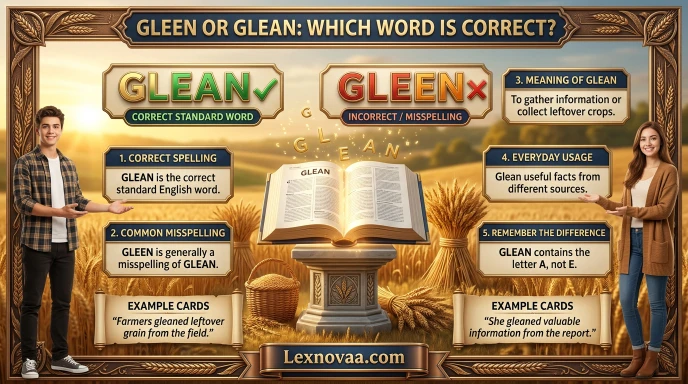
A small spelling mistake can change how clear your writing looks. If you are unsure if to write gleen or glean, the correct choice is glean.
The word glean is a standard English verb, while gleen is not a recognized standard spelling of the same word.
To glean means to gather information, facts, or useful details from different sources. It can also mean collecting leftover crops from a field after the main harvest.
You may see it in sentences such as “I gleaned useful information from the report” or “Farmers once allowed people to glean the fields.”
People often search for this spelling because the pronunciation can make the word difficult to spell. The letters ea can represent different sounds in English, which may lead some writers to use ee instead.
In this guide, you will learn what glean means, where it comes from, how to use it correctly, and how to avoid common spelling mistakes.
Gleen or Glean: The Correct Answer
Glean is the correct standard English spelling. It means to collect information, knowledge, or useful details gradually, often from different sources.
It can also mean gathering leftover crops after a harvest. Gleen is not a standard spelling of this verb, so use glean in formal, academic, and everyday writing.
Gleen or Glean : Quick Answer
Use glean, not gleen, when you mean to collect useful information or gather leftover crops.
Examples:
- I managed to glean several useful facts from the article.
- We can glean important lessons from past mistakes.
- Workers once gathered leftover grain from fields through a practice called gleaning.
Remember:
- Glean: Correct spelling.
- Gleen: Nonstandard spelling when intended to mean glean.
- Gleaned: Past tense and past participle.
- Gleaning: The act of collecting information or leftover crops.
What Does Gleen or Glean Mean?
The difference between gleen and glean is mainly a spelling issue. Only glean is the standard word for collecting or discovering something useful.
What Does “Glean” Mean?
Glean is a verb. It means to gather information, facts, knowledge, or useful details from different sources, often little by little.
For example:
- She gleaned useful advice from her teacher.
- We can glean several ideas from the research.
- He tried to glean the truth from the available evidence.
In these examples, someone collects information rather than receiving it all at once.
The word can also describe gathering leftover crops after a field has been harvested.
For example:
- Families were once allowed to glean the fields after the harvest.
- The workers returned to glean the remaining grain.
This older agricultural meaning is still found in historical, religious, and literary writing.
What Does “Gleen” Mean?
Gleen is not a standard English spelling of glean. If you use it to mean collecting information or leftover crops, readers will generally understand it as a spelling mistake.
For example:
- Incorrect: I want to gleen more information from this book.
- Correct: I want to glean more information from this book.
The correct spelling is glean, with the letters e-a.
What Does “Glean Information” Mean?
The phrase “glean information” means to collect useful details from sources such as books, reports, conversations, interviews, or observations.
It often suggests that the information is gathered gradually rather than given directly.
Examples:
- Researchers glean information from interviews.
- Students glean new ideas from reading.
- Journalists glean details from official reports.
- Businesses glean customer insights from feedback.
The phrase is common in academic, professional, and general writing.
Is “Glean” a Formal or Informal Word?
Glean is suitable for both formal and everyday writing. It is especially useful when you want to describe gathering information from several sources.
For example:
- Everyday: I gleaned a few tips from that video.
- Academic: The researchers gleaned insights from the survey responses.
- Business: The company gleaned useful feedback from its customers.
It can sound more precise than simply saying get or find information.
The Origin of Gleen or Glean

The word glean has an old agricultural history. Its meaning developed from gathering leftover crops to collecting information or knowledge.
Where Does the Word “Glean” Come From?
Glean entered English through Old French, from a word related to collecting ears of grain left behind after a harvest. Its deeper history is connected with the idea of gathering crops from a field.
Historically, gleaning was a practice in which people collected grain or other produce left in fields after the main harvest.
This meaning is still reflected in the modern use of the word.
How Did Its Meaning Change?
Over time, the meaning expanded beyond farming.
The basic idea of collecting small amounts remained the same. Instead of gathering leftover grain, people could gather small pieces of information, knowledge, or evidence.
Today, the word has two main uses:
- Agriculture: Collecting leftover crops after a harvest.
- Information: Gathering useful facts or knowledge from different sources.
For example, a person can glean information from a book just as someone once gleaned grain from a field.
Why Is “Gleen” a Common Spelling Mistake?
English spelling does not always match pronunciation. The letters ea can make different sounds in different words.
For example:
- Bread
- Great
- Speak
- Glean
Because English has many different vowel patterns, a writer may hear glean and guess that it should be spelled gleen.
However, the standard spelling is glean.
British English vs American English
There is no British-American spelling difference between glean and gleen. Glean is the correct standard spelling in both British and American English.
| Feature | British English | American English | Example |
| Correct spelling | Glean | Glean | Glean useful facts |
| Incorrect variant | Gleen | Gleen | Not standard for this meaning |
| Past tense | Gleaned | Gleaned | She gleaned information |
| Present participle | Gleaning | Gleaning | They are gleaning details |
| Noun form | Gleaning | Gleaning | Gleaning after harvest |
British English
British English uses glean to describe gathering information or collecting leftover crops.
Examples:
- We can glean useful details from the report.
- The villagers were allowed to glean the fields.
American English
American English uses the same spelling and meaning.
Examples:
- The team gleaned valuable information from the survey.
- Volunteers helped glean leftover produce from farms.
What About Canada and Australia?
Canadian and Australian English also use glean.
There is no special regional spelling for this word in these varieties.
Do Style Guides Recommend a Different Spelling?
No major regional spelling rule changes glean to gleen. Standard dictionaries recognize glean as the correct spelling.
For professional and academic writing, use glean and its standard forms:
- Glean
- Gleans
- Gleaned
- Gleaning
Which Version Should You Use?
The choice is simple because only one spelling is standard for this meaning.
United States
Use glean in American English.
Example: “We gleaned useful information from the customer survey.”
United Kingdom
Use glean in British English.
Example: “The students gleaned important details from the history book.”
Canada
Use glean in Canadian English. The spelling follows the same standard form used in the United States and United Kingdom.
Australia
Use glean in Australian English.
Example: “Researchers gleaned valuable insights from the interviews.”
International Writing
Use glean when writing for an international audience. It is the standard spelling across major English varieties.
Academic Writing
Glean is useful in research papers, essays, reports, and academic discussions.
Examples:
- The study allowed researchers to glean new insights.
- Students can glean information from primary sources.
- The findings help readers glean a better understanding of the topic.
Use it when you mean to gather information from evidence or sources.
Business Writing
The word is also suitable for professional communication.
Examples:
- We gleaned customer feedback from recent surveys.
- The team hopes to glean useful insights from the meeting.
- Managers can glean important trends from sales reports.
In business writing, it often works well when discussing research, customer feedback, and analysis.
Common Mistakes Of Gleen Or Glean
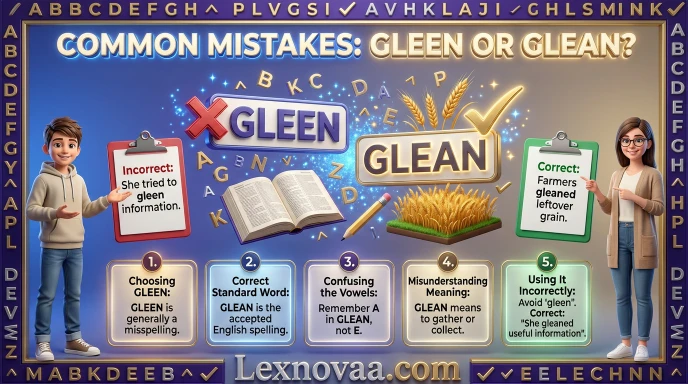
Writers sometimes confuse the spelling of glean or use it in a sentence where another word would be more suitable.
Mistake 1: Writing “Gleen” Instead of “Glean”
Incorrect: I need to gleen more information about this subject.
Correct: I need to glean more information about this subject.
Explanation: Glean is the standard verb. Gleen is not a standard alternative spelling.
Memory tip: Remember the EA in glean, just as you see it in words such as clean and dream.
Mistake 2: Using “Glean” When You Mean “Explain”
Incorrect: Can you glean this rule to me?
Correct: Can you explain this rule to me?
Explanation: Glean means to collect or discover information. Explain means to make something clear.
Memory tip: You glean information from a source, but you explain information to someone.
Mistake 3: Using the Wrong Past Tense
Incorrect: She gleened useful facts from the report.
Correct: She gleaned useful facts from the report.
Explanation: The past tense of glean is gleaned. Do not add an extra e before the past-tense ending.
Memory tip: Keep the base word glean and add -ed.
Mistake 4: Confusing “Glean” With “Clean”
Incorrect: I need to clean information from the article.
Correct: I need to glean information from the article.
Explanation: Clean means to remove dirt or make something clean. Glean means to collect useful information or details.
Memory tip: You clean a room, but you glean information.
Mistake 5: Assuming Glean Always Means Reading
Incorrect claim: You can only glean information from books.
Correct explanation: You can glean information from many sources, including conversations, interviews, observations, reports, videos, and research.
Memory tip: Think of glean as collecting useful details, no matter where they come from.
Quick Correction Table
| Incorrect | Correct | Explanation |
| Gleen information | Glean information | Correct spelling |
| Gleened facts | Gleaned facts | Correct past tense |
| Gleening details | Gleaning details | Correct -ing form |
| Clean information | Glean information | Different meanings |
| Gleaned the lesson to me | Explained the lesson to me | Different verb functions |
Everyday Examples of Glean
The word glean appears in many types of writing. It is especially useful when describing how someone gathers knowledge, facts, or insights.
1. Emails
“Thank you for sharing the report. I was able to glean several useful details from it.”
Another example:
“Could you send me the meeting notes? I would like to glean a few more details before the presentation.”
2. Business Writing
“The marketing team gleaned valuable customer insights from the latest survey.”
Another example:
“Managers can glean important information from monthly performance reports.”
3. News Headlines
“Researchers Glean New Insights From Climate Study”
Another example:
“Farmers Help Local Families Glean Leftover Crops”
The word works well in headlines about research, discoveries, and agriculture.
4. Blogs
“Here are five lessons you can glean from successful writers.”
Another example:
“Readers can glean practical advice from these simple grammar tips.”
5. Social Media
- “You can glean useful lessons from every experience.”
- “I managed to glean a few helpful tips from this video.”
- “What lessons have you gleaned from your recent projects?”
6. Academic Writing
“The researchers gleaned valuable information from interviews with local residents.”
Another example:
“Students can glean important details from historical documents.”
In academic writing, the word is useful when describing how researchers collect information from evidence.
7. Daily Conversation
Person A: How did you learn so much about the topic?
Person B: I gleaned a lot of information from books and videos.
Another example:
Person A: Did you understand the main idea?
Person B: Yes, I managed to glean the important points from the discussion.
Google Trends and Modern Usage
People search for gleen or glean because the spelling can be difficult to remember. The two forms may sound similar to some speakers, but only glean is the standard spelling for the meaning discussed in this article.
Why Do People Search for Gleen or Glean?
Common reasons include:
- Checking the correct spelling.
- Learning the meaning of glean.
- Understanding the phrase “glean information.”
- Checking the past tense and other word forms.
- Improving spelling in essays, reports, and emails.
How Is Glean Used Today?
The word is used in several modern contexts.
Education: Students glean facts from books, lessons, and research.
Business: Teams glean insights from surveys, reports, and customer feedback.
Journalism: Reporters glean details from interviews and official documents.
Technology: Analysts may glean information from digital records and data.
Agriculture: People can still use glean to describe collecting leftover crops after harvesting.
Is Glean a Common Word?
Glean is an established English word. It may be less common in casual conversation than simple alternatives such as get, collect, or find, but it is useful in writing when you want to express the idea of gathering information gradually.
What Does Google Trends Show?
Exact Google Trends data has not been verified for this article. Therefore, no search-volume figures or regional popularity claims are included.
The reliable usage rule is clear: glean is the standard spelling in British, American, Canadian, and Australian English.
Quick Comparison Table
| Version | Meaning | Correct? | Region | Example |
| Glean | Gather information or leftover crops | Yes | All major English varieties | We gleaned useful facts. |
| Gleen | Intended as a spelling of glean | No | Not standard | Gleen information |
| Gleaned | Past tense of glean | Yes | All major English varieties | She gleaned new insights. |
| Gleaning | Present participle or verbal noun | Yes | All major English varieties | They are gleaning information. |
| Gleans | Third-person singular form | Yes | All major English varieties | He gleans useful details. |
Key Takeaways
- Glean is the correct standard spelling.
- Gleen is not a standard spelling of the same word.
- To glean means to gather useful information, facts, or knowledge.
- It can also mean collecting leftover crops after a harvest.
- The word is used in academic, business, agricultural, and everyday contexts.
- Its past tense is gleaned, and its -ing form is gleaning.
- British, American, Canadian, and Australian English all use glean.
FAQs
1. Is it gleen or glean?
Glean is the correct spelling. It means to collect information, facts, or useful details from different sources.
It can also refer to gathering leftover crops after a harvest. Gleen is not a standard spelling of this word, so use glean in schoolwork, professional writing, and everyday communication.
2. What does glean mean?
To glean means to gather useful information, knowledge, or facts gradually, often from different sources.
It can also mean collecting crops left behind after a field has been harvested. For example, a student can glean information from a book, while workers can glean leftover grain from a field.
3. Is gleen a real English word?
Gleen is not a standard English spelling of the verb glean. You may encounter it as a typo or an unusual name, but it should not replace glean when you mean to collect information or leftover crops. In standard writing, use glean.
4. What does glean information mean?
“Glean information” means to collect useful facts or details from one or more sources. These sources might include books, reports, interviews, videos, or observations.
The phrase often suggests that someone gathers information gradually rather than receiving a complete explanation at once.
5. What is the past tense of glean?
The past tense of glean is gleaned. The past participle is also gleaned. For example, “She gleaned useful information from the report.” The spelling does not change between British and American English. Avoid writing gleened.
6. What is the difference between glean and collect?
Both words can describe gathering something, but glean often suggests gathering useful details or small amounts of information from different sources.
Collect is broader and can refer to almost anything gathered, such as books, coins, data, or objects.
7. Is glean formal or informal?
Glean is suitable for both formal and informal writing. It is especially common in academic, business, research, and professional contexts when discussing information or insights.
It can also appear in everyday conversation. For simple situations, words such as get or find may sound more natural.
8. Is glean used in British and American English?
Yes. Glean is the standard spelling in both British and American English. Canadian and Australian English use the same spelling as well.
Unlike some English words that have regional spelling variations, glean does not have a standard British or American alternative.
9. Can you glean information from a person?
Yes. You can glean information from a person’s words, actions, answers, or experiences. For example, “I gleaned useful advice from my teacher” means that you gathered helpful information from what the teacher shared. The word works with people as sources of information, not just books or reports.
10. What are synonyms for glean?
Common synonyms include gather, collect, obtain, discover, extract, learn, and acquire. The best choice depends on the sentence.
Gather and collect are broad alternatives, while discover may suggest finding something new. Glean is especially useful when information is gathered gradually from different sources.
Conclusion
When choosing between gleen or glean, always use glean for the meaning of gathering information, knowledge, or leftover crops. Gleen is not a standard spelling of this verb.
The word glean has an interesting history. It first referred to collecting crops left behind after a harvest.
Today, it is also widely used to describe gathering useful details from books, reports, interviews, research, and other sources.
Its spelling does not change between British and American English. The past tense is gleaned, while the present participle is gleaning.
These forms are useful in academic writing, business communication, journalism, and everyday conversation.
If you are unsure, remember the letters EA in glean. You glean information, but you do not “gleen” it.
One simple rule: Glean is correct, and gleen is a spelling mistake when used with this meaning.
For more easy explanations of confusing English words and spelling differences, visit Lexnovaa.com.
EXPLORE MORE ARTICLE CLICK HERE NOW!
- Franchisor or Franchisee: What’s the Difference?
- Edited or Editted: Which Spelling Is Correct?
- Dialled or Dialed: Which Spelling Is Correct?

I’m Orin Blake, a writer with a passion for making English grammar simple, practical, and easy to understand. I enjoy breaking down confusing words, spelling differences, and everyday language questions into clear, reader-friendly guides. My goal is to help students, professionals, and curious learners write with greater confidence and accuracy.