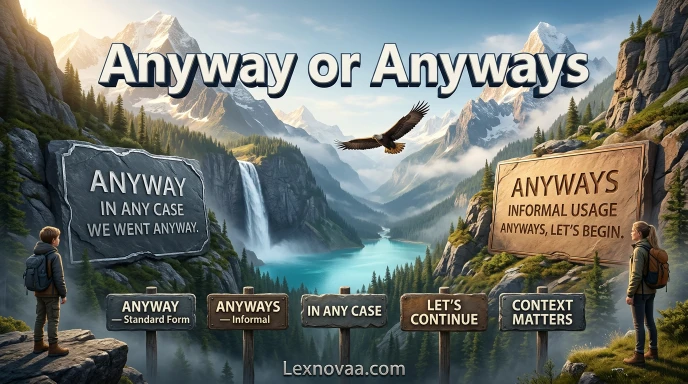
“Anyway” is the safer choice for all types of English writing, while “anyways” is common in informal speech and casual messages. Both forms are used in modern English, but they do not always suit the same situations. If you are writing an essay, business email, report, or formal article, choose “anyway.”
Many people search for “anyway or anyways” because they hear both words in daily conversation.
They may also see “anyways” in text messages, social media posts, videos, and online discussions. This can make it hard to tell if “anyways” is wrong or simply less formal.
The key difference is usage and tone, not a simple rule that one word exists and the other does not. “Anyway” is widely accepted in standard English.
“Anyways” is also used, especially in casual American and Canadian English, but some readers may consider it informal or nonstandard in edited writing.
In this guide, you will learn what both words mean, how they differ, where they came from, and when to use each one.
You will also find practical examples, common mistakes, and tips for choosing the right word in school, work, and everyday conversation.
Anyway or Anyways: The Short Answer
“Anyway” is the best choice in formal and informal writing. “Anyways” is also used in everyday speech and casual writing, especially in North American English, but it may sound less formal. Both can mean “in any case” or help return to a topic.
Examples:
- Anyway, let’s continue with the lesson.
- I was tired, but I went anyway.
- Anyways, what were you saying? (casual)
Anyway or Anyways: Quick Answer
Use anyway when you want a word that works in almost every setting. It can mean “in any case,” “despite that,” or “regardless.”
Use anyways mainly in casual conversation, informal messages, or dialogue that reflects how someone speaks.
- Formal: Anyway, we should review the report.
- Everyday: I didn’t really want to go anyway.
- Casual speech: Anyways, let’s talk about something else.
If you are unsure which form to choose, write “anyway.” It is the most widely suitable option.
What Do Anyway and Anyways Mean?
“Anyway” and “anyways” often carry the same meaning. The main difference is how they sound to readers and listeners.
What Does Anyway Mean?
“Anyway” is an adverb. It can mean “in any case,” “despite what happened,” or “regardless of the situation.”
It also helps a speaker return to the main point or move a conversation forward.
Examples:
- It was raining, but we went anyway.
- Anyway, let’s get back to the question.
- I don’t think the plan will work. We can try anyway.
- She was late, but the meeting started anyway.
In these examples, “anyway” shows that something happens despite a problem or helps shift the conversation.
What Does Anyways Mean?
“Anyways” is an informal variant of “anyway.” People often use it in conversation to mean “in any case” or to change the subject.
Examples:
- Anyways, what did you decide?
- I wasn’t going to buy it anyways.
- Anyways, we should head home.
These sentences are easy to understand. However, “anyways” can sound too casual in formal essays, reports, and professional emails.
Is Anyways Incorrect?
Not always. “Anyways” is used in modern English, especially in informal North American speech. It appears in casual conversations, online posts, and dialogue.
However, some teachers, editors, and style guides prefer “anyway,” even in places where “anyways” is common in speech. For formal writing, “anyway” is the more reliable choice.
What Is the Difference Between Anyway and Anyways?
The main difference is formality and editorial preference.
| Feature | Anyway | Anyways |
| Meaning | In any case; regardless | Usually the same meaning |
| Formal writing | Preferred | Often avoided |
| Casual conversation | Common | Common in some regions |
| Academic writing | Recommended | Usually not recommended |
| Business emails | Safe choice | Can sound too casual |
| General advice | Use by default | Use when an informal tone fits |
The Origin of Anyway and Anyways

The word “anyway” developed from the combination of “any” and “way.” The basic idea is that something happens “in any way” or “in any case,” regardless of other circumstances.
Over time, “anyway” became a common adverb in English. People use it to show that an action will continue despite a problem, or to move from one subject to another.
“Anyways” developed as a variant with an added “-s.” English has several adverbs and informal forms that end in “-s,” and speakers have used “anyways” for a long time. Its use is especially familiar in North American conversation.
The extra “s” does not create a major change in meaning. Instead, it often affects the tone. “Anyways” can sound more conversational, while “anyway” fits a wider range of writing.
The exact history of a word can involve changes across different periods and regions. For a detailed historical account, consult a historical dictionary such as the Oxford English Dictionary rather than relying on guesses about when the form first appeared.
British English vs American English
Both “anyway” and “anyways” are understood in British and American English. However, the two forms may differ in how often people use them and how formal they sound.
| British English | American English | Example |
| “Anyway” is the usual standard choice | “Anyway” is the usual standard choice | Anyway, we can try again. |
| “Anyways” may sound informal or nonstandard | “Anyways” is common in casual speech in some communities | Anyways, what happened next? |
| Formal writing generally favors “anyway” | Formal writing generally favors “anyway” | Anyway, the evidence supports the result. |
| Both forms are understandable | Both forms are understandable | I was going anyway. |
British English Usage
In British English, “anyway” is the normal choice in both formal and everyday writing. “Anyways” may appear in casual speech or dialogue, but it can sound informal to some readers.
Example: “Anyway, let’s finish the work before lunch.”
American English Usage
In American English, “anyway” is standard, while “anyways” is familiar in casual conversation. Its use varies by speaker, region, and personal style.
Example: “Anyways, I’ll see you tomorrow.”
This may sound natural in a casual chat, but “Anyway, I will see you tomorrow” is a safer choice for a professional email.
What About Style Guides?
Editors and publishers often prefer “anyway” because it works across formal and informal contexts. If your school, workplace, or publication has a style guide, follow its rule.
There is no need to change “anyway” to “anyways” to make writing sound more natural. A clear sentence and the right tone matter more than adding an “s.”
Which Version Should You Use?
The best choice depends on your audience and purpose. When you need one form that works almost everywhere, choose “anyway.”
United States
Use “anyway” in school assignments, professional emails, reports, and formal articles. “Anyways” can fit casual conversation or dialogue.
United Kingdom
Choose “anyway” for general writing. Use “anyways” only when the informal tone fits your audience or when you are representing natural speech.
Canada
“Anyway” is the safer choice in Canadian professional and academic writing. “Anyways” is also heard in informal conversation, but the preferred form can vary by speaker.
Australia
Use “anyway” as the standard option in formal and general writing. In casual speech, you may encounter “anyways,” but it is not necessary to use it.
International Writing
For readers from different countries, “anyway” is the clearest and safest option. It is widely understood and does not draw attention to an informal style.
Academic Writing
Use “anyway” if the word is suitable for your sentence. In more formal academic work, consider alternatives such as “nevertheless,” “in any case,” or “regardless,” depending on the meaning.
Example: “Nevertheless, the results support the original claim.”
Do not replace every use of “anyway” with a more formal word. Choose a phrase that fits the meaning.
Business Writing
In professional emails, reports, and presentations, “anyway” is usually best.
Casual: Anyways, I’ll send the file later.
Professional: Anyway, I will send the file later today.
You can also remove the word if it does not add meaning. For example, “I will send the file later today” is direct and professional.
Common Mistakes with Anyway and Anyways

Both forms appear in real communication, but writers can make mistakes when they choose a word that does not fit the situation.
Mistake 1: Using Anyways in a Formal Essay
Less suitable: Anyways, the experiment supports the theory.
Better: Anyway, the experiment supports the theory.
Why: “Anyway” is the more standard choice in edited academic writing. Depending on the sentence, “In any case” or “Nevertheless” may be more precise.
Memory tip: For schoolwork and formal writing, start with “anyway.”
Mistake 2: Assuming Anyways Is Always Wrong
Too strict: “Anyways” is never a real English word.
More accurate: “Anyways” is an informal variant used in modern English.
Why: People do use “anyways,” especially in casual speech. The issue is if it suits the context, not if readers can understand it.
Memory tip: Think of “anyways” as informal, not automatically meaningless.
Mistake 3: Adding an Extra “S” to Sound More Natural
Unnecessary: I will do it anyways.
Safer: I will do it anyway.
Why: The extra “s” does not make the sentence more correct or more natural for every audience. “Anyway” already expresses the intended meaning.
Memory tip: When in doubt, leave out the extra “s.”
Mistake 4: Using Anyway When a Clearer Connector Is Needed
Unclear: The sample was too small. Anyway, the results may not be reliable.
Clearer: The sample was too small. Therefore, the results may not be reliable.
Why: “Anyway” does not always show a clear cause-and-effect relationship. Words such as “therefore,” “however,” and “nevertheless” may express the intended link more accurately.
Memory tip: Choose the connector that matches the logic of the sentence.
Mistake 5: Overusing Anyway or Anyways
Repetitive: Anyway, I went anyway because I wanted to go anyway.
Better: I wanted to go, so I went despite the delay.
Why: Repeating the same word can make writing sound careless. Use it only when it adds meaning or helps the conversation move forward.
Everyday Examples of Anyway and Anyways
These examples show how the two forms work in different settings.
1. Daily Conversation
- Anyway, what were you saying?
- I was tired, but I went anyway.
- Anyways, are we still meeting tomorrow?
The third example sounds casual. The first two work in a wider range of situations.
2. Emails
Professional:
“Anyway, I have attached the updated report for your review.”
Casual:
“Anyways, I’ll send you the photos tonight.”
For most workplace emails, “anyway” is the better choice. You can often make the message even clearer by removing the word.
3. Business Writing
- Anyway, the team agreed to review the proposal.
- We should continue anyway, despite the delay.
- In any case, the budget needs another review.
The third example uses “in any case,” which can sound more formal.
4. News Headlines
- The Team Won Anyway Despite a Slow Start
- Anyway, the Debate Continues
- Why the Plan May Work Anyway
News headlines often use short, direct language. “Anyways” may appear in a quote or informal feature, but “anyway” is the safer editorial choice.
5. Blogs and Online Articles
- Anyway, let’s look at the next example.
- The first method did not work, but the second worked anyway.
- Anyways, here are three more tips.
The first two suit general online writing. The third has a more casual voice.
6. Academic Writing
- The results were limited, but they remain useful anyway.
- In any case, further research is needed.
- Nevertheless, the evidence supports the main conclusion.
“Anyway” can work in academic writing, but formal connectors may be more precise. Choose the phrase that best explains the relationship between your ideas.
7. Social Media
- Anyway, here’s the update you asked for.
- I was late, but I made it anyway.
- Anyways, who’s joining us tomorrow?
Social media allows a relaxed tone, so “anyways” may fit. Use “anyway” if you want a style that works for a wider audience.
Google Trends & Modern Usage
People search for “anyway or anyways” because they see both forms in conversation and online writing.
They want to know if the extra “s” changes the meaning, if one form is incorrect, and which version is suitable for school or work.
In general usage, “anyway” is the more reliable choice for standard edited writing. “Anyways” remains familiar in informal conversation and casual online communication, particularly in North America.
However, usage varies among speakers and communities, so it is best not to claim that every person in one country prefers one form.
No live Google Trends figures have been verified for this article. Therefore, no exact search volumes, country rankings, or percentage differences are claimed.
If you want to compare search interest, enter “anyway” and “anyways” in Google Trends. Select the regions and time period you want to examine.
Remember that Trends reports relative search interest, not grammar correctness or the number of people who use a word in everyday speech.
The practical lesson is simple: search popularity does not decide which form is best for a formal document. Your audience, tone, and purpose should guide that choice.
Quick Comparison Table
| Version | Meaning | Correct? | Region | Example |
| Anyway | In any case; regardless | Yes | International | Anyway, let’s continue. |
| Anyways | Usually the same as “anyway” | Used, mainly informally | Especially familiar in North American casual speech | Anyways, what’s next? |
| In any case | Regardless of the situation | Yes | International | In any case, we should check. |
| Nevertheless | Despite what was just stated | Yes | Formal and general writing | Nevertheless, the plan may work. |
| Regardless | Without being affected by something | Yes | International | We will continue regardless. |
Key Takeaways
- Anyway is the safest choice for formal and informal writing.
- Anyways is used in modern English, especially in casual conversation.
- The two forms usually have the same basic meaning.
- “Anyways” may sound too informal in academic or professional writing.
- British and American English both use “anyway.”
- For international readers, choose “anyway.”
- Use “nevertheless,” “regardless,” or “in any case” when they express your meaning more clearly.
FAQs
Is “anyway” or “anyways” correct?
Both forms are used, but “anyway” is the standard choice for most writing. “Anyways” is an informal variant that appears in casual conversation and messages. If you are writing an essay, business email, or article for a broad audience, choose “anyway” to avoid an overly casual tone.
Is “anyways” grammatically wrong?
“Anyways” is not simply an invented word. It is used in modern English, often in informal speech. However, some editors, teachers, and style guides prefer “anyway” in standard writing. The best choice depends on the context, audience, and level of formality.
Should I use anyway or anyways in an essay?
Use “anyway” in most essays. It is widely accepted and sounds more suitable for edited writing. If you need to show contrast or a logical result, a word such as “nevertheless,” “however,” or “therefore” may be clearer. Always choose the connector that matches your meaning.
Do Americans say “anyways”?
Yes. “Anyways” is familiar in casual American English, although individual preferences vary. Many Americans also use “anyway” in both speech and writing.
In formal American writing, “anyway” is generally the safer choice because it is standard and widely accepted.
Is “anyway” more British than American?
No. “Anyway” is common in both British and American English. “Anyways” may sound more familiar in some North American casual settings.
but it is not limited to one country. For formal writing in either variety, “anyway” is the recommended option.
What is the difference between anyway and anyways?
The main difference is tone and usage. Both usually mean “in any case” or “regardless,” but “anyway” is more widely suitable for formal writing. “Anyways” is more conversational and may sound informal to some readers. In many everyday sentences, the meaning stays the same.
Can I start a sentence with anyway?
Yes. You can start a sentence with “anyway” when you want to return to a topic, move the conversation forward, or show that something will happen despite a problem.
For example, “Anyway, let’s review the final question.” In formal writing, check that the word creates a clear link between ideas.
What are some formal alternatives to anyway?
Depending on the meaning, you can use “in any case,” “nevertheless,” “regardless,” or “even so.” These phrases are not perfect substitutes in every sentence.
For example, “nevertheless” often shows contrast, while “regardless” emphasizes that something will happen despite a condition.
Is “anyways” acceptable in a text message?
Yes. “Anyways” can fit a casual text message, especially when you are writing the way you speak. For example, “Anyways, see you later!”
sounds conversational. If you are messaging a teacher, client, manager, or someone you do not know well, “anyway” may be a safer choice.
Does anyway mean the same as nevertheless?
Not always. “Anyway” can mean “in any case” or show that something happens despite a problem. “Nevertheless” more clearly signals contrast, meaning “despite what was just stated.”
For example, “It was difficult; nevertheless, we finished” makes the contrast more explicit than “It was difficult, but we finished anyway.”
Conclusion: Choose Anyway for Clear, Correct Writing
When deciding between “anyway” and “anyways,” choose “anyway” for the clearest and safest option. It works in formal writing, casual messages, school assignments, business emails, and international communication.
“Anyways” is also used in modern English, especially in casual conversation, but it may sound informal to some readers.
Both forms usually express the same idea. They can mean “in any case,” “regardless,” or help a speaker return to the main topic. The difference is mainly about tone and editorial preference, not a major change in meaning.
If you are writing dialogue or a relaxed social media post, “anyways” may fit the voice you want. For essays, reports, and professional messages, “anyway” is the better default.
When a sentence needs a more exact link between ideas, consider alternatives such as “however,” “nevertheless,” or “in any case.”
Remember: “anyway” works almost everywhere, so use it whenever you are unsure.
For more clear explanations of confusing English words and grammar choices, visit Lexnovaa.com.
DISCOVER MORE ARTICLE CLICK HERE NOW!
- Into or In To? Learn the Difference With Easy Examples
- Their or There? Learn the Difference With Simple Examples
- Your or You’re: Difference and Stop Making This Common Mistake

I’m Orin Blake, a writer with a passion for making English grammar simple, practical, and easy to understand. I enjoy breaking down confusing words, spelling differences, and everyday language questions into clear, reader-friendly guides. My goal is to help students, professionals, and curious learners write with greater confidence and accuracy.