Choosing a or an is one of the first grammar rules English learners study. Yet even confident writers can make mistakes with words like hour, university, and honest.
The reason is simple: the correct article depends on the first sound of a word, not just its first letter.
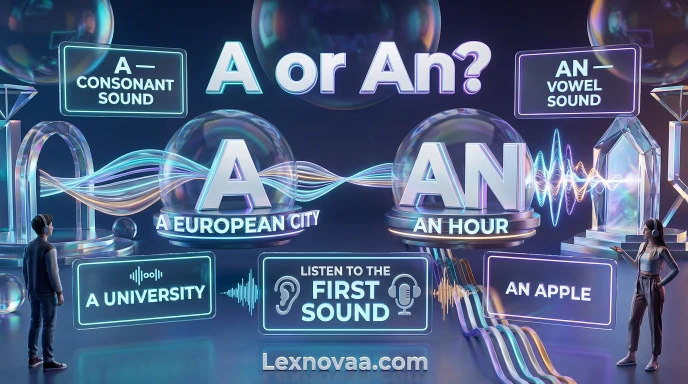
Use a before a consonant sound, as in a book or a university. Use an before a vowel sound, as in an apple or an hour. Once you understand this rule, choosing the right article becomes much easier.
Both a and an are called indefinite articles. They usually come before a singular countable noun when we talk about something in a general way or mention it for the first time.
For example, you might say, “I saw a bird” without telling the listener which bird you saw.
In this guide, you will learn the meaning of a and an, their origins, the differences between British and American English, and the rules for tricky words and abbreviations.
You will also find everyday examples, common mistakes, and simple tips to help you remember the correct form.
A or An: The Correct Answer in Simple English
Use a before a word that begins with a consonant sound. Use an before a word that begins with a vowel sound. The sound matters more than the spelling, so we say a university but an umbrella. We also say an hour because the h is silent.
A or An: Quick Answer
The rule for a or an is based on pronunciation.
- Use a before a consonant sound: a dog, a house, a European country.
- Use an before a vowel sound: an egg, an idea, an orange.
- Use an when the first letter is silent and the word begins with a vowel sound: an hour, an honest person.
- Use a when a word begins with a consonant sound, even if its first letter is a vowel: a university, a uniform.
Easy memory tip: Listen to the first sound you say, not the first letter you see.
What Do A and An Mean?
The words a and an are indefinite articles. They introduce a singular countable noun without identifying one specific person, place, thing, or idea.
For example:
- “I need a pen.” This means you need any suitable pen, not necessarily a particular one.
- “She ate an orange.” This introduces one orange without suggesting that the listener already knows which orange it was.
- “He wants to become a teacher.” This describes his intended profession.
Both articles have the same basic meaning. The difference is how they connect to the sound of the next word.
When Should You Use A?
Use a before a consonant sound. Common examples include:
- a car
- a student
- a house
- a one-time offer
- a useful tool
Notice that one-time begins with the letter o, but its opening sound is like the w in water. That is why a one-time offer is correct.
When Should You Use An?
Use an before a vowel sound. Common examples include:
- an apple
- an engineer
- an old house
- an MBA student
- an unusual idea
The phrase an MBA student is correct because the letter M is pronounced “em,” which begins with a vowel sound.
Do A and An Change the Meaning?
Usually, no. Both articles serve the same grammatical purpose. You choose one based on pronunciation, not because it has a different meaning.
Compare these examples:
- a teacher and an artist
- a European city and an Asian city
- a useful book and an interesting book
The nouns and their opening sounds determine which article to use.
The Origin of A and An

The English articles a and an developed from the Old English word ān, which meant “one.” Over time, the word changed in form and use as English developed.
As people spoke, the article often appeared in a shorter form before words that began with consonant sounds. The form a became common in those positions, while an remained before vowel sounds. This pattern also helped speech flow more smoothly.
Today, the two forms follow a simple pronunciation rule. The rule is not based on if a noun starts with a vowel letter. It depends on if the first spoken sound is a vowel or a consonant.
This history helps explain why English has phrases such as a house and an hour. In house, the h is pronounced. In hour, the h is silent, so the word begins with a vowel sound.
British English vs American English
The basic rule for a or an is the same in British and American English. Both varieties use the sound of the next word to choose the article.
| Word or phrase | British English | American English |
| Apple | an apple | an apple |
| University | a university | a university |
| Hour | an hour | an hour |
| European country | a European country | a European country |
| Historic event | a historic event / an historic event in some styles | usually a historic event |
| MBA student | an MBA student | an MBA student |
Is It A Historic Event or An Historic Event?
Both forms appear in English, but a historic event is widely used in modern British and American writing. Some speakers and style traditions use an historic event, especially when the h is weak or not pronounced.
For most readers, the safest choice is to follow the pronunciation you use and the style guide required by your school, publisher, or workplace.
Do British and American Pronunciations Affect A or An?
They can, especially when accents differ. However, the standard examples in this guide remain the same in both varieties.
For formal writing, focus on the pronunciation of the word as you intend to say it. If a word begins with a clear consonant sound, choose a. If it begins with a vowel sound, choose an.
Which Version Should You Use?
The same rule works across major English-speaking regions. You do not need to learn separate rules for each country.
- United States: Use a before consonant sounds and an before vowel sounds.
- United Kingdom: Follow the same sound-based rule. Pay attention to words such as historic if your publisher has a preferred style.
- Canada: Use the same standard rule in academic, professional, and everyday writing.
- Australia: Apply the same rule and follow the pronunciation used in your sentence.
- International writing: Choose the form that sounds natural when the word is spoken clearly.
- Academic writing: Follow your institution’s style guide and remain consistent.
- Business writing: Use the standard form, such as a report, an update, a user account, and an email.
Best advice: Do not choose a or an based on nationality. Choose it based on the first sound of the following word.
Common Mistakes When Using A or An
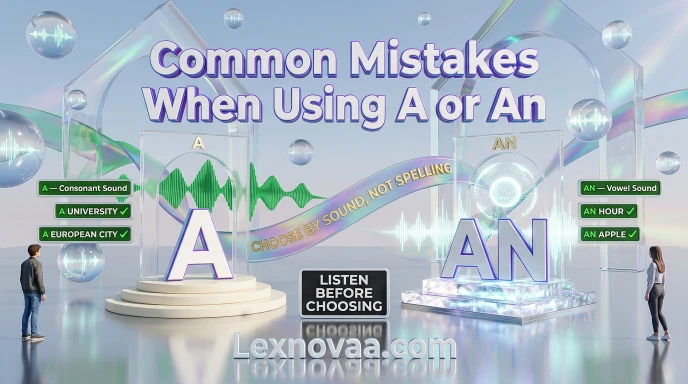
Many mistakes happen because writers look at the first letter instead of saying the word aloud. These examples show how to choose the correct article.
| Incorrect | Correct | Why? |
| an university | a university | The word begins with a “yoo” sound. |
| a apple | an apple | The word begins with a vowel sound. |
| a hour | an hour | The h is silent. |
| an useful idea | a useful idea | Useful begins with a “yoo” sound. |
| a honest man | an honest man | The h is silent. |
| an one-way street | a one-way street | One begins with a “w” sound. |
| a MBA student | an MBA student | The letter M is pronounced “em.” |
| an European country | a European country | European begins with a “y” sound. |
Mistake 1: Choosing By Spelling
A common error is to assume that every word beginning with a vowel letter needs an.
For example, university begins with u, but the first sound is /j/, like the y in yes. Therefore, a university is correct.
Mistake 2: Forgetting Silent Letters
Some words begin with a written consonant that is not pronounced.
- an hour
- an honest answer
- an honor
In each example, the h is silent in standard pronunciation, so an is the right choice.
Mistake 3: Ignoring Abbreviations
Abbreviations follow the same pronunciation rule as other words.
- an FBI agent because F is pronounced “ef”
- an X-ray because X is pronounced “ex”
- a USB cable because U is pronounced “you”
- a URL when pronounced “you-are-el”
Memory tip: Say the next word aloud. If it starts with a vowel sound, use an. If it starts with a consonant sound, use a.
Everyday Examples of A and An
The easiest way to learn this rule is to see it in real sentences. Here are examples from common writing situations.
1. Emails
- “I have a question about the meeting.”
- “Please send me an update by Friday.”
- “We need a response from the client.”
- “I received an email from the manager.”
2. Business Writing
- “The team prepared a report.”
- “We need an estimate before starting the project.”
- “She is a useful contact for this task.”
- “They hired an experienced designer.”
3. News Headlines
- “A Local School Opens a New Library”
- “An Unexpected Storm Delays Flights”
- “A European Team Wins the Final”
These examples show how the article works even when the writing is brief.
4. Blogs and Online Articles
- “Here is a simple way to improve your writing.”
- “An easy grammar rule can prevent many errors.”
- “Choose a suitable example for your lesson.”
5. Social Media
- “I found a great book today!”
- “An amazing opportunity just opened up.”
- “Looking for a new idea for my next project.”
6. Academic Writing
- “The study presents an analysis of the results.”
- “The researcher proposed a method for testing the theory.”
- “The experiment produced an unexpected result.”
7. Daily Conversation
- “Can I have a glass of water?”
- “I saw an owl in the tree.”
- “She bought a uniform for school.”
- “He waited for an hour.”
The article may be short, but choosing it correctly makes your English sound more natural.
Google Trends and Modern Usage
People search for a or an because the rule seems simple until they meet words that do not follow the spelling pattern they expect.
Questions such as a university or an university, a hour or an hour, and a MBA or an MBA reflect the same underlying confusion.
The rule remains standard in modern English. It applies to school assignments, business emails, websites, books, and everyday speech.
There is no need to claim that one article is more popular overall. A and an serve different sound patterns, so their frequency depends on the words people use.
Exact regional search-interest comparisons would require a dated Google Trends check for the relevant terms and location.
For writers and English learners, the most useful approach is to study common exceptions, listen to pronunciation, and check a trusted dictionary when a word is unfamiliar.
A or An: Quick Comparison Table
| Version | Meaning | Correct? | When to Use | Example |
| A | An indefinite article | Yes | Before a consonant sound | a book |
| An | An indefinite article | Yes | Before a vowel sound | an orange |
| A | An indefinite article | Yes | Before a vowel letter with a consonant sound | a university |
| An | An indefinite article | Yes | Before a silent h with a vowel sound | an hour |
| A | An indefinite article | Yes | Before a word beginning with a “w” sound | a one-way street |
| An | An indefinite article | Yes | Before an abbreviation beginning with a vowel sound | an FBI agent |
A or An: More Tricky Examples
| Phrase | Correct choice | Reason |
| ___ umbrella | an umbrella | Starts with a vowel sound |
| ___ uniform | a uniform | Starts with a “yoo” sound |
| ___ heir | an heir | The h is silent |
| ___ house | a house | The h is pronounced |
| ___ SOS message | an SOS message | S is pronounced “ess” |
| ___ NASA scientist | a NASA scientist | NASA is usually pronounced as a word beginning with a consonant sound |
Key Takeaways
- A comes before a consonant sound.
- An comes before a vowel sound.
- The first sound matters more than the first letter.
- Use a university and a useful idea because both begin with a “yoo” sound.
- Use an hour and an honest person because the h is silent.
- Abbreviations follow the same rule when spoken aloud.
- British, American, Canadian, and Australian English share the same basic rule.
- If you are unsure, say the phrase aloud and listen to its opening sound.
FAQs
1. Is it a or an before a vowel?
Use an before a vowel sound, as in an apple, an egg, and an idea. However, a vowel letter does not always create a vowel sound. For example, university begins with a “yoo” sound, so the correct phrase is a university.
2. Why do we say an hour instead of a hour?
We say an hour because the letter h is silent in the standard pronunciation of hour. The word begins with a vowel sound, so an is the correct article. Compare it with a house, where the h is pronounced.
3. Is it a university or an university?
The correct phrase is a university. Although university starts with the vowel letter u, its opening sound is /j/, like the y in yes. Since the word begins with a consonant sound, it takes a, not an.
4. Is it an honest person or a honest person?
The correct phrase is an honest person. The h in honest is silent, so the word begins with a vowel sound. This is why we also say an honor and an honesty test.
5. Should I use a or an before an abbreviation?
Choose the article based on how the abbreviation is pronounced. Write an FBI agent because F is pronounced “ef,” but use a USB drive because U is pronounced “you.” The same rule applies to initials, letters, and many shortened forms.
6. Is it a historic event or an historic event?
A historic event is the usual choice in modern American English and is also widely used in British English.
Some speakers and style traditions use an historic event, especially when the h is weak. Follow your publisher’s style guide if it specifies a preference.
7. Do a and an mean the same thing?
Yes. Both are indefinite articles used with singular countable nouns. They do not usually have different meanings. The choice depends on the sound that follows: a car and an automobile both refer to one vehicle, but the opening sounds require different articles.
8. Can I use a or an before an adjective?
Yes. When an adjective comes before a singular countable noun, choose the article based on the adjective’s first sound.
For example, write a beautiful flower and an unusual flower. The noun alone does not determine the choice when an adjective comes first.
9. Is it a MBA or an MBA?
The standard form is an MBA because the letter M is pronounced “em,” which begins with a vowel sound. For example, write, “She is pursuing an MBA.”
Always consider how an abbreviation is spoken rather than simply looking at its first written letter.
10. How can I remember when to use a or an?
Remember this short rule: listen to the sound, not the spelling. Use a before a consonant sound and an before a vowel sound.
Practise with tricky pairs such as a university and an umbrella, or a house and an hour, until the choice feels natural.
Conclusion: A or An Made Easy
Choosing a or an becomes easy once you understand the sound-based rule. Use a before a consonant sound.
as in a book, a university, and a useful idea. Use an before a vowel sound, as in an apple, an hour, and an honest answer.
The most important point is that the first sound matters more than the first letter. This explains why some words beginning with vowel letters.
take a, while some words beginning with the letter h take an. Abbreviations follow the same principle when spoken aloud.
if you write school assignments, business emails, blog posts, or everyday messages, the right article helps your sentences sound clear and natural.
If a word seems confusing, pronounce it slowly or check a trusted dictionary. With regular practice, you will make the right choice without having to stop and think.
Remember: choose the article your mouth needs, not the one the spelling seems to suggest.
For more practical English grammar comparisons and clear explanations, visit Lexnovaa.com and keep building your confidence in English.
DISCOVER MORE ARTICLE CLICK HERE NOW!
- Use To or Used To? Grammar Rule That Clears Up the Confusion
- Too Many or To Many? Avoid This Common English Mistake
- Home In or Homein? Avoid This Common Spelling Mistake

I’m Orin Blake, a writer with a passion for making English grammar simple, practical, and easy to understand. I enjoy breaking down confusing words, spelling differences, and everyday language questions into clear, reader-friendly guides. My goal is to help students, professionals, and curious learners write with greater confidence and accuracy.