“Their” and “there” are both correct, but they have different meanings. Use “their” to show that something belongs to people or a group.
Use “there” to talk about a place, point something out, or introduce a sentence such as “There is a book on the desk.”
These words confuse many English learners because they sound the same in most accents. However, their meanings and uses are different.
Choosing the wrong word can make a sentence unclear, especially in schoolwork, emails, articles, and business writing.
For example, “Their bags are in the car” means the bags belong to them. But “Their bags are over there” uses both words: “their” shows ownership, while “there” tells us where the bags are.
There is also a third word to learn: “they’re.” It is a short form of “they are.” For example, “They’re waiting over there with their friends.” All three words sound alike in most varieties of English, but each has its own job.
In this guide, you will learn the meanings of “their” and “there,” see clear examples, avoid common mistakes, and discover a simple trick to choose the right word every time.
Their or There: A Quick Answer
Use “their” to show ownership and “there” to refer to a place or introduce something in a sentence.
- Their: Shows that something belongs to people or a group. Example: “Their house is large.”
- There: Refers to a place or position. Example: “The house is over there.”
- There is / There are: Introduces something that exists. Example: “There are three books on the desk.”
Remember that “they’re” means “they are.” For example, “They’re happy with their new home.”
Definition and Meaning of Their and There
What Does “Their” Mean?
“Their” is a possessive word. It shows that something belongs to, or is linked to, two or more people or a group.
It usually comes before a noun. The noun may name a person, place, object, idea, or responsibility.
Examples:
- “Their dog is friendly.”
- “The students finished their work.”
- “The company changed their plans.”
- “Everyone should bring their own lunch.”
In each example, “their” connects people or a group with something related to them.
English speakers also use singular “their” when a person’s gender is unknown, not relevant, or when that person uses they/them pronouns.
Example: “Someone left their phone on the table.”
Here, “their” refers to one person whose identity is not specified. This is accepted in modern standard English.
What Does “There” Mean?
“There” has several uses. It can point to a place, draw attention to something, or help show that something exists.
1. To refer to a place
- “Put the box there.”
- “We went there yesterday.”
- “Your shoes are over there.”
2. To introduce something that exists
- “There is a problem.”
- “There are two seats left.”
- “There was a storm last night.”
3. To point something out or add emphasis
- “There you go!”
- “There is the answer.”
- “There comes a time when we must choose.”
The meaning depends on how “there” is used in the sentence. It does not show ownership.
What Is the Difference Between Their, There, and They’re?
These three words sound alike in most English accents, but their meanings differ.
| Word | Meaning | Example |
| Their | Belonging to them | Their car is new. |
| There | A place or something that exists | The car is over there. |
| They’re | Short for “they are” | They’re buying a car. |
The Origin of Their and There
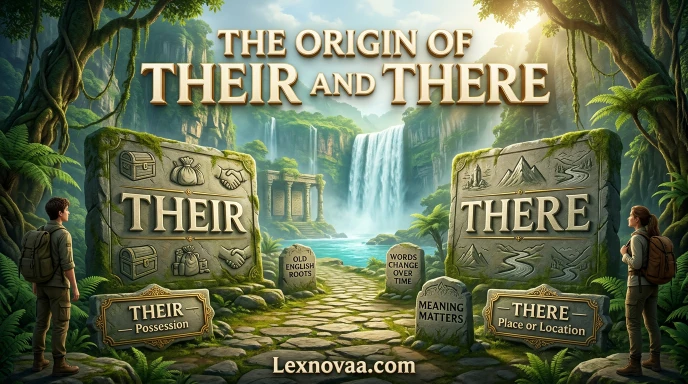
Old Norse influenced English during the Viking Age. Over time, “their” became the standard possessive form used today.
“There” comes from Old English þǣr, a word used to refer to a place or position. Its spelling and pronunciation changed over many centuries as English developed.
The words eventually came to sound alike in most modern English accents. This is an example of homophones, which are words that sound the same but have different meanings or spellings.
“They’re” developed later as a contraction of “they are.” It combines the pronoun “they” with the verb “are.”
Knowing the history can be interesting, but you do not need to memorize it to use these words correctly. Focus on the meaning of your sentence and the job each word performs.
British English vs American English
British and American English use “their” and “there” in the same way. Neither word has a different spelling or meaning based on these two regions.
| Use | British English | American English | Example |
| Possession | Their | Their | Their garden is beautiful. |
| Place | There | There | The shop is over there. |
| Existence | There is / There are | There is / There are | There are three chairs. |
| Contraction | They’re | They’re | They’re ready to leave. |
The main differences between British and American English often involve spelling, vocabulary, and some grammar preferences. “Their” and “there” are not examples of regional spelling differences.
Both forms are standard in school assignments, business documents, books, websites, and news writing. Style guides may set rules for clarity and consistency, but they do not change the basic distinction between these words.
Which Word Should You Use?
The correct choice depends on the meaning of your sentence, not the country where you are writing.
In the United States
Use “their” for ownership and “there” for a place or existence.
- Correct: “Their teacher is helpful.”
- Correct: “There is a new student in class.”
In the United Kingdom
The same rules apply.
- Correct: “Their football team played well.”
- Correct: “The stadium is over there.”
In Canada and Australia
Canadian and Australian English also use these words in the same way.
- “Their tickets are ready.”
- “There are many places to visit.”
In International English
Choose the word that matches your intended meaning. This is especially important when writing for readers who speak English as a second language.
In Academic Writing
Check if you mean ownership or existence. For example, “Their findings support the idea” shows ownership of the findings by a group. “There are several reasons for this result” introduces reasons.
In Business Writing
Use the right word to keep messages clear.
- “Their order has arrived.”
- “There is an update to your account.”
When in doubt, read the sentence aloud and test the meaning. You can also replace “they’re” with “they are” to check if that is the word you need.
Common Mistakes With Their and There

The most common error is using one word where the other belongs. The words sound alike, so spell-check tools may not catch every mistake.
| Incorrect Sentence | Correct Sentence | Why? |
| There going to the store. | They’re going to the store. | “They’re” means “they are.” |
| Their is a book on the desk. | There is a book on the desk. | “There is” introduces something that exists. |
| Put your bag over their. | Put your bag over there. | “There” refers to a place. |
| The students forgot there homework. | The students forgot their homework. | “Their” shows who the homework belongs to. |
| Their are many ways to learn. | There are many ways to learn. | “There are” introduces things that exist. |
A Simple Memory Trick
Try these three quick checks:
- Their = ownership. Think of “their books” or “their house.”
- There = place or existence. Think of “over there” or “there is.”
- They’re = they are. Expand the word to see if the sentence still makes sense.
For example, “They’re happy” becomes “They are happy,” so “they’re” is correct. But “Their happy” does not make sense if you mean that people are happy.
Why Spell-Check May Not Find the Mistake
Many spelling tools check if a word is spelled correctly, not if it fits the sentence. Since “their” and “there” are both real words, a tool may accept the wrong choice.
Proofread for meaning, not just spelling. Ask yourself: Does this sentence show ownership, name a place, or say that something exists?
Everyday Examples of Their and There
These examples show how the words work in different settings.
Emails
- “Their application has been received.”
- “There is one more form to complete.”
- “Please leave the documents over there.”
Business Writing
- “Their team will contact you tomorrow.”
- “There are two items missing from the order.”
- “The manager reviewed their proposal.”
News Headlines
- “Local Residents Share Their Concerns”
- “There Are New Rules for Travelers”
- “Students Celebrate Their Success”
Blogs and Articles
- “Many writers improve their skills through practice.”
- “There are several ways to make a sentence clearer.”
- “Readers can find more examples over there.”
Social Media
- “Their new video is worth watching.”
- “There you go! The answer is in the comments.”
- “They’re sharing their photos today.”
Academic Writing
- “The researchers published their results.”
- “There are several limits to this study.”
- “Each student should submit their own work.”
Daily Conversation
- “Their house is near the park.”
- “Your keys are over there.”
- “There is someone at the door.”
- “They’re waiting for us.”
The best way to learn the difference is to read examples and notice what each word does. With practice, the right choice becomes easier.
Google Trends and Modern Usage
“Their” and “there” are common words in everyday English. People may search for them when learning grammar, checking a sentence, or trying to improve their writing.
Searches often happen because the words sound alike, even though they have different meanings.
Modern writing also includes fast messages, social media posts, schoolwork, emails, and online articles. When people type quickly, as well as English learners.
No live Google Trends data is presented in this article, so no exact search volumes, regional rankings, or changes over time are claimed.
To compare search interest, visit Google Trends and enter “their or there.” Select a region and time range, and review the results.
Remember that search interest shows what people search for, not which word is correct. Grammar depends on the meaning and structure of the sentence.
Quick Comparison Table
| Word | Meaning | Correct? | Region | Example |
| Their | Possession or association | Yes | All major English varieties | Their car is parked outside. |
| There | Place or existence | Yes | All major English varieties | There is a car outside. |
| They’re | Short for “they are” | Yes | All major English varieties | They’re outside. |
| Their used for a place | Incorrect word choice | No | None | Incorrect: “Stand over their.” |
| There used for possession | Incorrect word choice | No | None | Incorrect: “There house is blue.” |
Key Takeaways
- Their shows ownership or a connection to people or a group.
- There refers to a place or helps introduce something that exists.
- They’re is short for “they are.”
- “Their” and “there” sound alike in most English accents.
- British, American, Canadian, and Australian English follow the same rules.
- Spell-check may miss these errors because both words are spelled correctly.
- Check the meaning of the sentence before choosing a word.
FAQs
1. What is the difference between “their” and “there”?
“Their” shows ownership or a connection to people or a group. “There” refers to a place or introduces something that exists. For example, “
Their books are over there” uses both words correctly. “Their books” shows ownership, while “over there” tells us where the books are.
2. When should I use “their” in a sentence?
Use “their” when something belongs to, or is connected with, people or a group. For example, “The children packed their bags” means the bags belong to the children.
You can also use singular “their” when a person’s gender is unknown or when that person uses they/them pronouns.
3. When should I use “there” instead of “their”?
Use “there” when you mean a place or when you introduce something that exists. For example, “The library is over there” refers to a place. “There are three books on the table” introduces the books. If you mean ownership, such as books belonging to a group, use “their.”
4. Is it “their welcome” or “there welcome”?
Neither phrase is usually correct if you want to tell someone that you are happy to help them. The correct expression is “you’re welcome,” which means “you are welcome.” “Their” shows ownership, and “there” refers to a place or existence. The right choice depends on the full sentence.
5. What does “they’re” mean?
“They’re” is a contraction of “they are.” For example, “They’re ready” means “They are ready.” It is different from “their,” which shows ownership, and “there,” which refers to a place or introduces something that exists. Try expanding “they’re” to “they are” to check if it fits.
6. Can “their” refer to one person?
Yes. Singular “their” is widely used when a person’s gender is unknown, not relevant, or when that person uses they/them pronouns.
For example, “Someone left their coat here” refers to one person without stating who they are. This use is accepted in modern standard English.
7. Is “their” or “there” correct in British English?
Both words are correct in British English, but they serve different purposes. Use “their” for ownership and “there” for a place or existence.
The same distinction applies in American, Canadian, and Australian English. There is no regional spelling change between these two words.
8. Why do “their” and “there” sound the same?
In most English accents, “their” and “there” are homophones. This means they sound the same but have different meanings and spellings.
Their similar pronunciation is why writers sometimes mix them up. The easiest way to avoid mistakes is to check what the word means in the sentence.
9. How can I remember the difference between “their” and “there”?
Remember that “their” shows ownership, as in “their home.” “There” can point to a place, as in “over there,” or introduce something, as in “there is a home.”
Also remember “they’re” means “they are.” These simple tests can help you choose the correct word.
10. Is it “there is” or “their is”?
Use “there is” when you want to say that something exists or is present. For example, “There is a message for you” is correct.
“Their is” is not correct in this construction because “their” shows ownership and must relate to a noun, as in “their message.”
Conclusion
“Their” and “there” are both correct English words, but they do different jobs. Use “their” to show that something belongs to people or a group.
Use “there” to point to a place or introduce something that exists. If you mean “they are,” choose “they’re.”
These words can be confusing because they sound alike in most English accents. However, you can avoid mistakes by checking the meaning of each sentence. Ask yourself if you are talking about ownership, a place, or what someone is doing.
For school assignments, emails, business messages, and online articles, this small check can make your writing clearer.
Remember that British and American English use the same basic rules, so the choice does not depend on your region.
The easiest rule to remember is this: “their” belongs to them, “there” points to a place or existence, and “they’re” means “they are.”
DISCOVER MORE ARTICLE CLICK HERE NOW!
- Clearer or More Clear: Which Form Is Correct in English?
- Your or You’re: Difference and Stop Making This Common Mistake
- Use To or Used To? Grammar Rule That Clears Up the Confusion

I’m Orin Blake, a writer with a passion for making English grammar simple, practical, and easy to understand. I enjoy breaking down confusing words, spelling differences, and everyday language questions into clear, reader-friendly guides. My goal is to help students, professionals, and curious learners write with greater confidence and accuracy.