A tiny apostrophe can change the meaning of a sentence. That is why many people get confused about whose or who’s when writing emails, essays, messages, and other everyday text. Both forms are correct, but they have different meanings and uses.
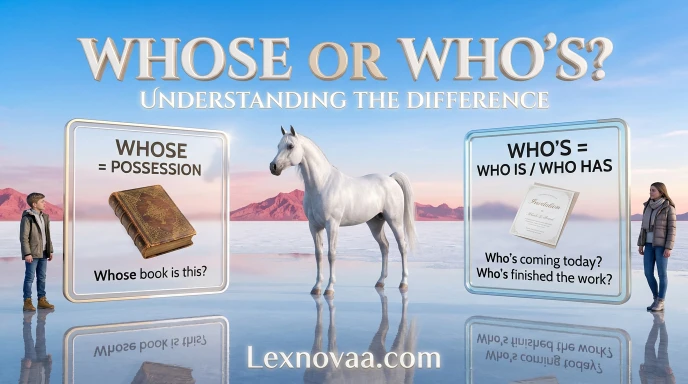
Whose shows possession. It asks who owns something or tells us that something belongs to a person. Who’s is a contraction of who is or who has.
For example, “Whose phone is this?” asks about ownership, while “Who’s calling?” means “Who is calling?”
The confusion often happens because who’s looks like a possessive word. In English, apostrophes often show possession.
as in Sarah’s book. But pronouns follow a different rule. Words such as his, hers, and whose do not need apostrophes to show ownership.
In this guide, you will learn the difference between whose and who’s, explore their meanings and examples, and discover a simple test that helps you choose the correct form every time.
Whose or Who’s: The Quick Answer
Whose is a possessive word that asks who owns something or shows that something belongs to someone. Who’s is a contraction of who is or who has.
- Whose bag is on the table?
- Who’s coming to the party?
- Who’s finished the assignment?
A simple test can help: replace who’s with who is or who has. If the sentence still makes sense, use who’s. If not, you probably need whose.
Whose or Who’s: Quick Answer
The main difference is possession versus contraction.
| Word | Meaning | Example |
| Whose | Belonging to whom | Whose jacket is this? |
| Who’s | Who is | Who’s at the door? |
| Who’s | Who has | Who’s completed the task? |
Remember:
- Use whose to ask about ownership.
- Use who’s when you mean who is or who has.
What Does Whose or Who’s Mean?
Although these words sound the same, they perform different jobs in a sentence. One shows possession, while the other joins words in a shorter form.
What Does Whose Mean?
Whose is a possessive form of who. It refers to the person who owns or is connected to something.
It can appear in direct questions, indirect questions, and relative clauses.
Examples:
- Whose shoes are these?
- I know whose car is parked outside.
- The student whose notebook is missing should speak to the teacher.
- We met a writer whose books are popular.
In each example, whose connects a person with something that belongs to or is associated with them.
Whose can also refer to an animal or an organization when the sentence asks about ownership or association.
Examples:
- The dog whose collar is red belongs to my neighbor.
- The company whose products we use has opened a new office.
What Does Who’s Mean?
Who’s is a contraction. A contraction combines two words and replaces one or more letters with an apostrophe.
It has two possible meanings:
- Who is
- Who has
The surrounding words tell you which meaning applies.
Who’s = Who is
Examples:
- Who’s your English teacher?
Meaning: Who is your English teacher? - Who’s waiting outside?
Meaning: Who is waiting outside? - Who’s responsible for this project?
Meaning: Who is responsible for this project?
Who’s = Who has
Examples:
- Who’s finished the report?
Meaning: Who has finished the report? - Who’s seen my keys?
Meaning: Who has seen my keys? - Who’s been to London?
Meaning: Who has been to London?
Notice that who’s does not always mean who is. It can also stand for who has when has is used as an auxiliary verb.
Is Whose a Possessive Pronoun?
Whose is a possessive form of who. It can function as a determiner before a noun or as a pronoun when the noun is understood.
Examples:
- Whose book is this?
Here, whose comes before the noun book. - Whose is this?
Here, the noun is understood from the context.
Both forms are correct.
The Origin of Whose and Who’s

The words whose and who’s come from the same basic pronoun, who, but their forms developed for different grammatical purposes.
The word who comes from Old English hwā, which was used to ask about or refer to a person. Its possessive form developed into whose, following the older pattern of English pronouns.
The apostrophe in who’s has a different purpose. It marks the missing letters in a shortened form:
- Who is becomes who’s.
- Who has becomes who’s.
This is part of a wider English spelling pattern. Many contractions use apostrophes to show that letters have been left out, such as it’s for it is and she’s for she is.
The confusion comes from another English spelling rule. Nouns often use apostrophe + s to show possession, as in the teacher’s desk. However, possessive pronouns do not follow that pattern.
For example:
- Whose is possessive.
- Who’s is a contraction.
- Hers is possessive, not her’s.
- Its is possessive, while it’s means it is or it has.
British English vs American English
The difference between whose and who’s is the same in British and American English. Both forms are standard, and the apostrophe rule does not change between these varieties.
| Language variety | Whose | Who’s | Example |
| British English | Shows possession | Means who is or who has | Whose coat is this? |
| American English | Shows possession | Means who is or who has | Who’s coming today? |
| Canadian English | Shows possession | Means who is or who has | Whose keys are these? |
| Australian English | Shows possession | Means who is or who has | Who’s ready to leave? |
| International English | Shows possession | Means who is or who has | Whose idea was this? |
Are There Regional Differences?
There is no meaningful regional difference in the standard use of these words. British, American, Canadian, and Australian English all use whose for possession and who’s for the contractions who is and who has.
The pronunciation is also usually the same. Both words are commonly pronounced /huːz/.
This makes the distinction a matter of grammar and spelling rather than accent.
What Do Style Guides Recommend?
Major English style guides follow the same basic distinction:
- Use whose for possession.
- Use who’s for who is or who has.
- Do not use an apostrophe to make whose possessive.
- Use apostrophes in contractions to show missing letters.
In edited writing, choosing the wrong form can make a sentence look careless or change its meaning.
Which Version Should You Use?
The correct form does not depend on where you live. It depends on what you want to say.
United States
American English uses both forms according to the standard rule.
- Correct: Whose phone is ringing?
- Correct: Who’s speaking at the meeting?
United Kingdom
British English follows the same spelling and grammar rules.
- Correct: Do you know whose bag this is?
- Correct: Who’s at the front door?
Canada
Canadian English also uses whose for possession and who’s for contractions.
- Correct: Whose turn is it?
- Correct: Who’s joining us tomorrow?
Australia
Australian English follows the same distinction.
- Correct: Whose bicycle is outside?
- Correct: Who’s responsible for the booking?
International Writing
For international readers, use the standard forms. Since the two words sound alike, check the meaning before choosing the spelling.
Academic Writing
Academic writing requires accurate grammar and clear meaning.
- Correct: The researcher whose work we reviewed published a new study.
- Correct: Who’s responsible for collecting the data?
In very formal academic writing, you may choose to expand contractions. For example, write who is instead of who’s when the required style or tone calls for it.
Business Writing
Use whose to identify ownership or responsibility. Use who’s in messages where a contraction fits the tone.
- Correct: Whose approval is required?
- Correct: Who’s leading the new project?
For formal reports, expanding contractions can create a more formal tone, but it does not change the grammatical difference.
Common Mistakes With Whose and Who’s
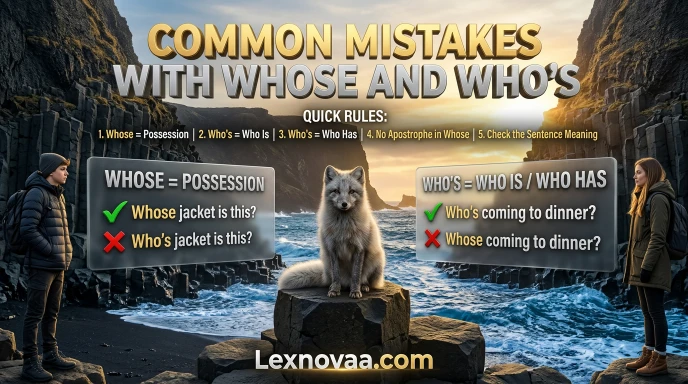
The most common error is adding an apostrophe to whose because people associate apostrophes with ownership.
Here are mistakes to avoid.
Mistake 1: Using Who’s to Show Possession
Incorrect: Who’s phone is this?
Correct: Whose phone is this?
Why? The sentence asks who owns the phone. It does not mean “Who is phone is this?”
Memory tip: If you are asking about ownership, use whose.
Mistake 2: Using Whose Instead of Who’s
Incorrect: Whose coming to dinner?
Correct: Who’s coming to dinner?
Why? The sentence means “Who is coming to dinner?” The contraction who’s is correct.
Memory tip: Try replacing the word with who is.
Mistake 3: Confusing Who’s With Who Has
Incorrect: Whose finished the work?
Correct: Who’s finished the work?
Why? The sentence means “Who has finished the work?” The word who’s can represent who has.
Mistake 4: Adding an Apostrophe to Whose
Incorrect: Who’s book did you borrow?
Correct: Whose book did you borrow?
Why? Whose is already the possessive form. It does not need an apostrophe.
Mistake 5: Assuming Every Apostrophe Shows Possession
Incorrect: I know who’s car is parked outside.
Correct: I know whose car is parked outside.
Why? Apostrophes can show possession in nouns, but they also mark missing letters in contractions. In this sentence, whose identifies the owner of the car.
Mistake 6: Confusing Whose With Who
Incorrect: The woman who’s bag was missing called the office.
Correct: The woman whose bag was missing called the office.
Why? The sentence describes a woman by referring to her bag. Whose connects the person to the thing associated with her.
A Simple Memory Trick
Use the replacement test:
- If you can replace the word with who is, use who’s.
- If you can replace it with who has, use who’s.
- If neither replacement works and the sentence asks about ownership, use whose.
For example:
- Who’s at the door? → Who is at the door?
- Who’s finished? → Who has finished?
- Whose jacket is this? → Who is jacket is this? This does not work, so use whose.
Everyday Examples of Whose and Who’s
These examples show how both forms work in common situations.
Emails
- Could you tell me whose signature is missing?
- Who’s available for the meeting tomorrow?
- Do you know whose desk this is?
Business Writing
- The manager whose team completed the project received an award.
- Who’s responsible for approving the budget?
- We need to identify whose account was affected.
News Headlines
- Whose Decision Led to the Sudden Change?
- Who’s Leading the Race for the Top Position?
- Whose Property Was Damaged in the Storm?
Blogs
- Whose Advice Should You Follow When Learning English?
- Who’s Making the Most of Online Learning?
- Learn How to Use Whose in Everyday Sentences.
Social Media
- Who’s watching the match tonight?
- Whose idea was it to start this challenge?
- Who’s ready for the weekend?
Academic Writing
- The student whose research received recognition presented the findings.
- Who’s responsible for checking the references?
- The study examines whose opinions were included in the survey.
Examples in Daily Conversation
- Whose shoes are these?
- Who’s calling me?
- Do you know whose turn it is?
- Who’s coming with us?
- Whose phone did you find?
Google Trends and Modern Usage
People search for whose or who’s because the words sound the same but look different. The apostrophe makes the confusion stronger, especially for learners who know that apostrophes often show possession.
The main questions people ask include:
- Is it whose or who’s?
- Does who’s mean who is?
- Is whose possessive?
- How do you use whose in a sentence?
- Why does whose not have an apostrophe?
The words are used in all major English varieties. There is no special American or British spelling difference.
In modern digital writing, who’s often appears in casual messages and social media because contractions make sentences shorter and more conversational. Whose appears in questions and descriptions about ownership.
These are general observations about usage, not verified search-volume statistics. Exact regional search interest should be checked in Google Trends by comparing both terms over the same time period.
One useful point remains constant: who’s is a contraction, while whose is possessive. Their pronunciation may be identical, but their spelling depends on meaning.
Quick Comparison Table: Whose vs Who’s
| Version | Meaning | Correct? | Region | Example |
| Whose | Shows possession | Yes | All standard English varieties | Whose book is this? |
| Who’s | Who is | Yes | All standard English varieties | Who’s your teacher? |
| Who’s | Who has | Yes | All standard English varieties | Who’s completed the test? |
| Who’s | Used to show possession | No | None in standard English | Who’s car is this? |
| Whose | Used instead of who is | No | None in standard English | Whose coming today? |
Whose or Who’s: Quick Replacement Test
| If you mean… | Use | Example |
| Who is | Who’s | Who’s waiting outside? |
| Who has | Who’s | Who’s seen this film? |
| Belonging to whom | Whose | Whose bag is this? |
| Connected to whom | Whose | The writer whose book won the prize |
Key Takeaways
- Whose shows possession or association.
- Who’s is short for who is or who has.
- Use whose when asking who owns something.
- Use who’s when you can expand it to who is or who has.
- Both words sound alike in standard English.
- The same rules apply in British and American English.
- Do not add an apostrophe to whose.
- Always check the meaning before choosing the spelling.
FAQs
1. Is it whose or who’s?
Both are correct, but they have different meanings. Whose shows possession or association, while who’s is a contraction of who is or who has. Use “Whose bag is this?” to ask about ownership and “Who’s coming?” to ask who is arriving.
2. What is the difference between whose and who’s?
The difference is possession versus contraction. Whose identifies the person something belongs to or is connected with.
Who’s replaces who is or who has. For example, “Whose phone is ringing?” asks about ownership, while “Who’s calling?” means “Who is calling?”
3. Is whose possessive?
Yes. Whose is the possessive form of who. It asks who owns something or identifies a person through something connected to them.
For example, “Whose jacket is this?” asks about ownership, while “The student whose work won the award” identifies a student through their work.
4. Does who’s mean who is or who has?
Who’s can mean both who is and who has. The words after it help you understand the meaning.
“Who’s ready?” means “Who is ready?” while “Who’s finished?” can mean “Who has finished?” Both uses are grammatically correct.
5. Why does whose not have an apostrophe?
Whose is already a possessive form, so it does not need an apostrophe. English possessive pronouns such as his, hers, and theirs also do not use apostrophes. The apostrophe in who’s marks missing letters in the contraction who is or who has.
6. Is it whose name or who’s name?
The correct phrase is whose name when you are asking who owns or is associated with the name.
For example, “Whose name is on the list?” Who’s name is incorrect because it cannot mean “who is name” or “who has name” in this sentence.
7. Can who’s mean whose?
No. In standard English, who’s cannot replace whose to show possession. Although the two words sound alike, their meanings are different. Use whose in “Whose car is parked outside?” and who’s in “Who’s driving the car?”
8. Is whose or who’s more formal?
Neither word is automatically more formal. Both are standard English forms. However, some formal writing styles prefer avoiding contractions, so a writer may choose who is instead of who’s. The possessive form whose remains correct and necessary when expressing ownership.
9. How do I remember the difference between whose and who’s?
Use the replacement test. If you can replace who’s with who is or who has, the contraction is correct.
If the sentence asks who owns something, use whose. For example, “Who’s there?” works as “Who is there?” but “Whose coat?” asks about ownership.
10. Are whose and who’s pronounced the same?
Yes. In most standard English accents, whose and who’s are pronounced the same way, usually /huːz/. This makes them homophones.
Since pronunciation cannot help you choose the spelling, you must use the sentence’s meaning and grammar to decide.
Conclusion: Choose Whose or Who’s With Confidence
The difference between whose and who’s is simple once you focus on meaning. Use whose to show possession or a connection between a person and something else. Use who’s when you mean who is or who has.
For example, “Whose laptop is this?” asks who owns the laptop. “Who’s using the laptop?” means “Who is using the laptop?” The two words may sound alike, but they cannot replace each other.
Remember that an apostrophe does not always show ownership. In who’s, it marks missing letters. In whose, possession is already part of the word, so no apostrophe is needed.
This rule works in British, American, Canadian, and Australian English. When you are unsure, expand who’s into who is or who has.
If the sentence still makes sense, keep the apostrophe. Otherwise, check if you need whose.
Memorable takeaway: Whose shows ownership; who’s means who is or who has.
For more clear explanations of confusing English words and grammar comparisons, visit Lexnovaa.com.
DISCOVER MORE ARTICLE CLICK HERE NOW!
- Lying Down or Laying Down: Understand Once and for All
- Whoever or Whomever: The Subject and Object Rule Explained
- Choose or Chose? Stop Confusing These Two English Words

I’m Orin Blake, a writer with a passion for making English grammar simple, practical, and easy to understand. I enjoy breaking down confusing words, spelling differences, and everyday language questions into clear, reader-friendly guides. My goal is to help students, professionals, and curious learners write with greater confidence and accuracy.