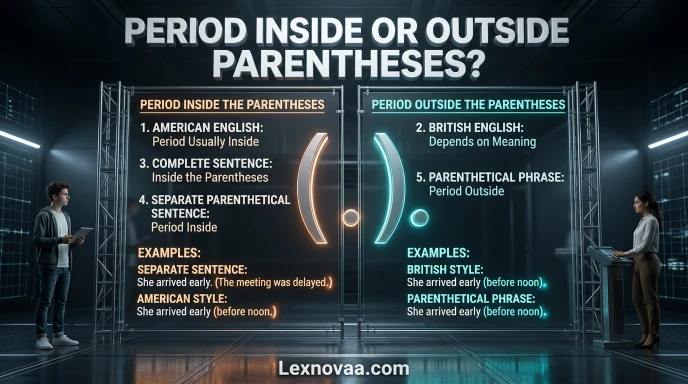
Should the period go inside or outside parentheses? The answer depends on if the words inside the parentheses form a complete, independent sentence or are simply part of a larger sentence.
In most cases, when the parenthetical information is part of a sentence, the period goes outside the closing parenthesis.
When the entire sentence appears inside parentheses, the period usually goes inside the closing parenthesis.
People often search for period inside or outside parentheses because this punctuation rule can look confusing on the page.
A small punctuation mark changes position based on sentence structure, and British and American style preferences can sometimes add more questions.
This guide explains the rules with simple examples, common mistakes, regional style considerations, and practical advice for emails, academic writing, business writing, and everyday English.
Period Inside or Outside Parentheses: Where Does It Go?
Put the period outside the closing parenthesis when the parenthetical text is part of a larger sentence. Put the period inside the closing parenthesis when the entire sentence is inside the parentheses.
Quick examples
Parenthetical phrase within a sentence:
The meeting starts at 9 a.m. (Please arrive early).
Here, the words inside the parentheses form a complete sentence, so the period stays inside.
Parenthetical information as part of a sentence:
The meeting starts at 9 a.m. (with a short introduction).
Here, the parenthetical words are part of the main sentence, so the period goes outside.
The easiest rule is:
- Complete sentence inside parentheses = period inside
- Parenthetical phrase within a larger sentence = period outside
Period Inside or Outside Parentheses: Quick Answer
Use the position of the period to show how the parenthetical material relates to the sentence.
- Period outside: The parentheses contain extra words within a larger sentence.
- Period inside: The parentheses contain a complete sentence that stands on its own.
Examples
Outside:
We visited the museum (it was closed on Monday).
Inside:
We visited the museum. (It was closed on Monday.)
However, these examples show an important point: punctuation should match the sentence structure. If the parenthetical material is only an inserted part of the main sentence, the period belongs after the closing parenthesis.
What Does Period Inside or Outside Parentheses Mean?
Parentheses are punctuation marks used to add extra information, clarification, or an aside.
The placement of the period depends on if the parenthetical content is grammatically connected to the surrounding sentence.
Period outside the parentheses
Place the period outside when the parenthetical material is only part of the main sentence.
The conference will be held in London (the venue will be announced later).
The entire sentence ends after the closing parenthesis, so the period comes outside.
Period inside the parentheses
Place the period inside when the entire parenthetical material is a complete sentence that is separate from the sentence before it.
The conference will be held in London. (The venue will be announced later.)
The sentence inside the parentheses has its own capital letter and its own ending punctuation.
The simplest difference
Think about this question:
Does the parenthetical text have its own complete sentence?
- Yes: Put the period inside.
- No: Put the period outside.
The Origin of Parentheses and Period Placement
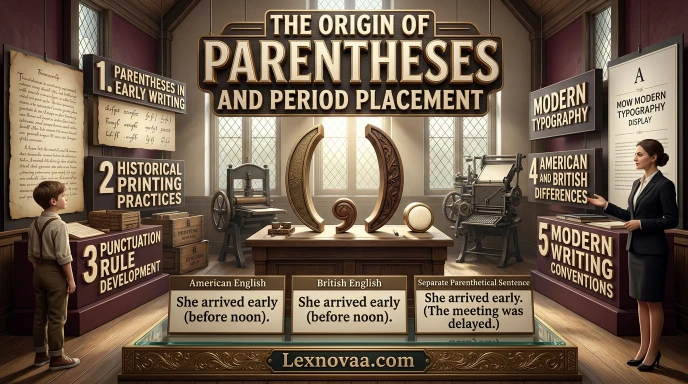
Parentheses developed as a way for writers to insert additional information without interrupting the main flow of a sentence.
Their name is connected with the Greek idea of placing something alongside or beside another part of the text.
Over time, printed English developed conventions for handling punctuation around parentheses.
The main goal was clarity: readers needed to know if the parenthetical words belonged to the main sentence or formed a separate statement.
The period has a much longer history as one of the basic punctuation marks used to show the end of a complete statement.
As punctuation systems became more standardized, writers and editors developed clearer conventions for combining periods with parentheses.
Modern style guides generally focus on the same principle: sentence structure determines punctuation placement.
British English vs American English
The basic rule is similar in British and American English, but style guides may differ in specific punctuation situations.
| Situation | British English | American English | Example |
| Parenthetical phrase inside a sentence | Period outside | Period outside | We arrived late (because of traffic). |
| Complete sentence in parentheses | Period inside | Period inside | (The event was cancelled.) |
| Full sentence followed by parenthetical sentence | Usually inside | Usually inside | We left early. (The weather was terrible.) |
| Citation or reference style | Depends on style guide | Depends on style guide | Follow the required style. |
Regional differences
The central grammar rule is not a major BritishversusAmerican difference.
The most important factor is the style guide you are following. Academic publishers, universities, legal organizations, and professional publications may have specific rules for citations, abbreviations, quotations, and parentheses.
For general writing, follow the sentencestructure rule.
Which Version Should You Use?
United States
Use a period outside the parentheses when the parenthetical words are part of the sentence.
The package will arrive tomorrow (if there are no delays).
Use a period inside when the parenthetical text is a complete sentence.
The package will arrive tomorrow. (There may still be delays.)
United Kingdom
Follow the same basic approach.
The train arrived late (as usual).
The train arrived late. (The weather caused delays.)
Canada
The same sentencestructure rule is appropriate. For formal work, follow your school’s or publisher’s style guide.
Australia
Use the same general rule. Editorial preferences may differ in specialist publications.
International writing
For international readers, clear sentence structure is the best guide:
- Parenthetical phrase = period outside
- Complete parenthetical sentence = period inside
Academic writing
Academic writing often uses parentheses for:
- Citations
- Dates
- Abbreviations
- Clarifications
- Supporting information
For example:
The results were statistically significant (Smith, 2025).
The period ends the main sentence, so it goes outside the parentheses.
Always follow the citation style required by your institution, such as APA, MLA, Chicago, or another approved style.
Business writing
In business communication, keep punctuation simple and clear.
Please review the attached report (see page 4 for details).
The period goes outside because the parenthetical material is part of the sentence.
Common Mistakes of Parentheses and Period Placement
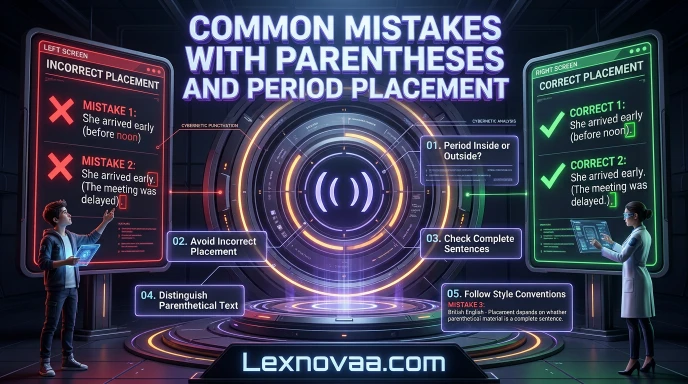
Mistake 1: Putting the period inside a parenthetical phrase
Incorrect:
The meeting begins at 10 a.m. (unless the manager is late.)
Correct:
The meeting begins at 10 a.m. (unless the manager is late).
Explanation: The words inside the parentheses are not a complete sentence. They depend on the main sentence.
Memory tip: If the words inside cannot stand alone, the period stays outside.
Mistake 2: Leaving a complete parenthetical sentence without its own period
Incorrect:
The meeting was postponed. (The manager was sick)
Correct:
The meeting was postponed. (The manager was sick.)
Explanation: The parenthetical material is a complete sentence, so it needs its own ending period.
Mistake 3: Starting a fragment with a capital letter
Less consistent:
We stayed home. (Because it was raining.)
Better:
We stayed home (because it was raining).
The words because it was raining are a fragment, not a complete sentence.
Mistake 4: Using parentheses when a comma would be clearer
Less clear:
The report was delayed (because of technical problems).
Also possible:
The report was delayed because of technical problems.
Use parentheses only when the information is genuinely additional or secondary.
Everyday Examples
Emails
Please send the document today (if possible).
The office will remain closed tomorrow. (A public holiday has been declared.)
Business writing
The project was completed on time (despite several technical issues).
The project was delayed. (The final approval arrived late.)
News headlines
Periods are uncommon in traditional news headlines, but parentheses may still add clarification:
New Airport Opens in Manchester (After Years of Delays)
Blogs
I finally finished the book (after several weeks).
I was surprised by the ending. (I did not see it coming.)
Social media
New video is coming tonight (finally!).
I missed the bus. (Again.)
Academic writing
The survey included 500 participants (ages 18 to 35).
The findings require further research. (The sample size was limited.)
Daily conversation
I’ll call you later (after dinner).
I forgot my keys. (Typical.)
Google Trends & Modern Usage
People search for “period inside or outside parentheses” because punctuation placement is easy to forget and difficult to judge quickly.
Common searches include:
- period inside parentheses or outside
- does the period go inside parentheses
- punctuation outside parentheses
- where does the period go with parentheses
- full stop inside parentheses
- parenthesis punctuation rules
- period after parentheses
The confusion is especially common in academic writing, professional documents, essays, and edited online content.
Exact Google Trends statistics are not included here because this article does not rely on verified live data. ,
General usage patterns show that the main source of confusion is determining if the parenthetical words are part of the main sentence or form a separate complete sentence.
Quick Comparison Table
| Situation | Period Placement | Correct? | Region | Example |
| Parenthetical phrase within a sentence | Outside parentheses | ✅ Yes | International | We left early (because it was late). |
| Complete sentence inside parentheses | Inside parentheses | ✅ Yes | International | (We left early.) |
| Main sentence with extra information | Outside parentheses | ✅ Yes | International | The event starts at 8 (doors open at 7). |
| Sentence fragment with period inside | Inside parentheses | ❌ Usually no | International | (because it was raining.) |
| Separate parenthetical sentence | Inside parentheses | ✅ Yes | International | The event was cancelled. (The weather was severe.) |
Key Takeaways
- Put the period outside when the parenthetical text is part of the main sentence.
- Put the period inside when the entire parenthetical text is a complete sentence.
- A fragment inside parentheses usually does not need its own period.
- The same core rule works in British and American English.
- Academic and professional writing may follow specific style guides.
- Check if the words inside the parentheses can stand alone.
- Use parentheses only when the information is secondary or additional.
FAQs
Does the period go inside or outside parentheses?
It depends on the sentence structure. Put the period outside when the parenthetical words are part of the larger sentence.
Put the period inside when everything inside the parentheses is a complete, separate sentence with its own punctuation.
When does a period go outside parentheses?
A period goes outside when the parenthetical information is grammatically part of the main sentence.
For example: “The store is closed today (it reopens tomorrow).” The entire sentence ends after the closing parenthesis, so the period appears outside.
When does a period go inside parentheses?
Put the period inside when the text inside the parentheses is a complete sentence. For example: “The store is closed today. (It reopens tomorrow.)” The parenthetical statement stands alone, so its period remains inside the closing parenthesis.
Does the period go inside parentheses in American English?
The basic rule is the same in American English: the period goes outside for parenthetical material that belongs to the main sentence.
and inside when the parentheses contain a complete sentence. Specific academic or publishing styles may have additional rules for citations and quotations.
Does the period go inside parentheses in British English?
British English follows the same general sentencestructure principle. The period, often called a full stop.
usually goes outside parentheses when the parenthetical material belongs to the larger sentence and inside when the parenthetical text forms a complete sentence.
What if the parentheses are at the end of a sentence?
If the parenthetical information is part of the main sentence, place the period after the closing parenthesis.
For example: “The event starts tomorrow (weather permitting).” The period ends the entire sentence.
Can I put a question mark inside parentheses?
Yes, if the parenthetical text is a complete question. For example: “The event was delayed. (Who made the decision?)” If the main sentence is the question, however, the question mark may go outside the closing parenthesis.
Should I capitalize the first word inside parentheses?
Capitalize the first word when the parenthetical text is a complete sentence. Do not normally capitalize it when the parenthetical text is only a phrase or fragment that continues the grammar of the main sentence.
Do parentheses change punctuation rules?
Parentheses do not remove normal sentence punctuation rules. Instead, they show that some information is additional or secondary.
The key question is if the material inside belongs grammatically to the main sentence or forms its own complete sentence.
Is there a difference between parenthesis and parentheses?
Parenthesis is singular, referring to one punctuation mark or one parenthetical remark. Parentheses is plural and usually refers to the pair of curved punctuation marks: ( ). In everyday usage, people sometimes use the terms loosely.
Conclusion
Knowing if to place a period inside or outside parentheses becomes easy once you look at the sentence structure.
If the words inside the parentheses are simply extra information within a larger sentence, the period goes outside the closing parenthesis.
If the parentheses contain a complete sentence that stands on its own, the period goes inside.
This rule works for most everyday, academic, and professional writing. The key is not to focus only on where the parentheses appear. Instead, ask if the parenthetical text is a complete sentence.
For specialized writing, such as academic papers and legal documents, always follow the required style guide.
Simple rule to remember: If the parentheses contain the whole sentence, keep the period inside. If they contain only part of the sentence, put the period outside.
DISCOVER MORE ARTICLE CLICK HERE NOW!
- Layed or Laid: Which Spelling Is Correct?
- In Effect or In Affect: Meaning and Correct Usage
- Whoever or Whomever: The Subject and Object Rule Explained

I’m Orin Blake, a writer with a passion for making English grammar simple, practical, and easy to understand. I enjoy breaking down confusing words, spelling differences, and everyday language questions into clear, reader-friendly guides. My goal is to help students, professionals, and curious learners write with greater confidence and accuracy.