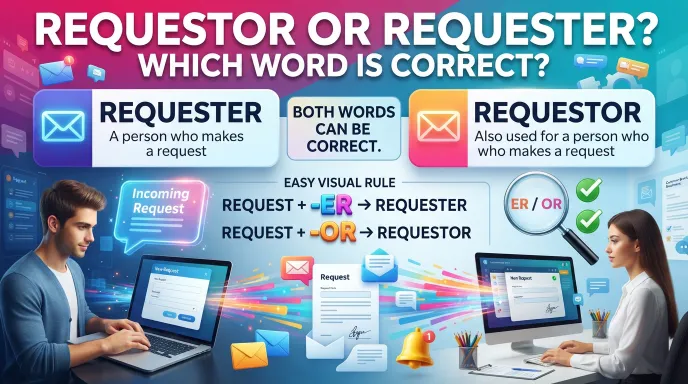
Both “requestor” and “requester” are correct; “requester” is more common in general English, while “requestor” is also used, especially in legal or technical contexts.Requestor and requester both describe someone who makes a request.
This can create confusion in business writing, legal documents, technical systems, and everyday English. The good news is that both forms are correct.
Requester is generally more common in modern general English. It works well in emails, websites, customer service, business communication, and general writing. Requestor is also a valid word and is often found in legal, administrative, and technical contexts.
For example, you can write, “The requester submitted the form” or “The requestor submitted the form.” Both sentences have the same basic meaning.
Unlike spelling differences such as defense/defence, this is not mainly a British English versus American English issue. Both requester and requestor can be used in British and American English.
In this guide, you will learn the difference between requestor and requester, their origins, common usage, mistakes to avoid, everyday examples, and which form is best for professional writing.
Requestor or Requester : Quick Answer
Both forms are correct:
- Requester ✅ — More common in general English
- Requestor ✅ — Common in formal and specialized contexts
Examples
The requester submitted the application.
The requestor submitted the application.
Both mean a person who makes a request.
Quick Tip
For most general writing, requester is the safer choice.
The Origin of Requestor or Requester
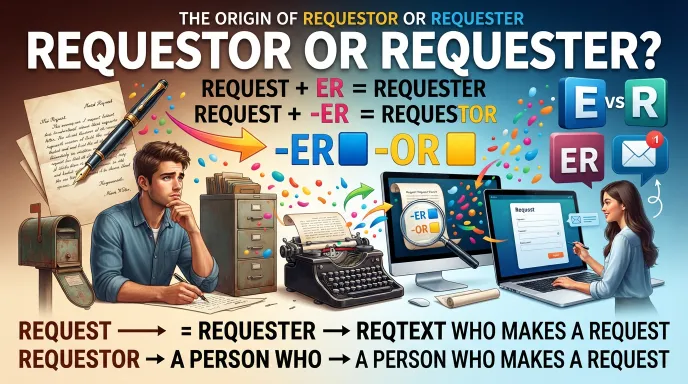
Both words come from the verb request, meaning to ask for something.
They are formed with different suffixes:
- request + -er → requester
- request + -or → requestor
The -er ending is common in English nouns that describe people who perform an action.
Examples:
- teach → teacher
- write → writer
- work → worker
- request → requester
The -or ending also appears in many English nouns, especially those influenced by Latin or formal terminology.
Examples include:
- act → actor
- inspect → inspector
- supervise → supervisor
British English vs American English Spelling
Requestor and requester are not strict British and American spelling variants. Both can be found in both varieties of English.
| Feature | Requester | Requestor |
| General English | ✅ Very common | ✅ Used |
| Business writing | ✅ Common | ✅ Used |
| Legal writing | ✅ Used | ✅ Common |
| Technical writing | ✅ Common | ✅ Common |
| Meaning | Person making a request | Person making a request |
Example
The requester must provide the required information.
The requestor must provide the required information.
Both are grammatically correct.
Which Spelling Should You Use?
Use “Requester” for General Writing
Requester is usually the best choice for:
- Emails
- Websites
- Customer service
- Business communication
- General articles
- Everyday professional writing
Example:
The requester will receive a confirmation email.
Use “Requestor” for Specialized Writing
Requestor may be preferred in:
- Legal documents
- Administrative forms
- Technical systems
- Internal company procedures
- Specialized terminology
Example:
The requestor must complete all required fields.
Follow Your Organization’s Style
If a company, software platform, legal document, or organization consistently uses requestor, follow that terminology.
Consistency makes professional writing clearer.
Common Mistakes with Requestor or Requester
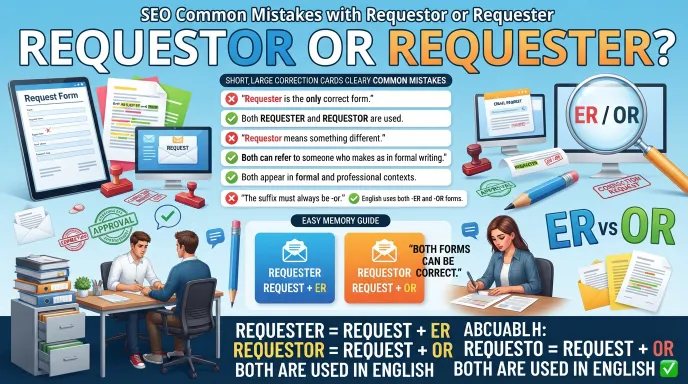
Mistake 1: Thinking “Requestor” Is Wrong
❌ Requestor is incorrect.
✅ Requestor is an accepted English word.
Mistake 2: Thinking “Requester” Is Informal
❌ Requester is only used in casual writing.
✅ Requester is widely used in professional and technical contexts.
Mistake 3: Mixing Both Forms
Avoid switching between the two forms without a reason.
❌ The requester submitted the form. The requestor received the confirmation.
✅ The requester submitted the form. The requester received the confirmation.
Requestor or Requester in Everyday Examples
The requester will receive an update after approval.
Customer Service
Please provide the requester’s contact information.
Legal Writing
The requestor submitted the application for review.
Technology
The system records the identity of the requester.
Formal Writing
The requestor must provide supporting documents.
Requestor or Requester : Google Trends & Usage Data

Searches for “requestor or requester” are common because both forms appear in professional and specialized writing.
Generally:
- Requester is more common in general English.
- Requestor appears frequently in legal, administrative, and technical contexts.
- Both forms are recognized and understood.
Search popularity can vary by country, industry, and time period, so exact Google Trends results depend on the selected region and date range.
Comparison Table
| Word | Common Usage | Meaning | Example |
| Requester | General & professional | Someone who makes a request | The requester submitted the form. |
| Requestor | Formal & specialized | Someone who makes a request | The requestor submitted the form. |
| Request | General | An act of asking | We received a request. |
| Requested | General | Asked for | The information was requested. |
FAQs
1. Should I use “requester” or “requestor”?
Requester is generally the preferred and more common spelling in modern English. Both requester and requestor are used, especially in technical.
legal, and administrative contexts, but requester is usually the safer choice for general and professional writing.
2. Is “requestor” or “requester” the correct spelling?
Both requestor and requester are recognized forms, but requester is more widely used in general English. A requester is a person who makes a request.
Requestor has the same basic meaning and is often found in specialized, legal, technical, or organizational language.
3. Is “requester” or “requestor” the correct spelling in English?
Requester is the more common standard spelling in contemporary English. However, requestor is not necessarily incorrect.
The choice can depend on the organization, industry, style guide, or technical terminology being followed.
4. What does “requestor” mean?
Requestor means a person or entity that makes a request. It is formed from the verb request and refers to someone asking for information, assistance, approval, access, or another action. For example, “The requestor must provide the required information.”
5. What does “requester” mean?
A requester is someone who makes a request. The word can describe a person asking for information, permission, support, access, or a service. For example, “The requester submitted a request for access to the records.”
Conclusion
Both requestor and requester are correct words for someone who makes a request. The difference is mainly about usage and context, not a strict British-versus-American spelling rule.
Requester is the more common choice for general English, business communication, websites, emails, and customer service. Requestor is also correct and appears often in legal, administrative, technical, and specialized writing.
If you are writing for a general audience, requester is usually the best choice. If your organization or industry uses requestor as its standard term, it is perfectly acceptable to use it.
The simple rule is: requester = common general usage; requestor = common specialized usage. Both forms are correct, so choose the one that fits your context and keep your usage consistent.
DISCOVER MORE ARTICLE!
- Jist or Gist? Which Spelling Is Correct?
- Go Into Effect or Affect? Which Phrase Is Correct?
- Dieing or Dying? Which Spelling Is Correct?

I’m Orin Blake, a writer with a passion for making English grammar simple, practical, and easy to understand. I enjoy breaking down confusing words, spelling differences, and everyday language questions into clear, reader-friendly guides. My goal is to help students, professionals, and curious learners write with greater confidence and accuracy.