Have you ever wondered if you should write noone or no one? This is a common English spelling question because many words that contain no are written as one word, such as nobody, nothing, and nowhere. That can make noone look correct.
However, the standard spelling is no one, written as two separate words. No one means not any person or nobody.
For example, “No one answered the phone” means that nobody answered it.
The form noone is generally considered a misspelling in standard English. If you are writing an essay, email, article, report, or professional document, use no one.
This guide explains the difference between noone or no one, the history of the phrase, British and American usage, common mistakes, everyday examples, and an easy rule to remember the correct spelling.
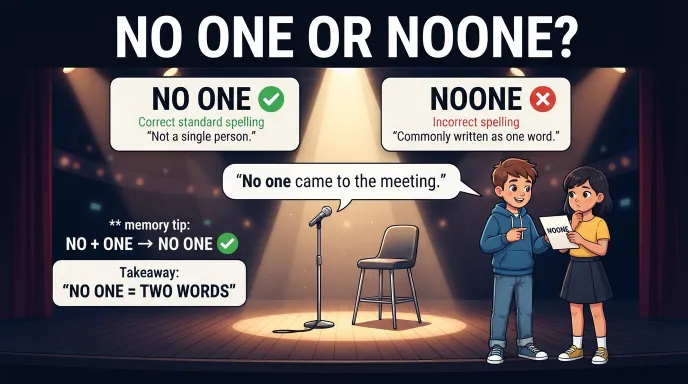
Noone or No One : Quick Answer
The correct form is:
- No one ✅ = Standard English
- Noone ❌ = Incorrect spelling
Examples
- No one knows the answer.
- No one called me yesterday.
- No one was available to help.
- No one can solve the problem alone.
Quick Tip
Remember:
No one = two words
The Origin of Noone or No One
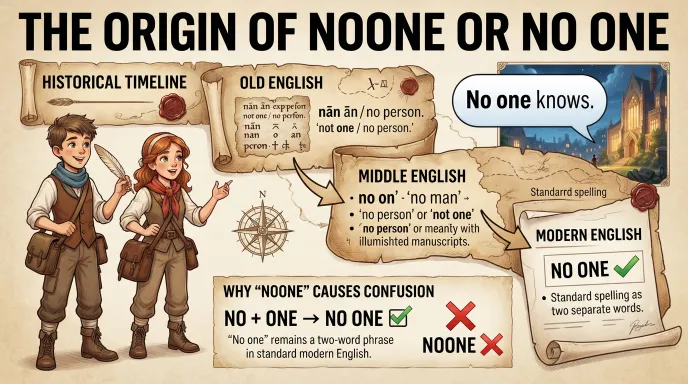
The phrase no one is made from two simple words:
- no = not any
- one = a person or individual
Together, no one means not a single person.
Unlike words such as nobody and nothing, the phrase no one has remained as two words in standard English.
The spelling noone may appear because speakers naturally connect the two words when saying them quickly. However, standard written English keeps them separate.
British English vs American English Spelling
Both British and American English use no one as the standard spelling.
Comparison Table
| Feature | British English | American English |
| Correct form | No one | No one |
| Incorrect form | Noone | Noone |
| Number of words | Two | Two |
| Meaning | Not any person | Not any person |
Examples
British English:
No one was at the station.
American English:
No one was at the station.
The spelling does not change.
Which Spelling Should You Use?
Use no one whenever you mean nobody or not any person.
Use “No One”
- No one answered the door.
- No one understands the problem.
- No one was ready.
- No one knew what happened.
Avoid “Noone”
❌ Noone answered the question.
✅ No one answered the question.
For professional and academic writing, always use no one.
Common Mistakes with Noone or No One
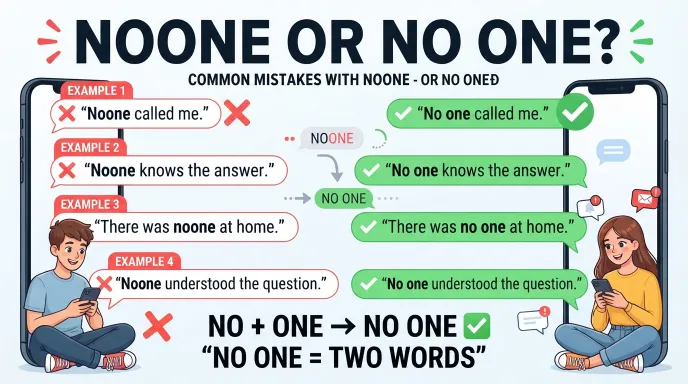
Mistake 1: Combining the Words
❌ Noone was there.
✅ No one was there.
Mistake 2: Confusing No One With Noone
No one is the standard form.
Noone is not the standard spelling.
Mistake 3: Using “No One” With an Unnecessary Double Negative
Avoid constructions such as:
❌ No one didn’t answer.
Better:
✅ No one answered.
Or:
✅ No one failed to answer.
The exact sentence depends on what you want to say.
Noone or No One in Everyday Examples
No one has responded to the request yet.
News
No one was injured in the incident.
Social Media
No one can believe how quickly time passed!
Formal Writing
No one can accurately predict every future outcome.
Noone or No One : Google Trends & Usage Data
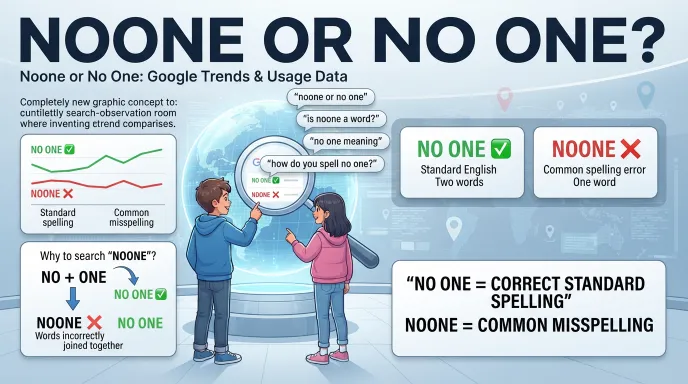
The search query “noone or no one” is common because English has many similar words that are written as one word.
For example:
- nobody
- nothing
- nowhere
- no one
This makes no one easy to misspell as noone.
People commonly search the phrase when:
- Learning English
- Writing essays
- Checking grammar
- Editing emails
- Proofreading articles
- Preparing professional documents
Usage Comparison
| Form | Standard English? | Meaning |
| No one | ✅ Yes | Not any person |
| Noone | ❌ No | Common misspelling |
| Nobody | ✅ Yes | Not any person |
Comparison Table
| Expression | Correct? | Meaning | Example |
| No one | ✅ Yes | Not any person | No one called. |
| Noone | ❌ No | Incorrect spelling | Avoid this form. |
| Nobody | ✅ Yes | Not any person | Nobody called. |
FAQs
1. Is it “noone” or “no one”?
The correct spelling is “no one” as two separate words. “Noone” is generally considered a misspelling in standard English.
For formal writing, academic work, professional communication, and content, use no one.
2. Is “noone” a word in the English dictionary?
In standard modern English, “noone” is not the accepted spelling of the pronoun meaning “not any person.”
Major English dictionaries recognize “no one” as the standard form. If you are unsure if to write noone or no one, choose no one.
3. Is “no one” one word or two words?
No one is written as two words. It functions as an indefinite pronoun and means “not anyone” or “not a single person.” For example: “No one knows the answer.”
4. Is there a space in “no one”?
Yes. There is a space between no and one. The standard spelling is no one, not noone. This applies to both American English and British English, so the spelling does not normally change between US and UK English.
5. What does “no one” mean?
No one means not any person or nobody. It refers to zero people. For example, “No one called me” means that nobody called.
In this sense, no one and nobody are often interchangeable, although their usage can vary slightly by sentence.
6. What is the correct spelling: “noone” or “no one” in British English?
In British English, the standard form is no one, with a space. Noone is not the standard spelling when you mean “nobody.”
The same rule generally applies in American English, making no one the safest choice for international English.
7. Is “noone” grammatically correct?
No. When no one means “nobody,” writing it as noone is generally considered a spelling error.
The grammatically and orthographically standard form is no one. If you see “noone” in informal writing, it is usually a typo rather than an accepted alternative spelling.
8. What is another word for “no one”?
Common alternatives to no one include nobody, not anybody, and not a single person, depending on the sentence. For example, “No one answered” and “Nobody answered” have essentially the same meaning.
9. Is “no one” the same as “no ones”?
No. No one is an indefinite pronoun meaning “nobody,” while no ones is not normally used to express that meaning. If you want to say that there are no people, use a phrase such as no one was there or nobody was there.
10. Can “no one” be used in formal writing?
Yes. No one is completely acceptable in formal, academic, professional, and everyday English. It is actually preferable to the misspelled form noone.
For essays, business writing, websites, and other professional content, use the standard spelling no one.
Conclusion
The correct spelling is no one, not noone. The phrase no one means not any person or nobody, and it should be written as two separate words in standard English.
For example, “No one answered the phone” means that nobody answered it.
The confusion is understandable because English has many related words that are written as one word, such as nobody, nothing, and nowhere.
However, no one follows its own standard spelling and remains two words.
The rule is simple: whenever you mean not a single person, write no one. This form is used in both British and American English and is appropriate for everyday, academic, and professional writing.
Avoid noone, which is generally considered a spelling mistake. Remembering the phrase as “not one person” can make the correct spelling easy to recall.
DISCOVER MORE ARTICLE HERE!
- Learnt or Learned? Which Spelling Is Correct?
- Cancelation or Cancellation? Which Spelling Is Correct?
- Affect or Effect? Which Word Is Correct?

I’m Orin Blake, a writer with a passion for making English grammar simple, practical, and easy to understand. I enjoy breaking down confusing words, spelling differences, and everyday language questions into clear, reader-friendly guides. My goal is to help students, professionals, and curious learners write with greater confidence and accuracy.