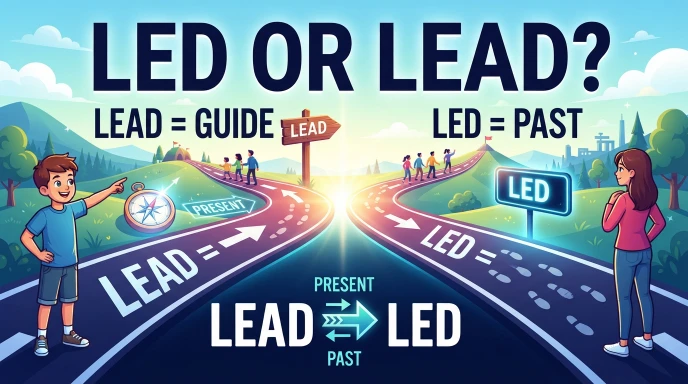
Led is correct when you mean the past tense of lead, while lead is correct for the present tense or the metal, depending on pronunciation and meaning.
English has many words that look almost the same but work differently in a sentence. Led and lead are a perfect example. They are closely related, but using the wrong one can make your writing look incorrect.
The main confusion comes from pronunciation. When lead means “guide,” it is pronounced like leed. When lead means the metal, it is pronounced like led. Meanwhile, led is always pronounced like the metal-related pronunciation of lead.
Knowing when to use each word is important for emails, schoolwork, articles, business writing, and everyday communication.
In this guide, we will explain led or lead, their meanings, pronunciation, origins, common mistakes, and correct usage with simple examples.
Quick Answer: Led or Lead?
Led and lead are both correct, but they are used differently.
- Lead = present tense of the verb meaning “to guide” or “to direct.”
- Led = past tense and past participle of lead.
- Lead = a metal when pronounced like “led.”
Examples
- Present: She will lead the team.
- Past: She led the team yesterday.
- Metal: The pipe contains lead.
So, if you are talking about something that happened in the past, led is usually the correct word.
Definition and Meaning of Led and Lead
What does “lead” mean?
Lead has several meanings.
As a verb, lead means to guide, direct, or be in charge of someone or something.
The coach will lead the team.
As a noun, lead can mean being ahead or having an advantage.
Our team has the lead.
Lead can also refer to the chemical element, a heavy metal. In this meaning, it is pronounced differently from the verb.
What does “led” mean?
Led is the past tense and past participle of lead when lead means “to guide” or “direct.”
She led the meeting.
He led the group through the city.
You should use led when the action happened in the past.
The Origin of Led and Lead

The words lead and led come from the same English verb.
The verb lead has very old Germanic roots. It developed from Old English forms connected with guiding or showing the way.
Over time, English developed different forms for the present and past:
- Lead → present form
- Led → past form
The spelling became especially confusing because the word lead is also used for the metal. The metal word has a different historical origin from the verb, even though modern English spells both words lead.
This makes lead a classic English homograph: one spelling can represent different meanings and pronunciations.
Led vs Lead in British and American English
Both British English and American English use lead and led in essentially the same way.
| Word | British English | American English | Meaning |
| Lead | Correct | Correct | Guide or direct |
| Led | Correct | Correct | Past tense of lead |
| Lead | Correct | Correct | A heavy metal |
There is no major British-American spelling difference here.
The important distinction is meaning, tense, and pronunciation, not regional spelling.
Lead as a verb
When lead means “guide,” it is pronounced like leed.
I will lead the group.
Led as the past tense
Led is pronounced like red with an L.
She led the group yesterday.
Lead as a metal
The noun lead, meaning the metal, has the same pronunciation as led.
The old paint contained lead.
Which Version Should You Use: Led or Lead?
Choose the word based on what you mean.
Use “lead” for present or future actions
Use lead when someone is guiding or directing something now or will do so later.
Examples:
- I lead the project.
- She will lead the meeting.
- They lead the discussion.
- He wants to lead the team.
Use “led” for completed actions
Use led when the action already happened.
Examples:
- She led the meeting yesterday.
- He led the team last year.
- They led us to the correct building.
- The manager led the discussion.
Use “lead” for the metal
Use lead when you are talking about the chemical element.
Example:
Scientists tested the water for lead.
Remember: this use of lead is pronounced like led.
Common Mistakes with Led and Lead
Mistake 1: Using “lead” for a past action
Incorrect:
She lead the team last year.
Correct:
She led the team last year.
Why?
The action happened in the past, so the past tense led is required.
Memory tip:
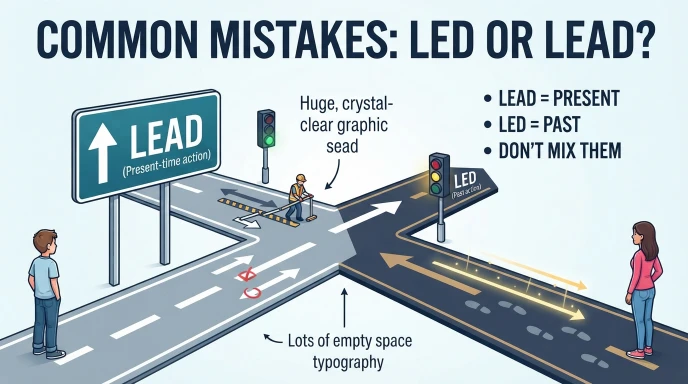
Present = lead
Past = led
Mistake 2: Writing “led” for a present action
Incorrect:
He led the team every Monday.
If you mean that this is his current regular responsibility, leads may be correct:
He leads the team every Monday.
However, led can be correct if you are describing a past routine.
Mistake 3: Confusing pronunciation
Many learners expect lead to always sound the same.
But:
- lead = guide → sounds like “leed”
- led = past of lead → sounds like “led”
- lead = metal → sounds like “led”
The spelling alone does not tell you the pronunciation.
Everyday Examples of Led and Lead
In emails
I will lead the meeting tomorrow.
Sarah led the meeting yesterday.
In school writing
The teacher will lead the class discussion.
The teacher led the discussion last week.
In business
He leads the sales department.
He led the sales department for five years.
In news writing
The candidate led the vote count.
The candidate continues to lead the race.
In social media
She led the team to victory.
In formal writing
The research led to an important discovery.
How Do You Remember Led vs Lead?
A simple way to remember the difference is:
Lead → present
Led → past
Think of the sentence:
I lead today.
I led yesterday.
There is one extra point to remember: lead can also mean the metal, and in that meaning it sounds like led.
Led or Lead: Google Trends & Usage Data
Searches for “led or lead” often come from people who know the two words are related but are unsure which form belongs in a particular sentence.
Usage depends heavily on context. Lead is common because it functions as a verb, noun, and name for the metal. Led is mainly encountered as the past form of the verb lead.
Search-volume numbers can change over time, so exact Google Trends figures should be checked directly for the specific country and date range rather than guessed.
For grammar writing, the most useful rule remains simple:
Use lead for the present form and led for the past form.
Quick Comparison: Led vs Lead
| Feature | Led | Lead |
| Part of speech | Verb | Verb / noun |
| Main meaning | Past of lead | Guide, direct, or other meanings |
| Tense | Past | Present |
| Example | She led us. | She will lead us. |
| Pronunciation | “led” | “leed” as a verb |
| Metal meaning | No | Yes |
Key Takeaways
- Lead is the present form of the verb meaning “guide.”
- Led is the past tense of lead.
- Lead can also mean the heavy metal.
- The metal lead is pronounced like led.
- Led and lead are used the same way in British and American English.
- Use led when the guiding action already happened.
- Use lead for a present or future guiding action.
People Also Ask: Led or Lead
1. Is it “led” or “lead”?
Both are correct. Lead is the present form, while led is the past tense of the verb lead.
2. Is “led” the past tense of “lead”?
Yes. Led is the past tense and past participle of lead when it means to guide or direct.
3. Is it “lead the team” or “led the team”?
Use lead the team for the present or future. Use led the team for a completed past action.
4. Why is lead sometimes pronounced like led?
The word lead has different meanings. When it refers to the metal, it is pronounced like led.
5. Is “I lead the team yesterday” correct?
No. If the action happened yesterday, the correct form is “I led the team yesterday.”
6. What is the difference between lead and led?
Lead is the present form of the verb, while led is its past form. Lead can also refer to a metal.
7. Is “led” a correct English word?
Yes. Led is a standard English word and is the past tense of lead.
8. What is the past tense of lead?
The past tense of lead is led.
9. Do Americans spell led differently?
No. American English uses led, just like British English.
10. How do you pronounce lead and led?
When lead means “guide,” it sounds like “leed.” Led sounds like “red” with an L. When lead means the metal, it sounds like led.
Conclusion: Led or Lead?
Led and lead are both correct words, but they have different uses. The easiest rule is to remember that lead is the present form of the verb meaning “guide,” while led is its past tense.
For example, you can say, “She will lead the team,” but if the action already happened, you should say, “She led the team.”
The word lead also has another important meaning: a heavy metal. In that meaning, it is pronounced like led, which is one reason these words can be confusing.
British and American English follow the same basic rules for these words. Once you connect lead = present and led = past, the difference becomes much easier to remember.
if you are writing an email, school assignment, article, business report, or social media post, choosing the correct form will make your English clearer and more accurate.
DISCOVER MORE ARTICLE HERE!
- Something to That Effect or Affect? Which One Is Correct?
- Take Affect or Take Effect? Which One Is Correct?(2026)
- Highschool or High School? Which One Is Correct?

I’m Orin Blake, a writer with a passion for making English grammar simple, practical, and easy to understand. I enjoy breaking down confusing words, spelling differences, and everyday language questions into clear, reader-friendly guides. My goal is to help students, professionals, and curious learners write with greater confidence and accuracy.