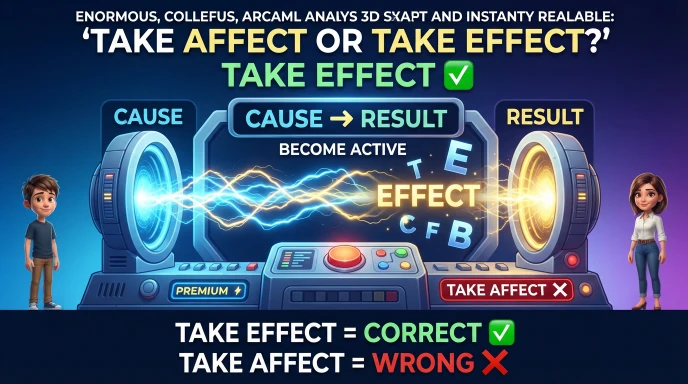
Take effect is correct; take affect is incorrect when you mean that something starts to work, happen, or become active.
English has many words that sound alike but have different meanings. “Take affect or take effect” is a common example. People often search this phrase because affect and effect are easy to mix up.
The correct phrase is take effect. We use it when a law, rule, medicine, decision, plan, or change begins to work or produce a result.
For example:
The new law will take effect next month.
The medicine should take effect soon.
The new rules took effect yesterday.
The phrase take affect is not correct when you mean “begin to work” or “become active.”
This guide explains the difference between affect and effect, their meanings and origins, British and American usage, common mistakes, everyday examples, and simple rules to help you choose the right phrase every time.
Take Affect or Take Effect : Quick Answer
Take effect is the correct phrase.
It means to begin working, operating, or producing a result.
Correct
The new policy will take effect on Monday.
Incorrect
The new policy will take affect on Monday.
If you are talking about something becoming active or starting to work, always use take effect.
Easy Memory Tip
Take effect = start working.
You can also remember:
- Affect = usually a verb meaning influence
- Effect = usually a noun meaning result
For example:
The new rule will take effect tomorrow.
The new rule may affect many employees.
Take Affect or Take Effect: Definition and Meaning
What Does “Take Effect” Mean?
Take effect means to begin to work, operate, or produce a result.
It is commonly used with laws, rules, policies, medicines, agreements, decisions, and changes.
Example:
The new policy will take effect next week.
This means the policy will begin to operate next week.
What Does “Affect” Mean?
Affect is usually a verb. It means to influence or change something.
Example:
The new policy may affect employees.
Here, affect means that the policy may influence employees.
What Does “Effect” Mean?
Effect is usually a noun. It means a result or outcome.
Example:
The new policy had a positive effect.
Here, effect means the result of the policy.
Is “Take Affect” Ever Correct?
Not as the standard phrase meaning “begin to work” or “become active.”
If that is your intended meaning, use:
take effect
The Origin of Take Affect or Take Effect

The words affect and effect have different histories, although both are connected to Latin.
Affect comes through Latin afficere, which means to act on or influence something. This helps explain why affect is commonly used as a verb meaning “influence.”
Effect comes through Latin efficere, meaning to accomplish, produce, or bring about something. This connects with its common noun meaning of “result.”
The phrase take effect developed around the idea of something beginning to produce its intended result. When a law or rule takes effect, it begins to operate. When medicine takes effect, it begins to work.
This is why English uses the established phrase take effect, rather than take affect, for this meaning.
British English vs American English Spelling
There is no British-American spelling difference in the phrase take effect.
Both British English and American English use take effect.
| English Variety | Correct Form | Example |
| American English | take effect | The law will take effect soon. |
| British English | take effect | The law will take effect soon. |
| Canadian English | take effect | The changes will take effect tomorrow. |
| Australian English | take effect | The rules will take effect next week. |
| International English | take effect | The policy will take effect in June. |
So, is “take effect” British or American? It is both. The phrase is standard in both major varieties of English.
Unlike words such as color/colour or traveling/travelling, there is no spelling variation here.
Which Spelling Should You Use?
If you mean that something starts working, becomes active, or begins producing a result, use take effect.
For US English
The new law will take effect next year.
For UK English
The new rules will take effect next month.
For Canada and Australia
The changes will take effect immediately.
For International English
Take effect is the safest standard choice.
The important thing is to understand the difference between the phrase take effect and the verb affect.
Compare:
The new rules will take effect tomorrow.
This means the rules will become active.
The new rules will affect many people.
This means the rules will influence many people.
Common Mistakes with Take Affect or Take Effect
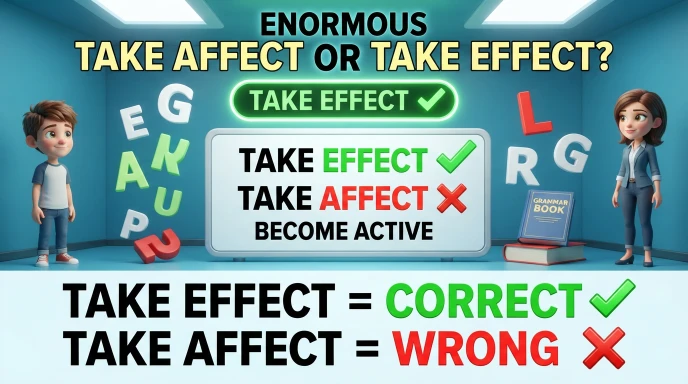
1. Take affect
❌ The new law will take affect tomorrow.
✅ The new law will take effect tomorrow.
Why?
The phrase means that the law will begin to operate.
Memory tip:
Something that starts working takes effect.
2. Effect vs. Affect
❌ The new rule will effect many workers.
✅ The new rule will affect many workers.
Here, affect is the verb meaning “influence.”
3. Using “affect” after “take”
❌ The medicine will take affect soon.
✅ The medicine will take effect soon.
The correct phrase is take effect.
4. Confusing “effect” with “affect”
❌ The decision had a strong affect on sales.
✅ The decision had a strong effect on sales.
Here, effect is a noun meaning “result.”
5. Mixing the two words
A useful rule is:
Affect = influence.
Effect = result.
This rule works in many common English sentences.
Take Affect or Take Effect in Everyday Examples
Knowing the rule is easier when you see it in real situations.
In Emails
Please note that the new schedule will take effect on Monday.
The updated policy will take effect immediately.
These sentences work well in workplace and school emails.
In News Writing
The new law will take effect next year.
The changes took effect after the vote.
News reports often use take effect when discussing laws, regulations, and government decisions.
On Social Media
The new rules will take effect tomorrow.
The changes finally took effect this week.
The phrase stays the same in informal online writing.
In Formal Writing
The agreement will take effect after both parties sign it.
The revised regulations will take effect on January 1.
With Medicine
The medicine should take effect within an hour.
Here, take effect means that the medicine should begin working.
With Business Decisions
The new pricing policy will take effect next month.
This means the new pricing policy will become active next month.
Take Affect or Take Effect : Google Trends & Usage Data
People search for “take affect or take effect” because the two words are commonly confused.
Search interest can vary by country and context. For example, people may search the phrase while writing an email, checking a business document, reading about a new law, or trying to describe the results of a decision.
However, search frequency does not determine if a phrase is grammatically correct. A commonly searched spelling can simply show that many people are unsure about it.
For reliable English usage, established dictionaries and style references are better guides.
The standard phrase is take effect when you mean that something begins to operate or produce a result.
Quick Comparison Table: Take Affect vs Take Effect
| Word or Phrase | Correct? | Meaning | Example |
| take effect | ✅ Yes | Begin to work | The rule will take effect Monday. |
| take affect | ❌ No | Not standard for this meaning | Avoid this phrase. |
| affect | ✅ Yes | Influence | The rule may affect workers. |
| effect | ✅ Yes | Result | The rule had a major effect. |
| have an effect | ✅ Yes | Produce a result | The change had an effect. |
| affect something | ✅ Yes | Influence something | The change may affect sales. |
The Fastest Rule
Something takes effect.
Something affects something else.
Something has an effect.
Remember these three patterns and you will avoid most affect/effect mistakes.
People Also Ask: Take Affect and Take Effect
1. Is it take affect or take effect?
Take effect is correct when you mean that something begins to work, operate, or become active.
2. What is the meaning of take effect?
Take effect means to begin working, operating, or producing a result.
3. Is take affect grammatically correct?
No. Take affect is not the standard phrase when you mean “begin to work.” Use take effect instead.
4. What is the difference between affect and effect?
Affect is usually a verb meaning “influence,” while effect is usually a noun meaning “result.”
5. Is it correct to say the law will take effect?
Yes. The law will take effect is a standard and correct expression.
6. Does medicine take effect or take affect?
Medicine takes effect. This means the medicine begins to work.
7. Is “take effect” one word?
No. Take effect is written as two separate words.
8. Can I say “the changes will take affect”?
No. Write “the changes will take effect.”
9. Is effect a noun or a verb?
Effect is most commonly a noun meaning a result. It can also be a verb in formal writing meaning to bring about something.
10. Is affect a noun or a verb?
Affect is most commonly a verb meaning to influence. It also has a less common noun use in psychology.
Key Takeaways: Take Affect or Take Effect
- Take effect is the correct phrase.
- Take affect is incorrect when you mean “begin to work.”
- Affect usually means influence.
- Effect usually means result.
- Laws and rules take effect.
- Medicine takes effect.
- Changes can affect people.
- Decisions can have an effect.
- British and American English both use take effect.
Conclusion: Take Effect or Take Affect ?
When choosing between take affect and take effect, the correct choice is take effect when you mean that something begins to work, operate, or produce a result.
For example, you can say, “The new law will take effect next month.” You can also say, “The medicine should take effect soon.” In both cases, something is beginning to work or become active.
The word affect has a different common role. It is usually a verb meaning “to influence,” as in “The new rule may affect many people.” Effect is usually a noun meaning a result, as in “The new rule had a major effect.”
There is no British or American spelling difference in take effect. The phrase is standard in both varieties of English and is also widely used in Canadian, Australian, and international English.
The easiest rule to remember is simple: something takes effect, something affects you, and something has an effect. Keep this pattern in mind, and you can confidently use the correct phrase in emails, schoolwork, business writing, news, and everyday English.
DISCOVER MORE ARTICLE HERE!
- Ax or Axe? Which Spelling Is Correct?
- Among or Amongst: Which One Should You Use?
- Separate or Seperate: Which Spelling Is Correct?

I’m Orin Blake, a writer with a passion for making English grammar simple, practical, and easy to understand. I enjoy breaking down confusing words, spelling differences, and everyday language questions into clear, reader-friendly guides. My goal is to help students, professionals, and curious learners write with greater confidence and accuracy.