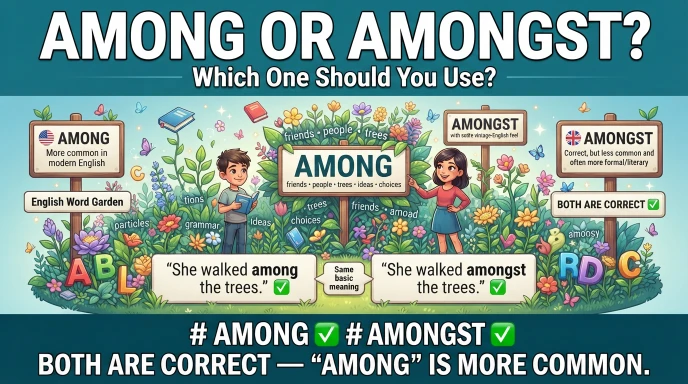
Choosing between among or amongst can be confusing. Both words are correct, and both have the same basic meaning.
They are used when talking about someone or something within a group or surrounded by several people or things.
For example, you can say, “She was sitting among her friends.” You can also say, “She was sitting amongst her friends.” Both sentences are grammatically correct.
So, what is the difference between among and amongst? The main difference is style and usage. Among is much more common in modern English, especially in American English.
Amongst is less common and can sound more formal, literary, or traditional. It is also more frequently used in British English.
This guide explains the meaning, origin, grammar, regional differences, common mistakes, and everyday use of among or amongst.
By the end, you will know which word is better for formal writing, casual conversations, academic work, and professional communication.
Among or Amongst : Quick Answer
Among and amongst are both correct. They usually mean the same thing: being in, surrounded by, or included in a group.
Examples:
- She found her phone among the books.
- She found her phone amongst the books.
- He was among the best students.
- He was amongst the best students.
The main difference is frequency and style.
| Word | Meaning | Common Usage |
| Among | In or surrounded by a group | Very common |
| Amongst | In or surrounded by a group | Less common, more formal/literary |
For most situations, among is the safest choice.
The Origin of Among or Amongst

The word among has very old roots in English. It developed from Old English forms related to the idea of being in a group or surrounded by others.
Amongst developed as a variation of among. The ending st was added to create a slightly different form.
Both words have continued to exist in English for centuries.
Over time, among became the more common form in everyday English. Amongst remained in use, especially in British English and more formal or literary writing.
Today, neither word is incorrect. The choice usually depends on writing style, regional preference, and personal preference.
British English vs American English Spelling
Unlike many spelling differences, among and amongst are not simply British and American spelling variants.
Both are used in both varieties of English. However, among is much more common in American English, while amongst appears more often in British English.
| Usage | American English | British English |
| Most common form | Among | Among |
| Alternative form | Amongst | Amongst |
| Formal/literary feel | Less common | More common |
| Everyday writing | Among | Among |
| Correct? | Both | Both |
Example
American English:
The decision was popular among employees.
British English:
The decision was popular among employees.
You could replace among with amongst in both sentences, but it may sound more formal or traditional.
Which Spelling Should You Use?
The good news is that you do not need to worry about choosing the “correct” word. Both among and amongst are grammatically correct.
However, among is usually the better choice for modern writing.
Use “Among” for Everyday English
Choose among when you want your writing to sound natural and simple.
Examples:
- He walked among the trees.
- The teacher shared the papers among the students.
- She was among the winners.
Use “Amongst” for a More Formal or Literary Style
Amongst can give writing a slightly more formal, traditional, or literary tone.
Examples:
- A quiet village stood amongst the hills.
- The writer searched amongst the old documents.
- He felt comfortable amongst his colleagues.
For school assignments, websites, business writing, and general communication, among is usually the clearest option.
Common Mistakes with Among or Amongst
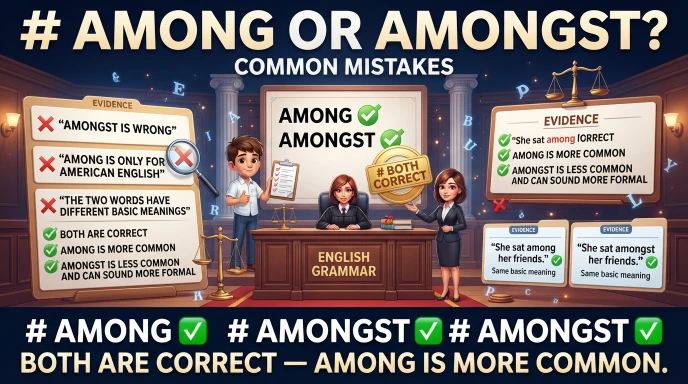
Mistake 1: Thinking “Amongst” Is Wrong
Some people believe amongst is incorrect. It is not.
Correct:
- She was among her friends.
- She was amongst her friends.
Both are grammatically acceptable.
Mistake 2: Using “Among” Only for Two Things
Traditionally, between is often associated with two items, while among is associated with three or more. However, modern English usage is more flexible.
Among generally refers to being within a group or collection.
Example:
- The teacher walked among the students.
Mistake 3: Using “Amongst” Everywhere
Although amongst is correct, it can sound unnecessarily formal in casual writing.
Instead of:
I found it amongst my old files.
A simpler modern version is:
I found it among my old files.
Mistake 4: Assuming They Have Different Meanings
In most normal sentences, among and amongst have the same meaning.
You usually do not change the meaning by switching one for the other.
Among or Amongst in Everyday Examples
Both words can be used in many different situations.
In Casual Conversation
Among is usually more natural.
- He is among my closest friends.
- I found the letter among the papers.
- She was among the crowd.
In Formal Writing
Both are possible.
- The report was shared among the departments.
- The report was shared amongst the departments.
However, among is still often preferred because it is concise and modern.
In Academic Writing
Among is generally the better choice.
Examples:
- The study found differences among the participants.
- There was agreement among researchers.
- The results varied among different groups.
In Literary Writing
Amongst may appear more often because it can create an older or more poetic tone.
Example:
- The house stood amongst the trees.
Still, among would also be completely correct.
Among or Amongst ;
Google Trends : & Usage Data
Search and languageuse patterns generally show that among is much more common than amongst.
This makes sense because among is widely preferred in everyday English, professional writing, news, education, and online content.
Amongst remains active, especially in British English and literary or formal contexts.
A simple way to understand the usage pattern is:
Among → common, modern, neutral
Amongst → less common, traditional, formal/literary
The popularity of among does not make amongst incorrect. It simply means that readers are more likely to encounter among in modern English.
Among vs Amongst Comparison Table
| Feature | Among | Amongst |
| Correct? | Yes | Yes |
| Meaning | In or surrounded by a group | In or surrounded by a group |
| Frequency | Very common | Less common |
| American English | Very common | Less common |
| British English | Very common | More noticeable |
| Formal writing | Excellent | Acceptable |
| Casual writing | Excellent | Can sound formal |
| Literary writing | Common | Often suitable |
FAQs
Is “amongst” grammatically correct?
Yes. Amongst is a grammatically correct word. It has essentially the same meaning as among.
Is among or amongst more common?
Among is much more common in modern English. It is especially common in American English and is also widely used in British English.
Is amongst British English?
Amongst is more strongly associated with British English, but it is not exclusively British. It can also be used in American English.
Should I use among or amongst in formal writing?
Among is usually the best choice because it is clear, natural, and widely accepted. Amongst is also correct but may sound more traditional or literary.
Do among and amongst mean the same thing?
Yes. In most contexts, among and amongst have the same meaning.
Is “amongst” oldfashioned?
It can sometimes sound more traditional or literary, but it is not obsolete. People still use it, particularly in British English and certain formal or literary contexts.
Which is better for : among or amongst?
For general content, among is usually the more natural and widely recognized choice. If your target keyword is “among or amongst,” you can naturally discuss both forms.
Conclusion
Among and amongst are both correct English words. They generally have the same meaning and can be used in the same types of sentences.
The biggest difference is style and frequency. Among is much more common and works well in almost every situation.
It sounds natural in casual conversation, academic writing, business communication, websites, and everyday English.
Amongst is also correct, but it is less common. It may sound more formal, traditional, or literary. It is especially noticeable in British English, although it is not limited to British English.
If you are unsure which word to choose, among is the safest option. It is simple, modern, and widely understood.
So, when deciding between among or amongst, remember: neither is wrong. Use among for normal modern English, and choose amongst when you prefer a more traditional or literary tone.
DISCOVER MORE ARTICLE HERE!
- Everytime or Every Time? Which Spelling Is Correct?
- Quite or Quiet: Which Is Correct?
- Ax or Axe? Which Spelling Is Correct?

I’m Orin Blake, a writer with a passion for making English grammar simple, practical, and easy to understand. I enjoy breaking down confusing words, spelling differences, and everyday language questions into clear, reader-friendly guides. My goal is to help students, professionals, and curious learners write with greater confidence and accuracy.