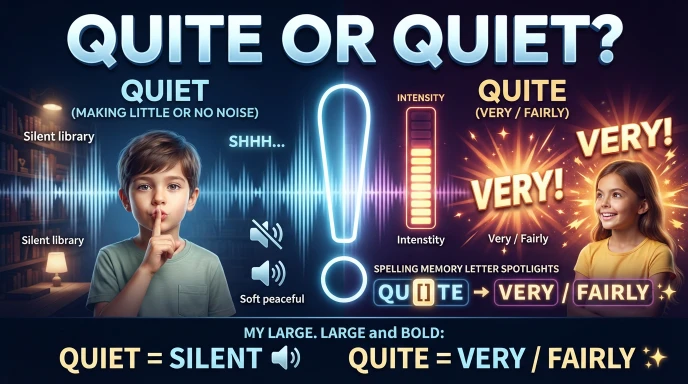
Quite or quiet? These two words look almost identical, but they have very different meanings. Quite usually means fairly, completely, or very, depending on the sentence. Quiet means making little noise or being silent and calm.
For example, you might say, “The movie was quite interesting,” but “Please be quiet during the movie.” One extra letter changes the meaning completely.
People often search for quite or quiet because the words have similar spelling and pronunciation. They are especially confusing for students.
ESL learners, and writers who may accidentally use one when they mean the other. The mistake can change the meaning of an entire sentence.
This guide explains the difference between quite and quiet, their meanings, pronunciation, grammar, common mistakes, and practical examples. By the end, you will have a simple trick to remember which word to use.
Quite or Quiet: The Quick Answer You Need
Use “quite” to add emphasis or show degree. Use “quiet” to describe little or no noise.
Quick examples
- The book was quite interesting. ✅
- Please be quiet in the library. ✅
- She is quite tired today. ✅
- The room is quiet now. ✅
Easy rule:
- Quite = degree or emphasis
- Quiet = silence or little noise
Quite or Quiet : Quick Answer
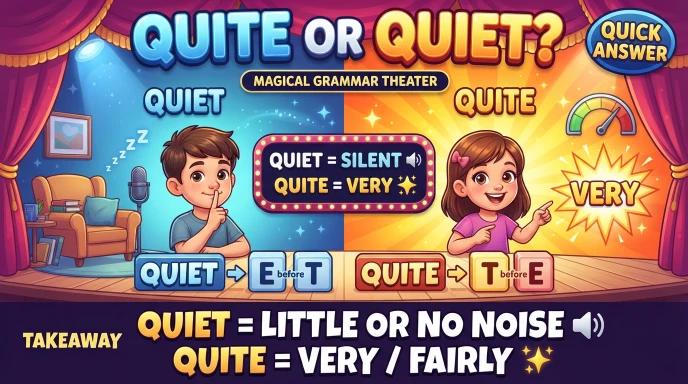
Although quite and quiet look similar, they have different grammatical roles and meanings.
Quite
Quite is an adverb. It can mean:
- fairly
- rather
- completely
- totally
The exact strength depends on the sentence and regional usage.
The test was quite difficult.
I am quite sure.
The answer is quite correct.
Quiet
Quiet is usually an adjective. It describes a person, place, or situation with little noise.
The classroom is quiet.
Please be quiet.
We live on a quiet street.
It can also be used as a noun or verb in some contexts.
What Does Quite or Quiet Mean?
What does “quite” mean?
Quite modifies another word. It adds information about degree or emphasis.
Examples:
She is quite happy.
The task was quite easy.
I am quite certain about the answer.
The meaning can vary depending on context.
In some sentences, quite means fairly:
The weather is quite cold.
In other sentences, it means completely:
You are quite right.
What does “quiet” mean?
Quiet describes a lack of noise, activity, or disturbance.
Examples:
The baby is quiet.
It is quiet outside.
We found a quiet place to study.
Quiet can also describe a calm personality:
He is a quiet person.
The main difference
Quite tells you how much.
Quiet tells you how noisy or silent something is.
The Origin of Quite or Quiet
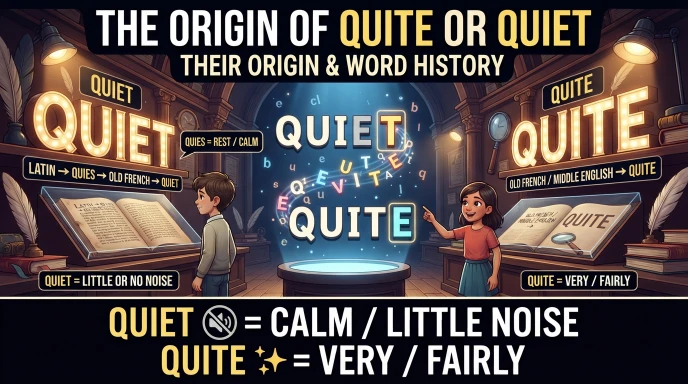
The words quite and quiet have different histories and developed from different language roots.
Quiet is connected with earlier forms referring to calmness, rest, and freedom from disturbance. Its meaning has remained closely linked to silence and peacefulness.
Quite developed separately and became an English adverb used to show degree, agreement, or emphasis. Over time, its meaning became flexible and could range from fairly to completely, depending on context.
Their similar modern spelling is one reason they are often confused, but they are unrelated in meaning and grammatical function.
British English vs American English
Both British and American English use quite and quiet, but quite can sometimes create subtle differences in strength.
| Word | British English | American English | Example |
| quite | Can mean fairly or completely, depending on context | Often means very or fairly | The film was quite good. |
| quiet | Means little or no noise | Means little or no noise | Please be quiet. |
| quite right | Strong agreement | Strong agreement | You are quite right. |
| quiet place | Peaceful place | Peaceful place | We found a quiet café. |
Regional differences
The meaning of quiet is stable across major English varieties.
Quite is more flexible. In British English, quite good can sometimes sound more moderate than very good, depending on tone and context. In American English, quite may sound more emphatic or formal in some situations.
Because tone affects the meaning, context is important.
Which Version Should You Use?
United States
Use quite for degree or emphasis.
The presentation was quite useful.
Use quiet for little noise.
The office is quiet today.
United Kingdom
Use the same basic distinction.
The exam was quite difficult.
Please keep quiet.
Remember that quite can have subtle differences in strength depending on context.
Canada
Both words follow the same basic meanings.
The restaurant was quite busy.
The neighborhood is quiet.
Australia
Use quite for degree and quiet for silence or calmness.
The weather is quite warm.
It is quiet here.
International writing
The difference is the same worldwide:
- Quite = degree
- Quiet = silence
Academic writing
Use quite carefully because it can sometimes sound vague.
Less precise:
The results were quite significant.
More precise:
The results showed a substantial difference.
Use quiet when describing sound or activity.
The participants worked in a quiet environment.
Business writing
Use quite when appropriate, but choose more precise language when clarity matters.
The project was quite successful.
More specific:
The project exceeded its target by 20%.
Use quiet for workplace conditions.
Please find a quiet area for the call.
Common Mistakes
Mistake 1: Using “quiet” when you mean “quite”
Incorrect:
The movie was quiet interesting.
Correct:
The movie was quite interesting.
Explanation: Quite means fairly or very in this sentence.
Memory tip: Quite has “te” at the end and often talks about degree.
Mistake 2: Using “quite” when you mean silence
Incorrect:
Please be quite.
Correct:
Please be quiet.
Explanation: Quiet describes a lack of noise.
Memory tip: Quiet has an extra “e” before the “t,” giving it the letters “quiet.” Think: Quiet = silence.
Mistake 3: Assuming “quite” always means “very”
The meaning of quite can depend on context.
The movie was quite good.
This may mean fairly good or very good, depending on the speaker and regional usage.
Mistake 4: Misspelling the words in fast writing
Because quite and quiet have the same letters in a different order, typing errors are common.
A useful check is to ask:
Am I talking about degree or silence?
- Degree → quite
- Silence → quiet
Everyday Examples
Emails
I am quite happy with the proposed schedule.
Please find a quiet place before joining the call.
Business writing
The results were quite encouraging.
The team needs a quiet workspace.
News headlines
City Centre Becomes Quiet After Midnight
New Policy Receives Quite Positive Response
Blogs
Why a Quiet Workspace Can Improve Focus
The Quite Unexpected Result of My Experiment
In formal publishing, the second example would depend on the intended meaning.
Social media
This sunset is quite beautiful! 🌅
Enjoying a quiet evening at home.
Academic writing
The experiment was conducted in a quiet room.
The difference was quite noticeable.
Daily conversation
That was quite funny!
Please be quiet for a minute.
Google Trends & Modern Usage
The keyword quite or quiet is commonly searched because the words differ by only the position of two letters but have completely different meanings.
Common related searches include:
- quite vs quiet
- difference between quite and quiet
- quiet or quite meaning
- quite and quiet pronunciation
- please be quiet or quite
- quite interesting meaning
- how to remember quite vs quiet
The search intent is informational, educational, and comparisonbased.
The confusion is especially common among English learners because the words look similar but belong to different parts of speech. Quite is primarily an adverb, while quiet is commonly an adjective.
Exact Google Trends statistics are not included because this article does not rely on verified live search data. The discussion is based on general modern English usage and common spelling confusion.
Quick Comparison Table
| Version | Meaning | Correct? | Region | Example |
| quite | Fairly, very, or completely | ✅ Yes | International | The film was quite good. |
| quiet | Making little or no noise | ✅ Yes | International | Please be quiet. |
| quiet interesting | Incorrect word choice | ❌ No | International | Use “quite interesting.” |
| be quite | Incorrect for silence | ❌ No | International | Use “be quiet.” |
| quite right | Completely correct | ✅ Yes | International | You are quite right. |
Key Takeaways
- Quite and quiet have different meanings.
- Quite usually shows degree or emphasis.
- Quiet describes little or no noise.
- Quite is mainly an adverb.
- Quiet is commonly an adjective.
- Ask if you mean how much or how silent.
- The meaning of quite can change slightly depending on context and region.
- Quite = degree. Quiet = silence.
FAQs
What is the difference between quite and quiet?
Quite usually means fairly, very, or completely and is used to show degree. Quiet means making little or no noise. For example, “The test was quite difficult,” but “Please be quiet during the test.”
Is it quite or quiet good?
The correct phrase is quite good. Here, quite modifies the adjective good and shows degree. Quiet good is incorrect because quiet describes little noise rather than intensity.
Is it “be quite” or “be quiet”?
The correct phrase is be quiet when asking someone to stop making noise. Quiet describes silence or little noise. Be quite has a different meaning and is not the standard phrase for asking for silence.
Does quite mean very?
Sometimes, but not always. Quite can mean fairly, rather, very, or completely, depending on context, tone, and regional usage. For example, “quite right” usually means completely right.
How do you remember quite vs quiet?
Remember the meaning first. Quite is about degree, while quiet is about silence. Ask yourself: Am I describing how much, or am I describing how noisy something is?
Can quiet be a verb?
Yes. Quiet can sometimes be used as a verb, meaning to make something calmer or less noisy. For example, “The teacher quieted the class.” However, quiet is most commonly used as an adjective.
Is quiet an adjective?
Yes. Quiet is commonly an adjective because it describes a noun. For example, “a quiet room,” “a quiet child,” and “a quiet street.”
Is quite an adverb?
Yes. Quite is primarily an adverb. It modifies adjectives, verbs, or other adverbs by showing degree or emphasis. For example, “quite difficult” and “quite slowly.”
Why are quite and quiet confusing?
They are confusing because they contain many of the same letters and have similar spelling. However, the letters appear in a different order, and the words have completely different meanings and grammatical roles.
Which word should I use in “The room is ___”?
Use quiet: “The room is quiet.” The sentence describes the amount of noise in the room. Quite would not fit because it normally modifies another word.
Conclusion
The difference between quite or quiet is simple once you focus on meaning. Quite is mainly used to show degree or emphasis.
It can mean fairly, very, or completely, depending on the sentence and context. Quiet, on the other hand, describes little noise, silence, calmness, or peacefulness.
The two words are easy to confuse because their spelling is similar, but one small change completely changes the meaning.
Before choosing a word, ask yourself if you are talking about how much or how silent something is.
If you mean degree, use quite. If you mean silence or little noise, use quiet. This simple check will help you avoid one of the most common spelling mistakes in English.
DISCOVER MORE ARTICLE HERE!
- Colon or Semicolon: What’s the Difference?
- Drier or Dryer: Which Is Correct?
- Quite or Quiet: Which Is Correct?

I’m Orin Blake, a writer with a passion for making English grammar simple, practical, and easy to understand. I enjoy breaking down confusing words, spelling differences, and everyday language questions into clear, reader-friendly guides. My goal is to help students, professionals, and curious learners write with greater confidence and accuracy.