The correct spelling is “grateful,” not “greatful.” Although “greatful” looks logical because it resembles the word great, it is a common spelling mistake. Grateful means feeling or showing thanks and appreciation.
For example, you can say, “I am grateful for your help.” The spelling greatful is incorrect in standard English.
The confusion often happens because grateful sounds somewhat like it could be formed from great + ful. However, its spelling is connected to gratitude.
not great. This makes grateful the form you should use in school, work, emails, academic writing, and everyday communication.
In this guide, you will learn the meaning of grateful, its origin, the difference between grateful and greatful, common mistakes, practical examples, and an easy memory trick.
Is It Grateful or Greatful? The Correct Spelling Explained
Grateful is the correct spelling. It means feeling or expressing thanks and appreciation. Greatful is a common misspelling and should be avoided in standard English.
For example: “I am grateful for your support.” Think of grateful as being connected to gratitude.
Grateful or Greatful: Quick Answer
The correct spelling is:
- Grateful ✅
- Greatful ❌
Correct examples
- I am grateful for your kindness.
- She was grateful for the opportunity.
- We are grateful to everyone who helped us.
Why is “grateful” correct?
The word grateful is related to gratitude and means feeling thankful or appreciative.
The spelling greatful is incorrect because the word is not formed from great + ful.
A simple memory trick is:
Grateful = gratitude + grateful
If you remember gratitude, you are more likely to remember the correct spelling grateful.
What Does Grateful Mean?
Grateful is an adjective that describes someone who feels or expresses thanks.
It can describe appreciation for:
- Help
- Kindness
- Support
- An opportunity
- A gift
- Good circumstances
- Someone’s actions
For example:
I am grateful for your advice.
This means that I appreciate your advice and feel thankful for it.
You can also use grateful to when referring to the person who helped you:
I am grateful to my teacher for her guidance.
Grateful for vs. grateful to
These two structures are both common, but they serve slightly different purposes.
Grateful for + thing/action:
I am grateful for your support.
Grateful to + person:
I am grateful to my parents.
You can combine them:
I am grateful to my parents for their support.
The Origin of Grateful

The word grateful comes from the same word family as gratitude and grace. It ultimately traces back through French to Latin roots associated with being pleasing, thankful, or appreciative.
The important point for spelling is that grateful is not derived from the English adjective “great.”
This explains why the spelling is:
grateful ✅
rather than:
greatful ❌
The ending -ful means “full of” or “characterized by,” but the base word here is related to grate in its historical sense of being thankful or pleasing, not the modern adjective great.
Over time, grateful became the standard English spelling used to describe a feeling of thankfulness.
Why do people spell it “greatful”?
The mistake is understandable.
People often hear:
grateful
and connect it with:
great + ful
Because great is a familiar English word, greatful may seem logical at first glance.
However, pronunciation does not determine the spelling. The standard form is grateful.
British English vs American English
There is no spelling difference between British and American English for this word.
Both varieties use:
grateful ✅
Neither uses greatful as the standard spelling.
| Feature | British English | American English | Example |
| Correct spelling | grateful | grateful | I am grateful for your help. |
| Incorrect spelling | greatful | greatful | Avoid this spelling. |
| Part of speech | Adjective | Adjective | She felt grateful. |
| Related noun | gratitude | gratitude | He expressed his gratitude. |
| Opposite idea | ungrateful | ungrateful | He seemed ungrateful. |
Regional differences
Unlike spelling pairs such as colour/color or travelling/traveling, grateful does not change between British and American English.
The same spelling is used in:
- The United States
- The United Kingdom
- Canada
- Australia
- New Zealand
- International English
So there is no need to choose between a British and American version.
Which Version Should You Use?
United States
Use grateful in all standard writing.
I am grateful for your support.
United Kingdom
British English also uses grateful.
We are grateful for your assistance.
Canada
The standard spelling is grateful.
Australia
Use grateful in both formal and informal writing.
International writing
For an international audience, always choose grateful.
Academic writing
Grateful is perfectly acceptable when discussing appreciation or expressing thanks.
The researchers are grateful to the participants for their cooperation.
Business writing
It is common in professional emails and letters:
We are grateful for your continued support.
For a more formal tone, you might use:
We appreciate your continued support.
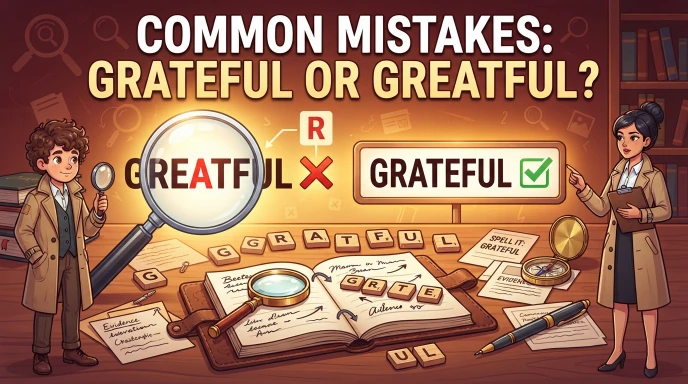
Common Mistakes Of Grateful
Mistake 1: Writing “greatful”
Incorrect:
I am greatful for your help.
Correct:
I am grateful for your help.
Explanation: Greatful is a misspelling. The standard English word is grateful.
Memory tip: Connect grateful with gratitude, not great.
Mistake 2: Using “greatfully”
The same spelling mistake appears in the adverb.
Incorrect:
I greatfully accept your offer.
Correct:
I gratefully accept your offer.
The correct forms are:
- grateful ✅
- gratefully ✅
- gratitude ✅
- greatful ❌
- greatfully ❌
Mistake 3: Confusing “grateful” and “thankful”
These words are often similar in meaning, but they are not always interchangeable in every context.
I am grateful for your support.
I am thankful for your support.
Both can be correct. Grateful often emphasizes appreciation, while thankful can also emphasize relief or appreciation for a positive situation.
Mistake 4: Using the wrong preposition
A common structure is:
grateful for something
Example:
She is grateful for the opportunity.
When identifying the person receiving your thanks, use:
grateful to someone
Example:
She is grateful to her teacher.
Everyday Examples
Emails
I am grateful for your quick response.
This is polite and professional.
Business writing
We are grateful for your continued partnership.
This works well in formal business communication.
News writing
The family said they were grateful for the public’s support.
Blogs
I am grateful for everyone who supported me during this journey.
Social media
Feeling grateful for all the kind messages today.
Academic writing
The authors are grateful to the participants who contributed to the study.
Daily conversation
I’m really grateful for your help.
This is a natural expression in everyday English.
Google Trends & Modern Usage
Grateful is a well-established English word used across many varieties of English. People commonly search for “grateful or greatful” because the incorrect spelling seems intuitive when the word is heard or typed quickly.
The main search intent is spelling clarification. Users may also search related questions such as:
- grateful or greatful
- is greatful correct?
- how do you spell grateful?
- grateful meaning
- grateful definition
- grateful spelling
- gratefully or greatfully
- grateful vs thankful
- grateful pronunciation
There is no British-versus-American spelling difference to explain here. Both major varieties use grateful.
Exact Google Trends statistics should not be invented without current, verifiable data. The general usage pattern is clear: grateful is the established standard spelling, while greatful is a misspelling.
Quick Comparison Table
| Version | Meaning | Correct? | Region | Example |
| grateful | Feeling or showing thanks | ✅ Yes | International | I am grateful for your help. |
| greatful | Intended to mean thankful | ❌ No | Not standard | Avoid this spelling. |
| gratefully | In a thankful way | ✅ Yes | International | She gratefully accepted the gift. |
| greatfully | Intended as the adverb | ❌ No | Not standard | Use gratefully instead. |
| gratitude | The feeling of thankfulness | ✅ Yes | International | He expressed his gratitude. |
| thankful | Feeling or expressing thanks | ✅ Yes | International | I am thankful for your support. |
Key Takeaways
- Grateful is the correct spelling.
- Greatful is a common misspelling.
- Grateful means feeling or showing thanks.
- The word is connected to gratitude, not the word great.
- British and American English both use grateful.
- The correct adverb is gratefully, not greatfully.
- Use grateful for when talking about something you appreciate.
- Use grateful to when identifying the person you appreciate.
FAQs
1. Is it “grateful” or “greatful”?
The correct spelling is grateful. Greatful is a common spelling mistake and is not the standard spelling of the adjective meaning thankful or appreciative. If you are writing in British English or American English, use grateful.
2. Why is it “grateful” and not “greatful”?
The correct form is grateful because the word comes from gratitude and is related to the Latin root gratus, meaning thankful or pleasing.
Although “greatful” may look logical because of the word great, it is not the standard English spelling. Therefore, when choosing between grateful or greatful, always use grateful.
3. What does “grateful” mean?
Grateful means feeling or showing appreciation and thankfulness for something someone has done, received, or experienced.
For example, “I am grateful for your help” means “I appreciate your help.” Common related words include thankful, appreciative, obliged, and indebted.
4. What is the meaning of “greatful”?
Greatful is generally considered a misspelling of grateful when someone intends to express thankfulness or appreciation.
It is sometimes written because people associate the word with great, but standard dictionaries and edited English use grateful for the meaning “thankful.”
5. Is “greatful” a word?
Greatful is not the standard English word used to mean “thankful.” In normal modern English writing, the correct word is grateful.
If you are checking spelling for an essay, email, website, academic paper, or professional document, choose grateful, not greatful.
6. Is it “grateful” or “greatful” in the UK?
In British English, the correct spelling is grateful. There is no separate British spelling greatful. The same standard spelling is used in American English, Canadian English, Australian English, and other major varieties of English.
7. Is “grateful” the same as “thankful”?
Grateful and thankful are very similar in meaning, and they can often be used interchangeably. Both describe appreciation for something received or experienced.
For example, “I am grateful for your support” and “I am thankful for your support” are both correct.
8. Which is correct in American English: “greatful or grateful”?
The correct spelling in American English is grateful. American dictionaries and standard English usage do not normally use greatful as the spelling for “thankful.”
Therefore, whether you are writing for a US or UK audience, grateful is the safe and correct choice.
9. Why do people spell “grateful” as “greatful”?
People often spell grateful as greatful because the pronunciation can make the spelling confusing, and the familiar word great appears to fit naturally into the incorrect version.
However, grateful is historically connected with gratitude, not simply with the adjective “great.” This makes greatful a common spelling error.
10. What are synonyms for “grateful”?
Common synonyms for grateful include thankful, appreciative, obliged, indebted, appreciative, and appreciative of.
The best synonym depends on the context. In everyday English, thankful and appreciative are among the closest alternatives to grateful
What is an easy way to remember grateful?
Connect grateful with gratitude. Both begin with grat-. So remember: gratitude → grateful, not great → greatful. If you see greatful, stop and replace it with grateful.
Conclusion
When choosing between grateful or greatful, the correct answer is always grateful in standard English. Greatful is a common spelling mistake caused by the tempting connection between the word and great.
Grateful means feeling or showing appreciation or thanks. It is related to gratitude, which makes a useful memory clue.
for its spelling. The same spelling is used in British, American, Canadian, Australian, and international English.
You can use grateful in almost any type of writing. It works naturally in personal messages, professional emails.
academic writing, business communication, speeches, blogs, and everyday conversation. Remember the useful patterns grateful to someone and grateful for something.
If you are unsure about the spelling, think of gratitude. That one connection can help you remember the correct form every time.
Memorable rule: You feel grateful because you have gratitude, not because something is “great.”
DISCOVER MORE ARTICLE!
- Highschool or High School? Which One Is Correct?
- To Late or Too Late? The Correct Spelling(2026)
- Preform or Perform: Which Word Is Correct?(2026)

I’m Orin Blake, a writer with a passion for making English grammar simple, practical, and easy to understand. I enjoy breaking down confusing words, spelling differences, and everyday language questions into clear, reader-friendly guides. My goal is to help students, professionals, and curious learners write with greater confidence and accuracy.