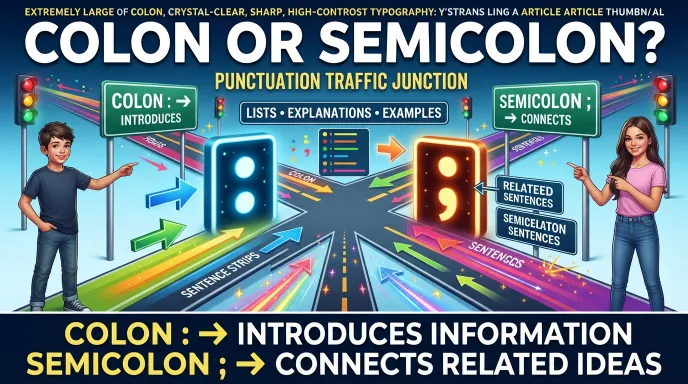
A colon (:) and a semicolon (;) may look similar, but they do very different jobs in English writing. A colon usually introduces something, while a semicolon usually connects closely related ideas.
For example, you might write, “I need three things: a pen, paper, and a notebook.” Here, the colon introduces a list.
But you could write, “I finished my homework; then I watched a movie.” Here, the semicolon links two closely connected ideas.
People often search for colon or semicolon because both punctuation marks create a pause and can appear between parts of a sentence. However, choosing the wrong one can make a sentence unclear or grammatically incorrect.
This guide explains the difference between a colon and semicolon, when to use each mark, common mistakes, and simple examples you can use in everyday, academic, and professional writing.
Colon or Semicolon: What’s the Difference?
A colon (:) introduces or explains something that follows, such as a list, example, explanation, or quotation. A semicolon (;) connects two closely related independent clauses or separates complicated items in a list.
Quick rule: Use a colon to introduce and a semicolon to connect.
Colon or Semicolon: Quick Answer
Choose the punctuation mark based on what your sentence needs:
- Colon (:) = introduces, explains, or presents information
- Semicolon (;) = connects closely related complete sentences
- Colon (:) = often introduces a list
- Semicolon (;) = can separate complex list items
Examples
Colon:
I brought everything I needed: a laptop, a charger, and headphones.
Semicolon:
The weather was terrible; we decided to stay home.
Both sentences are correct, but the punctuation marks perform different functions.
What Does a Colon or Semicolon Mean?
What does a colon mean?
A colon (:) is a punctuation mark used to introduce information that explains, expands on, or completes the idea before it.
Common uses include:
- Introducing a list
- Introducing an explanation
- Introducing an example
- Introducing a quotation
- Separating a title and subtitle
- Showing time in digital formats
Example:
She had one goal: to finish the project.
The words after the colon explain the goal.
What does a semicolon mean?
A semicolon (;) is a punctuation mark that links closely related independent clauses without using a coordinating conjunction such as and, but, or so.
Example:
I wanted to go outside; it was raining.
Both parts can stand as complete sentences:
I wanted to go outside.
It was raining.
Because the ideas are closely related, a semicolon can connect them.
The simplest difference
Think of it this way:
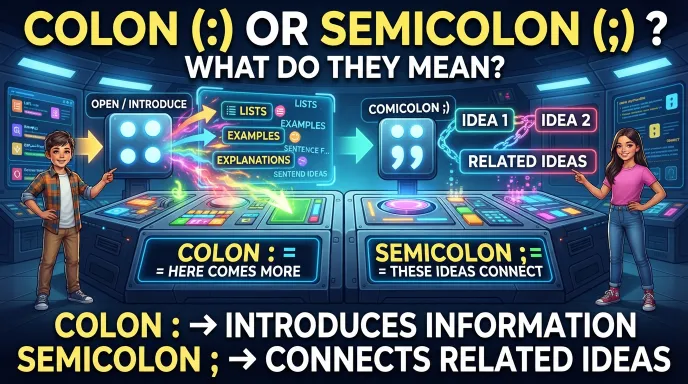
Colon = “Here comes more information.”
Semicolon = “These two complete ideas are closely connected.”
The Origin of the Colon and Semicolon
The colon and semicolon have been part of written punctuation for centuries.
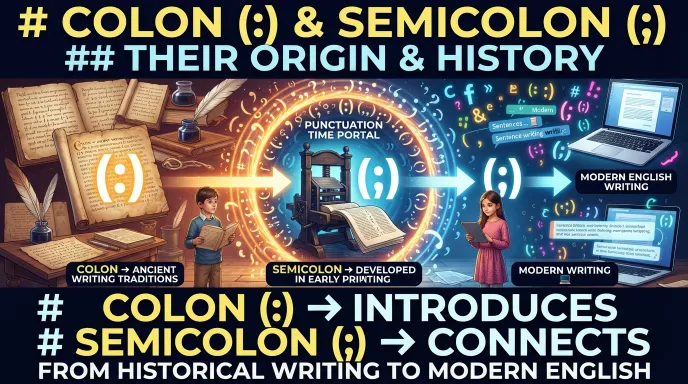
The colon has roots in ancient Greek and Latin writing traditions. Its name comes from the Greek word kōlon, which referred to a part or section of a sentence.
Early punctuation systems used marks to help readers understand pauses and divisions in written text.
The semicolon was developed later. It is widely associated with the Italian printer and publisher Aldus Manutius, who used and helped establish the mark in early printed books during the late fifteenth century.
Over time, punctuation rules became more standardized. Today, the colon and semicolon are used mainly to show relationships between ideas rather than simply indicating the length of a pause.
Modern style guides may differ slightly in specific situations, but the central distinction remains the same: colons introduce, while semicolons connect closely related complete ideas.
British English vs American English
Both British and American English use colons and semicolons in largely the same way.
The main differences are usually related to style preferences rather than basic grammar rules.
| Feature | British English | American English | Example |
| Introduce a list | Colon | Colon | Bring three items: paper, pens, and a ruler. |
| Connect related clauses | Semicolon | Semicolon | It was late; we went home. |
| Complex lists | Semicolon | Semicolon | Paris, France; Rome, Italy; and Tokyo, Japan. |
| Introduce an explanation | Colon | Colon | The answer was clear: we needed more time. |
| Style preference | May vary by publisher | May vary by style guide | Follow the house style. |
Regional differences
The basic rules are the same in both British and American English.
However, publishers and academic institutions may have their own punctuation preferences. For professional or academic work, always follow the relevant style guide.
Which Version Should You Use?
The choice is not about British or American spelling. It depends on the relationship between the ideas in your sentence.
United States
Use a colon to introduce information.
I have one request: please be on time.
Use a semicolon to connect closely related complete sentences.
The meeting ended early; everyone went home.
United Kingdom
The same core rules apply.
A colon introduces information, while a semicolon connects related clauses.
Canada
Follow the same grammar rules. For formal writing, check the style guide required by your school, university, or organization.
Australia
Use colons and semicolons according to the same basic principles.
International writing
The rules are widely understood across Englishspeaking regions:
- Colon = introduction or explanation
- Semicolon = connection between complete ideas
Academic writing
Both punctuation marks can be useful in academic writing.
Use a colon to introduce:
- Evidence
- A list
- An explanation
Use a semicolon to connect closely related independent clauses or separate complex list items.
Business writing
Use both marks carefully.
In modern business writing, shorter sentences are often easier to read. Do not use a semicolon simply to make writing look more formal.
Common Mistakes
Mistake 1: Using a semicolon before an incomplete sentence
Incorrect:
I need several things; a notebook, a pen, and a calculator.
Correct:
I need several things: a notebook, a pen, and a calculator.
Explanation: The second part is a list, not a complete sentence. A colon is the better choice.
Memory tip: Lists often follow colons.
Mistake 2: Using a colon between two complete sentences that should be connected differently
Less natural:
I was tired: I went to bed.
Better:
I was tired, so I went to bed.
or:
I was tired; I went to bed.
A colon can sometimes introduce an explanation, but a semicolon or conjunction may be clearer when simply connecting two related actions.
Mistake 3: Using a semicolon with a coordinating conjunction
Incorrect:
I was tired; but I continued working.
Correct:
I was tired, but I continued working.
A semicolon usually replaces the comma and coordinating conjunction when joining two independent clauses.
Mistake 4: Using a colon after a verb when the sentence is incomplete
Incorrect:
My favorite foods are: pizza, pasta, and soup.
Better:
My favorite foods are pizza, pasta, and soup.
or:
I have three favorite foods: pizza, pasta, and soup.
The words before the colon should normally form a complete thought.
Everyday Examples
Emails
Please bring the following documents: your ID, application form, and receipt.
I have reviewed your request; I will respond tomorrow.
Business writing
The company has one priority: customer satisfaction.
Sales increased this quarter; costs also increased.
News headlines
Government Announces New Plan: Changes Begin Next Month
Storm Continues; Thousands Remain Without Power
Blogs
I learned one important lesson: preparation matters.
The recipe looked difficult; it was actually simple.
Social media
Today’s goal: stay positive.
I tried to wake up early; it did not happen. 😅
Academic writing
The results showed one clear pattern: student participation increased.
The first group improved significantly; the second group showed little change.
Daily conversation
I have good news: we got the tickets!
I wanted to call you; my phone battery died.
Google Trends & Modern Usage
People search for “colon or semicolon” because punctuation rules can feel confusing, especially when both marks appear to create a stronger break than a comma.
Common searches include:
- colon vs semicolon
- when to use a colon
- when to use a semicolon
- colon and semicolon difference
- semicolon examples
- colon examples
- colon before a list
- how to use a semicolon correctly
The search intent is informational, educational, and comparisonbased.
Modern writing often uses shorter sentences and simpler punctuation, especially online. As a result, semicolons may appear less often in casual digital writing. However, they remain useful in formal, academic, and carefully edited writing.
Exact Google Trends statistics are not included here because this article does not rely on verified live data. The discussion is based on general modern writing patterns rather than invented statistics.
Quick Comparison Table
| Version | Main Purpose | Correct Use | Region | Example |
| Colon (:) | Introduces information | Lists, explanations, examples | International | I need one thing: help. |
| Semicolon (;) | Connects related ideas | Two closely related independent clauses | International | It was late; we left. |
| Colon (:) | Introduces a list | Before a complete introductory clause | International | Bring these items: pens and paper. |
| Semicolon (;) | Separates complex list items | Items already contain commas | International | London, England; Paris, France; Rome, Italy. |
| Colon (:) | Introduces an explanation | Expands on the first clause | International | The reason was simple: we were late. |
Key Takeaways
- A colon (:) usually introduces information.
- A semicolon (;) usually connects closely related complete sentences.
- Use a colon before a list when the first part is a complete thought.
- Use a semicolon between two independent clauses without a coordinating conjunction.
- Use semicolons to separate complex list items that already contain commas.
- British and American English follow the same core rules.
- Avoid overusing semicolons in simple or casual writing.
- Remember: A colon introduces; a semicolon connects.
FAQs
What is the difference between a colon and semicolon?
A colon introduces information, such as a list, explanation, example, or quotation. A semicolon connects two closely related complete sentences or separates complicated items in a list. A simple rule is: use a colon to introduce and a semicolon to connect.
When should I use a colon?
Use a colon when the words after it explain, expand on, or list information connected to the first part of the sentence. For example: “She brought everything she needed: a laptop, charger, and notebook.” The first part prepares the reader for the information that follows.
When should I use a semicolon?
Use a semicolon between two closely related independent clauses. Both sides should normally be complete sentences. For example: “I wanted to go for a walk; it started to rain.” You can also use semicolons to separate items in a complicated list.
Can I use a semicolon before “and”?
Usually, no. When joining two independent clauses with and, but, or, so, or another coordinating conjunction, use a comma before the conjunction.
For example: “I was tired, but I continued working.” A semicolon usually replaces the conjunction rather than appearing before it.
Can I use a colon before a list?
Yes, but the words before the colon should usually form a complete thought. Write, “I need three things: a pen, paper, and a notebook.”
Avoid inserting a colon directly after a verb or preposition when the sentence is already grammatically complete without it.
Are colons and semicolons used differently in British and American English?
The main rules are the same in British and American English. Differences are usually matters of editorial style rather than basic grammar.
For academic, legal, or professional writing, follow the style guide required by your school, employer, publisher, or organization.
Can a semicolon replace a period?
Sometimes. A semicolon can connect two complete sentences that are closely related in meaning. For example: “The store was closed; we returned home.”
A period would also be grammatically correct, but the semicolon shows a closer connection between the ideas.
Can a colon connect two complete sentences?
Yes, when the second sentence explains, clarifies, or expands on the first. For example: “She knew what she had to do: finish the report before Friday.” The information after the colon explains the statement before it.
What is the easiest way to remember colon vs semicolon?
Think of their jobs. A colon tells the reader, “Here is more information.” A semicolon tells the reader, “These two complete ideas belong closely together.” This simple distinction solves most common colon and semicolon mistakes.
Can I use a semicolon in everyday writing?
Yes, but you do not need to use one often. Semicolons are useful when two complete sentences are closely related. In casual writing.
two shorter sentences may sometimes be clearer. Use a semicolon when it improves the relationship and flow between ideas.
Conclusion
When deciding between a colon or semicolon, focus on what you want the punctuation mark to do. A colon introduces something that follows, such as a list, explanation.
example, or clarification. A semicolon connects two complete sentences that are closely related or separates complex items in a list.
The easiest way to remember the difference is to think about direction. A colon points forward and says that more information is coming. A semicolon creates a bridge between two complete ideas.
Both punctuation marks are useful in academic, professional, and everyday writing. However, clear writing should always come first.
If a sentence becomes complicated, rewriting it may be better than adding more punctuation.
Memorable rule: A colon introduces what comes next; a semicolon connects what already belongs together.
DISCOVER MORE ARTICLE HERE!
- Spelt or Spelled? Which Spelling Is Correct?
- Noone or No One? Which Spelling Is Correct?
- Requestor or Requester? Which Word Is Correct?

I’m Orin Blake, a writer with a passion for making English grammar simple, practical, and easy to understand. I enjoy breaking down confusing words, spelling differences, and everyday language questions into clear, reader-friendly guides. My goal is to help students, professionals, and curious learners write with greater confidence and accuracy.