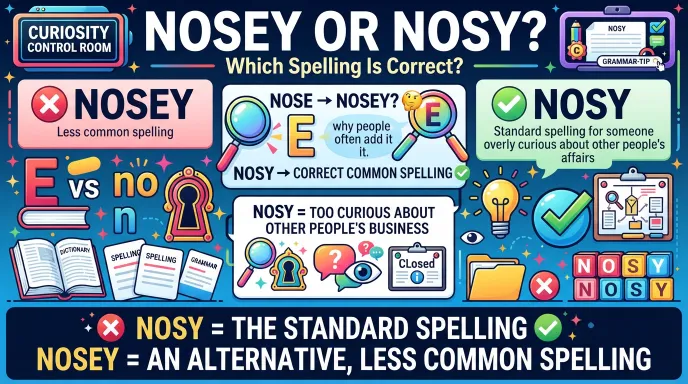
Have you ever described someone as curious about everyone else’s business and wondered whether to write nosey or nosy? The short answer is that both spellings are used, but nosy is generally the more common spelling in modern English, especially in American English.
The confusion exists because both words have the same meaning and pronunciation. They describe someone who is too interested in other people’s private affairs.
Many writers assume that nosey must be correct because the word comes from nose, while others are more familiar with nosy.
This article explains the difference between nosey and nosy, their meaning, spelling preferences, regional usage, common mistakes, and practical examples.
By the end, you will know which spelling is best for your audience and how to use the word naturally.
Nosey or Nosy: What’s the Difference?
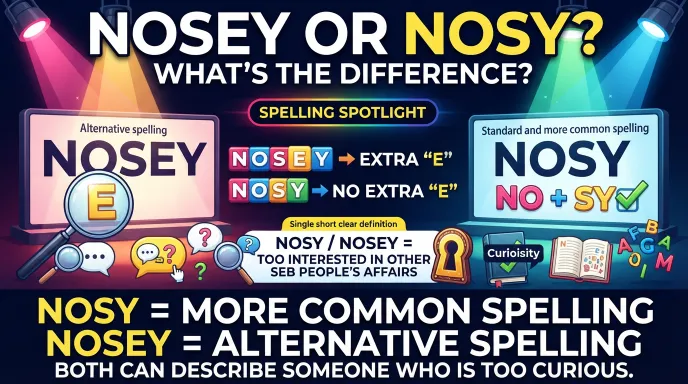
Nosy and nosey both mean overly interested in other people’s private affairs. Both spellings are recognized, but nosy is generally the more common modern spelling, particularly in American English. Nosey is also accepted and appears more often in some British usage. For most general writing, choose one spelling and use it consistently.
Nosey or Nosy: Quick Answer
Both spellings can be correct:
- Nosy ✅ Common and widely used
- Nosey ✅ Alternative spelling
- Nosy ⭐ Usually the safer choice for general writing
Examples
My nosy neighbor always asks too many questions.
My nosey neighbor always asks too many questions.
Both sentences are understandable and use an accepted spelling variation.
Quick recommendation
For most modern, international, and American English writing, nosy is usually the simplest choice.
What Does Nosey or Nosy Mean?
Nosy or nosey is an adjective describing someone who shows too much interest in matters that do not concern them.
For example:
She is always nosy about other people’s conversations.
The word can describe someone who:
- Asks overly personal questions
- Listens to private conversations
- Wants to know private information
- Interferes in other people’s affairs
- Shows excessive curiosity
The word often has a negative tone, but it can also be used playfully among friends.
Don’t be so nosy!
In this sentence, the speaker is telling someone not to interfere or ask too many personal questions.
Nosy vs curious
These words are related but not identical.
Curious can be neutral or positive:
She is curious about how the machine works.
Nosy usually suggests unwanted interest in another person’s private life:
He is nosy about his coworkers’ personal lives.
So, a person can be curious without being nosy.
The Origin of Nosey or Nosy
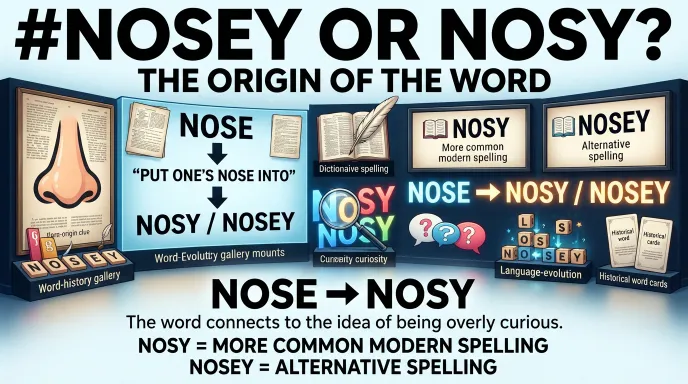
The words nosy and nosey are closely connected with the noun nose. The idea behind the expression is easy to understand: a person who is excessively curious may figuratively “stick their nose” into someone else’s business.
The adjective developed in English to describe someone who is overly inquisitive about matters that are not their concern. Over time, both nosy and nosey became accepted spellings.
The difference between the two spellings is mainly a matter of usage preference rather than meaning. The spelling nosy became especially common as a shorter form, while nosey keeps a more visible connection to the word nose.
This is why both forms can look reasonable:
- nose + y → nosey
- nosy → established shortened spelling
Modern dictionaries may list one spelling as the main entry and the other as a variant, depending on the dictionary and regional editorial preference.
British English vs American English
Both British and American English recognize nosy and nosey, although spelling preferences can vary by dictionary, publisher, and style guide.
In general:
- Nosy is widely used in American English.
- Nosey is also accepted and may appear more often in British English.
- Both spellings have the same meaning.
- Consistency matters more than switching between them.
| Feature | British English | American English | Example |
|---|---|---|---|
| Common spelling | nosey / nosy | nosy | Don’t be so nosy. |
| Alternative spelling | nosy | nosey | Don’t be so nosey. |
| Meaning | Too interested in private affairs | Too interested in private affairs | She is a nosy neighbor. |
| Formal meaning change | No | No | Both mean the same thing. |
| Best practice | Follow house style | Usually use nosy | Stay consistent. |
Regional differences
Unlike colour/color or travelling/traveling, the difference between nosey and nosy is not a strict British-versus-American spelling rule.
You may see both forms in different regions. For professional publishing, follow the spelling preferred by your dictionary, publication, school, or editorial style guide.
Which Version Should You Use?
United States
For American English, nosy is generally the preferred and more familiar spelling.
He is always nosy about other people’s business.
United Kingdom
Both forms may be seen. Check your preferred dictionary or house style.
She is a nosey neighbor.
or:
She is a nosy neighbor.
Canada
Nosy is a safe choice for general and international writing, although editorial preferences may vary.
Australia
Both spellings may appear, depending on the publication and style guide. Consistency is important.
International writing
For a broad international audience, nosy is usually the safest choice because it is short and widely recognized.
Academic writing
The word can be used when describing informal behavior or quoting speech, but more neutral alternatives may be better in formal academic writing.
Depending on context, consider:
- Inquisitive
- Intrusive
- Overly curious
- Invasive
Business writing
Avoid calling someone nosy in professional communication unless you deliberately want an informal or humorous tone.
Instead, you might write:
The question was overly personal.
or:
The request involved private information.
Common Mistakes
Mistake 1: Thinking only one spelling exists
Incorrect assumption:
Nosey is always wrong.
Better understanding:
Both nosy and nosey are recognized spellings.
The best choice depends on your audience and preferred style.
Mistake 2: Mixing spellings in the same article
Less consistent:
My nosy neighbor is always asking questions. That nosey person never stops.
Better:
My nosy neighbor is always asking questions. That nosy person never stops.
Choose one spelling for a document and stay consistent.
Mistake 3: Using nosy when you mean curious
Less accurate:
She is nosy about science.
Better:
She is curious about science.
Explanation: Nosy usually has a negative meaning involving interest in other people’s private matters.
Mistake 4: Using “nosy” in overly formal situations
Informal:
The interviewer was nosy.
More professional:
The interviewer asked overly personal questions.
Memory tip: If the curiosity feels intrusive, nosy is probably the right word.
Everyday Examples
Emails
I don’t want to sound nosy, but could I ask why the meeting was moved?
This can soften a personal question.
Business writing
The customer asked several questions that seemed overly personal.
In formal business writing, this is often better than calling someone nosy.
News headlines
Residents complained about a nosy neighbor.
Blogs
Here are five polite ways to deal with nosy questions.
Social media
Trying not to be nosy, but I need to know what happened! 😅
Academic writing
Participants may view overly personal questions as intrusive.
This is usually more suitable than nosy in formal research.
Daily conversation
Why are you being so nosy?
This is a common informal use.
Google Trends & Modern Usage
People search for “nosey or nosy” because the two spellings look equally possible. The word is strongly connected with nose, which makes nosey seem logical, while many dictionaries and modern publications commonly use nosy.
Common related searches include:
- nosey or nosy spelling
- is nosey correct?
- is nosy correct?
- nosey meaning
- nosy meaning
- how do you spell nosy?
- nosy vs nosey
- nosey neighbor or nosy neighbor
The search intent is mainly informational, educational, and comparison-based.
Exact current Google Trends figures are not included here because this article does not rely on verified live statistics. The discussion is based on general dictionary usage and modern spelling patterns rather than invented numbers.
Quick Comparison Table
| Version | Meaning | Correct? | Region | Example |
|---|---|---|---|---|
| nosy | Too interested in private affairs | ✅ Yes | Widely used | My nosy neighbor asks many questions. |
| nosey | Too interested in private affairs | ✅ Yes | Alternative spelling | My nosey neighbor asks many questions. |
| nosy person | An intrusive or overly curious person | ✅ Yes | International | He can be a nosy person. |
| nosey person | Same meaning | ✅ Yes | Alternative | She is a nosey person. |
| curious | Interested in learning or knowing | ✅ Yes | International | She is curious about science. |
Key Takeaways
- Nosy and nosey are both accepted spellings.
- Both words mean overly interested in other people’s private affairs.
- Nosy is generally the more common choice in modern general writing.
- Nosey is an accepted alternative spelling.
- There is no major difference in meaning.
- Follow your publication’s style guide when writing professionally.
- Choose one spelling and use it consistently.
- Use curious instead when the interest is neutral rather than intrusive.
FAQs
Is it nosey or nosy?
Both nosey and nosy are accepted spellings. They have the same meaning: overly interested in other people’s private affairs. Nosy is generally the more common choice in modern English, particularly in American writing, while nosey remains an accepted alternative.
Is nosey a correct spelling?
Yes. Nosey is a recognized spelling of the adjective meaning overly curious about other people’s private affairs. However, nosy is generally more common in modern writing. For general international audiences, nosy is often the safest spelling.
Is nosy the American spelling?
Nosy is widely used in American English and is often the preferred spelling in American dictionaries and publications. However, nosey is not simply a British-only spelling. Both variants can appear in different varieties of English.
Is nosey British English?
Nosey can be found in British English, but it is not a strict British-only spelling. Both nosey and nosy are recognized in English.
Dictionary and editorial preferences can differ, so professional writers should follow their chosen style guide.
What does nosy mean?
Nosy means too interested in other people’s private matters or personal affairs. It often describes someone who asks personal questions.
listens to private conversations, or interferes where they are not wanted. The word usually has a mildly negative meaning.
What is the difference between nosy and curious?
Curious usually means interested in learning or discovering something and can be positive or neutral. Nosy usually suggests unwanted or excessive interest in another person’s private life.
Someone can be curious about science without being nosy, but asking intrusive personal questions may seem nosy.
Can I use nosey in formal writing?
You can, because nosey is an accepted spelling. However, nosy or a more formal alternative such as intrusive or overly inquisitive may be better depending on the tone and style guide. Formal writing often benefits from more precise language.
Should I write nosy neighbor or nosey neighbor?
Both nosy neighbor and nosey neighbor are correct. For general modern writing, nosy neighbor is often the safer and more familiar choice. If you choose nosey, remain consistent throughout the article, document, or publication.
Is “nosy” rude?
It can be. Calling someone nosy usually suggests that they are too interested in private matters, so the word can sound critical.
Among friends, however, it can sometimes be used playfully. Tone and context determine how strong the criticism sounds.
What is an easy way to remember how to spell nosy?
For most general writing, remember that nosy is the shorter and more widely used modern spelling. If you see nosey, remember that it is also accepted, but choose one spelling based on your audience or style guide and stay consistent.
Conclusion
When choosing between nosey or nosy, the good news is that both spellings are accepted. They have the same meaning and describe someone who takes too much interest in other people’s private affairs.
For most general, international, and American English writing, nosy is usually the safer choice because it is widely used and familiar. Nosey remains a valid alternative, particularly when it fits a publication’s preferred style.
The most important point is consistency. Once you choose one spelling for an article, email, or document, avoid switching between the two.
Also remember that nosy usually has a negative meaning. If you simply mean someone enjoys learning or discovering new things, curious may be the better word.
Simple rule: Both are correct, but for most modern writing, “nosy” is the easiest choice.
DISCOVER MORE ARTICLE HERE!
- Desert or Dessert: Which Is Correct?
- Noone or No One? Which Spelling Is Correct?
- Spelt or Spelled? Which Spelling Is Correct?

I’m Orin Blake, a writer with a passion for making English grammar simple, practical, and easy to understand. I enjoy breaking down confusing words, spelling differences, and everyday language questions into clear, reader-friendly guides. My goal is to help students, professionals, and curious learners write with greater confidence and accuracy.