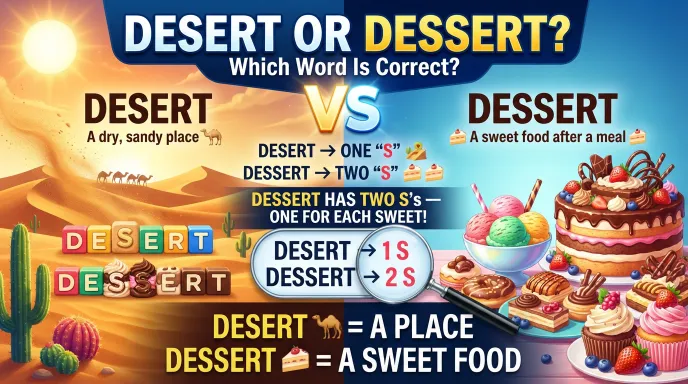
Desert and dessert are two commonly confused English words. They look almost identical, but they have very different meanings. The main difference is simple: a desert is usually a dry, sandy area of land, while a dessert is a sweet food eaten at the end of a meal.
For example, you might travel across the desert and then enjoy a piece of cake for dessert. The extra s makes a big difference.
People often search for desert or dessert because the words have similar spelling and pronunciation in some forms. The confusion can cause embarrassing mistakes in schoolwork, emails, menus, and everyday writing.
This guide explains the difference between desert and dessert, their meanings, pronunciation, origins, common mistakes, and easy ways to remember which spelling to use.
Desert or Dessert: What’s the Difference?
Desert usually means a dry area of land with little rainfall, while dessert means a sweet course eaten after a meal.
The easiest way to remember the difference is that dessert has two S letters because you may want seconds. Example: You cross a desert but eat dessert.
Desert or Dessert: Quick Answer
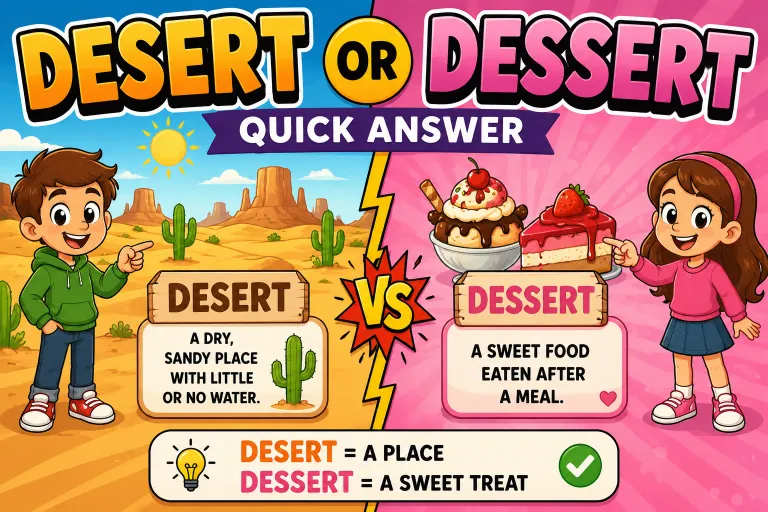
The correct word depends on what you mean:
- Desert = a dry, often sandy area of land 🏜️
- Dessert = sweet food eaten after a meal 🍰
Examples
- The Sahara is a famous desert.
- We traveled through the desert by car.
- Chocolate cake is my favorite dessert.
Easy memory trick
Remember:
Dessert has two S letters because you may want seconds.
You usually want seconds of a delicious dessert.
What Does Desert or Dessert Mean?
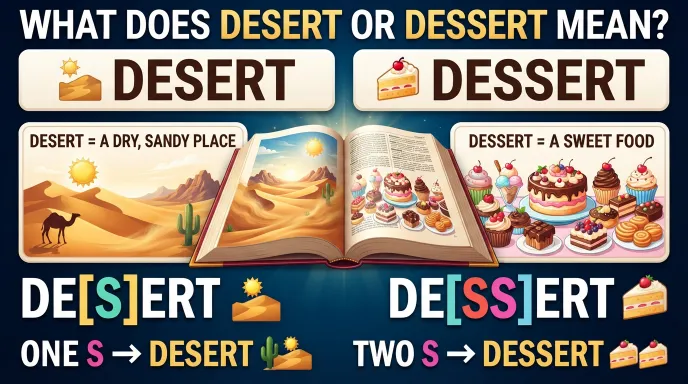
What does desert mean?
Desert has more than one meaning.
As a noun, it usually means a large, dry area with little rainfall and limited vegetation.
They crossed the desert during their journey.
As a verb, desert can mean to leave someone or something behind, especially when you have a duty or responsibility.
The soldier was accused of deserting his post.
It can also appear in the phrase get one’s just deserts, where deserts means something a person deserves.
What does dessert mean?
Dessert is a noun. It means a sweet dish served at the end of a meal.
Examples include:
- Cake
- Ice cream
- Pie
- Cookies
- Pudding
- Fruit dishes
Example:
We had ice cream for dessert.
Unlike desert, dessert does not normally have a verb form.
The Origin of Desert or Dessert
Although desert and dessert look similar, they developed from different uses and meanings.
The origin of desert
The noun desert, meaning a dry or uninhabited region, came into English through Old French and Latin roots connected with the idea of something abandoned or left alone.
This connection also relates to the verb desert, meaning to abandon or leave.
Over time, the word developed into the modern English noun used for dry regions such as the Sahara Desert.
British English vs American English
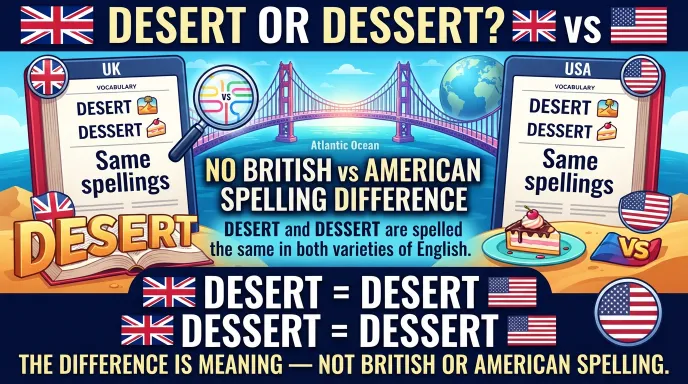
There is no spelling difference between British and American English for these words.
Both varieties use:
- desert for a dry region
- dessert for a sweet course after a meal
| Meaning | British English | American English | Example |
| Dry region | desert | desert | The camel crossed the desert. |
| Sweet course | dessert | dessert | We had cake for dessert. |
| To abandon | desert | desert | Do not desert your team. |
| Something deserved | deserts | deserts | He got his just deserts. |
Regional differences
British and American English use the same spellings. The main differences involve pronunciation in some forms, especially when desert is used as a verb.
For spelling purposes, the rule remains simple:
Dry land = desert
Sweet food = dessert
Which Version Should You Use?
United States
Use desert for dry land and dessert for sweet food.
The desert was extremely hot.
We ordered dessert after dinner.
United Kingdom
The same spelling rules apply.
Canada
Canadian English also uses desert and dessert in the same way.
Australia
Use desert for the geographical area and dessert for the sweet course.
International writing
These spellings are standard across international English.
Academic writing
Use desert when discussing geography, climate, ecosystems, or landforms.
Desert ecosystems support many specially adapted species.
Use dessert when discussing food, nutrition, menus, or dining.
Business writing
The correct word depends entirely on context.
A travel company may write:
Explore the beauty of the desert.
A restaurant may write:
Our dessert menu includes chocolate cake and ice cream.
Common Mistakes
Mistake 1: Using “desert” for sweet food
Incorrect:
We had cake for desert.
Correct:
We had cake for dessert.
Explanation: Sweet food after a meal is always dessert.
Memory tip: Dessert has two S letters because you may want seconds.
Mistake 2: Using “dessert” for dry land
Incorrect:
The Sahara is the largest hot dessert.
Correct:
The Sahara is the largest hot desert.
Explanation: A dry geographical region is a desert, with one S.
Mistake 3: Forgetting that desert can be a verb
Incorrect understanding:
Desert only means dry land.
Correct understanding:
Desert can also be a verb meaning to abandon or leave.
He deserted his responsibilities.
The meaning depends on context.
Mistake 4: Confusing “desert” with “deserts”
The phrase just deserts means what someone deserves.
The villain got his just deserts.
Despite the pronunciation, the traditional spelling is deserts, not desserts, because it comes from the meaning of something deserved.
Everyday Examples
Emails
Our trip through the desert was unforgettable.
Please choose your dessert from the menu.
Business writing
The company offers guided desert tours.
The restaurant introduced a new dessert menu.
News headlines
Heavy rain transformed parts of the desert.
Local bakery launches a new dessert collection.
Blogs
Watching the sunset over the desert was an unforgettable experience.
This chocolate dessert is easy to make at home.
Social media
Dreaming of a desert adventure! 🏜️
Life is short. Order dessert! 🍰
Academic writing
Desert plants have developed adaptations for dry environments.
Researchers examined consumer preferences for frozen desserts.
Daily conversation
Is the desert far from here?
What are we having for dessert?
Google Trends & Modern Usage
People often search “desert or dessert” because the two words differ by only one letter but have completely different meanings.
The most common search intent is educational and informational. People want to know:
- Which spelling means dry land?
- Which spelling means sweet food?
- How can I remember desert vs dessert?
- Why does dessert have two S letters?
- How are desert and dessert pronounced?
The confusion is especially common among students, ESL learners, and people learning English spelling.
There is no British-versus-American spelling difference. Both words are used internationally with the same meanings.
Exact Google Trends statistics are not included here because current verified data is not available in this article. The discussion is based on general spelling and usage patterns rather than invented search figures.
Quick Comparison Table
| Version | Meaning | Correct? | Region | Example |
| desert | A dry area of land | ✅ Yes | International | Camels can survive in the desert. |
| dessert | Sweet food after a meal | ✅ Yes | International | We had cake for dessert. |
| desert | To abandon or leave | ✅ Yes | International | Do not desert your responsibilities. |
| just deserts | What someone deserves | ✅ Yes | International | He got his just deserts. |
| dessert | A spelling for dry land | ❌ No | Not standard | Avoid this usage. |
Key Takeaways
- Desert usually means a dry area of land.
- Dessert means a sweet course eaten after a meal.
- Desert has one S.
- Dessert has two S letters.
- Remember: Dessert has two S letters because you may want seconds.
- Desert can also be a verb meaning to abandon.
- Just deserts means what someone deserves.
- British and American English use the same spellings.
FAQs
Is it desert or dessert?
It depends on the meaning. Desert refers to a dry area of land, while dessert is a sweet food eaten after a meal. For example, you might travel through the desert and later eat dessert after dinner.
How do I remember desert and dessert?
A popular memory trick is that dessert has two S letters because you may want seconds. Since seconds also begins with S, the extra S helps you remember that sweet food is spelled dessert.
Why does dessert have two S letters?
The spelling comes from the word’s historical development from French. The easiest practical way to remember it is that dessert has two S letters. The extra S helps distinguish it from desert, which refers to dry land or the act of abandoning something.
Is the Sahara a desert or dessert?
The Sahara is a desert. A desert is a geographical region that receives very little rainfall. Dessert refers to sweet food eaten after a meal, such as cake, ice cream, or pie.
Is cake a desert or dessert?
Cake is a dessert when served as a sweet course after a meal. The correct spelling has two S letters: dessert. Desert refers to dry land or can mean to abandon someone or something.
Can desert be a verb?
Yes. Desert can be a verb meaning to abandon, leave, or give up someone or something, especially when you have a duty or responsibility. For example: “The captain refused to desert the ship.” Its pronunciation may differ from the noun meaning dry land.
What does “just deserts” mean?
Just deserts means the rewards or punishments that someone deserves because of their actions. The phrase uses deserts, not desserts, because it comes from the older meaning of desert as something deserved.
Is there a British and American spelling difference?
No. British and American English both use desert for dry land and dessert for sweet food. There is no regional spelling difference between the two words.
How do you pronounce desert and dessert?
The pronunciation depends on meaning. The noun desert, meaning dry land, is usually pronounced with stress on the first syllable.
Dessert has stress on the second syllable. The verb desert, meaning abandon, is also usually stressed on the second syllable.
Can I use “desert” and “dessert” in the same sentence?
Yes. For example: “After exploring the desert all day, we enjoyed dessert at the hotel.” This sentence is a useful way to remember the difference because it uses both correct spellings in different contexts.
Conclusion
When choosing between desert or dessert, focus on the meaning. A desert is usually a dry region of land, while a dessert is a sweet dish served after a meal. The two words may look similar, but their meanings are completely different.
The easiest spelling rule is simple: dessert has two S letters because you may want seconds. This popular memory trick can help you avoid one of the most common English spelling mistakes.
Remember that desert can also be a verb meaning to abandon, and just deserts refers to what someone deserves. Context will tell you which meaning is intended.
British, American, Canadian, Australian, and international English all follow the same spelling rules.
Memorable rule: You travel through a desert, but you save room for dessert.
DISCOVER MORE ARTICLE CLICK HERE!
- Theatre or Theater? Which Spelling Is Correct?
- Realise or Realize? Which Spelling Is Correct?
- Color Grey or Gray? Which Spelling Is Correct?

I’m Orin Blake, a writer with a passion for making English grammar simple, practical, and easy to understand. I enjoy breaking down confusing words, spelling differences, and everyday language questions into clear, reader-friendly guides. My goal is to help students, professionals, and curious learners write with greater confidence and accuracy.