Have you ever stopped while writing and wondered if to use affect or effect? You’re not alone. These two words sound similar, look similar, and are often confused, even by experienced English speakers.
Students, professionals, bloggers, and writers regularly search for “affect or effect” because choosing the wrong word can change the meaning of a sentence.
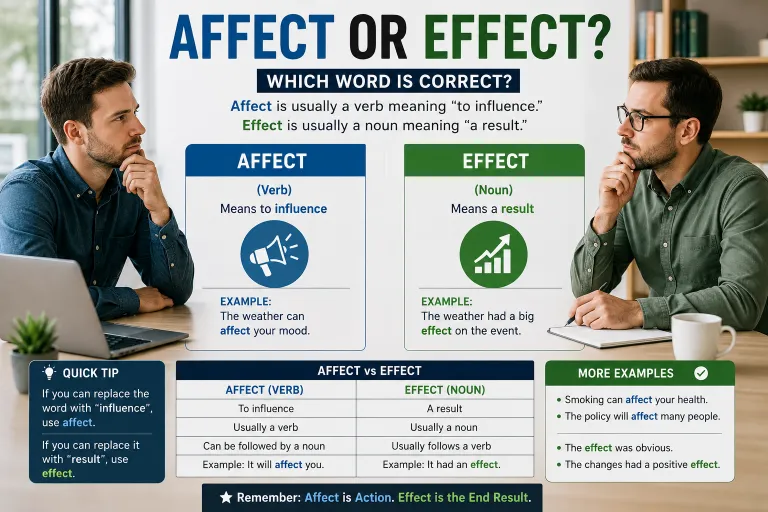
The good news is that there is a simple way to understand the difference. Affect is usually a verb that means “to influence or change something.”
Effect is usually a noun that means “a result or consequence.” For example, “Rain can affect traffic” means rain can influence traffic. “The effect of rain was heavy traffic” means heavy traffic was the result.
In this guide, you’ll learn the difference between affect and effect, their meanings, common mistakes, practical examples, and simple rules. By the end, you’ll know which word to use in emails, essays, reports, and everyday writing.
Affect or Effect 😀 Quick Answer
The basic rule is:
- Affect = usually a verb meaning to influence
- Effect = usually a noun meaning a result
Examples
- Lack of sleep can affect your concentration.
- Lack of sleep can have an effect on your concentration.
- The new rule will affect employees.
- The new rule had a major effect on employees.
Quick Tip
Remember:
Affect = Action
Effect = End result
This simple memory trick works for most everyday uses.
The Origin of Affect or Effect
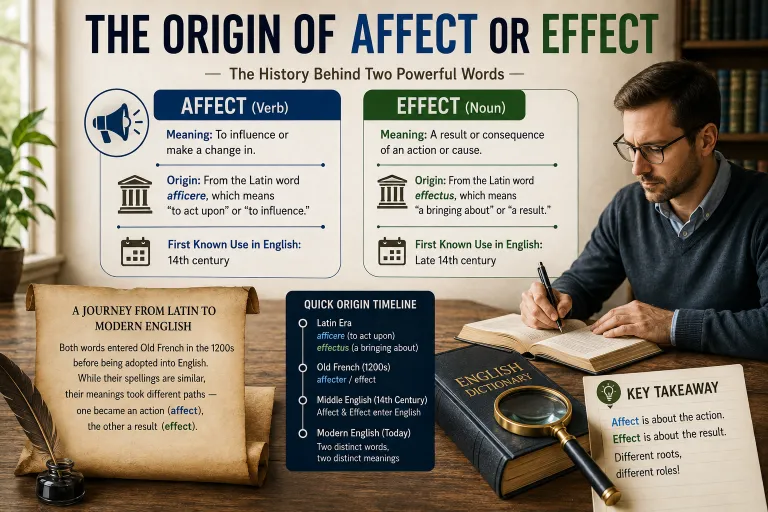
Both affect and effect have Latin roots, but they developed different meanings in English.
Affect comes from the Latin word afficere, meaning “to act upon” or “to influence.” This connects to its common use as a verb.
Effect comes from the Latin word efficere, meaning “to accomplish” or “to bring about.” This connects to its meaning as a result or outcome.
Over time, both words developed additional meanings. However, the basic distinction between affect as an influence and effect as a result remains useful for modern English.
Affect vs Effect 😀 Quick Comparison
| Feature | Affect | Effect |
| Most common use | Verb | Noun |
| Basic meaning | Influence | Result |
| Example | Noise can affect sleep. | Noise has an effect on sleep. |
| Memory clue | Action | End result |
| Common phrase | Affect something | Effect on something |
British English vs American English
Unlike spelling differences such as gray/grey or canceled/cancelled, there is generally no major British-American spelling difference between affect and effect.
Both varieties use the same basic rules.
British English
- The weather affected the match.
- The weather had an effect on the match.
American English
- The weather affected the game.
- The weather had an effect on the game.
The main challenge is not regional spelling. It is understanding the different meanings and grammatical roles.
Which One Should You Use?
Use affect when you mean influence or change.
Use effect when you mean result or outcome.
Use Affect
- The noise affected my concentration.
- The decision will affect our plans.
- Stress can affect performance.
Use Effect
- The decision had a major effect on the project.
- The medicine produced an immediate effect.
- We noticed the effects of the change.
A Simple Test
Try replacing the word with “influence.”
If the sentence still makes sense, affect is probably correct.
The weather will affect our plans.
→ The weather will influence our plans. ✅
Now try “result.”
The effect was unexpected.
→ The result was unexpected. ✅
Common Mistakes with Affect or Effect
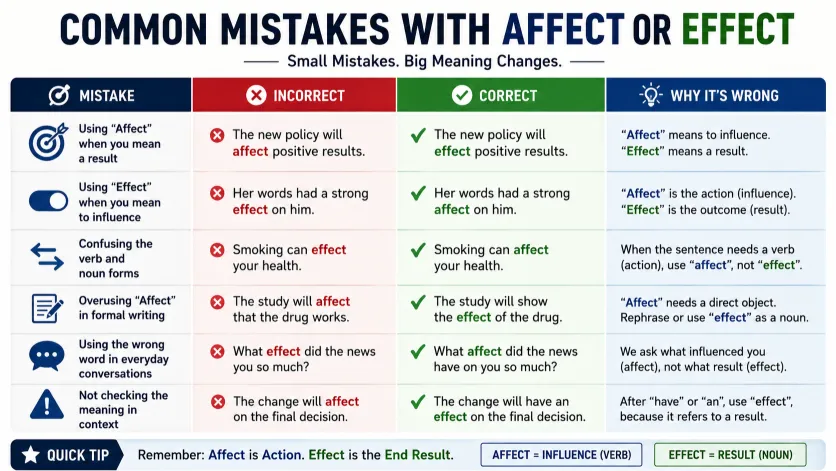
Mistake 1: Using Effect as a Verb
❌ The new rule will effect everyone.
✅ The new rule will affect everyone.
Here, the meaning is “influence,” so affect is correct.
Mistake 2: Using Affect as a Noun
❌ The new rule had a major affect.
✅ The new rule had a major effect.
Here, you’re talking about a result, so effect is correct.
Mistake 3: Confusing “Effect on”
❌ The change had a strong affect on sales.
✅ The change had a strong effect on sales.
The phrase “effect on” is usually correct when describing a result.
Mistake 4: Forgetting the Verb Rule
❌ The loud music effected my concentration.
✅ The loud music affected my concentration.
Affect or Effect in Everyday Examples
Emails
The schedule change may affect your appointment time.
Please explain the effect this change will have on the project.
News
The storm affected thousands of residents.
The storm had a major effect on local transport.
Social Media
Too much screen time can affect your sleep.
The change had a positive effect on the community.
Formal Writing
Economic conditions can affect consumer behavior.
The policy had a significant effect on employment.
Affect or Effect 😀 Special Cases
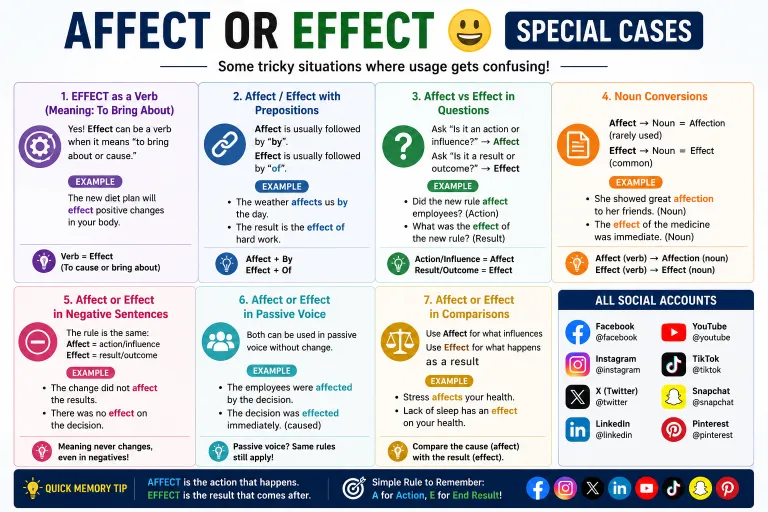
There are a few less common uses worth knowing.
Effect as a Verb
Effect can sometimes be a verb meaning to bring about or cause something to happen.
Example:
The committee hopes to effect meaningful change.
This use is formal and less common.
Affect as a Noun
In psychology, affect can refer to a person’s observable emotional expression.
Example:
The patient displayed a calm affect.
This is a specialized meaning, so most everyday writers do not need to use it.
Affect or Effect 😀Google Trends & Usage Data
The keyword “affect or effect” has strong search interest because the two words are among the most commonly confused terms in English.
People often search this phrase when they are:
- Writing school assignments
- Editing professional documents
- Preparing reports
- Learning English grammar
- Proofreading articles
- Writing emails
Usage Comparison
| Context | Common Word |
| Influence something | Affect |
| Result of something | Effect |
| “___ on” | Effect |
| “Will ___” | Affect |
| “Had an ___” | Effect |
Search interest can vary by country and time, so exact Google Trends numbers should be checked for the specific date range and region rather than treated as fixed figures.
Comparison Table
| Word | Part of Speech | Meaning | Example |
| Affect | Usually verb | Influence | Noise can affect sleep. |
| Effect | Usually noun | Result | Noise has an effect on sleep. |
| Effect | Sometimes verb | Bring about | The policy may effect change. |
| Affect | Specialized noun | Emotional expression | The patient had a calm affect. |
FAQs
Is affect or effect correct?
Both are correct words, but they have different meanings. Affect usually means influence, while effect usually means result.
Is affect a verb or a noun?
Affect is usually a verb. It means to influence or change something.
Is effect a verb or a noun?
Effect is usually a noun meaning result. It can also be a verb meaning to bring about something.
What is an easy way to remember affect and effect?
Remember Affect = Action and Effect = End result.
Should I say “effect on” or “affect on”?
Usually, say “effect on” when referring to a result.
Example:
“The decision had an effect on sales.”
Is affect or effect different in British English?
No major regional spelling difference exists. British and American English generally use the same distinction.
Which one should I use in formal writing?
Use affect for influence and effect for a result. The same rule works in formal and everyday writing.
Conclusion
Understanding affect or effect becomes much easier when you focus on their most common grammatical roles.
Affect is usually a verb meaning to influence or change, while effect is usually a noun meaning a result or consequence.
For example, “The weather can affect travel” means the weather can influence travel. “The weather had an effect on travel” refers to the result.
A useful memory trick is Affect = Action and Effect = End result. This will help you choose the right word in most everyday situations.
Remember that both British and American English generally follow the same distinction.
Once you understand the basic rule, you can use these words confidently in emails, essays, reports, articles, and professional communication.
DISCOVER MORE ARTICLE CLICK HERE NOW!
- Learnt or Learned? Which Spelling Is Correct?
- Travelling or Traveling? Which Spelling Is Correct?
- Judgement or Judgment? Which Spelling Is Correct?

I’m Orin Blake, a writer with a passion for making English grammar simple, practical, and easy to understand. I enjoy breaking down confusing words, spelling differences, and everyday language questions into clear, reader-friendly guides. My goal is to help students, professionals, and curious learners write with greater confidence and accuracy.