Have you ever wondered if you should write travelling or traveling? You’re not alone. Many students, writers, bloggers, and English learners search for “travelling or traveling” because both spellings appear in books, websites, travel blogs, and official documents.
This often causes confusion, especially when writing for an international audience.
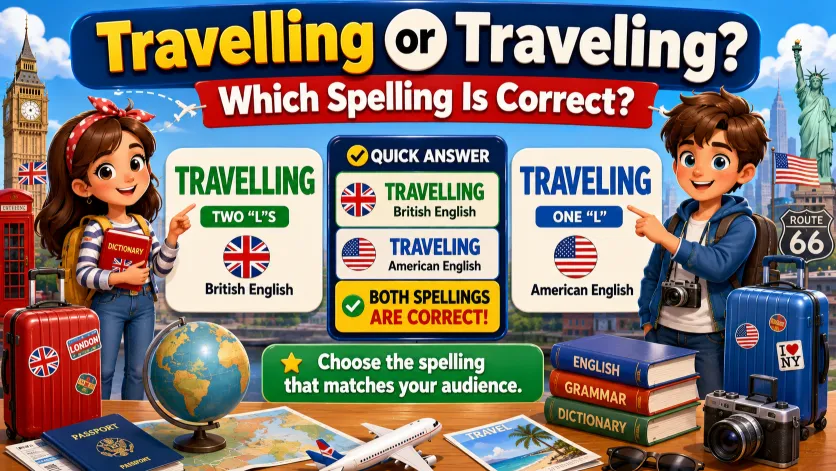
The good news is that both “travelling” and “traveling” are correct. The difference depends on the variety of English you use.
American English prefers traveling, while British English and most Commonwealth countries prefer travelling.
Neither spelling is wrong, but choosing the version that matches your audience makes your writing look more natural and professional.
In this guide, you’ll learn the history behind travelling and traveling, compare British and American English spelling rules, discover common mistakes, explore everyday examples, and find out which spelling is best for your audience.
Travelling or Traveling 🙂 Quick Answer
Both spellings are correct.
- Traveling ✅ = Preferred in American English
- Travelling ✅ = Preferred in British English
- Choose the spelling that matches your audience.
Examples
American English
- We are traveling to New York next week.
- She enjoys traveling with her family.
British English
- We are travelling to London next week.
- She enjoys travelling around Europe.
Quick Tip
If your audience is in the United States, use traveling. If your readers are in the United Kingdom, Australia, or other Commonwealth countries, use travelling.
The Origin of Travelling or Traveling
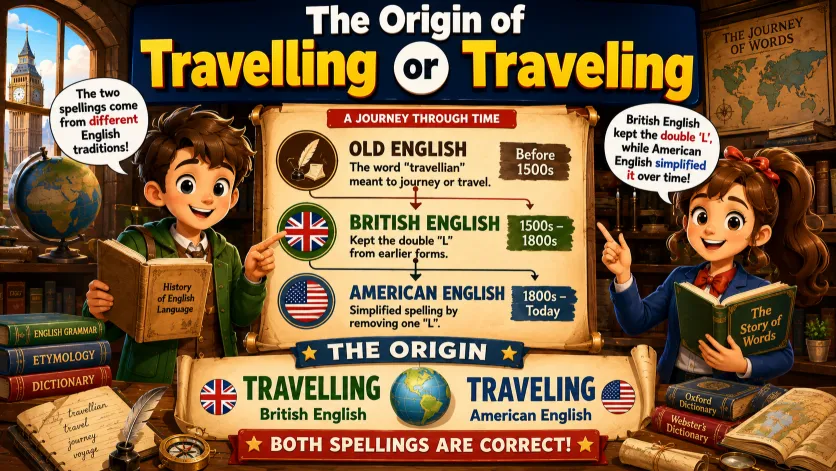
The word travel comes from the Old French word travail, which originally referred to hard work or a difficult journey. Over time, its meaning changed to describe moving from one place to another.
The spelling difference developed because British and American English adopted different rules for doubling the final l before adding suffixes like -ing.
In British English, verbs ending in -l usually double the final l.
Examples:
- travel → travelling
- cancel → cancelling
In American English, the final l is usually not doubled when the last syllable is unstressed.
Examples:
- travel → traveling
- cancel → canceling
This difference explains why both spellings exist today.
British English vs American English Spelling
The choice between travelling and traveling depends on regional spelling conventions.
Comparison Table
| Feature | British English | American English |
| Preferred spelling | Travelling | Traveling |
| Present participle | Travelling | Traveling |
| Related noun | Traveller | Traveler |
| Common regions | UK, Australia, New Zealand, Ireland | United States |
Examples
British English
- We love travelling during summer.
- She is travelling abroad.
American English
- We love traveling during summer.
- She is traveling abroad.
Which Spelling Should You Use?
Choose the spelling based on your audience.
Use Traveling if:
- You are writing for an American audience.
- You follow American English.
- You use AP Style.
- Your website targets readers in the United States.
Use Travelling if:
- Your audience is in the United Kingdom.
- You write for Australia, New Zealand, or Ireland.
- You follow British English spelling rules.
For International Content
Either spelling is correct. However, use one version consistently throughout your article or website.
Common Mistakes with Travelling or Traveling
Many writers make simple spelling mistakes.
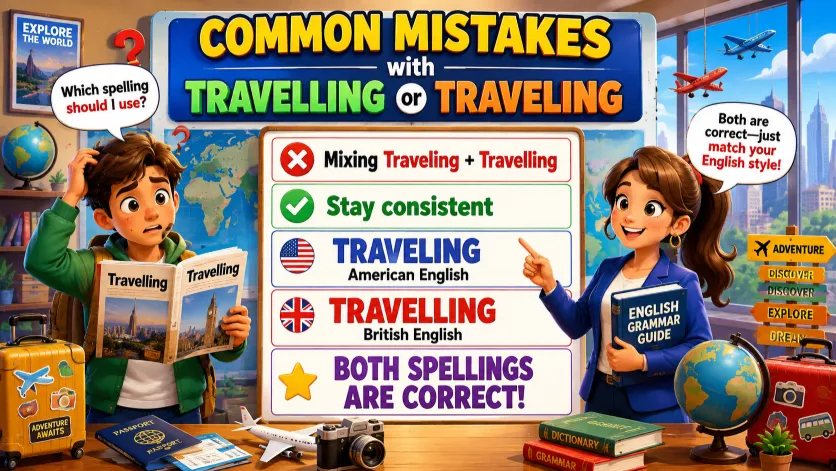
Mixing Both Spellings
❌ We enjoy traveling, and our favorite hobby is travelling.
✅ Choose one spelling style and use it consistently.
Using British Spelling for US Readers
❌ We are travelling across America.
✅ We are traveling across America.
Using American Spelling for UK Readers
❌ We are traveling across England.
✅ We are travelling across England.
Forgetting Related Words
American English:
- traveler
- traveling
British English:
- traveller
- travelling
Travelling or Traveling in Everyday Examples
We are traveling to Chicago next Monday.
News
Thousands of people are travelling during the holiday season.
Social Media
I love traveling and exploring new places!
Formal Writing
Employees travelling on business must submit their expense reports within seven days.
Travelling or Traveling 🙂 Google Trends & Usage Data
Searches for “travelling or traveling” remain popular because both spellings are widely used around the world.
Popular by Country
| Country | Preferred Spelling |
| United States | Traveling |
| United Kingdom | Travelling |
| Australia | Travelling |
| Canada | Travelling (more common) |
| New Zealand | Travelling |
| India | Travelling |
People commonly search this keyword when they are:
- Writing travel blogs
- Learning English grammar
- Editing business documents
- Preparing school assignments
- Creating website content
Comparison Table
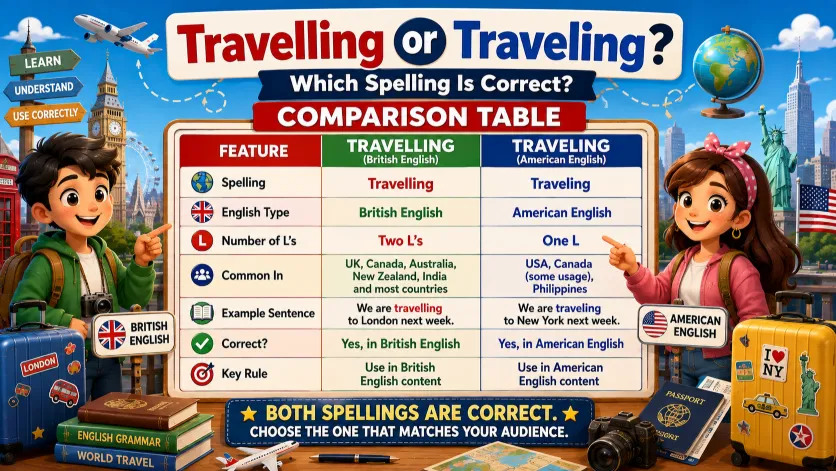
| Feature | Travelling | Traveling |
| Correct? | ✅ Yes | ✅ Yes |
| English Type | British | American |
| Double L | Yes | No |
| Used in the USA | Rare | ✅ Very Common |
| Used in the UK | ✅ Very Common | Rare |
| Used in Australia | ✅ Very Common | Rare |
| Used in Canada | Common | Sometimes |
| Best for | UK & Commonwealth | United States |
FAQs
Is travelling or traveling correct?
Both are correct. Traveling is preferred in American English, while travelling is preferred in British English.
Which spelling is used in the United States?
American English uses traveling.
Which spelling is used in the United Kingdom?
British English prefers travelling.
Why are there two spellings?
The difference comes from British and American spelling conventions for verbs ending in -l.
Is “traveller” also spelled differently?
Yes. American English uses traveler, while British English uses traveller.
Can I use both spellings in one article?
No. Choose one spelling and use it consistently.
Which spelling is better for ?
Use the spelling that matches your target audience. If your audience is global, choose one version and stay consistent throughout the content.
Conclusion
The difference between travelling and traveling is based on regional spelling conventions, not grammar. Both spellings are correct and accepted by major dictionaries.
Traveling is the standard form in American English, while travelling is preferred in British English and most Commonwealth countries.
Understanding your audience will help you choose the most appropriate spelling.
If you are writing for readers in the United States, traveling is the best option. If your audience is in the United Kingdom, Australia, New Zealand, or other Commonwealth countries, travelling will feel more natural.
Whichever spelling you choose, use it consistently throughout your writing to create a professional, polished, and easy-to-read article.
DISCOVER MORE ARTICLE CLICK HERE NOW!
Canceled or Cancelled? Which Spelling Is Correct?
Judgement or Judgment? Which Spelling Is Correct?
Learnt or Learned? Which Spelling Is Correct?

I’m Orin Blake, a writer with a passion for making English grammar simple, practical, and easy to understand. I enjoy breaking down confusing words, spelling differences, and everyday language questions into clear, reader-friendly guides. My goal is to help students, professionals, and curious learners write with greater confidence and accuracy.