Have you ever wondered if you should write alot or a lot? This is a common English mistake because the two forms sound almost identical when spoken. Students, English learners, bloggers, and professionals often search for “alot or a lot” when checking an email, essay, article, or social media post.
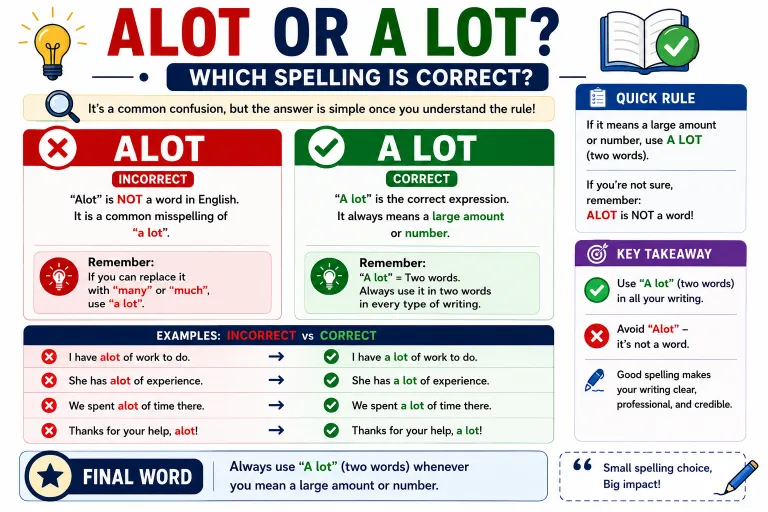
The simple answer is clear: a lot is the correct standard form. It is written as two separate words and means a large amount or many
. The form alot is generally considered a spelling error in standard English and should be avoided in formal and professional writing.
For example, you can say, “I have a lot of work today” or “She travels a lot.” The phrase works in both everyday and professional English.
In this guide, you’ll learn why a lot is correct, where the phrase came from, common mistakes, British and American usage, and simple examples that will help you use it correctly every time.
Alot or A Lot 🙂 Quick Answer
The correct form is:
- A lot ✅ = Correct
- Alot ❌ = Incorrect in standard English
Examples
- I have a lot of homework.
- She knows a lot about computers.
- We had a lot of fun.
- He travels a lot.
Quick Tip
Always write a lot as two words.
The Origin of Alot or A Lot
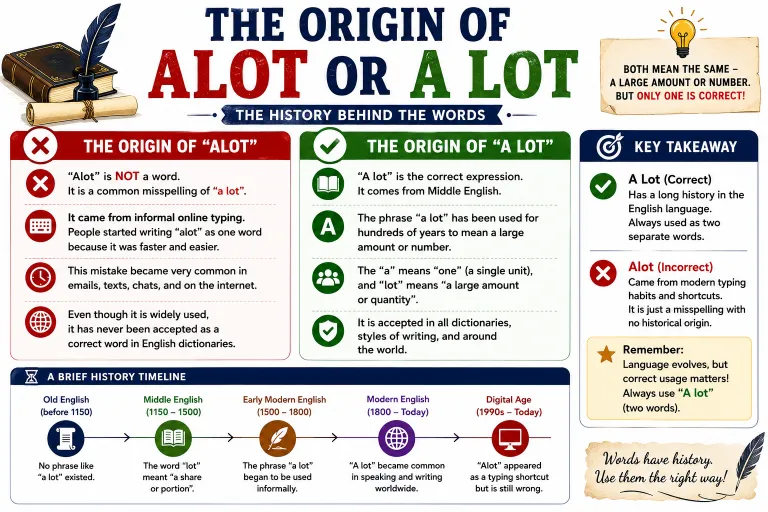
The phrase a lot developed from the noun lot, which has been used in English for many centuries. A lot could refer to a group, quantity, or portion of something.
Over time, a lot became a common expression meaning a large amount or a large number.
The incorrect form alot likely developed because English speakers often connect words together when speaking. Since a lot sounds like one unit in quick speech, some writers began combining the words.
However, standard English keeps them separate:
a + lot = a lot
British English vs American English Spelling
There is no major British-American difference here. Both British and American English use a lot as the standard form.
Comparison Table
| Feature | British English | American English |
| Correct form | A lot | A lot |
| Incorrect form | Alot | Alot |
| Number of words | Two | Two |
| Formal writing | A lot | A lot |
| Informal writing | A lot | A lot |
Examples
British English:
I have a lot of work today.
American English:
I have a lot of work today.
The spelling remains the same in both varieties.
Which Spelling Should You Use?
Use a lot whenever you mean many, much, or a large amount.
Use “A Lot” in Everyday Writing
- I like this song a lot.
- She talks a lot.
- We have a lot of time.
Use “A Lot” in Formal Writing
Although a lot is correct, more precise words can sometimes make formal writing stronger.
Instead of:
There are a lot of reasons for this change.
You could write:
There are many reasons for this change.
Or:
There are several reasons for this change.
Common Mistakes with Alot or A Lot
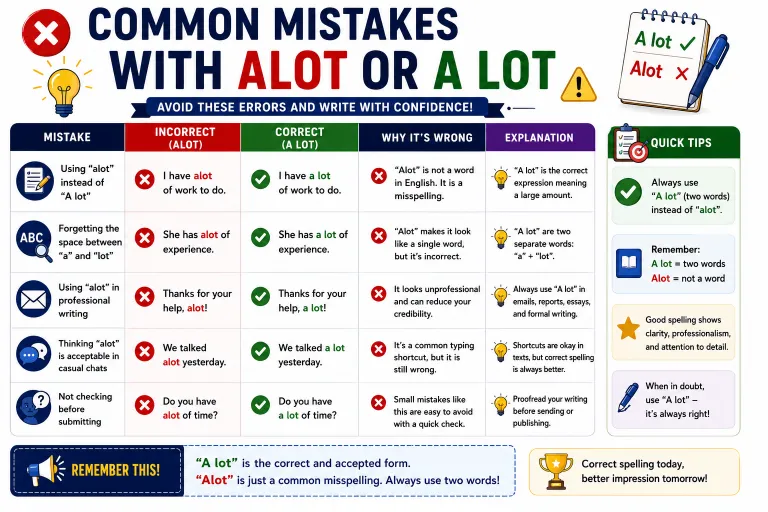
Writing “Alot” as One Word
❌ I have alot of work.
✅ I have a lot of work.
Forgetting the Space
❌ She studies alot.
✅ She studies a lot.
Confusing “A Lot” With “Allot”
Allot is a real word, but it has a different meaning.
Allot means to distribute or assign something.
Example:
The teacher will allot ten minutes to each group.
A lot means a large amount.
Example:
We have a lot of time.
Alot or A Lot in Everyday Examples
Thank you a lot for your help.
For a more formal email:
Thank you very much for your help.
News
A lot of people attended the event.
Social Media
I learned a lot today!
Formal Writing
A lot of research supports this conclusion.
For highly formal writing, much, many, or a specific quantity may be more precise.
Alot or A Lot 🙂 Google Trends & Usage Data
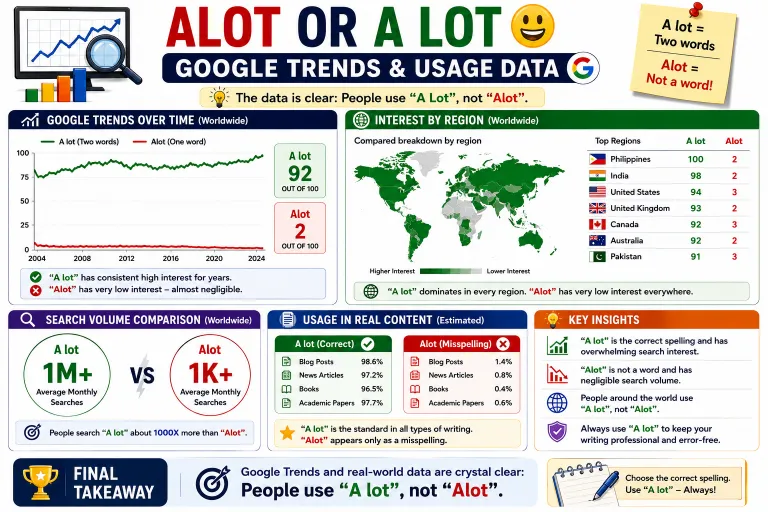
The search query “alot or a lot” is common because alot frequently appears as a spelling mistake in informal online writing.
People often search this phrase when:
- Writing school assignments
- Checking grammar
- Editing emails
- Creating blog content
- Learning English
- Proofreading professional documents
Usage Comparison
| Meaning | Correct Form |
| Large amount | A lot |
| Many things | A lot |
| Frequently | A lot |
| Distribute or assign | Allot |
| Standard English | A lot |
Comparison Table
| Word/Phrase | Correct? | Meaning | Example |
| A lot | ✅ Yes | Large amount/number | I have a lot of work. |
| Alot | ❌ No | Not standard English | Avoid this form. |
| Allot | ✅ Yes | Assign or distribute | We will allot each team five minutes. |
FAQs
Is alot or a lot correct?
A lot is correct. It should always be written as two words in standard English.
Is “alot” a real word?
Alot is generally not accepted as a standard English word. It is usually a spelling mistake.
Why do people write alot?
People often write alot because the phrase sounds like one word when spoken quickly.
Is a lot formal English?
Yes, a lot is grammatically correct, but words such as many, much, or numerous may be more precise in formal writing.
Is a lot one word or two?
A lot is two words.
What is the difference between a lot and allot?
A lot means a large amount or number. Allot means to assign or distribute something.
Can I use a lot in academic writing?
Yes, but depending on the sentence, a more precise word such as many, much, or numerous may be better.
Conclusion
The correct spelling is a lot, not alot. The phrase a lot is always written as two words when it means a large amount, many, or frequently.
For example, “I have a lot of work” means you have a large amount of work, while “She travels a lot” means she travels frequently.
The form alot is generally considered a spelling mistake in standard English. It should be avoided in school assignments, professional emails, business documents, websites, and other formal writing.
Also remember that allot is a different word. It means to assign or distribute something.
The easiest rule is simple: when you mean a large amount or number, write a lot as two words. This rule works in both British and American English.
Once you remember the space, you’ll never need to wonder about alot or a lot again.
DISCOVER MORE ARTICLE CLICK HERE NOW!
- Affect or Effect? Which Word Is Correct?
- Canceled or Cancelled? Which Spelling Is Correct?
- Judgement or Judgment? Which Spelling Is Correct?

I’m Orin Blake, a writer with a passion for making English grammar simple, practical, and easy to understand. I enjoy breaking down confusing words, spelling differences, and everyday language questions into clear, reader-friendly guides. My goal is to help students, professionals, and curious learners write with greater confidence and accuracy.