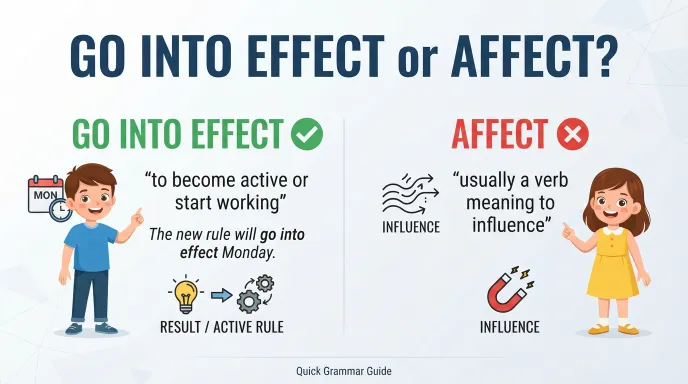
Go into effect is correct; go into affect is incorrect.
Have you ever wondered if the correct phrase is “go into effect” or “go into affect”? This is a common English mistake.
because effect and affect sound similar. The confusion becomes even greater when writing about new laws, rules, policies, contracts, or decisions.
The correct phrase is “go into effect.” Here, effect is a noun meaning result, operation, or force.
When a law or rule “goes into effect,” it means that the law or rule becomes active or officially starts to apply. Affect is not correct in this expression.
For example, you can write, “The new policy will go into effect next Monday.” This means the policy will officially begin to apply next Monday.
The phrase is widely used in American English and is also understood in British English. In this guide, you’ll learn why effect is correct, how the phrase is used, common mistakes, British and American usage, and practical examples.
Go Into Effect or Affect : Quick Answer
The correct phrase is:
Go into effect ✅
Go into affect ❌
Meaning
Go into effect means:
- Become active
- Start operating
- Begin to apply
- Become legally valid
Examples
- The new rule will go into effect next month.
- The policy went into effect yesterday.
- The changes will go into effect immediately.
Quick Tip
Remember: effect = result or operation, while affect = influence.
The Origin of Go Into Effect or Affect

The word effect comes from the Latin effectus, meaning something accomplished or brought about. Over time, effect developed meanings connected with results, consequences, and operation.
The word affect comes from a different Latin root and is commonly used as a verb meaning to influence or change.
The expression “go into effect” developed from the idea of something beginning to operate or produce its intended result.
Today, it is especially common when discussing laws, rules, policies, agreements, and official changes.
British English vs American English
The phrase “go into effect” is especially common in American English.
British English often uses “come into force” for laws and regulations, although “go into effect” is understood and used in British English too.
Comparison Table
| Context | American English | British English |
| New law | Go into effect | Come into force / go into effect |
| New rule | Go into effect | Come into effect |
| New policy | Go into effect | Come into effect |
| Influence | Affect | Affect |
Examples
American English:
The new law will go into effect on January 1.
British English:
The new law will come into force on January 1.
Which Phrase Should You Use?
Use go into effect when you mean that something becomes active or starts operating.
Use “Go Into Effect”
- The new law will go into effect tomorrow.
- The policy went into effect last week.
- The changes will go into effect immediately.
Use “Affect” Separately
Use affect when you mean influence.
The new law may affect businesses.
Here, affect is correct because the law may influence businesses.
Compare the Two
The new law will go into effect next month.
The new law may affect businesses.
These sentences use the words correctly for two different meanings.
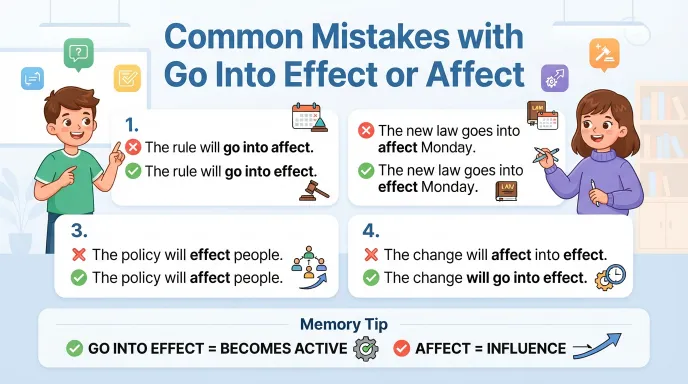
Common Mistakes with Go Into Effect or Affect
Using “Affect”
❌ The new policy will go into affect next week.
✅ The new policy will go into effect next week.
Confusing “Effect” and “Affect”
❌ The new rule will effect employees.
✅ The new rule will affect employees.
Using “Go Into Effect” for Influence
❌ The new policy will go into effect employee performance.
✅ The new policy will affect employee performance.
Go Into Effect or Affect in Everyday Examples
The updated schedule will go into effect on Monday.
News
The new law will go into effect later this year.
Social Media
The new rules go into effect tomorrow.
Formal Writing
The revised policy shall go into effect upon approval by the board.
Go Into Effect or Affect : Google Trends & Usage Data
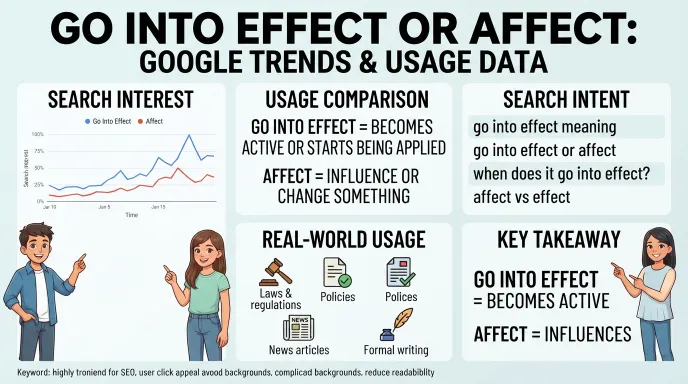
The phrase “go into effect or affect” is commonly searched because effect and affect are among the most frequently confused English words.
Searchers often want to check the phrase when writing about:
- Laws
- Government policies
- Company rules
- Contracts
- Regulations
- Official announcements
Usage Comparison
| Phrase | Correct? | Meaning |
| Go into effect | ✅ Yes | Become active |
| Go into affect | ❌ No | Incorrect phrase |
| Affect something | ✅ Yes | Influence something |
| Have an effect | ✅ Yes | Produce a result |
Comparison Table
| Expression | Meaning | Example |
| Go into effect | Become active | The law goes into effect tomorrow. |
| Affect | Influence | The law may affect businesses. |
| Have an effect | Produce a result | The law had an effect on businesses. |
| Come into force | Become legally active | The regulation comes into force next month. |
FAQs
Is it go into effect or affect?
The correct phrase is “go into effect.”
What does go into effect mean?
It means that a law, rule, policy, or change becomes active or starts to apply.
Is “go into affect” ever correct?
No. “Go into affect” is not the standard English phrase.
Can I say “come into effect”?
Yes. “Come into effect” is also correct and means that something becomes active.
What is the difference between affect and effect?
Affect usually means to influence, while effect usually means a result or, in this phrase, operation.
Is “go into effect” American English?
It is especially common in American English. British English often uses “come into force” for laws and regulations.
Which phrase should I use in formal writing?
Go into effect is correct, but for British legal or regulatory writing, come into force may be more natural.
Conclusion
The correct phrase is “go into effect,” not “go into affect.” The phrase means that a law, rule, policy, agreement, or change becomes active and starts to apply.
For example, “The new policy will go into effect next Monday” means the policy will officially begin operating on Monday.
The confusion comes from the similar-looking words affect and effect. In most everyday uses, affect is a verb meaning to influence, while effect is a noun meaning a result. In
“go into effect,” effect refers to something becoming operational.
For American English, go into effect is the standard phrase. In British English, especially for laws and regulations, come into force is also very common.
-The key is to match your phrase to your audience and context. When you mean “become active,” remember: go into effect.
DISCOVER MORE ARTICLE HERE!
- Cannot or Can Not? Which Spelling Is Correct?
- Alot or A Lot? Which Spelling Is Correct?
- Travelling or Traveling? Which Spelling Is Correct?

I’m Orin Blake, a writer with a passion for making English grammar simple, practical, and easy to understand. I enjoy breaking down confusing words, spelling differences, and everyday language questions into clear, reader-friendly guides. My goal is to help students, professionals, and curious learners write with greater confidence and accuracy.