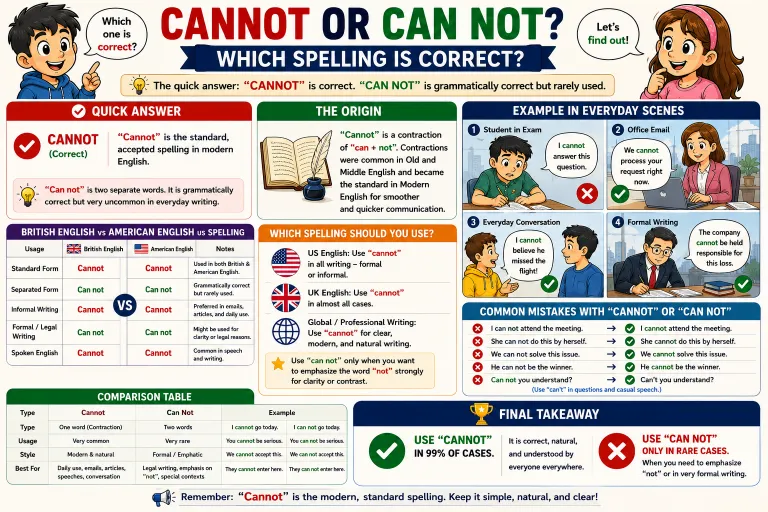
Have you ever wondered if the correct form is cannot or can not? This small difference causes confusion because both forms can appear in English writing.
Students, professionals, and English learners often search for “cannot or can not” when proofreading emails, essays, reports, and online content.
The good news is that cannot is the standard spelling when you mean that someone is unable to do something. For example, “I cannot attend the meeti The two-word form can not is also possible, but it is used in specific sentence structures, usually when not separately modifies another part of the sentence or when the writer wants to emphasize a choice.
For most everyday and professional writing, cannot is the safest choice. In this guide, you’ll learn the difference between cannot and can not, their history, British and American usage, common mistakes, practical examples, and simple rules to help you choose the correct form.
Cannot or Can Not 🙂 Quick Answer
The standard form is:
- Cannot ✅ = Standard negative form of can
- Can not ✅ = Possible in special contexts
- Can’t ✅ = Common contraction
Examples
- I cannot attend the meeting.
- She cannot drive yet.
- We cannot accept your request.
Special Use of “Can Not”
Can not can be used when not is part of a separate construction.
You can not only read the book but also discuss it.
Here, not only forms a separate expression.
Quick Tip
If you simply mean “unable to”, use cannot.
The Origin of Cannot or Can Not
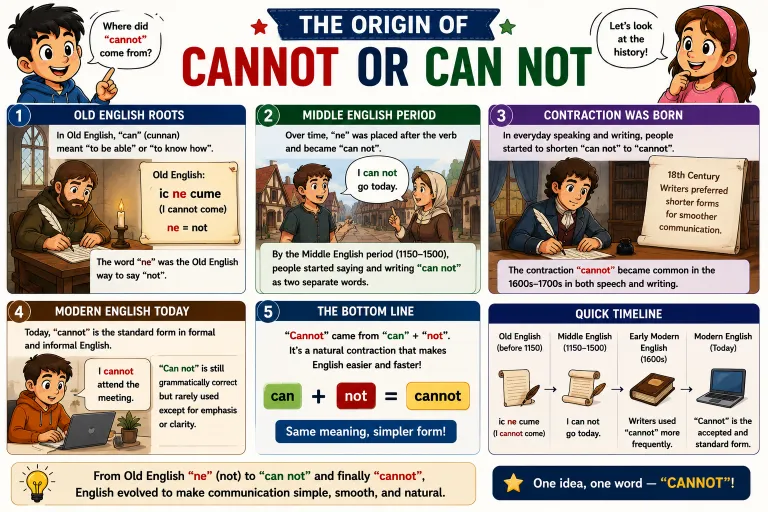
The word cannot developed as the standard negative form of can. English has many contracted or combined negative forms, such as:
- cannot
- shall not
- will not
- should not
The spelling cannot became established as the normal written form of the negative modal verb can.
Although can not can appear in certain constructions, it is not normally used as a replacement for cannot when expressing inability.
British English vs American English Spelling
British and American English generally follow the same rule.
Comparison Table of Cannot vs Can Not
| Usage | British English | American English |
| Standard negative | Cannot | Cannot |
| Contraction | Can’t | Can’t |
| Special construction | Can not | Can not |
| Formal writing | Cannot | Cannot |
Examples
British English:
I cannot understand the instructions.
American English:
I cannot understand the instructions.
The standard spelling is the same in both varieties.
Which Spelling Should You Use?
In most situations, use cannot.
Use “Cannot” for Inability
- I cannot help today.
- He cannot swim.
- They cannot enter the building.
- We cannot change the deadline.
Use “Can Not” in Special Constructions
The two-word form can occur when not has a separate grammatical role.
For example:
You can not only learn the rules but also practice them.
Another example:
We can not approve the request without additional information.
This second construction is possible when the writer is deliberately treating not separately, but in ordinary negative statements, cannot is preferred.
Common Mistakes with Cannot or Can Not
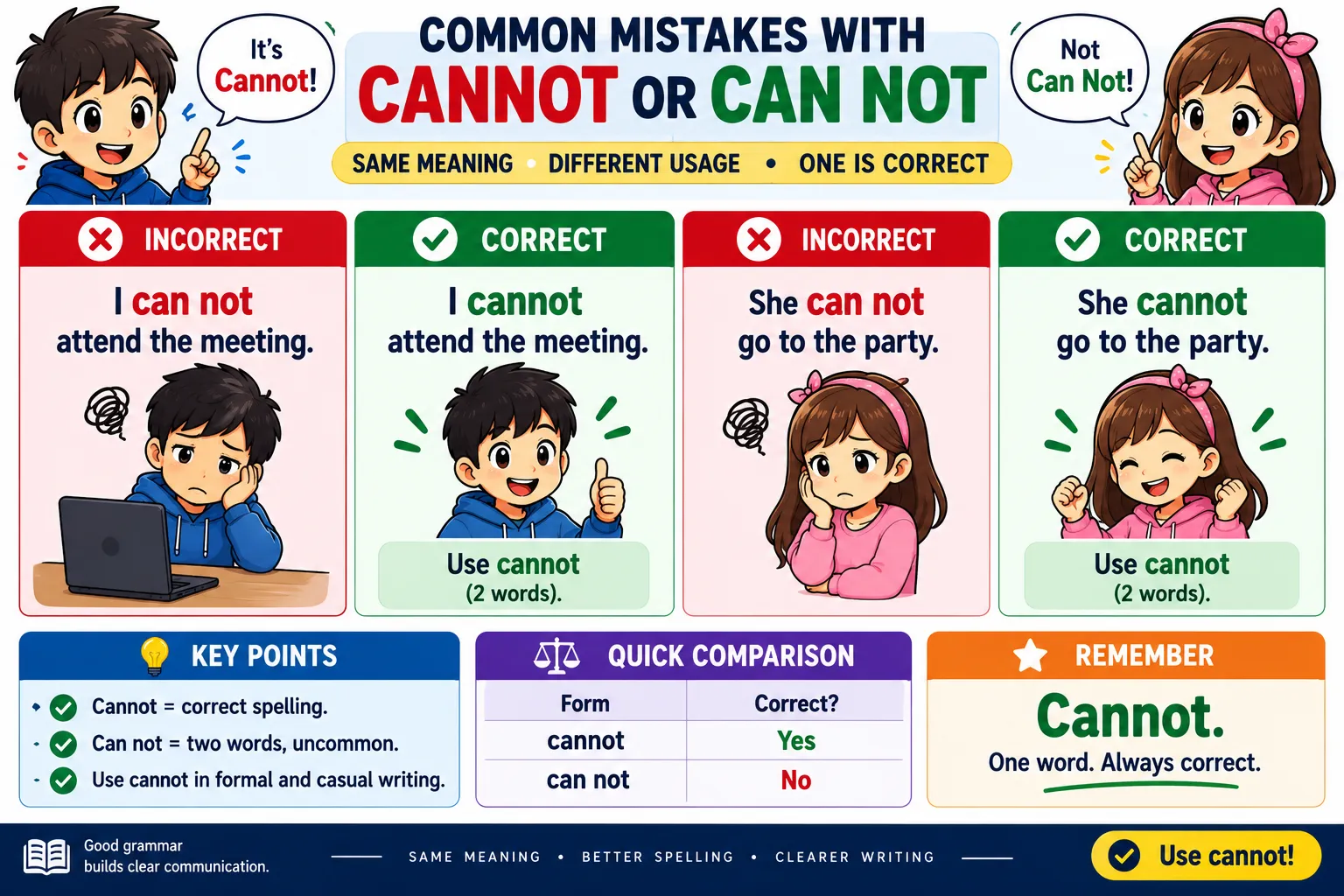
Using “Can Not” for Simple Negatives
❌ I can not attend the meeting.
✅ I cannot attend the meeting.
Confusing “Cannot” With “Can’t”
Both express inability:
I cannot come.
I can’t come.
Cannot is often better for formal writing, while can’t is common in conversation and informal writing.
Forgetting That “Cannot” Is One Word
❌ She can not understand the question.
✅ She cannot understand the question.
Cannot and Can Not in Everyday Examples
Unfortunately, I cannot attend the meeting tomorrow.
News
The team cannot continue without additional support.
Social Media
I cannot believe how quickly the year passed!
Formal Writing
The application cannot be processed without the required documents.
Cannot or Can Not : Google Trends & Usage Data
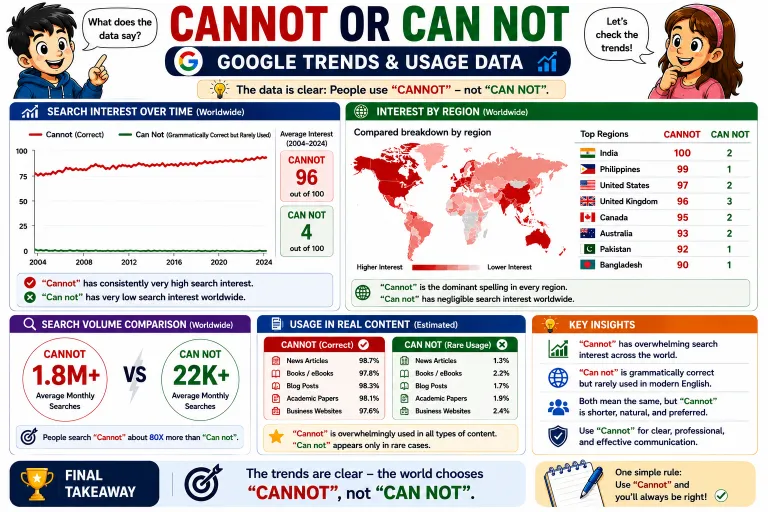
The phrase “cannot or can not” is commonly searched because writers often see both forms online and want to know when each is appropriate.
People search this keyword when:
- Writing essays
- Editing emails
- Learning English grammar
- Creating professional content
- Proofreading documents
Usage Comparison
| Meaning | Preferred Form |
| Unable to do something | Cannot |
| Formal negative | Cannot |
| Informal negative | Can’t |
| Special “not only” construction | Can not |
Comparison Table of Cannot or Can Not
| Form | Correct? | Main Use | Example |
| Cannot | ✅ Yes | Standard negative | I cannot go. |
| Can not | ✅ Sometimes | Special constructions | You can not only read but write. |
| Can’t | ✅ Yes | Contraction | I can’t go. |
FAQs
Is cannot or can not correct?
Cannot is the standard form when can means “be able to” and is made negative.
Is “can not” ever correct?
Yes. Can not can be correct when not functions separately, especially in constructions such as “can not only… but also…”
Is cannot one word?
Yes. Cannot is normally written as one word.
Is can’t the same as cannot?
Yes. Can’t is the contraction of cannot and is common in informal writing and speech.
Which form is better for formal writing?
Cannot is generally preferred in formal writing.
Do British and American English use different forms?
No. Both generally use cannot as the standard negative form.
Can I write “can not” instead of “cannot”?
Not usually. If you simply mean “not be able to,” use cannot.
Conclusion
The standard form is cannot when you mean that someone is unable or not permitted to do something. For example, “I cannot attend the meeting” is the normal and correct form.
The contraction can’t is also correct, especially in informal writing and conversation.
The two-word form can not is possible in specific grammatical constructions, particularly when not belongs to a separate phrase such as “can not only… but also…” However, it should not normally replace cannot in simple negative sentences.
A simple rule will solve most cases: if you mean “unable to,” write “cannot” as one word. This rule works in both British and American English.
Using cannot consistently will make your writing clear, professional, and grammatically sound.
DISCOVER MORE ARTICLE HERE!
- Canceled or Cancelled? Which Spelling Is Correct?
- Judgement or Judgment? Which Spelling Is Correct?
- Travelling or Traveling? Which Spelling Is Correct?

I’m Orin Blake, a writer with a passion for making English grammar simple, practical, and easy to understand. I enjoy breaking down confusing words, spelling differences, and everyday language questions into clear, reader-friendly guides. My goal is to help students, professionals, and curious learners write with greater confidence and accuracy.