Dying is correct; dieing is incorrect.Have you ever wondered if the correct spelling is dieing or dying? This is a common English spelling question because the verb die changes in an unusual way when -ing is added. Many students, writers, and English learners expect die + ing = dieing, but standard English uses dying when referring to the verb die.
The correct form is dying. The spelling changes from die to dying because English removes the final e and changes the ie pattern before adding -ing.
This rule makes dying look different from what you might expect.
There is one important exception: dieing can be a legitimate word in a very specialized context related to die, a tool or process used in manufacturing.
However, this meaning is uncommon in everyday English. For normal writing about someone or something approaching death, dying is the correct form.
Dieing or Dying : Quick Answer
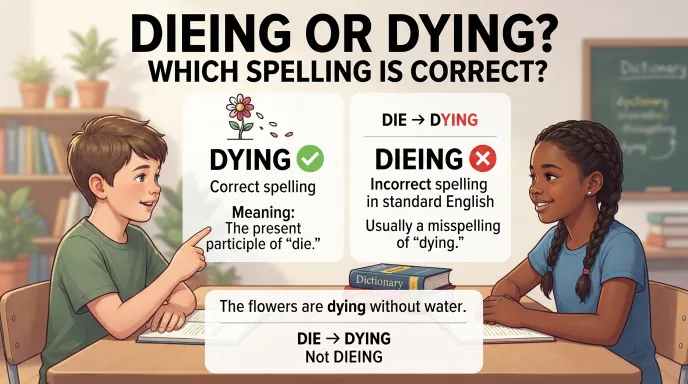
For the verb die, the correct form is:
- Dying ✅ = Present participle of die
- Dieing ❌ = Incorrect for the normal verb die
Examples
- The plant is dying.
- The flowers are dying without water.
- The character is dying in the story.
Quick Tip
Remember:
die → dying
Not:
die → dieing
The Origin of Dieing or Dying
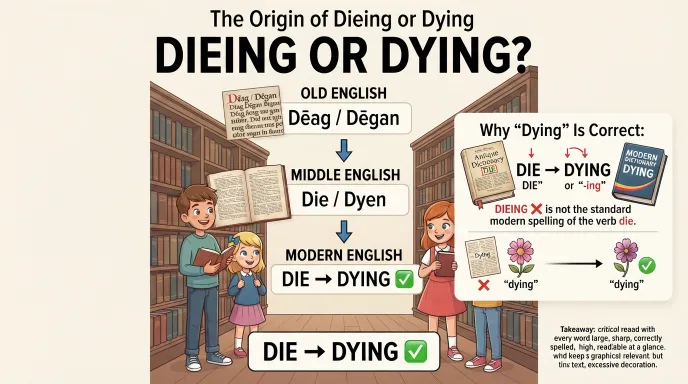
The verb die has Old Norse and Germanic roots and has been part of English for many centuries.
When English verbs ending in a silent e take -ing, the final e is usually removed.
Examples:
- make → making
- write → writing
- take → taking
- love → loving
However, die has an unusual spelling change:
die → dying
The ie changes to y before -ing. This helps avoid the awkward spelling dieing and follows a long-established English spelling convention.
British English vs American English Spelling
There is no major British-American spelling difference for dying.
Both varieties use:
dying ✅
Comparison Table
| Feature | British English | American English |
| Verb | Die | Die |
| Present participle | Dying | Dying |
| Incorrect everyday form | Dieing | Dieing |
| Past tense | Died | Died |
Examples
British English:
The flowers are dying.
American English:
The flowers are dying.
The spelling is the same in both varieties.
Which Spelling Should You Use?
Use dying when you are talking about the verb die.
Use “Dying”
- The plant is dying.
- The leaves are dying.
- The battery is dying.
- The fire is dying down.
Avoid “Dieing” in Normal Writing
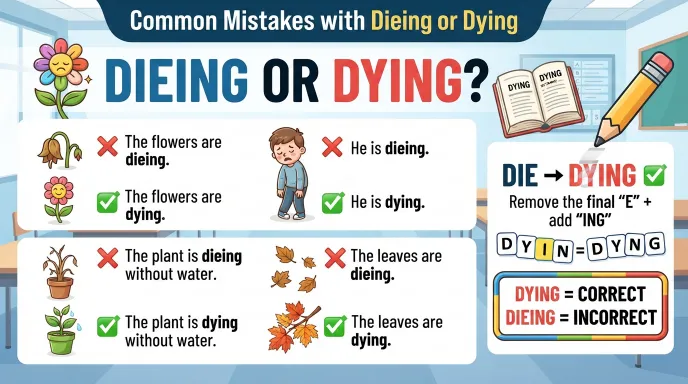
❌ The flowers are dieing.
✅ The flowers are dying.
Common Mistakes with Dieing or Dying
Adding -ing Directly to Die
❌ die + ing = dieing
✅ die + ing = dying
The spelling changes when -ing is added.
Confusing Dying With Dyeing
Dying means approaching death or becoming inactive.
The plant is dying.
Dyeing means coloring something, usually fabric or another material.
She is dyeing the fabric blue.
These words sound similar but have different meanings.
Using Dieing for Dying
❌ The battery is dieing.
✅ The battery is dying.
Dieing or Dying in Everyday Examples
The flowers in the office are dying because they need water.
News
Several trees are dying because of prolonged drought.
Social Media
My phone battery is dying! 🔋
Formal Writing
The researchers observed that several plants were dying due to a lack of water.
Dieing or Dying : Google Trends & Usage Data
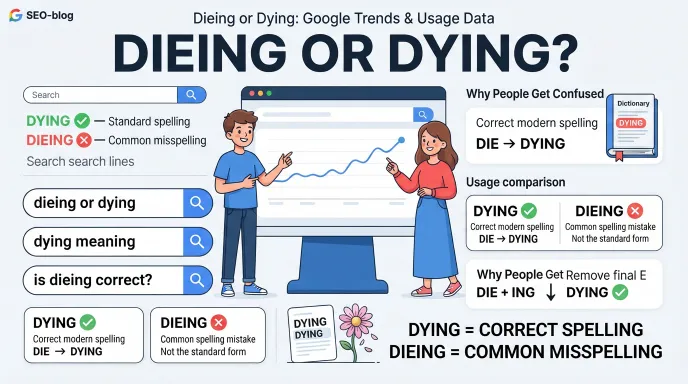
The search query “dieing or dying” is common because many learners assume that die simply takes -ing to become dieing.
People search this term when:
- Learning English spelling
- Writing school assignments
- Editing articles
- Checking grammar
- Proofreading professional content
Usage Comparison
| Word | Standard Everyday English? | Meaning |
| Dying | ✅ Yes | Present participle of die |
| Dieing | ❌ No for this meaning | Usually a misspelling |
| Dyeing | ✅ Yes | Coloring something |
Comparison Table
| Word | Meaning | Example |
| Dying | Approaching death / becoming inactive | The plant is dying. |
| Dyeing | Coloring something | She is dyeing the fabric. |
| Dieing | Specialized technical use; otherwise usually incorrect | Avoid in ordinary writing. |
FAQs
Is dieing or dying correct?
Dying is correct when it is the present participle of die.
Why is dying spelled with a y?
English changes die to dying when adding -ing. The ie changes to y.
Is dieing ever a word?
Yes, dieing can appear in specialized technical contexts related to die, a manufacturing tool or process. It is not the normal spelling of the verb die.
Is dying the same in British and American English?
Yes. Both British and American English use dying.
What is the difference between dying and dyeing?
Dying relates to die. Dyeing means coloring something.
How do I remember dying?
Remember the spelling change:
die → dying
Think of y as replacing ie before -ing.
Is “dieing” a common spelling mistake?
Yes. It is a common mistake because dieing seems like the natural result of adding -ing to die.
Conclusion
The correct spelling is dying when you mean the present participle of die. Although dieing may seem logical because it looks like die + ing, standard English changes the spelling to dying. This same form is used in both British and American English.
The most important distinction is between dying and dyeing. Dying means approaching death or gradually stopping, while dyeing means coloring something.
The spelling dieing should generally be avoided in everyday writing, although it can have a specialized technical use connected with manufacturing.
The easiest rule to remember is simple: die → dying. When you write about a plant, battery, fire, or other subject that is gradually stopping or losing life, use dying.
This simple spelling rule will help you avoid one of the most common mistakes with the verb die.
DISCOVER MORE ARTICLE HERE!
- Canceled or Cancelled? Which Spelling Is Correct?
- Fourty or Forty? Which Spelling Is Correct?
- Judgement or Judgment? Which Spelling Is Correct?

I’m Orin Blake, a writer with a passion for making English grammar simple, practical, and easy to understand. I enjoy breaking down confusing words, spelling differences, and everyday language questions into clear, reader-friendly guides. My goal is to help students, professionals, and curious learners write with greater confidence and accuracy.