Truly is correct; truely is incorrect.Have you ever wondered if the correct spelling is truely or truly? This is a common spelling mistake because the word true ends in e, so it may seem natural to write truely when adding -ly. However, standard English uses truly.
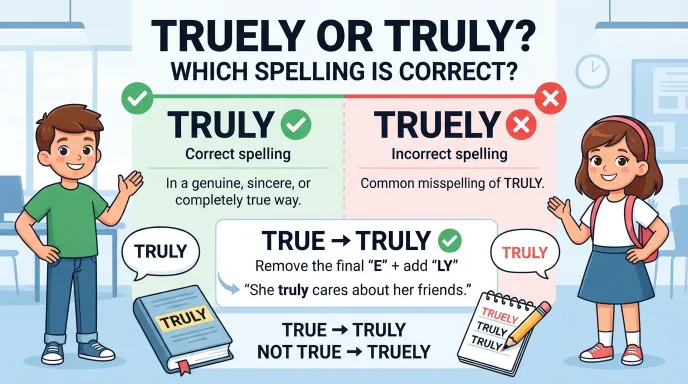
The correct spelling is truly. The incorrect form truely is often created by adding -ly directly to true, but English spelling rules remove the final e in this case.
The word truly means in a truthful, sincere, or genuine way.
For example, you can say, “I truly appreciate your help.” Here, truly shows that the speaker sincerely appreciates the help.
The word is common in everyday conversation, emails, formal writing, articles, and social media. In this guide, you’ll learn why truly is correct, where the word comes from, common mistakes, British and American usage, and easy examples to help you remember the spelling.
Truely or Truly : Quick Answer
The correct spelling is:
- Truly ✅
- Truely ❌
Examples
- I truly appreciate your help.
- She is truly talented.
- He truly believes in the idea.
Quick Tip
Remember:
true → truly
The final e is removed before adding -ly.
The Origin of Truely or Truly
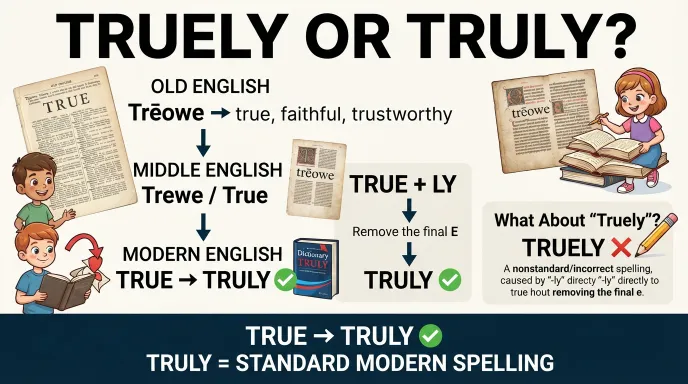
The word truly comes from true, which has Old English and Germanic roots.
In modern English, truly developed as the adverbial form of true. Unlike many words that simply add -ly, true drops its final e:
true → truly
This spelling became standard over time.
The form truely may look logical, but it is not the standard spelling in modern English.
British English vs American English Spelling
There is no major spelling difference between British and American English for truly.
Both use:
Truly ✅
Comparison Table
| Feature | British English | American English |
| Correct spelling | Truly | Truly |
| Incorrect spelling | Truely | Truely |
| Root word | True | True |
| Adverb | Truly | Truly |
Examples
British English:
I truly enjoyed the experience.
American English:
I truly enjoyed the experience.
The spelling is the same.
Which Spelling Should You Use?
Use truly whenever you mean genuinely, sincerely, or really.
Use “Truly”
- I truly appreciate your support.
- She truly understands the problem.
- This is truly amazing.
- He is truly committed to the project.
Avoid “Truely”
❌ I truely appreciate your help.
✅ I truly appreciate your help.
Common Mistakes with Truely or Truly
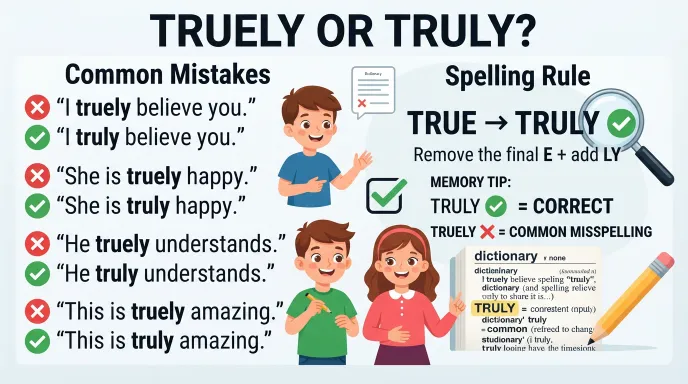
Adding “Ly” Directly to True
❌ true + ly = truely
✅ true + ly = truly
The final e is removed.
Confusing Truly With True
True is usually an adjective:
That statement is true.
Truly is an adverb:
I truly believe that statement.
Confusing Truly With Truthfully
Both can express sincerity, but they are not always interchangeable.
I truly appreciate your help.
I answered truthfully.
Truly often means genuinely or sincerely, while truthfully focuses more directly on telling the truth.
Truely or Truly in Everyday Examples
I truly appreciate your time and assistance.
News
The event was truly remarkable, according to the organizers.
Social Media
This was truly one of the best days ever!
Formal Writing
The findings truly demonstrate the importance of careful planning.
Truely or Truly : Google Trends & Usage Data
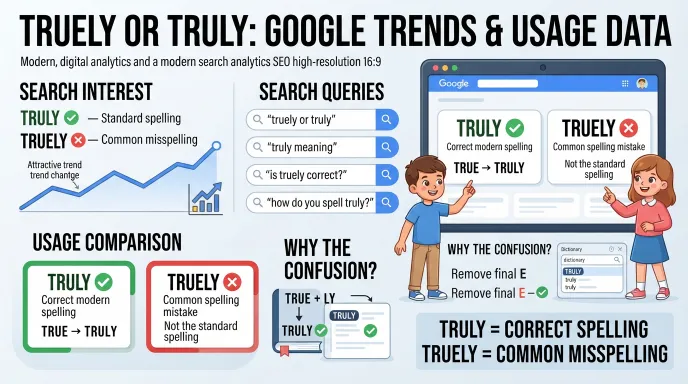
The search query “truely or truly” is common because truely looks like a natural spelling of true + ly.
People often search this term when:
- Writing essays
- Checking emails
- Learning English
- Editing articles
- Proofreading professional documents
Usage Comparison
| Spelling | Standard English? | Meaning |
| Truly | ✅ Yes | Genuinely or sincerely |
| Truely | ❌ No | Common misspelling |
Comparison Table
| Word | Correct? | Meaning | Example |
| Truly | ✅ Yes | Genuinely / sincerely | I truly appreciate it. |
| Truely | ❌ No | Incorrect spelling | Avoid this form. |
| True | ✅ Yes | Correct or factual | The statement is true. |
FAQs
Is truely or truly correct?
Truly is correct. Truely is a common misspelling.
Why is truly not spelled truely?
The final e in true is removed before adding -ly.
true → truly
Is truly the same in British and American English?
Yes. Truly is spelled the same in both varieties.
What does truly mean?
Truly means genuinely, sincerely, or really.
Is truely ever correct?
No. Truely is not the standard spelling of the adverb.
How do I remember truly?
Remember the spelling:
true → truly
The e disappears before -ly.
Can I use truly in formal writing?
Yes. Truly is completely acceptable in formal and professional writing.
Conclusion
The correct spelling is truly, not truely. The word truly is the adverb form of true and means genuinely, sincerely, or really.
Although truely may seem logical because it appears to follow the pattern of adding -ly to true, standard English removes the final e.
The easiest way to remember the spelling is true → truly.
The final e is dropped before -ly. This spelling is the same in both British and American English, so there is no regional difference to worry about.
if you are writing an email, school assignment, article, report, or social media post, use truly.
Once you remember that true becomes truly, you can easily avoid this common spelling mistake and keep your writing clear and professional.
DISCOVER MORE ARTICLE HERE!
- Jist or Gist? Which Spelling Is Correct?
- Go Into Effect or Affect? Which Phrase Is Correct?
- Cannot or Can Not? Which Spelling Is Correct?

I’m Orin Blake, a writer with a passion for making English grammar simple, practical, and easy to understand. I enjoy breaking down confusing words, spelling differences, and everyday language questions into clear, reader-friendly guides. My goal is to help students, professionals, and curious learners write with greater confidence and accuracy.