“Sometime” and “some time” are both correct, but they have different meanings. Sometime means at an unknown or unspecified time, while some time means a period of time.
For example, “Let’s meet sometime next week” refers to an unspecified day or time. “I need some time to finish my work” means you need a period of time.
These expressions look almost the same, so it is easy to mix them up. However, the space between the words changes how they work in a sentence. Choosing the correct form helps make your writing clear and natural.
The good news is that the rule is simple. Use sometime when talking about when something may happen. Use some time when talking about how much time something takes or how much time you need.
In this guide, you will learn the meanings, spelling rules, common mistakes, and everyday examples of sometime and some time. You will also find answers to common questions to help you use both expressions correctly.
Sometime or Some Time : Quick Answer
Use sometime to mean “at an unspecified time.” Use some time to mean “a period of time.”
- Sometime: Let’s have lunch sometime next week.
- Some time: I need some time to think.
- Sometime: We should visit them sometime.
- Some time: It took some time to solve the problem.
Easy rule: If you mean when, use sometime. If you mean how much time or a period of time, use some time.
Definition and Meaning of Sometime and Some Time
What Does Sometime Mean?
Sometime is an adverb. It refers to an unspecified or unknown time, usually in the past or future.
Examples:
- Let’s go shopping sometime tomorrow.
- I hope to visit London sometime next year.
- We met sometime in June.
- You should call me sometime this week.
In these sentences, sometime tells us when something happens or may happen, but it does not give an exact time.
What Does Some Time Mean?
Some time is a phrase made up of the determiner some and the noun time. It refers to a period or amount of time.
Examples:
- I need some time to prepare.
- She spent some time reading.
- It will take some time to complete the project.
- We have some time before the meeting starts.
In these sentences, some time means a period of time, often without saying exactly how long.
What Is the Difference Between Sometime and Some Time?
The main difference is that sometime refers to an unspecified point in time, while some time refers to a duration.
| Expression | Meaning | Example |
| Sometime | At an unspecified time | Call me sometime tomorrow. |
| Some time | A period of time | Give me some time to decide. |
| Sometimes | On some occasions | I sometimes walk to school. |
Remember that sometimes is another word. It means “occasionally” or “on some occasions.”
The Origin of Sometime and Some Time

The word sometime developed from the combination of some and time. Over time, the two words came to be written as one when used as an adverb meaning “at an unspecified time.”
The phrase some time keeps the two words separate because some describes the noun time. It refers to an amount or period of time rather than a particular point on a calendar.
Although the expressions share the same basic words, their grammar and meaning are different. Understanding how each phrase works can help you choose the correct form.
British English vs American English Spelling
There is no major difference between British and American English in the use of sometime and some time. Both varieties use the same spelling and basic rules.
| English variety | Correct expression | Example |
| American English | Sometime | Let’s meet sometime next week. |
| American English | Some time | I need some time to rest. |
| British English | Sometime | We should visit sometime soon. |
| British English | Some time | It took some time to finish. |
| Canadian and Australian English | Both forms | The same rules apply. |
The choice depends on the meaning of the sentence, not the type of English you use.
Which Expression Should You Use?
Use Sometime When You Mean “At an Unknown Time”
Use sometime when you do not know or do not need to specify the exact time.
Examples:
- Let’s meet sometime this weekend.
- I saw him sometime last month.
- We should talk sometime soon.
- She plans to travel sometime next year.
In each example, the exact time is not stated.
Use Some Time When You Mean “A Period of Time”
Use some time when you mean a length or amount of time.
Examples:
- I need some time to learn this skill.
- He spent some time with his family.
- The repair may take some time.
- Please give me some time to finish.
Here, some time refers to a period, even if its exact length is unknown.
What About Sometimes?
Sometimes means “occasionally” or “on some occasions.” It describes how often something happens.
Examples:
- I sometimes read before bed.
- She sometimes works on weekends.
- Sometimes, the simplest answer is the best.
Compare these three sentences:
- Sometime: Let’s talk sometime tomorrow.
- Some time: I need some time to talk.
- Sometimes: We sometimes talk after school.
The meanings are different, so the spellings are not interchangeable.
An Easy Memory Trick
Remember these three clues:
- Sometime = when?
- Some time = how long?
- Sometimes = how often?
For example, “Come over sometime” refers to when you should visit. “Stay for some time” refers to how long you should stay. “Sometimes I visit” means you visit occasionally.
Common Mistakes with Sometime and Some Time
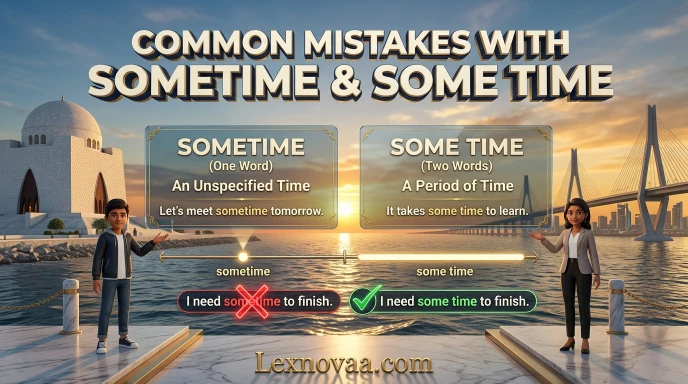
Many writers confuse these expressions because they look and sound similar. Here are some common mistakes.
| Incorrect or intended meaning | Correct sentence | Why? |
| I need sometime to rest. | I need some time to rest. | It means a period of time. |
| Let’s meet some time tomorrow. | Let’s meet sometime tomorrow. | It means an unspecified time. |
| I sometime go there. | I sometimes go there. | It means occasionally. |
| It will take sometime to finish. | It will take some time to finish. | It means a period of time. |
Mistake 1: Using Sometime for a Duration
Incorrect: I need sometime to finish my homework.
Correct: I need some time to finish my homework.
You need a period of time, so the two-word form is correct.
Mistake 2: Using Some Time for an Unspecified Appointment
Less suitable: Let’s meet some time next week.
Better: Let’s meet sometime next week.
When you mean an unspecified day or time, use sometime as one word.
Mistake 3: Confusing Sometime With Sometimes
Incorrect: I sometime play football after school.
Correct: I sometimes play football after school.
Use sometimes when you mean that something happens occasionally.
Mistake 4: Assuming Both Forms Always Mean the Same Thing
The sentence “We can talk sometime” suggests an unspecified time to talk. The sentence “We need some time to talk” means you need a period of time for the conversation.
Always check the intended meaning before choosing the spelling.
Everyday Examples of Sometime and Some Time
1. In Everyday Conversation
- “Let’s grab coffee sometime.”
- “I need some time to think about it.”
- “Sometimes, I just want to relax.”
2. At School
- “We will finish the assignment sometime this week.”
- “I spent some time studying for the exam.”
- “Sometimes, studying with a friend helps.”
3. At Work
- “Can we schedule a call sometime tomorrow?”
- “This task will take some time.”
- “Sometimes, the team needs an extra meeting.”
4. In Relationships
- “We should visit our grandparents sometime soon.”
- “Give me some time to understand the situation.”
- “Sometimes, a simple conversation helps.”
5. While Making Plans
- “Let’s go for a walk sometime this evening.”
- “We have some time before the bus arrives.”
- “Sometimes, plans change at the last minute.”
6. In Writing
- “The report will be published sometime next month.”
- “The writer spent some time checking the facts.”
- “Sometimes, a shorter sentence is easier to understand.”
These examples show how context determines which expression is correct.
Sometime or Some Time: Quick Comparison
| Feature | Sometime | Some Time |
| Word form | One word | Two words |
| Part of speech | Adverb | Determiner + noun |
| Meaning | At an unspecified time | A period of time |
| Common use | Future or past timing | Duration |
| Example | Call me sometime. | Give me some time. |
A quick way to choose is to ask yourself if you are talking about when something happens or how much time is involved.
Google Trends and Modern Usage
People search for “sometime or some time” because the expressions have similar spellings but different meanings. The confusion often appears in emails, school assignments, online messages, and everyday writing.
Sometime is useful when making flexible plans, such as meeting sometime next week. Some time is common when discussing tasks, waiting, learning, or needing a break. Sometimes also appears frequently in everyday English when people describe habits or repeated events.
No live Google Trends figures have been verified for this article, so exact search volumes and popularity rankings should not be assumed.
You can explore current search interest using Google Trends. Remember that popularity does not determine correct spelling. The meaning and grammar of your sentence should guide your choice.
FAQs
1. Is it sometime or some time?
Both are correct. Sometime means at an unspecified time, while some time means a period of time.
2. What is the difference between sometime and some time?
Sometime tells you when something may happen. Some time refers to a duration or amount of time.
3. Is sometime one word?
Yes. Sometime is one word when it means at an unspecified time, as in “Let’s meet sometime next week.”
4. Is some time two words?
Yes. Some time contains the word some and the noun time. It refers to a period of time, as in “I need some time to rest.”
5. Is it sometime tomorrow or some time tomorrow?
Sometime tomorrow is usually the better choice when you mean an unspecified time tomorrow. For example, “I will call you sometime tomorrow.”
6. Is it sometime soon or some time soon?
Use sometime soon when you mean at an unspecified time in the near future. Example: “We should meet sometime soon.”
7. Is it spend sometime or spend some time?
Use spend some time when you mean to use a period of time doing something. Example: “I want to spend some time with my family.”
8. What is the difference between sometime and sometimes?
Sometime means at an unspecified time. Sometimes means occasionally or on some occasions. For example, “Visit sometime” and “I sometimes visit” have different meanings.
9. Is “some time ago” correct?
Yes. Some time ago means a period in the past, often without stating exactly how long ago. Example: “I met her some time ago.”
10. How can I remember sometime vs. some time?
Remember sometime for “when,” some time for “how long,” and sometimes for “how often.” These simple questions help you choose the correct form.
Key Takeaways
- Sometime: At an unspecified time.
- Some time: A period or amount of time.
- Sometimes: Occasionally or on some occasions.
- Sometime next week: An unspecified time next week.
- Some time to finish: A period needed to complete something.
- Sometimes I walk: An action that happens occasionally.
Conclusion
The difference between sometime and some time is easy to understand when you focus on meaning. Use sometime when referring to an unknown or unspecified point in time.
Use some time when talking about a period or amount of time. For example, “Let’s meet sometime next week” does not give an exact meeting time, while “I need some time to prepare” means you need a period to get ready.
Also, remember sometimes, which means “occasionally.” It is a third form with its own meaning. Asking yourself “when?”, “how long?”, or “how often?” can help you choose the correct spelling.
With a little practice, you can use all three expressions confidently in schoolwork, emails, conversations, and professional writing. The key is to understand what your sentence means before deciding if to write one word or two.
For more clear grammar guides, spelling comparisons, and everyday examples, visit Lexnovaa.com.
DISCOVER MORE ARTICLE CLICK HERE NOW!
- Apart or A Part: Which Is Correct? Meaning, Rules, and Examples
- Rhythm or Rythm:Meaning, Rules, and Examples
- Passed or Past: Is Correct? Meaning, Rules, and Examples

I’m Orin Blake, a writer with a passion for making English grammar simple, practical, and easy to understand. I enjoy breaking down confusing words, spelling differences, and everyday language questions into clear, reader-friendly guides. My goal is to help students, professionals, and curious learners write with greater confidence and accuracy.