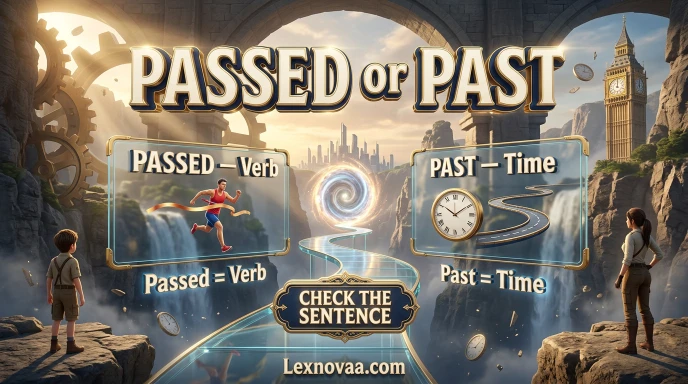
“Passed” and “past” are both correct English words, but they have different meanings and uses. Passed is usually the past tense of the verb pass. Past can refer to an earlier time, a place beyond something, or something that has already happened.
For example, “She passed the test” is correct because it describes an action, while “We walked past the school” is correct because it describes movement beyond a place.
Many people search for “passed or past” because the words sound alike but do different jobs in a sentence. Using the wrong one can make your writing unclear. The good news is that a simple rule can help you choose the right word.
Use passed when someone or something completes an action, such as passing a test, passing a car, or passing away. Use past when you mean an earlier time, movement beyond a point, or something that has already happened.
In this guide, you will learn the meanings, origins, spelling rules, common mistakes, and everyday examples of passed and past.
Passed or Past : Quick Answer
Use “passed” for an action and “past” for time, location, or something that has already happened.
- Passed: The past tense of pass. Example: She passed her exam.
- Past: Refers to an earlier time or a point beyond something. Example: We walked past the store.
Easy memory trick: If you can replace the word with an action like “went by” or “completed,” passed may be correct. If you mean “earlier” or “beyond,” use past.
Definition and Meaning of Passed and Past
What Does Passed Mean?
Passed is the past tense and past participle of the verb pass. It describes an action that has happened or been completed.
The word can have several meanings, depending on the sentence.
Examples:
- She passed the English test.
- The bus passed our house.
- He passed the ball to his teammate.
- Time passed quickly during the holiday.
- The patient passed away peacefully.
In each sentence, passed describes an action or event. It tells us that something happened, moved, or was completed.
You can also use passed with helping verbs:
- She has passed the exam.
- They had passed the building before they noticed it.
- The message was passed to the manager.
What Does Past Mean?
Past can refer to a time before now, movement beyond a place, or a period that has ended. It can work as a noun, adjective, adverb, or preposition.
Examples:
- We talked about the past.
- The past year was full of changes.
- She walked past the library.
- It is half past six.
- He moved past his mistake.
In these examples, past does not describe the action of passing as a verb. Instead, it points to time, position, or something that has already happened.
The key difference is simple: passed usually describes an action, while past refers to time, position, or an earlier period.
The Origin of Passed and Past
The words passed and past are linked through the history of the verb pass.
Pass entered English through Old French, with roots in the Latin word passus, meaning a step or pace. Over time, pass developed meanings related to movement, progress, and going from one point to another.
Passed developed as the regular past-tense form of pass. It is used when describing an action that happened in the past.
Past developed as a word linked to the idea of something that has gone by or is beyond a point. Today, it can describe an earlier time, a location beyond something, or a completed period.
Their shared history helps explain why the words sound similar. However, their roles in modern English are different, so you must choose the spelling that fits the sentence.
Is Passed or Past Different in British English and American English?

No. Passed and past have the same basic meanings and spellings in British English and American English. The difference is based on grammar and meaning, not regional spelling.
| English variety | Action or completed event | Earlier time or beyond a point |
| American English | Passed | Past |
| British English | Passed | Past |
| Canadian English | Passed | Past |
| Australian English | Passed | Past |
Examples that are correct in all these varieties include:
- “He passed his driving test.”
- “We drove past the museum.”
- “The event happened in the past.”
- “She passed the message to her friend.”
if you are writing an email, school assignment, report, or article, choose the word based on its role in the sentence.
Which Word Should You Use?
The correct word depends on what you want to say.
Use Passed for an Action
Use passed when describing an action related to the verb pass.
Examples:
- She passed the final exam.
- The car passed the truck.
- He passed the salt to his sister.
- Three hours passed before the train arrived.
- The teacher passed the papers to the students.
A helpful question is: Is the word describing an action that happened? If yes, passed is often the right choice.
Use Past for Time
Use past when talking about an earlier time or something that has already happened.
Examples:
- I learned a lot from my past mistakes.
- The past few weeks have been busy.
- We cannot change the past.
- It is ten minutes past nine.
- She often talks about her past.
In these sentences, past refers to time or events that came before the present.
Use Past for Movement Beyond Something
Use past when describing a place or point that someone or something moves beyond.
Examples:
- We walked past the bank.
- The bus went past our stop.
- He ran past the finish line.
- Drive past the school and turn left.
Notice the difference:
- The car passed the house. The car performed the action of passing.
- The car drove past the house. The word past shows the car’s position or movement beyond the house.
Both sentences are correct, but the words have different grammatical roles.
An Easy Memory Trick
Remember these simple rules:
- Passed = an action.
- Past = earlier or beyond.
Try these examples:
- “She passed the test.” She completed the test successfully.
- “She walked past the test center.” She moved beyond the building.
- “She remembered the past.” She thought about an earlier time.
If you can replace the word with “earlier” or “beyond,” past may fit. If you need the past-tense form of pass, choose passed.
Common Mistakes with Passed and Past
People often confuse these words because they sound alike. Checking the meaning and grammar of the sentence can help you avoid mistakes.
| Incorrect sentence | Correct sentence | Why? |
| She past the exam. | She passed the exam. | Passing an exam is an action. |
| We walked passed the shop. | We walked past the shop. | Past means beyond the shop. |
| I learned from my passed mistakes. | I learned from my past mistakes. | Past refers to earlier mistakes. |
| The bus past our house. | The bus passed our house. | Passed describes the bus’s action. |
Mistake 1: Writing “Past the Exam”
Incorrect: He past the exam.
Correct: He passed the exam.
The sentence describes an action that he completed successfully. Therefore, passed is correct.
Mistake 2: Writing “Walked Passed”
Incorrect: We walked passed the library.
Correct: We walked past the library.
After walked, the word past shows where the movement happened. It means the people went beyond the library.
Mistake 3: Using “Passed” for Earlier Time
Incorrect: I miss my passed life.
Better: I miss my past life.
The sentence refers to an earlier period, so past is the correct word.
Mistake 4: Assuming “Passed Away” and “Past Away” Are Both Correct
The correct phrase is passed away. It is a polite expression meaning that someone has died.
Example: “Her grandfather passed away many years ago.”
Past away is incorrect because the phrase needs the verb passed.
Everyday Examples of Passed and Past
Here are practical examples that show how each word works in everyday English.
1. At School
- “Mia passed her science test.”
- “We walked past the school library.”
- “He learned from his past mistakes.”
The first sentence describes success, the second describes movement, and the third refers to earlier events.
2. At Work
- “The manager passed the report to the team.”
- “The office is just past the main entrance.”
- “We discussed the past month’s results.”
3. While Traveling
- “The train passed the station.”
- “We drove past the airport.”
- “The town looked different compared with the past.”
4. In Everyday Conversation
- “Time passed faster than I expected.”
- “Let’s put the past behind us.”
- “She passed the message to her friend.”
5. In Questions
- “Have you passed your driving test?”
- “Did we walk past the right street?”
- “What happened in the past?”
6. In Emails and Messages
- “I passed your request to the support team.”
- “Please see the past email for more details.”
- “We drove past the office but did not stop.”
These examples show that the correct word depends on if you mean an action, an earlier time, or movement beyond a point.
Passed or Past: Quick Comparison

| Feature | Passed | Past |
| Main role | Verb form | Noun, adjective, adverb, or preposition |
| Main meaning | An action that happened | Earlier time or beyond a point |
| Common phrase | Passed the exam | Past mistakes |
| Movement example | The car passed us | We walked past the car |
| Time example | Time passed quickly | In the past |
| Memory clue | Action | Earlier or beyond |
The main rule is easy to remember: passed is usually an action, while past usually means earlier or beyond.
Google Trends and Modern Usage
People search for “passed or past” because the words sound alike and often appear in similar sentences. The confusion is common in schoolwork, emails, social media posts, and everyday writing.
Passed often appears in phrases such as “passed the test,” “passed the message,” and “passed away.” Past commonly appears in phrases such as “in the past,” “past mistakes,” and “walked past the building.”
No live Google Trends figures have been verified for this article, so exact search volumes or popularity rankings should not be assumed.
You can compare current search interest in Google Trends by entering “passed” and “past.” Keep in mind that search interest does not show if people use the words correctly.
For clear writing, focus on the meaning of your sentence. Use passed for an action and past for an earlier time or a point beyond something.
FAQs
1. Is it passed or past?
Both words are correct, but they have different uses. Passed is usually the past tense of pass, while past refers to an earlier time or a point beyond something.
2. What is the difference between passed and past?
Passed describes an action, such as passing a test. Past describes an earlier time or movement beyond a place, as in “walked past the store.”
3. Is it “passed the school” or “past the school”?
Both can be correct, depending on the sentence. “The bus passed the school” describes an action. “The bus drove past the school” uses past to show the bus’s route.
4. Is it “walked past” or “walked passed”?
Walked past is correct when you mean that someone moved beyond a place.
Example: “We walked past the post office.”
5. Is it “passed away” or “past away”?
Passed away is correct. It is a polite phrase used to say that someone has died.
6. Is it “past experience” or “passed experience”?
Past experience is correct when referring to experience gained earlier in life or work.
Example: “Her past experience helped her solve the problem.”
7. Is it “time passed” or “time past”?
“Time passed” is correct when describing time moving by.
Example: “Time passed quickly during the trip.”
However, past can appear in expressions such as “in the past” or “half past six.”
8. Is it “passed my test” or “past my test”?
Passed my test is correct when you mean that you succeeded in the test.
Example: “I passed my driving test last week.”
9. Can past be a noun?
Yes. Past can be a noun that refers to an earlier time or the events of someone’s life.
Example: “We cannot change the past.”
10. How can I remember passed vs. past?
Remember that passed describes an action, while past means earlier or beyond. “She passed the shop” describes an action; “she walked past the shop” describes movement beyond it.
Key Takeaways
- Passed: The past tense and past participle of pass.
- Past: Refers to an earlier time, a place beyond something, or a previous period.
- Passed the exam: Correct when describing success.
- Walked past the store: Correct when describing movement beyond a place.
- Passed away: The correct phrase for this polite expression.
- Writing tip: Check if you need an action or a word about time or location.
Conclusion
The difference between passed and past is simple once you understand how each word works. Use “passed” when describing an action and “past” when referring to an earlier time or a point beyond something.
For example, “She passed the test” describes success, while “She walked past the school” describes movement beyond a building.
The words sound alike, but they cannot always replace each other. You can say “time passed quickly” because passed describes an action. You can also say “the past year was busy” because past refers to an earlier period.
Whenever you are unsure, look at the role of the word in your sentence. If you need the past-tense form of pass, use passed.
If you mean “earlier” or “beyond,” use past. With this simple rule and the examples in this guide, you can choose the correct word in schoolwork, emails, and everyday conversations.
Explore More English Grammar Tips on Lexnovaa.com
Want to avoid common word-choice mistakes and improve your English? Visit Lexnovaa.com for clear word comparisons, simple grammar explanations, and practical examples that make English easier to understand.
DISCOVER MORE ARTICLE CLICK HERE NOW!
- Further or Farther: Meaning, Rules, and Examples
- Discrete or Discreet: Which Spelling Is Correct? Meaning Rules.
- IPA vs Lager: What’s the Difference? Taste, Alcohol Content.

I’m Orin Blake, a writer with a passion for making English grammar simple, practical, and easy to understand. I enjoy breaking down confusing words, spelling differences, and everyday language questions into clear, reader-friendly guides. My goal is to help students, professionals, and curious learners write with greater confidence and accuracy.