IPA and lager are two different styles of beer, with differences in flavor, brewing method, and bitterness. IPA stands for India Pale Ale. It is usually known for its strong hop flavor, which can taste bitter, fruity, or citrusy.
Lager is a beer style made using bottom-fermenting yeast and cool fermentation. It is often crisp, smooth, and clean in flavor.
People compare IPA vs. lager because both are popular beer styles, but they can taste very different. An IPA may have bold aromas of citrus, pine, tropical fruit, or flowers. A lager often has a lighter, more balanced taste, although some lagers are dark, rich, or full-bodied.
Neither style is automatically stronger or better than the other. Alcohol content, color, bitterness, and flavor depend on the specific beer and how it is brewed.
In this guide, you will learn what IPA and lager mean, how they differ, and how their brewing methods affect their taste. You will also find a simple comparison table and answers to common questions about these two beer styles.
IPA vs Lager : Quick Answer
IPA is a hop-forward ale, while lager is a beer style usually fermented at cooler temperatures with lager yeast.
- IPA: Often bold, hoppy, bitter, or fruity.
- Lager: Often crisp, clean, and balanced.
- Main difference: Yeast and fermentation method, along with typical flavor and hop character.
IPAs can be light or dark, and lagers can range from pale and mild to dark and rich. Their exact characteristics depend on the recipe.
Definition and Meaning of IPA and Lager
What Does IPA Mean?
IPA stands for India Pale Ale. It belongs to the ale family of beers and is commonly associated with a noticeable hop character.
Hops are flowers used in brewing to add bitterness, aroma, and flavor. Depending on the hops and recipe, an IPA may have notes of grapefruit, lemon, pine, mango, or other fruits.
Common IPA styles include:
- West Coast IPA: Often bitter, crisp, and piney or citrusy.
- New England IPA: Often hazy, soft, and fruity.
- Session IPA: Usually lower in alcohol than many standard IPAs.
- Double IPA: Often stronger and more hop-forward than a standard IPA.
Not every IPA tastes the same. Some are sharply bitter, while others are smooth and fruit-focused.
What Does Lager Mean?
Lager is a broad family of beer traditionally brewed with lager yeast and fermented under cooler conditions than many ales. Lager yeast generally works well at cooler temperatures, and many lagers are conditioned for a period to develop a clean flavor.
Common lager styles include:
- Pilsner: Usually pale, crisp, and noticeably hopped.
- Helles: Often pale, smooth, and malt-focused.
- Dunkel: A dark lager with toasted or malty notes.
- Bock: A malt-rich lager that can have a stronger alcohol content.
Lager does not always mean light in color or low in alcohol. Its flavor and strength depend on the style.
The Origin of IPA and Lager

The Origin of IPA
India Pale Ale developed in Britain in the 18th and 19th centuries. British brewers made pale ales with substantial hop additions, which helped preserve beer during long journeys, including shipments to British India.
Over time, IPA became a distinct beer style. Modern versions have developed in many directions, including American IPAs known for bold hop aromas and newer versions that emphasize tropical fruit flavors.
The Origin of Lager
The word lager comes from the German word lagern, meaning “to store.” The name reflects the traditional practice of storing beer in cool conditions while it matured.
Lager brewing became closely associated with Central Europe, especially Germany and the Czech lands. Advances in refrigeration later helped breweries produce lagers more consistently on a large scale.
Today, lagers are brewed worldwide and include many different styles.
Is IPA or Lager Different in British English and American English?
The terms IPA and lager are used in both British and American English. Their basic meanings do not change, although local brewing traditions and popular examples may differ.
| Feature | British English | American English |
| IPA | India Pale Ale | India Pale Ale |
| Lager | Beer made with lager yeast | Beer made with lager yeast |
| Common IPA character | Varies by style; British examples may be more restrained | Many popular examples emphasize bold hop flavors |
| Common lager character | Often includes pale lagers and traditional European styles | Includes pale lagers and many craft lager styles |
These are broad tendencies, not strict rules. Both countries produce a wide range of IPAs and lagers.
Which Beer Style Should You Choose?
The choice depends on the flavors and characteristics you prefer.
Choose an IPA for Bold Hop Flavor
IPAs may suit people who enjoy pronounced hop aromas and flavors. Depending on the style, they can taste bitter, citrusy, piney, floral, or tropical.
Examples of common flavor descriptions include:
- Grapefruit and citrus
- Pine and herbs
- Mango and tropical fruit
- Floral or resin-like aromas
An IPA is not always stronger than a lager. Check the specific product label for its alcohol content.
Choose a Lager for a Clean, Balanced Taste
Lagers are often associated with a crisp, clean finish. Pale lagers may have mild malt flavors, while other types can taste toasted, sweet, or rich.
Common flavor descriptions include:
- Light malt
- Bread or crackers
- Gentle bitterness
- Crisp, clean finish
Some lagers, such as pilsners, can be quite hoppy. Therefore, the difference is not simply that every lager is mild and every IPA is bitter.
Common Mistakes When Comparing IPA and Lager
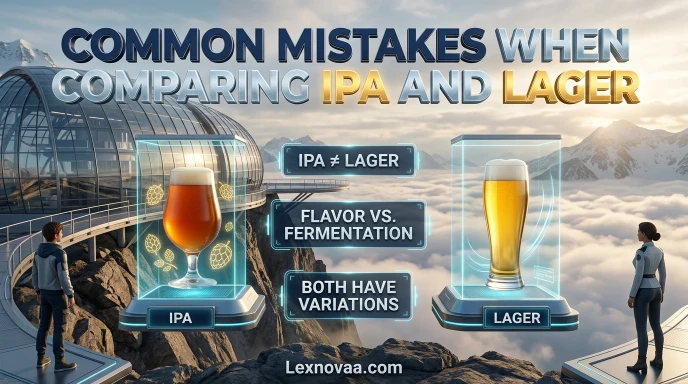
People often make assumptions about these beer styles that are not always correct.
| Common claim | More accurate explanation |
| Every IPA is very bitter. | Some are bitter, while others emphasize fruit and softer hop flavors. |
| Every lager is light-colored. | Lagers can be pale, amber, or dark. |
| IPA always has more alcohol. | Alcohol content varies by individual beer. |
| Lager means low alcohol. | Some lagers have a high alcohol content. |
| IPA and lager differ only in taste. | They are associated with different yeast and fermentation methods. |
Mistake 1: Assuming All IPAs Taste the Same
Different hop varieties and brewing methods can produce very different IPA flavors. Check the style description instead of assuming every IPA tastes sharply bitter.
Mistake 2: Assuming Lager Means a Pale Beer
Pale lagers are common, but dark lagers also exist. Color alone does not determine if a beer is an IPA or a lager.
Mistake 3: Comparing Alcohol Content Without Checking Labels
The style name alone cannot tell you exactly how much alcohol a beer contains. Check the stated alcohol by volume, or ABV, for the particular product.
Everyday Examples of IPA and Lager
Here are examples of how people describe these styles when discussing beer.
1. Talking About Flavor
- “This IPA has a strong citrus aroma.”
- “This lager has a crisp, clean finish.”
2. Describing Bitterness
- “The West Coast IPA has a pronounced bitter finish.”
- “This lager has a more balanced malt flavor.”
3. Discussing Beer Styles
- “A New England IPA is often hazy and fruit-forward.”
- “A pilsner is a type of lager.”
4. Comparing Alcohol Content
- “Check the IPA’s label to find its ABV.”
- “Lagers vary in alcohol content, so the style name is not enough.”
These examples show why the specific beer matters more than broad assumptions about either category.
IPA vs Lager: Quick Comparison
| Feature | IPA | Lager |
| Full name or category | India Pale Ale | Lager |
| Beer family | Ale | Lager |
| Typical yeast | Ale yeast | Lager yeast |
| Fermentation | Commonly warmer than traditional lager fermentation | Commonly cooler fermentation |
| Flavor | Often hop-forward | Often clean and balanced |
| Bitterness | Often noticeable, but varies | Varies by style |
| Color | Pale to dark | Pale to dark |
| Alcohol content | Varies | Varies |
| Examples | West Coast IPA, New England IPA | Pilsner, Helles, Dunkel |
Google Trends and Modern Usage
IPA and lager are widely recognized beer-style terms used on brewery menus, product labels, and beer guides. People often compare them when learning about beer flavors or trying to understand a menu.
The popularity of individual styles can vary by country, brewery, and time. No live Google Trends figures have been verified for this article, so exact search volumes or popularity rankings should not be assumed.
You can explore current search interest in Google Trends by comparing “IPA beer” and “lager beer.”
Search interest is not the same as sales or personal preference. For a meaningful comparison, look at the exact time period and location selected in Google Trends.
FAQs
1. What is the main difference between IPA and lager?
IPA is an ale style commonly known for its hop-forward flavor. Lager is a beer family brewed with lager yeast and commonly fermented at cooler temperatures.
2. Is IPA stronger than lager?
Not always. Both styles vary in alcohol content. Check the ABV on the label to compare specific beers.
3. Is lager less bitter than IPA?
Many lagers are less bitter than many IPAs, but this is not a universal rule. Pilsners can be noticeably hoppy, and some IPAs have a softer bitterness.
4. What does IPA stand for?
IPA stands for India Pale Ale.
5. Is lager an ale?
No. Lager and ale are different beer families, traditionally distinguished by the yeast and fermentation methods used.
6. Can lager be dark?
Yes. Dark lagers, such as Dunkel, can have toasted, roasted, or rich malt flavors.
7. Does IPA always taste fruity?
No. Some IPAs have citrus or tropical fruit notes, while others emphasize pine, herbs, floral aromas, or bitterness.
8. Is pilsner a lager?
Yes. Pilsner is a type of lager, usually known for its pale color, crisp flavor, and hop character.
9. Which has more calories, IPA or lager?
It depends on the specific beer, its alcohol content, and its ingredients. The style name alone is not enough to determine which contains more calories.
10. Are IPA and lager the same thing?
No. IPA is a style within the ale family, while lager refers to a separate beer family that includes styles such as pilsner and Helles.
Key Takeaways
- IPA: India Pale Ale, an ale style often known for its hop-forward flavor.
- Lager: A beer family commonly brewed and fermented with lager yeast at cooler temperatures.
- Taste: IPAs often have stronger hop character; lagers are often crisp and balanced.
- Bitterness: Both styles vary.
- Color: Both can range from pale to dark.
- Alcohol content: Check the specific product label rather than relying on the style name.
Conclusion
IPA and lager are different beer styles with distinct brewing traditions and common flavor profiles.
IPA stands for India Pale Ale and is often known for bold hop flavors, while lager is a broad beer family often associated with a clean, crisp finish. However, neither description applies to every beer in either category.
IPAs can range from sharply bitter to soft and fruit-forward. Lagers can be pale and light-tasting or dark and rich. Their alcohol content also varies, so the style name alone cannot tell you which beer is stronger.
The most useful way to compare them is to consider the specific style, flavor description, and ABV listed on the label. Understanding these differences makes beer menus and brewing terms easier to follow.
Explore More Helpful Guides on Lexnovaa.com
Visit Lexnovaa.com for clear word comparisons, easy explanations, practical examples, and helpful guides that make unfamiliar terms easier to understand.
DISCOVER MORE ARTICLE CLICK HERE NOW!
- Do To or Due To: Meaning, Rules, and Examples
- Breath or Breathe: Which Word Should You Use in a Sentence?
- By Hook or by Crook: Meaning, Origin, and Correct Usage

I’m Orin Blake, a writer with a passion for making English grammar simple, practical, and easy to understand. I enjoy breaking down confusing words, spelling differences, and everyday language questions into clear, reader-friendly guides. My goal is to help students, professionals, and curious learners write with greater confidence and accuracy.