
“Breath” and “breathe” are both correct words, but they have different meanings and uses. Breath is a noun that means the air you take into or release from your lungs.
Breathe is a verb that means to take air into and release it from your lungs. For example, “Take a deep breath” is correct, while “Remember to breathe” is also correct.
Many English learners confuse these words because their spellings are similar and their meanings are closely related.
However, choosing the wrong word can make a sentence grammatically incorrect. This mistake often appears in school assignments, emails, social media posts, and everyday conversations.
The good news is that the difference is easy to learn. Once you understand how nouns and verbs work, you can choose the right word with confidence.
In this guide, you will learn the definitions, grammar rules, differences between British and American English, common mistakes, and everyday examples of breath and breathe.
Breath or Breathe : Quick Answer
Use breath when you mean the air you inhale or exhale. Use breathe when you mean the action of taking air in and letting it out.
- Breath (noun): Take a deep breath.
- Breathe (verb): Try to breathe slowly.
- Breath (noun): His breath was cold.
- Breathe (verb): Plants need air to breathe.
Easy memory tip: Breath is a thing; breathe is an action. The final e in breathe helps distinguish the verb from the noun.
Definition and Meaning
What Does “Breath” Mean?
Breath is a noun that refers to the air taken into or released from the lungs. It can also describe a single act of breathing or, in some expressions, a small amount of air.
Examples:
- Take a deep breath before you begin.
- Her breath was visible in the cold air.
- He took a short breath and continued speaking.
- The runner was out of breath after the race.
- The fresh air felt like a breath of relief.
In these sentences, breath names something rather than describing an action. It can be used with words such as deep, short, fresh, and out of.
What Does “Breathe” Mean?
Breathe is a verb that means to take air into the lungs and release it. It can also be used figuratively to describe giving something space, life, or a sense of freshness.
Examples:
- Remember to breathe slowly.
- Fish breathe through their gills.
- It was difficult to breathe in the smoky room.
- Let the paint dry in a room where it can breathe.
- The new design helps the room breathe.
The first three examples describe breathing or respiration. The last two use the word in a broader sense to describe allowing air or space.
What Is the Main Difference Between Breath and Breathe?
The main difference is their grammatical role.
| Word | Part of Speech | Meaning | Example |
| Breath | Noun | Air taken in or released from the lungs | Take a deep breath. |
| Breathe | Verb | To take air in and release it | Breathe slowly. |
Although the words are related, they cannot usually replace each other. Use the noun breath when naming the air or an act of breathing, and use the verb breathe when describing the action.
The Origin of Breath or Breathe
The words breath and breathe come from the same historical word family in English. Both are connected to the idea of breathing and air.
Breath developed from Old English forms related to breathing or the air taken into the lungs. Breathe developed as a verb from the same word family. Over time, English spelling came to distinguish the noun from the verb through the final e in breathe.
This spelling difference is useful because English often uses related words with different endings to show different grammatical roles. For example, belief is a noun, while believe is a verb.
Remember that breath names the air or an act of breathing, while breathe describes what a person or living thing does.
Breath vs. Breathe: British English vs. American English
The spelling and basic meanings of breath and breathe are the same in British and American English. Both varieties use breath as a noun and breathe as a verb.
| Example | American English | British English |
| Take a deep ___ . | Take a deep breath. | Take a deep breath. |
| Remember to ___ . | Remember to breathe. | Remember to breathe. |
| He was out of ___ . | He was out of breath. | He was out of breath. |
| Try to ___ slowly. | Try to breathe slowly. | Try to breathe slowly. |
Pronunciation may vary slightly by accent, but the spelling distinction remains the same. In both varieties, breath generally ends with an unvoiced th sound, while breathe ends with a voiced th sound.
This means the final sound in breathe involves vibration of the vocal cords, while the final sound in breath does not. Learning to hear this difference can help you remember which word to use.
Which Word Should You Use: Breath or Breathe?
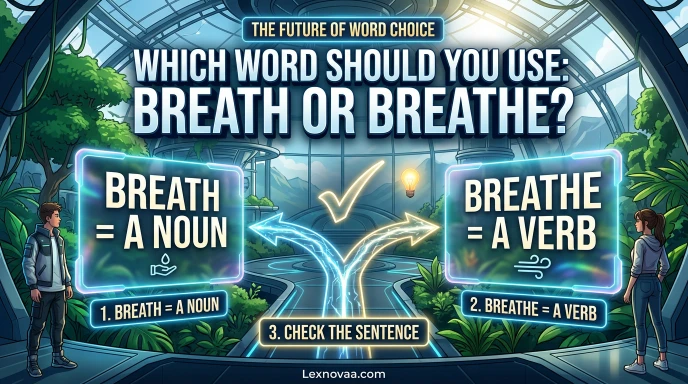
To choose the correct word, first decide if your sentence needs a noun or a verb.
Use “Breath” When Naming Air or an Act of Breathing
Use breath when referring to air taken into or released from the lungs, or to one act of breathing.
Examples:
- Take a deep breath before speaking.
- I could see his breath in the winter air.
- She held her breath while waiting.
- The athlete was out of breath.
- He let out a sigh of relief and took another breath.
In these examples, breath names something. It often appears after verbs such as take, hold, and catch.
Use “Breathe” When Describing an Action
Use breathe when talking about the act of taking air into the lungs and releasing it.
Examples:
- Try to breathe calmly.
- Most land animals breathe using lungs.
- It was hard to breathe through the thick smoke.
- Remember to breathe while speaking.
- The doctor asked him to breathe normally.
In these sentences, breathe describes an action. It can follow words such as to, can, must, and should.
How Can You Remember the Difference?
A simple way to remember the distinction is to check if the sentence describes an action or names something.
- “Take a deep breath.” Here, breath is the thing you take.
- “Breathe deeply.” Here, breathe is the action you perform.
You can also remember the spelling pattern: breath has no final e, while breathe has a final e and functions as a verb.
Common Mistakes With Breath or Breathe
Writers often mix up these words because they look similar. Here are common mistakes and their corrections.
| Incorrect | Correct | Explanation |
| Take a deep breathe. | Take a deep breath. | The sentence needs a noun. |
| I can’t breath properly. | I can’t breathe properly. | The sentence needs a verb. |
| He was out of breathe. | He was out of breath. | “Out of breath” is the correct expression. |
| Remember to breath slowly. | Remember to breathe slowly. | The word after “to” is a verb. |
| She held her breathe. | She held her breath. | “Held” takes the noun breath here. |
| It is difficult to breath here. | It is difficult to breathe here. | The infinitive requires a verb. |
| Take one more breathe. | Take one more breath. | “One more” refers to a noun. |
| He could hardly breath. | He could hardly breathe. | “Could” is followed by the base verb. |
How to Avoid These Mistakes
First, identify the job of the word in your sentence. If you are naming the air or an act of breathing, use breath. If you are describing the action, use breathe.
Second, look at the words around it. Phrases such as take a deep, hold your, and out of commonly take the noun breath. Phrases such as to breathe, can breathe, and should breathe use the verb.
Finally, remember that the words sound slightly different in many accents. Listening for the final th sound can help, but checking the grammar is the most reliable method.
Everyday Examples of Breath and Breathe
These examples show how to use both words in daily conversations, schoolwork, messages, and formal writing.
Everyday Conversations
- Take a breath and tell me what happened.
- I need a moment to breathe.
- He was out of breath after climbing the stairs.
- Please breathe slowly while you relax.
Schoolwork
- Every person needs to breathe to stay alive.
- The diagram shows how air moves during a breath.
- The exercise asked students to use breath in a sentence.
- Animals breathe in different ways.
Emails and Messages
- I need a short break to catch my breath.
- Remember to breathe and take your time.
- The long walk left me out of breath.
- Take a breath before responding to a difficult message.
Stories and Creative Writing
- She took a deep breath before opening the door.
- The cold morning air made every breath visible.
- He stopped to breathe after running across the field.
- The quiet garden seemed to breathe with new life.
These examples show that breath and breathe can appear in many contexts, but their grammatical roles remain different.
Breath or Breathe: Quick Comparison
| Feature | Breath | Breathe |
| Part of speech | Noun | Verb |
| Main meaning | Air or an act of breathing | The action of taking air in and releasing it |
| Example | Take a breath. | Breathe slowly. |
| Common phrase | Out of breath | Hard to breathe |
| Final letter | No final e | Ends with e |
| Memory tip | A thing | An action |
Remember: You take a breath, but you breathe. This simple rule can help you choose the correct word in most everyday sentences.
Breath or Breathe: Google Trends and Modern Usage
Breath and breathe are common words in everyday English. They appear in health-related information, school materials, books, conversations, social media posts, and expressions such as take a breath and breathe deeply.
People may search for the difference when checking spelling or learning English grammar. However, search popularity does not determine which word is correct in a sentence. The correct choice depends on if you need a noun or a verb.
For example, “Take a breath” is correct because breath names the thing you take. “Take a moment to breathe” is correct because breathe describes an action.
No specific Google Trends figures are included here because current data has not been verified for this article. You can compare search interest using Google Trends
Breath or Breathe?
What is the difference between breath and breathe?
Breath is a noun meaning the air you take into or release from your lungs. Breathe is a verb meaning to take air in and let it out. For example, say “Take a deep breath” but “Remember to breathe.” Both words are correct, but they have different grammatical roles.
FAQs
1. Is it “breath” or “breathe”?
Both are correct words. Use breath as a noun and breathe as a verb. For example, “Take a breath” and “Breathe slowly.”
2. What is the difference between breath and breathe?
Breath names the air or an act of breathing, while breathe describes the action of taking air into and releasing it from the lungs.
3. Is it “take a breath” or “take a breathe”?
“Take a breath” is correct because the sentence needs a noun after “take a.” The word breathe is a verb.
4. Should I write “I can’t breathe” or “I can’t breath”?
“I can’t breathe” is correct because can’t is followed by the base form of a verb.
5. Is “out of breath” or “out of breathe” correct?
“Out of breath” is correct. This common expression uses the noun breath.
6. Is breathe a noun or a verb?
Breathe is a verb. It describes the action of taking air into the lungs and releasing it.
7. Is breath a noun or a verb?
Breath is a noun. It refers to air taken into or released from the lungs, or to an act of breathing.
8. Do breath and breathe sound the same?
No. In many accents, the final th in breath is unvoiced, while the final th in breathe is voiced. Accent differences may affect how noticeable this distinction is.
9. Do British and American English spell breath and breathe differently?
No. The standard spellings and basic meanings are the same in British and American English.
10. What is the easiest way to remember breath and breathe?
Remember this rule: you take a breath, but you breathe. The noun names the thing; the verb describes the action.
Key Takeaways
- Breath is a noun.
- Breathe is a verb.
- Say “take a deep breath,” not “take a deep breathe.”
- Say “I need to breathe,” not “I need to breath.”
- “Out of breath” is a common correct expression.
- British and American English use the same standard spellings.
- Check if your sentence needs a noun or a verb before choosing the word.
Conclusion
The difference between breath and breathe becomes simple when you understand how each word works. Breath is a noun that refers to air taken into or released from the lungs, while breathe is a verb that describes the action of doing so.
For example, “Take a deep breath” and “Remember to breathe” are both correct because each sentence uses the right part of speech.
To avoid common mistakes, look at the words around the target word. Expressions such as take a breath, hold your breath, and out of breath use the noun.
Sentences such as to breathe, can breathe, and should breathe use the verb. Remembering the simple phrase “take a breath, then breathe” can help you keep the two words separate.
With regular practice, you will become more confident using these words in schoolwork, emails, conversations, and other writing. For more clear explanations of confusing English words, spelling differences, and grammar rules, visit Lexnovaa.com.
DISCOVER MORE ARTICLE HERE!
- Followup or Follow Up: Which Spelling Is Correct?
- Piece of Mind or Peace of Mind: Which Phrase Is Correct?
- That or Which: Which Word Is Correct?

I’m Orin Blake, a writer with a passion for making English grammar simple, practical, and easy to understand. I enjoy breaking down confusing words, spelling differences, and everyday language questions into clear, reader-friendly guides. My goal is to help students, professionals, and curious learners write with greater confidence and accuracy.