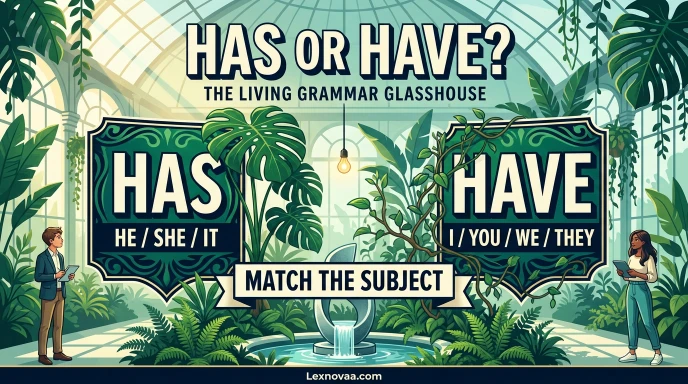
Both “has” and “have” are correct, but the right choice depends on the subject of the sentence. Use has with he, she, it, and singular third-person subjects.
Use have with I, you, we, they, and plural subjects. For example, “She has a book” and “They have a book” are both correct.
Many English learners confuse has and have because both words show possession or help form different verb tenses.
Choosing the wrong word can make a sentence grammatically incorrect. This confusion often appears in schoolwork, emails, online messages, and everyday conversations.
The good news is that the rules are simple once you understand subject-verb agreement. In this guide, you will learn the meanings of has and have, their grammar rules, the differences between British and American English, and common mistakes to avoid.
You will also find easy examples and answers to frequently asked questions. By the end, you will know how to choose the correct word with greater confidence.
Has or Have : Quick Answer
Use has with he, she, it, and singular third-person nouns. Use have with I, you, we, they, and plural nouns.
- Has: She has a new phone.
- Have: I have a new phone.
- Has: The student has a question.
- Have: The students have a question.
Remember this simple rule: he has, she has, it has — I have, you have, we have, they have.
Definition and Meaning
What Does “Has” Mean?
Has is the present-tense form of the verb have used with third-person singular subjects. It can show possession, relationships, experiences, or responsibilities. It also helps form the present perfect tense.
Examples:
- He has a blue backpack.
- She has two brothers.
- The house has three bedrooms.
- My teacher has a question.
- He has finished his homework.
In the first four examples, has shows possession or a feature. In the last example, it helps form the present perfect tense.
What Does “Have” Mean?
Have is used with I, you, we, and they, as well as plural nouns. Like has, it can show possession, experiences, responsibilities, and actions connected to other verb forms.
Examples:
- I have a new notebook.
- You have a good idea.
- We have enough time.
- They have two dogs.
- We have completed the project.
In these examples, have either expresses possession or helps form the present perfect tense.
What Is the Main Difference Between Has and Have?
The main difference is the subject that comes with each word.
| Word | Used With | Example |
| Has | He, she, it, singular third-person nouns | She has a car. |
| Have | I, you, we, they, plural nouns | They have a car. |
Both words come from the same verb, have. The subject determines which form you should use in the present tense.
The Origin of Has or Have
The words has and have developed from older forms of the English verb have. This verb has a long history in English and is related to similar words in other Germanic languages.
Over time, English developed different verb forms to match different subjects. Today, have is used with most subjects in the present tense, while has is used with third-person singular subjects.
The verb have is also irregular because its past-tense form is had, not haved. For example:
- I have a book. (Present tense)
- She has a book. (Present tense)
- They had a book. (Past tense)
Understanding these forms helps you use has and have correctly in both everyday speech and formal writing.
Has vs. Have: British English vs. American English

The basic rules for has and have are the same in British and American English. Both varieties use has with third-person singular subjects and have with I, you, we, they, and plural nouns.
| Example | American English | British English |
| She ___ a new bag. | She has a new bag. | She has a new bag. |
| They ___ two cars. | They have two cars. | They have two cars. |
| He ___ finished his work. | He has finished his work. | He has finished his work. |
| We ___ enough food. | We have enough food. | We have enough food. |
There can be differences in how people use certain expressions. For example, British English often uses have got to talk about possession:
- British English: I have got a new phone.
- American English: I have a new phone.
However, both varieties also use have got, and the expression is understood in both places. These differences do not change the basic rules for choosing has or have.
Which Word Should You Use: Has or Have?
To choose the correct word, first identify the subject of your sentence. The subject tells you who or what the sentence is about.
Use “Has” With He, She, and It
Use has with he, she, and it, as well as singular nouns referring to one person, animal, place, or thing.
Examples:
- He has a new bicycle.
- She has a beautiful voice.
- It has a broken screen.
- The cat has green eyes.
- My brother has a busy schedule.
Each subject is third-person singular, so has is correct.
Use “Have” With I, You, We, and They
Use have with these pronouns, even when you refers to only one person.
Examples:
- I have a question.
- You have a great opportunity.
- We have a meeting today.
- They have three children.
- The players have new uniforms.
Remember that you have is correct if you are speaking to one person or several people.
Use “Have” With Plural Nouns
Plural nouns generally take have in the present tense.
Examples:
- The students have homework.
- My friends have different hobbies.
- The shops have new opening hours.
- The dogs have clean water.
- These books have colorful covers.
The noun does not need to be a person. Objects, animals, and groups represented by plural nouns also take have.
Use “Has” in the Present Perfect Tense
The present perfect tense uses has or have followed by the past participle of a verb.
Examples:
- She has completed her assignment.
- He has visited London.
- The train has arrived.
- It has stopped raining.
has when the subject is third-person singular.
“Have” in the Present Perfect Tense
have with I, you, we, and they, along with plural subjects.
Examples:
- I have completed my assignment.
- You have done a great job.
- We have visited London.
- They have arrived.
- The students have passed the test.
The same subject rules apply if has and have express possession or help form a verb tense.
What Happens After “Does” or “Doesn’t”?
After does or doesn’t, use the base form have, not has.
Correct:
- Does she have a pen?
- He doesn’t have enough time.
- Does your brother have a car?
Incorrect:
- Does she has a pen?
- He doesn’t has enough time.
This happens because does already carries the third-person singular form. The main verb stays in its base form.
Common Mistakes With Has or Have
Writers often choose the wrong form when they focus on nearby words instead of the main subject. The following table shows common mistakes and their corrections.
| Incorrect | Correct | Explanation |
| She have a car. | She has a car. | “She” takes has. |
| He have two brothers. | He has two brothers. | “He” is third-person singular. |
| They has a problem. | They have a problem. | “They” takes have. |
| I has a question. | I have a question. | “I” takes have. |
| The students has books. | The students have books. | “Students” is plural. |
| Does he has a phone? | Does he have a phone? | Use the base form after does. |
| She doesn’t has time. | She doesn’t have time. | Use the base form after doesn’t. |
| Everyone have a chance. | Everyone has a chance. | “Everyone” is grammatically singular. |
How to Avoid These Mistakes
First, identify the subject. In “The girl has a notebook,” the subject is girl, so has is correct. In “The girls have notebooks,” the subject is plural, so use have.
Second, remember the special rule for I and you. Both take have, not has.
Third, pay attention to helping verbs such as does and doesn’t. After these words, use have.
Finally, read your sentence carefully. Checking the subject and verb together can help you spot mistakes before publishing an article, sending an email, or completing an assignment.
Everyday Examples of Has and Have
Here are practical examples of has and have in everyday communication.
Everyday Conversations
- My sister has a new phone.
- I have something to tell you.
- He has a busy day today.
- We have plans for the weekend.
- In Schoolwork
- The student has completed the task.
- They have finished their homework.
- Our teacher has explained the lesson.
- We have learned a new grammar rule.
Emails and Messages
- She has sent the documents.
- I have attached the requested file.
- The manager has approved the request.
- We have received your message.
Business and Formal Writing
- The company has introduced a new policy.
- Employees have received updated instructions.
- The report has several important findings.
- The departments have submitted their results.
These examples show that the correct choice depends on the subject, not on if the sentence is casual or formal.
Has or Have: Quick Comparison
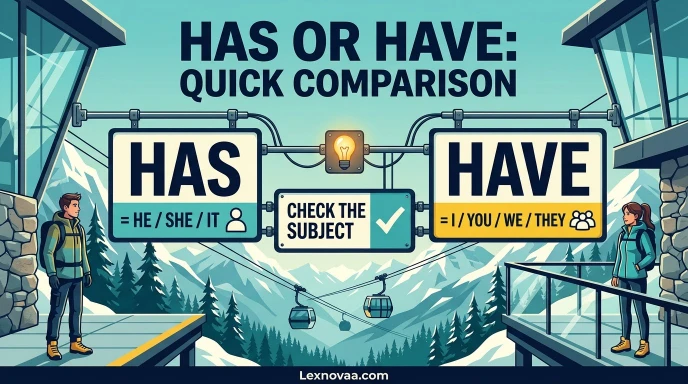
| Grammar Rule | Use “Has” | Use “Have” |
| Pronoun | He has a book. | I have a book. |
| Singular noun | The child has a toy. | — |
| Plural noun | — | The children have toys. |
| Present perfect | She has arrived. | They have arrived. |
| Questions with do/does | — | Does he have a pen? |
| Negative with do/does | — | She doesn’t have a car. |
Easy memory tip: Remember he has, she has, it has. For I, you, we, and they, use have. After does or doesn’t, always use the base form have.
Has or Have: Google Trends and Modern Usage
Has and have are common English words used in conversations, books, emails, news reports, and online communication. People may search for the difference when learning grammar, writing assignments, or checking a sentence.
However, the number of times a word appears in searches does not determine which form is correct. The choice depends on the subject and sentence structure.
For example, “She has a new laptop” and “They have new laptops” are both correct because their subjects differ. In contrast, “Does she have a laptop?” uses have after does.
No specific Google Trends figures are included here because current data has not been verified for this article. You can compare search interest using Google Trends.
Has or Have?
Has or have: Which one is correct?
Both has and have are correct forms of the verb have. Use has with he, she, it, and singular third-person subjects. Use have with I, you, we, they, and plural subjects. For example, “She has a car” and “They have a car.” After does or doesn’t, use have, as in “Does he have a car?”
FAQs
1. Should I use “has” or “have”?
Use has with he, she, it, and singular third-person nouns. Use have with I, you, we, they, and plural nouns.
2. Is it “she has” or “she have”?
“She has” is correct in standard English because she is a third-person singular subject.
3. Is it “they has” or “they have”?
“They have” is correct because they takes have in the present tense.
4. Is “I has” grammatically correct?
No. In standard English, say “I have.” The pronoun I takes have, not has.
5. Should I say “does she have” or “does she has”?
Say “Does she have?” After does, the main verb uses its base form, so have is correct.
6. Is it “everyone has” or “everyone have”?
“Everyone has” is correct in standard English because everyone is grammatically singular.
7. Is “has” used in the present perfect tense?
Yes. Use has with third-person singular subjects, as in “He has finished his work.”
8. Is “have” used in the present perfect tense?
Yes. Use have with I, you, we, they, and plural subjects, as in “They have finished their work.”
9. Do British and American English use has and have differently?
The basic grammar rules are the same in both varieties. Some expressions, such as have got, may be more common in certain contexts, but the subject-verb agreement rules remain the same.
10. What is the easiest way to remember has and have?
Remember this pattern: he has, she has, it has; I have, you have, we have, they have. Also remember to use have after does and doesn’t.
Key Takeaways
- Has is used with he, she, it, and singular third-person subjects.
- Have is used with I, you, we, they, and plural subjects.
- Both words can show possession or help form the present perfect tense.
- Use have after does and doesn’t.
- Words such as everyone and someone take has in standard present-tense statements.
- The basic rules are the same in British and American English.
- Always identify the subject before choosing the correct form.
Conclusion
Understanding the difference between has and have can help you write clearer and more accurate English.
Both words are correct, but they are used with different subjects. Use has with he, she, it, and singular third-person nouns.
Use have with I, you, we, they, and plural nouns. For example, “My brother has a bicycle” and “My brothers have bicycles” are both correct.
Remember that the same rule applies when forming the present perfect tense: “She has finished” but “They have finished.”
Also, after does or doesn’t, use have, as in “Does he have a question?” This is a common rule that can help you avoid many grammar mistakes.
With regular practice, choosing between has and have will become easier in conversations, school assignments, emails, and professional writing.
Focus on the subject, check the verb form, and practise with simple examples. For more easy English grammar guides and word comparisons, visit Lexnovaa.com
DISCOVER MORE ARTICLE HERE!
- In-Person or In Person: Which Spelling Is Correct?
- Unphased or Unfazed: Which Spelling Is Correct?
- Shiney or Shiny: Which Spelling Is Correct?

I’m Orin Blake, a writer with a passion for making English grammar simple, practical, and easy to understand. I enjoy breaking down confusing words, spelling differences, and everyday language questions into clear, reader-friendly guides. My goal is to help students, professionals, and curious learners write with greater confidence and accuracy.