Both “that” and “which” are correct, but they are used differently depending on the meaning and structure of a sentence.
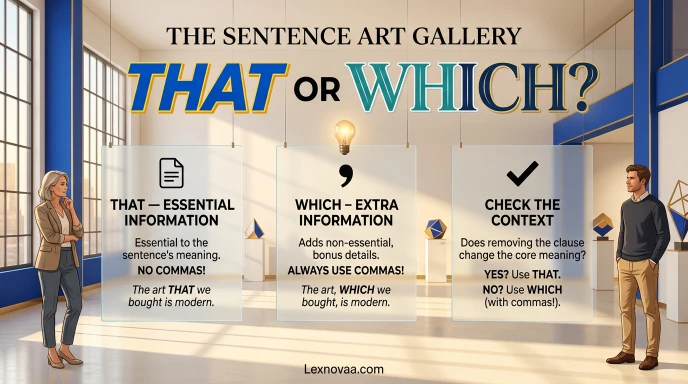
The word that often introduces essential information that identifies exactly which person or thing you mean.
The word which often introduces extra information that is not necessary to identify the noun. For example, “The book that I borrowed was interesting” identifies a specific book, while “The book, which I borrowed yesterday, was interesting” adds extra information about the book.
Many writers find these words confusing because both can refer to things and appear in relative clauses. The rules also vary somewhat between American and British writing styles, especially when commas are involved.
Learning when to use that or which can help you write clearer emails, essays, articles, and professional documents.
In this guide, you will learn the meanings, grammar rules, common mistakes, and everyday examples of both words. You will also discover how punctuation changes the meaning of a sentence.
That or Which : Quick Answer
- That: Usually introduces essential information that identifies a person or thing.
- Which: Often introduces extra information, especially in a clause separated by commas.
- Easy rule: Use that for essential information and which for additional information in standard American English.
Example: The phone that I bought yesterday works well.
Remember that which can also introduce essential information in British English and in some American usage. The comma and the intended meaning matter.
Definition and Meaning
What Does That Mean?
That can serve several grammatical roles, including as a demonstrative pronoun, determiner, conjunction, and relative pronoun. In comparisons involving that or which, the most important use is introducing a relative clause.
A relative clause gives information about a noun. When the information is essential to identify the noun, that is commonly used in American English.
Examples:
- The car that has a red door belongs to my neighbor.
- The student that won the contest received a prize.
- I returned the shirt that I bought yesterday.
In each sentence, the clause helps identify the particular car, student, or shirt.
What Does Which Mean?
Which can also introduce a relative clause. It is often used to add extra information about something that is already identified.
Examples:
- My laptop, which I bought last year, still works well.
- The library, which closes at six, is near my school.
- She visited London, which is famous for its history.
The information between commas adds detail but is not required to identify the noun.
Which can also be used in questions, such as “Which book do you want?” This is a different grammatical use from the relative clause discussed in this article.
The Origin of That or Which
The words that and which have different histories in English. That developed from an older demonstrative form used to point to a particular person or thing. Over time, it gained several grammatical uses, including its role in relative clauses.
Which comes from an Old English word used to ask questions or distinguish between alternatives. It later became common as a relative pronoun, allowing writers to add information about a noun.
Today, both words are important parts of English grammar. Their correct use depends on the sentence structure, the information being conveyed, and sometimes the style guide being followed.
British English vs. American English Grammar
The main difference between British and American usage concerns restrictive relative clauses—clauses that provide essential information.
| Grammar rule | American English | British English |
| Essential information | That is commonly preferred | That and which can both be used |
| Extra information | Which is common with commas | Which is common with commas |
| Commas around extra information | Usually required when the clause interrupts or follows the noun | Usually required when the clause interrupts or follows the noun |
| Formal writing | Often follows the restrictive that rule | Often allows more flexibility |
For example, American formal writing usually prefers “The book that I read was helpful” when identifying a particular book. British English may also use “The book which I read was helpful.”
Both varieties use which for additional information: “The book, which I read last week, was helpful.”
Which Word Should You Use?
Choosing between that and which becomes easier when you ask if the information is essential.
Use That for Essential Information
An essential clause tells readers exactly which person or thing you mean. Without it, the sentence may have a different or unclear meaning.
Examples:
- The dog that barked all night belongs to our neighbor.
- Please open the file that I sent you.
- The road that leads to the school is closed.
In these sentences, the clauses identify the specific dog, file, and road.
Use Which for Extra Information
An extra-information clause adds a detail but does not identify the noun itself. In standard written English, set this clause apart with commas.
Examples:
- My bicycle, which is blue, is parked outside.
- The meeting, which lasted two hours, ended late.
- Our school library, which opened in 1995, has many books.
The reader already knows which bicycle, meeting, or library is being discussed.
Can Which Be Used for Essential Information?
Yes. British English commonly uses which in essential relative clauses, and some American writers do too. However, if you are following standard American formal-writing conventions, that is usually the safer choice for essential clauses referring to things.
Common Mistakes with That or Which
Mistake 1: Using Which Without Understanding the Meaning
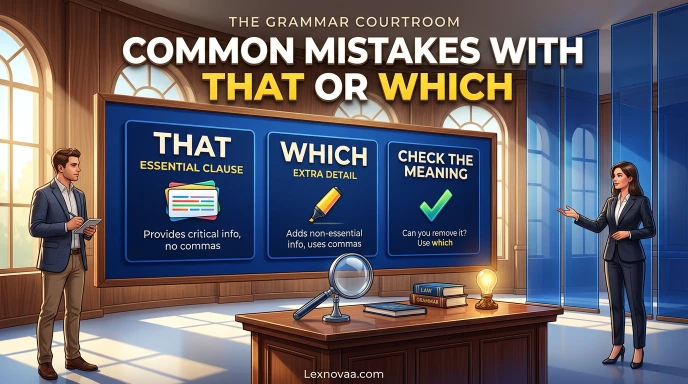
Less preferred in formal American English: The book which has a blue cover is mine.
Preferred in formal American English: The book that has a blue cover is mine.
Why? The clause identifies which book is yours. British English may accept the first version, too.
Mistake 2: Leaving Out Commas Around Extra Information
Incorrect: My car which I bought last year is reliable.
Clearer: My car, which I bought last year, is reliable.
Why? If you are adding extra information about a specific car, use commas to mark the nonessential clause.
Mistake 3: Using That in a Nonessential Clause
Less standard: My phone, that I bought last month, is already damaged.
Better: My phone, which I bought last month, is already damaged.
Why? In standard formal English, that is generally not used to introduce a nonessential relative clause separated by commas.
Mistake 4: Assuming Every Clause Needs That or Which
Sometimes the relative pronoun can be omitted when it is the object of the clause.
Example: The movie (that) I watched was excellent.
Both versions are correct because that is the object of watched and can be left out.
Everyday Examples of That or Which
Emails and Business Writing
- Please review the document that I attached.
- The report, which was completed yesterday, is ready.
- We need the information that the client requested.
- The new policy, which begins next month, applies to all staff.
School and Academic Writing
- The experiment that produced the best results was repeated.
- The novel, which was published in the nineteenth century, remains popular.
- Students who complete the assignment that was given today can leave early.
- The science lab, which has new equipment, is open after class.
Everyday Conversations
- Where is the jacket that I left here?
- My brother’s bike, which is very old, still works.
- The restaurant that we visited was excellent.
- This phone, which belongs to my sister, is new.
That or Which: Quick Comparison
| Feature | That | Which |
| Essential information | Commonly used | Also possible in British English |
| Extra information | Generally avoided in formal relative clauses | Commonly used |
| Commas | Usually no commas around essential clauses | Commas for extra information |
| Example | The bag that I lost was black. | My bag, which was black, was found. |
Google Trends and Modern Usage
The distinction between that and which remains a common grammar topic because both words can introduce relative clauses. Writers often search for guidance when editing essays, business documents, and website content.
Many American style guides recommend using that for essential clauses and which for nonessential clauses. British English is more flexible about using which in essential clauses. In either variety, punctuation helps readers understand if information is essential or additional.
Without checking current Google Trends data, it would not be accurate to provide exact search volumes or claim a specific change in search popularity.
That vs. Which
What is the difference between that and which?
That commonly introduces essential information that identifies a person or thing, especially in American English. Which often introduces extra information set off by commas. For example, “The book that I borrowed was useful” identifies a specific book, while “The book, which I borrowed yesterday, was useful” adds extra information. British English allows which more freely in essential clauses.
FAQs

1. Is that or which correct?
Both are correct. The right choice depends on if the relative clause provides essential information or adds extra detail.
2. When should I use that instead of which?
In standard American formal writing, use that for essential clauses that identify a specific thing.
3. When should I use which instead of that?
Use which for nonessential information that adds detail about a noun. Set the clause apart with commas.
4. Does which always need a comma?
No. Which can introduce essential clauses without commas, especially in British English. For nonessential clauses, commas are generally needed.
5. Can I use which in American English?
Yes. American English commonly uses which for nonessential clauses and also uses it in questions, such as “Which one do you prefer?”
6. Is that more common in British or American English?
Both varieties use that. American formal writing tends to prefer it over which in essential relative clauses.
7. Can that and which be used interchangeably?
Not always. The meaning, punctuation, and style conventions of the sentence determine which form is suitable.
8. What is an example of that in a sentence?
“The shoes that I ordered arrived today.” The clause identifies which shoes arrived.
9. What is an example of which in a sentence?
“My shoes, which arrived today, are very comfortable.” The clause adds information about the shoes.
10. How can I remember the difference between that and which?
For standard American formal writing, remember: that usually identifies; which often adds extra information. Use commas around nonessential information.
Key Takeaways
- Both that and which are correct English words.
- That is commonly used for essential relative clauses in American English.
- Which often introduces additional information set off by commas.
- British English permits which more freely in essential clauses.
- Commas can change the meaning of a sentence, so use them carefully.
Conclusion
The difference between that and which depends on the role of the clause in your sentence. When a clause identifies exactly.
which person or thing you mean, that is the usual choice in standard American formal writing. When a clause adds extra information about something already identified, which is commonly used with commas.
For example, “The phone that I bought yesterday is expensive” identifies a particular phone. In contrast, “My phone, which I bought yesterday, is expensive” adds information about a phone that is already known.
British English allows which in essential clauses more often than American formal-writing conventions do, so the best choice can depend on your audience and style guide.
The most useful habit is to ask if the information is essential. If it identifies the noun, that is often the clearest choice in American writing.
If it adds a side detail, use which with the appropriate commas. Following this rule will help you create clearer sentences in essays, professional emails, and online articles.
DISCOVER MORE ARTICLE HERE!
- Shiney or Shiny: Which Spelling Is Correct?
- Timeframe or Time Frame? Which Spelling Is Correct?
- Piece of Mind or Peace of Mind: Which Phrase Is Correct?

I’m Orin Blake, a writer with a passion for making English grammar simple, practical, and easy to understand. I enjoy breaking down confusing words, spelling differences, and everyday language questions into clear, reader-friendly guides. My goal is to help students, professionals, and curious learners write with greater confidence and accuracy.