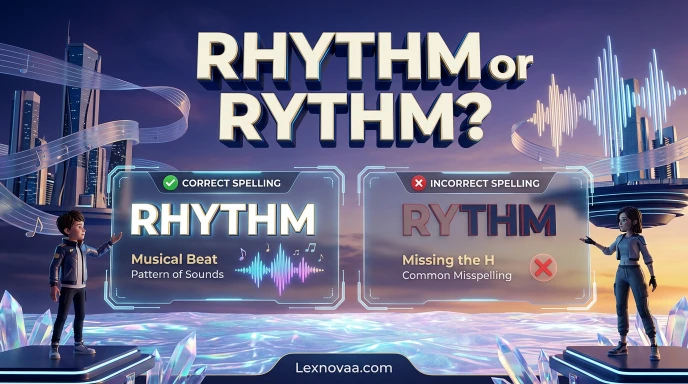
“Rhythm” is the correct spelling, while “rythm” is a misspelling. The word rhythm refers to a regular pattern of sounds, beats, movements, or events. It is often used when talking about music, poetry, dance, speech, and daily routines.
For example, “The song has a strong rhythm” is correct because the word describes the pattern of beats in the music.
Many people search for “rhythm or rythm” because rhythm is an unusual English word to spell. It does not contain the usual vowel pattern found in many words, which can make it hard to remember. The missing h in rythm is a common spelling mistake.
The good news is that you can learn the correct spelling with a simple memory trick. Remember that rhythm has an “h” after the first letter and another h near the end. Once you learn this pattern, it becomes easier to write the word correctly.
In this guide, you will learn the meaning, origin, spelling rules, common mistakes, and everyday examples of rhythm. You will also find answers to common questions about its pronunciation and use.
Rhythm or Rythm : Quick Answer
“Rhythm” is correct. “Rythm” is incorrect in standard English.
- Rhythm: The correct spelling.
- Rythm: A common misspelling.
- Meaning: A pattern of beats, sounds, movements, or events.
Correct: The drummer kept a steady rhythm.
Incorrect: The drummer kept a steady rythm.
Easy memory trick: Remember the h in rhythm. You can also break the word into the letters R-H-Y-T-H-M and say them slowly as you write.
Definition and Meaning of Rhythm
What Does Rhythm Mean?
Rhythm is a noun that describes a regular or repeated pattern. It often refers to the way sounds or movements happen over time.
The word has several common uses.
1. Rhythm in music
Rhythm is the pattern of beats and sounds in a piece of music.
Example: The song has a fast rhythm.
2. Rhythm in poetry
Rhythm describes the pattern of stressed and unstressed syllables in spoken or written language.
Example: The poet used rhythm to make the lines flow smoothly.
3. Rhythm in dance
Rhythm helps dancers match their movements to the beat of music.
Example: The dancers moved to the rhythm of the drums.
4. Rhythm in daily life
The word can also describe repeated patterns in everyday activities.
Example: I am trying to get back into a regular sleep rhythm.
In each case, rhythm describes a pattern that repeats or develops over time.
Is Rythm a Correct Word?
No. “Rythm” is a misspelling of “rhythm” in standard English. It is not the accepted spelling for the noun that describes a pattern of beats, sounds, or movements.
For example:
- Correct: The rhythm of the music was easy to follow.
- Incorrect: The rythm of the music was easy to follow.
When writing school assignments, emails, articles, or social media posts, always use rhythm.
The Origin of Rhythm
The word rhythm entered English through French and Latin forms that came from the Greek word rhythmos. This Greek word referred to measured movement or a pattern.
Over time, English adopted rhythm to describe patterns in music, poetry, movement, and other repeated events.
The unusual spelling reflects the word’s history. The letters may look different from those in many common English words, but the spelling has remained established in modern English.
Understanding the word’s origin can make it easier to recognize why the spelling is unusual. However, the simplest way to avoid mistakes is to remember the complete form: rhythm.
Is Rhythm or Rythm Different in British English and American English?
No. “Rhythm” is the correct spelling in both British English and American English. The spelling does not change between these varieties.
| English variety | Correct spelling | Incorrect spelling |
| American English | Rhythm | Rythm |
| British English | Rhythm | Rythm |
| Canadian English | Rhythm | Rythm |
| Australian English | Rhythm | Rythm |
Examples:
- American English: The rhythm of the song is catchy.
- British English: The rhythm of the poem is easy to follow.
- Canadian English: The band played with a steady rhythm.
- Australian English: The dancers followed the rhythm of the music.
Unlike words such as color and colour, rhythm has one standard spelling across these varieties of English.
Which Spelling Should You Use?
Use rhythm whenever you mean a repeated pattern of beats, sounds, movements, or events.
Use Rhythm When Talking About Music
The word often describes the beat or timing of a song.
Examples:
- The drummer created a strong rhythm.
- I like the rhythm of this song.
- The band played in rhythm.
- She clapped along with the rhythm.
Use Rhythm When Talking About Poetry
Writers use rhythm to create flow and sound patterns in poems and other forms of writing.
Examples:
- The poem has a gentle rhythm.
- The rhythm makes the verse easier to read.
- The writer changed the rhythm of the lines.
Use Rhythm When Talking About Daily Routines
The word can describe a repeated pattern in life or work.
Examples:
- I have found a good rhythm for studying.
- The team settled into a steady work rhythm.
- Travel disrupted my normal daily rhythm.
An Easy Memory Trick
The spelling of rhythm can be hard to remember because it has no standard vowel letter a, e, i, o, or u. The letter y acts as the vowel sound in the word.
Try this method:
- Remember the first pair: RH.
- Remember the middle letters: YTH.
- Finish with: HM.
Put them together: R-H-Y-T-H-M = RHYTHM.
You can also write the word a few times while saying each letter aloud. This helps you remember the unusual spelling.
Common Mistakes with Rhythm
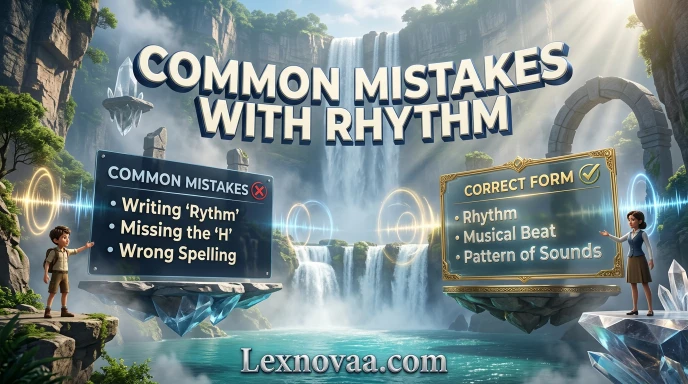
The most common mistake is leaving out the first h and writing rythm. Checking the spelling before publishing or submitting your work can help prevent this error.
| Incorrect spelling or phrase | Correct spelling or phrase | Explanation |
| Rythm | Rhythm | The first h is missing. |
| The song has a good rythm. | The song has a good rhythm. | Use the standard spelling. |
| She moved to the rythm. | She moved to the rhythm. | The word needs both h letters. |
| A steady rythm of work | A steady rhythm of work | The correct spelling is rhythm. |
Mistake 1: Leaving Out the First H
Incorrect: The music has a strong rythm.
Correct: The music has a strong rhythm.
Remember that the word begins with rh, not just r.
Mistake 2: Forgetting the Second H
Incorrect: The band played with a steady rythm.
Correct: The band played with a steady rhythm.
The correct spelling contains two h letters: one after r and another after t.
Mistake 3: Thinking the Spelling Changes by Country
Incorrect assumption: Rythm is American, while rhythm is British.
Correct rule: Rhythm is the standard spelling in both American and British English.
Mistake 4: Relying Only on Pronunciation
Because the h letters are not pronounced as separate sounds, you cannot always work out the spelling by listening to the word. It helps to learn the written form and practice it.
Everyday Examples of Rhythm
Here are simple sentences showing how to use rhythm correctly.
1. In Music
- The song has a lively rhythm.
- The drummer kept the rhythm steady.
- We danced to the rhythm of the music.
2. In Poetry and Writing
- The poem has a smooth rhythm.
- The rhythm of the sentence makes it pleasant to read.
- The poet changed the rhythm in the final lines.
3. In Dance and Movement
- The dancers followed the rhythm of the drums.
- She learned to move in rhythm with the music.
- The class practiced keeping the same rhythm.
4. In Daily Life
- I am getting into a better rhythm with my studies.
- The new schedule changed our daily rhythm.
- He works best when he follows a steady rhythm.
5. In Nature
- The rhythm of the waves was calming.
- The seasons create a natural rhythm throughout the year.
- The rhythm of day and night affects many living things.
6. In Sports
- The runner found a steady rhythm during the race.
- The team lost its rhythm after the break.
- Practicing helped her develop a better rhythm.
These examples show that rhythm can describe much more than music. It can refer to any repeated pattern or flow.
Rhythm or Rythm: Quick Comparison
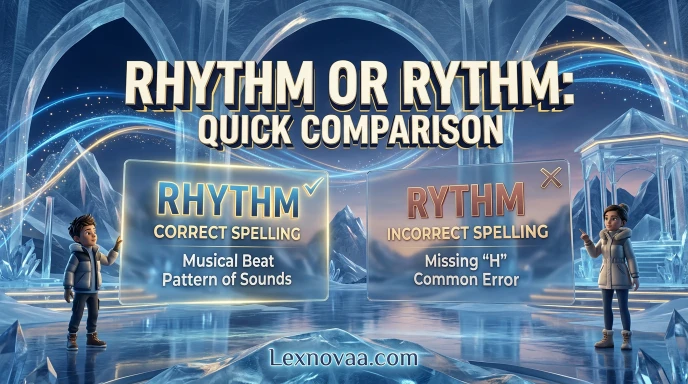
| Feature | Rhythm | Rythm |
| Is it correct? | Yes | No |
| Standard spelling | Rhythm | Misspelling |
| Meaning | A repeated pattern or flow | No standard meaning intended here |
| Used in music | Yes | No |
| Used in poetry | Yes | No |
| Used for routines | Yes | No |
| Correct example | A steady rhythm | A steady rythm |
The main rule is simple: always write “rhythm,” with both h letters.
Google Trends and Modern Usage
People search for “rhythm or rythm” because the correct spelling is unusual and easy to mistype. The question often comes up when writing about music, poetry, dance, sports, or daily routines.
Rhythm is used in many contexts. A musician may discuss the rhythm of a song, a poet may work on the rhythm of a line, and a student may try to build a steady rhythm for studying.
No live Google Trends figures have been verified for this article, so exact search volumes or popularity rankings should not be assumed.
You can explore current search interest in Google Trends by comparing “rhythm” and “rythm.” Search interest can show what people look for, but it does not make a misspelling correct.
For accurate writing, remember the standard form: rhythm.
FAQs
1. Is it rhythm or rythm?
Rhythm is correct. Rythm is a misspelling in standard English.
2. How do you spell rhythm correctly?
Spell it R-H-Y-T-H-M. Remember that the word has two h letters.
3. Why is rhythm so hard to spell?
The word has an unusual letter pattern and does not use the usual vowel letters a, e, i, o, or u. The letter y provides the vowel sound.
4. What does rhythm mean?
Rhythm means a repeated pattern of beats, sounds, movements, or events.
5. Is rhythm spelled differently in British and American English?
No. Both British English and American English use the spelling rhythm.
6. Is rythm ever correct?
Not as the standard spelling of the English word rhythm. In ordinary writing, use rhythm.
7. What is an example of rhythm in a sentence?
“The rhythm of the song made everyone want to dance.” Here, rhythm refers to the pattern of beats in the music.
8. Does rhythm only refer to music?
No. It can also describe poetry, dance, speech, nature, sports, and repeated daily activities.
9. What is the plural of rhythm?
The plural is rhythms.
Example: “The musicians explored different rhythms.”
10. What is an easy way to remember the spelling of rhythm?
Remember the letters R-H-Y-T-H-M. Practice writing the complete word and pay special attention to both h letters.
Key Takeaways
- Rhythm is the correct spelling.
- Rythm is a misspelling.
- The word describes repeated patterns of beats, sounds, movements, or events.
- The correct spelling is the same in British and American English.
- The plural form is rhythms.
- Memory tip: Remember both h letters in R-H-Y-T-H-M.
Conclusion
The choice between rhythm and rythm is simple: rhythm is the only correct standard spelling for the word you need. It describes patterns in music, poetry, movement, nature, and everyday life.
Although the word can be difficult to spell because of its unusual letter pattern, learning the correct form will help you avoid common mistakes.
Remember that rhythm begins with rh and contains another h near the end. The word is spelled the same way in British English, American English, and other major varieties of English. You do not need to learn a different spelling for different audiences.
When writing an essay, email, article, or social media post, check that you have included both h letters. With a little practice, the spelling becomes easier to remember.
Explore More English Grammar Tips on Lexnovaa.com
Visit Lexnovaa.com for clear spelling comparisons, simple grammar explanations, and practical examples that help you write English with confidence.
DISCOVER MORE ARTICLE CLICK HERE NOW!
- Worse Case or Worst Case: Meaning, Rules, and Examples
- By Hook or by Crook: Meaning, Origin, and Correct Usage
- Verbage or Verbiage : Meaning, Usage, and Examples

I’m Orin Blake, a writer with a passion for making English grammar simple, practical, and easy to understand. I enjoy breaking down confusing words, spelling differences, and everyday language questions into clear, reader-friendly guides. My goal is to help students, professionals, and curious learners write with greater confidence and accuracy.