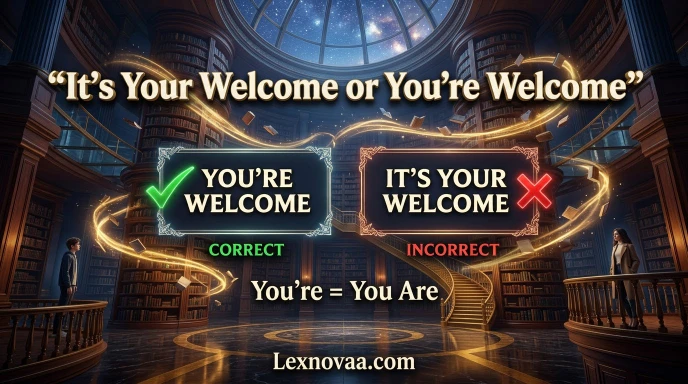
The correct phrase is “you’re welcome,” not “it’s your welcome,” when you reply to someone who says “thank you.” You’re welcome is a polite way to show that you are happy to help or do something for another person. The phrase is common in daily talks, emails, text messages, and formal conversations.
Many people mix up “your” and “you’re” because they sound the same. But they have different meanings. “Your” shows that something belongs to someone. “You’re” is the short form of “you are.” This small difference can change the meaning of a sentence.
For example, if a friend thanks you for helping with homework, you can say, “You’re welcome!” You should not say, “It’s your welcome,” because that does not fit the situation.
In this guide, you will learn why “you’re welcome” is correct, what “your welcome” means, and how to use both words in the right way. You will also find easy examples, common mistakes, and answers to common questions.
It’s Your Welcome or You’re Welcome : Quick Answer
“You’re welcome” is the correct phrase to use after someone says “thank you.”
- You’re welcome: A polite reply to thanks.
- Your welcome: Not correct as a reply to thanks, but “your” can be correct in other sentences.
- It’s your welcome: Usually incorrect for this situation.
Example:
- Correct: “Thank you for your help.” “You’re welcome!”
- Incorrect: “Thank you for your help.” “It’s your welcome!”
Remember, “you’re” means “you are.” So, “you’re welcome” means “you are welcome.”
Definition and Meaning
What Does “You’re Welcome” Mean?
“You’re welcome” is a polite phrase used when someone thanks you. It tells the other person that helping them was fine and that they do not need to feel they owe you anything.
Examples:
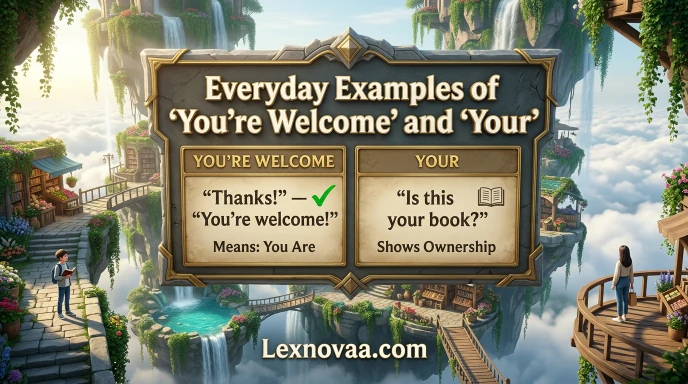
- “Thanks for opening the door.” “You’re welcome!”
- “Thank you for your time.” “You’re welcome.”
- “Thanks for helping me study.” “You’re welcome. I’m glad I could help.”
What Does “Your Welcome” Mean?
“Your” is a word that shows ownership. It tells us that something belongs to you or is linked to you. By itself, “your welcome” is not the usual reply to “thank you.”
However, the words can appear together in a sentence when “welcome” is used as a noun.
Example: “Your welcome message was kind and warm.”
Here, “your” refers to the message. It does not work as a reply to thanks.
What Does “It’s Your Welcome” Mean?
“It’s” means “it is” or, in some cases, “it has.” The phrase “it’s your welcome” is not the normal way to reply when someone thanks you. In most everyday situations, use “you’re welcome” instead.
The Origin of “You’re Welcome”
The phrase “you’re welcome” comes from the older use of the word “welcome” to show that someone is gladly received or accepted. Over time, it became a common polite reply to thanks.
The word “welcome” can also describe a person who is gladly accepted in a place. For example, “You are welcome here” means that you are invited or free to stay.
The shorter phrase “you’re welcome” became a familiar way to respond to gratitude. Today, people use it in homes, schools, workplaces, shops, and online conversations.
“Your,” meanwhile, comes from the possessive form of “you.” It shows ownership, as in “your book,” “your idea,” or “your welcome message.”
The key difference is simple: “you’re” means “you are,” while “your” shows ownership.
British English vs American English Usage

There is no spelling difference between British and American English for this phrase. Both use “you’re welcome” as the standard reply to “thank you.”
| Situation | American English | British English |
| Reply to thanks | You’re welcome. | You’re welcome. |
| Show ownership | Your bag is here. | Your bag is here. |
| Friendly reply | You’re welcome! | You’re welcome! |
| Casual reply | No problem! | No problem! |
Both varieties also use other replies, such as “No problem,” “My pleasure,” and “Not at all.” The best choice depends on the situation and the tone you want.
Which Phrase Should You Use?
Choose the phrase based on what you want to say.
Use “You’re Welcome” After Thanks
Use “you’re welcome” when someone thanks you for a favor, gift, or kind action.
Examples:
- “Thanks for the ride.” “You’re welcome.”
- “Thank you for the gift.” “You’re welcome!”
- “Thanks for explaining it.” “You’re welcome.”
Use “Your” to Show Ownership
Use “your” before a noun when you mean that something belongs to the person you are speaking to.
Examples:
- “Your welcome note made me smile.”
- “Your work looks great.”
- “Your answer is correct.”
Avoid “It’s Your Welcome” as a Reply
If someone says “thank you,” do not reply with “it’s your welcome.” The natural and correct response is “you’re welcome.”
Common Mistakes with “Your” and “You’re”
These words sound alike, so it is easy to mix them up. Here are some common mistakes and their corrections.
| Incorrect or Unnatural | Correct Version |
| Your welcome! | You’re welcome! |
| Its your welcome. | You’re welcome. |
| Youre welcome. | You’re welcome. |
| Your very welcome. | You’re very welcome. |
| Thanks, your welcome. | Thanks. You’re welcome. |
Easy Trick to Remember
Replace “you’re” with “you are.” If the sentence still makes sense, “you’re” is likely correct.
- “You’re welcome” → “You are welcome.” Correct.
- “Your welcome” → “Your are welcome.” Incorrect.
This quick test can help you choose the right word in writing.
Everyday Examples of “You’re Welcome” and “Your”
Examples of “You’re Welcome”
- “Thank you for helping me.” “You’re welcome.”
- “Thanks for the coffee.” “You’re welcome!”
- “I appreciate your advice.” “You’re welcome. I hope it helps.”
- “Thank you for waiting.” “You’re welcome.”
- “Thanks for showing me the way.” “You’re welcome.”
- “Thank you for your support.” “You’re very welcome.”
- “Thanks for lending me your pen.” “You’re welcome.”
- “I’m grateful for your help.” “You’re welcome. Anytime!”
- “Thank you for checking my work.” “You’re welcome.”
- “Thanks for being so kind.” “You’re welcome!”
Examples of “Your”
- “Your phone is on the table.”
- “Your welcome message was lovely.”
- “I like your new shoes.”
- “Your answer helped me understand.”
- “Please check your email.”
- “Your idea sounds great.”
- “I read your note this morning.”
- “Your help made the task easier.”
- “Your name is on the list.”
- “Your kind words mean a lot.”
Google Trends and Modern Usage
“You’re welcome” is a common phrase in spoken and written English. People use it in face-to-face conversations, emails, schoolwork, customer service, and online chats.
The mistake “your welcome” often appears because “your” and “you’re” sound the same. Spell-check tools may catch some errors, but they may not catch every mistake if the sentence still looks grammatically possible.
No live Google Trends figures are included here, so no search-volume numbers or trend claims are being made. To compare current interest in the phrases, visit Google Trends and search for “you’re welcome” and “your welcome.” Use the same region and time range for a fair comparison.
For everyday writing, the main rule remains the same: use “you’re welcome” to reply to thanks, and use “your” to show ownership.
FAQs
1. Is it “it’s your welcome” or “you’re welcome”?
“You’re welcome” is correct when replying to someone who says “thank you.” “It’s your welcome” is not the usual phrase for this situation.
2. Is “your welcome” ever correct?
Yes, but not as the normal reply to thanks. For example, “Your welcome message was thoughtful” is correct because “your” describes the message.
3. Why is “you’re welcome” correct?
“You’re” is short for “you are.” The phrase means “you are welcome,” which is a polite reply to someone’s thanks.
4. What is the difference between “your” and “you’re”?
“Your” shows ownership, as in “your book.” “You’re” means “you are,” as in “you’re welcome.”
5. Can I write “you are welcome” instead?
Yes. “You are welcome” is correct. “You’re welcome” means the same thing and is more common in everyday conversation.
6. Is “you’re welcome” formal or informal?
It works in both formal and informal situations. You can use it with friends, teachers, coworkers, customers, or strangers.
7. Is “you’re very welcome” correct?
Yes. “You’re very welcome” is a warm and polite way to respond to thanks.
8. What can I say instead of “you’re welcome”?
You can say “No problem,” “My pleasure,” “Not at all,” or “Anytime.” Choose the phrase that fits the situation.
9. Is “your welcome” a spelling mistake?
It is a mistake when you use it as a reply to “thank you.” It can be correct when “your” shows ownership, as in “your welcome note.”
10. How can I remember the correct phrase?
Replace “you’re” with “you are.” If the sentence makes sense, “you’re” is likely the right choice. “You are welcome” makes sense, so write “you’re welcome.”
Key Takeaways
- You’re welcome is the correct reply to “thank you.”
- You’re means “you are.”
- Your shows ownership.
- “Your welcome” is not correct as a reply to thanks.
- “It’s your welcome” is not the natural phrase for this situation.
- The rule is the same in British and American English.
Conclusion
The correct phrase is “you’re welcome,” not “it’s your welcome,” when someone thanks you. It is a polite and natural way to respond in everyday English. You can use it with friends, family, teachers, coworkers, and people you meet in daily life.
The easiest way to remember the rule is to know what each word means. “You’re” is short for “you are,” while “your” shows ownership.
That is why “you’re welcome” makes sense as a reply to thanks. In contrast, “your welcome” does not work in that situation, although it can be correct in a sentence such as “Your welcome message was kind.”
When you are unsure, say the full words “you are” in place of “you’re.” If the sentence sounds right, you have likely chosen the correct form.
With this simple check, you can avoid a common English mistake in messages, emails, schoolwork, and professional writing.
For more clear English grammar comparisons, spelling tips, and easy explanations, visit Lexnovaa.com.
DISCOVER MORE ARTICLE CLICK HERE NOW!
- Passed or Past: Is Correct? Meaning, Rules, and Examples
- Rhythm or Rythm:Meaning, Rules, and Examples
- Apart or A Part: Which Is Correct? Meaning, Rules, and Examples

I’m Orin Blake, a writer with a passion for making English grammar simple, practical, and easy to understand. I enjoy breaking down confusing words, spelling differences, and everyday language questions into clear, reader-friendly guides. My goal is to help students, professionals, and curious learners write with greater confidence and accuracy.