Tying is the correct spelling, while “tieing” is incorrect in standard English. The word tying is the present participle and gerund form of the verb tie, meaning to fasten, connect, or secure something with a knot, string, rope, or similar material.
If you have searched for “tieing or tying,” “is tieing a word,” or “how do you spell tying,” the answer is simple: use tying.
The confusion happens because the base verb tie ends in -ie, and English changes this ending when adding -ing.
For example, we write tie → tying, not tie → tieing.
This spelling rule is also seen in other English words ending in -ie. When -ing is added, -ie changes to -y.
Understanding this small rule can help you avoid one of the most common spelling mistakes involving the word tie.
In this guide, we will explain the meaning, spelling rule, origin, British and American usage, common mistakes, everyday examples, and correct ways to use tying in your writing.
Tieing or Tying : Quick Answer
Tying is correct. Tieing is incorrect in standard English.
| Spelling | Correct? | Example |
| Tying | ✅ Yes | She is tying her shoes. |
| Tieing | ❌ No | Incorrect spelling |
| Tie | ✅ Yes | Please tie the rope. |
The correct spelling is:
Tie → Tying
Not:
Tie → Tieing
Definition and Meaning
What Does Tying Mean?
Tying is the -ing form of the verb tie.
The verb tie means to fasten or secure something by making a knot or connecting it in some way.
Examples:
She is tying her shoes.
He is tying the rope.
They are tying the package with string.
The word tying can also mean connecting or linking things together.
For example:
The evidence is tying the two events together.
Why Is Tying Spelled Without “Ie”?
The spelling rule is simple:
When a verb ends in -ie, change -ie to -y before adding -ing.
So:
tie + ing → tying
The same pattern appears in:
- die → dying
- lie → lying
- tie → tying
This is why tieing is not the standard spelling.
Easy Memory Rule
Remember:
IE + ING → YING
Therefore:
tie → tying
lie → lying
die → dying
The Origin of Tying
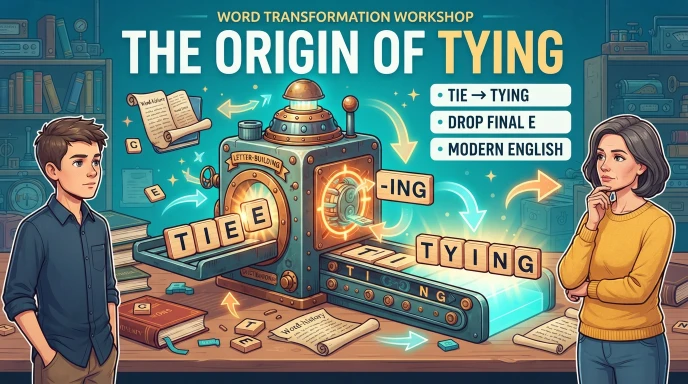
The word tie has a long history in English and is related to the idea of fastening, binding, or connecting things together.
Over time, the verb developed several meanings. It can refer to physically fastening something, connecting people or ideas, or creating a connection between events.
The modern form tying follows the established English spelling rule for verbs ending in -ie.
This rule helps explain why English uses tying, rather than tieing.
Tying vs Tieing: British English vs American English
There is no major British-American spelling difference here.
Tying is the standard spelling in both British and American English.
| Feature | Tying | Tieing |
| Standard English | ✅ Yes | ❌ No |
| American English | ✅ Yes | ❌ No |
| British English | ✅ Yes | ❌ No |
| Correct -ing form of tie | ✅ Yes | ❌ No |
| Meaning | Fastening/connecting | — |
Unlike words such as colour/color or travelled/traveled, this is not a regional spelling difference.
Which Spelling Should You Use?
Use “Tying”
Always use tying when you need the -ing form of tie.
Examples:
I am tying my shoes.
She is tying a ribbon around the box.
He was tying the rope.
Avoid “Tieing”
Tieing is not the standard spelling.
Instead of:
She is tieing her shoes.
Write:
She is tying her shoes.
This rule applies regardless of if you are writing in American or British English.
Common Mistakes with Tieing or Tying
Mistake 1: Writing “Tieing”
Incorrect:
He is tieing his shoes.
Correct:
He is tying his shoes.
The final -ie changes to -y before -ing.
Mistake 2: Thinking “Tie” Simply Takes “-ing”
It may seem logical to write:
tie + ing = tieing
But English spelling rules do not work that way for verbs ending in -ie.
The correct transformation is:
tie → tying
Mistake 3: Confusing Tying With Typing
Tying and typing are completely different words.
- Tying = fastening or connecting
- Typing = entering words using a keyboard
Example:
She is tying her shoes.
She is typing an email.
Everyday Examples of Tying
Tying Shoes
The child is tying his shoes.
Tying a Knot
She is tying a knot in the rope.
Tying a Package
He is tying the package with string.
Tying Hair
She is tying her hair back.
Tying a Ribbon
They are tying a ribbon around the gift.
Connecting Ideas
The report is tying several facts together.
Tying in Formal Writing
Tying is completely appropriate in formal and informal writing.
Examples:
The study is tying several factors to the observed results.
The company is tying its new strategy to customer feedback.
The evidence is tying the two issues together.
However, the exact meaning depends on the context. Tying can describe physical fastening or a figurative connection.
Is Tieing Ever Correct?
In standard modern English, tieing is generally treated as an incorrect spelling of tying.
If you see tieing online, it is usually a spelling error rather than an accepted alternative.
The standard form is:
Tying
Google Trends and Modern Usage
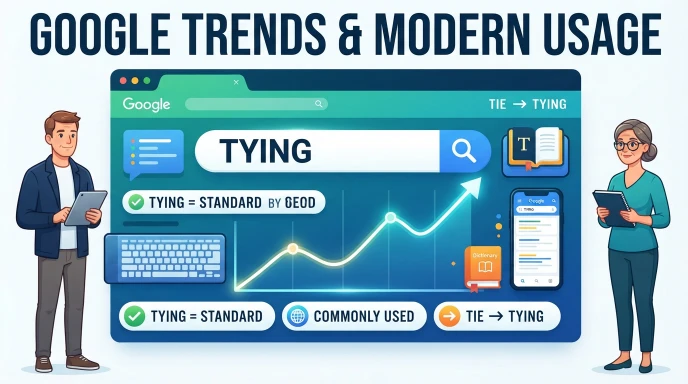
People often search for “tieing or tying” because the spelling rule is not immediately obvious. The confusion is understandable because the base word is spelled tie.
However, modern standard English consistently uses tying as the -ing form.
Search interest can come from many everyday situations, including tying shoes, tying knots, tying hair, and tying a tie.
Exact Google Trends data can change over time and by region, so current figures should be checked directly rather than invented.
For content, useful related searches include “tieing or tying,” “is tieing a word,” “how do you spell tying,” and “tie + ing spelling.”
Quick Comparison: Tying vs Tieing
| Tying | Tieing |
| ✅ Correct | ❌ Incorrect |
| Standard English | Nonstandard spelling |
| Used in US English | Not standard |
| Used in UK English | Not standard |
| Means fastening or connecting | — |
Key Takeaways
- Tying is the correct spelling.
- Tieing is incorrect in standard English.
- The base verb is tie.
- The correct -ing form is tying.
- Change -ie to -y before adding -ing.
- The same rule applies to lie → lying and die → dying.
- Tying is correct in both American and British English.
- There is no standard regional spelling tieing.
People Also Ask: Tieing or Tying
1. Is it tieing or tying?
Tying is the correct spelling. Tieing is not the standard spelling.
2. Is tieing a word?
In standard modern English, tieing is generally considered an incorrect spelling. Use tying instead.
3. How do you spell tying?
The correct spelling is tying: T-Y-I-N-G.
4. Why is tying not spelled tieing?
Because verbs ending in -ie normally change -ie to -y before adding -ing.
5. What is the -ing form of tie?
The -ing form of tie is tying.
6. Is tying correct in British English?
Yes. Tying is the standard spelling in British English.
7. Is tying correct in American English?
Yes. Tying is also the standard spelling in American English.
8. What is the spelling rule for tie and tying?
When a verb ends in -ie, change -ie to -y before adding -ing.
9. Is “tying” a verb?
Yes. Tying is the present participle and gerund form of the verb tie.
10. What is the difference between tying and tieing?
Tying is the correct spelling. Tieing is a common spelling mistake.
Final Verdict: Tieing or Tying?
Tying is the correct spelling, while tieing is incorrect in standard English. The confusion comes from the spelling of the base verb tie, but the rule is simple: when a verb ends in -ie, change -ie to -y before adding -ing.
Therefore:
Tie → Tying
The same pattern can be seen in:
Lie → Lying
Die → Dying
There is no British-American spelling difference here. Tying is the correct form in both varieties of English.
So, whenever you need the -ing form of tie, remember to write tying, not tieing. Once you learn the -ie → -y rule, this spelling becomes much easier to remember.
DISCOVER MORE ARTICLE HERE!
- Girlie or Girly: Which Spelling Is Correct?
- Drier or Dryer: Which Is Correct?
- To Bad or Too Bad: Which Is Correct?

I’m Orin Blake, a writer with a passion for making English grammar simple, practical, and easy to understand. I enjoy breaking down confusing words, spelling differences, and everyday language questions into clear, reader-friendly guides. My goal is to help students, professionals, and curious learners write with greater confidence and accuracy.