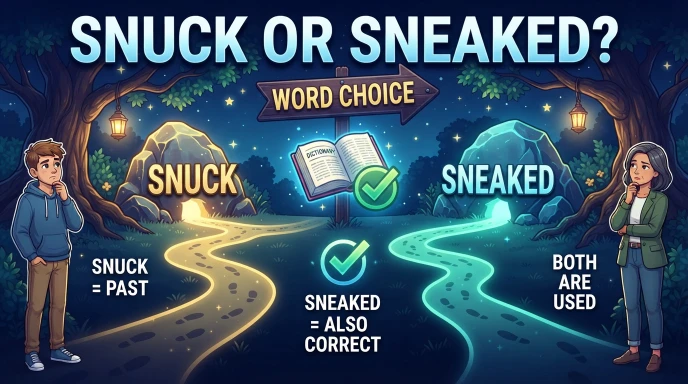
Both “snuck” and “sneaked” are correct past-tense forms of the verb “sneak.” The main difference is usage and regional preference.
Sneaked is the regular past tense, while snuck is an irregular form that is especially common in American English.
If you have searched for “snuck or sneaked,” “is snuck a word,” or “what is the past tense of sneak,” you may be wondering which form is grammatically correct. The answer is that you can use either one in modern English.
For example, you can say, “She sneaked out of the room” or “She snuck out of the room.” Both sentences are correct.
In this guide, we will explain the meaning, origin, British and American usage, common mistakes, everyday examples, and the best situations for using snuck and sneaked.
Snuck or Sneaked : Quick Answer
Both “snuck” and “sneaked” are correct.
| Word | Correct? | Use |
| Snuck | ✅ Yes | Past tense of sneak |
| Sneaked | ✅ Yes | Past tense of sneak |
| Sneak | ✅ Yes | Present/base form |
Examples:
- She snuck out early. ✅
- She sneaked out early. ✅
- They snuck into the room quietly. ✅
- They sneaked into the room quietly. ✅
The key difference is that sneaked follows the regular -ed pattern, while snuck is an irregular past-tense form.
Definition and Meaning
What Does Sneaked Mean?
Sneaked is the regular past tense and past participle of sneak. It means moving quietly or secretly to avoid being noticed.
Example:
He sneaked into the house.
It can also be used when someone secretly does something.
She sneaked a look at the answer.
What Does Snuck Mean?
Snuck has the same meaning as sneaked. It is an irregular past-tense form of sneak.
Example:
He snuck into the house.
There is no major difference in meaning between the two forms.
The Origin of Snuck and Sneaked

The verb sneak has been used in English for centuries to describe moving quietly or secretly.
For a long time, sneaked was the regular past-tense form. Later, snuck developed as an irregular alternative, following the pattern of other English verbs that have irregular past forms.
The use of snuck became particularly strong in American English. Today, both forms are accepted in modern English.
Snuck vs Sneaked: British English vs American English
The biggest difference between snuck and sneaked is regional preference.
| Feature | Snuck | Sneaked |
| Correct? | Yes | Yes |
| Past tense of sneak | Yes | Yes |
| American English | Very common | Common |
| British English | Less common | More traditional/common |
| Meaning | Same | Same |
In American English, snuck is very common in everyday speech and writing.
In British English, sneaked has traditionally been more common, although snuck is also recognized and used.
Which Form Should You Use?
Use “Snuck” in Casual American English
Snuck sounds very natural in everyday American English.
I snuck out of the room.
She snuck a cookie before dinner.
Use “Sneaked” in More Traditional Writing
Sneaked is the regular form and can be a good choice when you want a traditional or broadly recognizable form.
He sneaked into the building.
For British English
If your audience mainly uses British English, sneaked may sound more familiar.
For International Writing
Both forms are acceptable. If you want to avoid regional variation, sneaked is the regular form and is widely understood.
Common Mistakes with Snuck or Sneaked
Mistake 1: Thinking “Snuck” Is Incorrect
Some people believe that snuck is always wrong because it does not use -ed.
That is not true.
Correct:
He snuck out of the house.
Why?
Snuck is an accepted irregular past-tense form of sneak.
Mistake 2: Thinking “Sneaked” Is Wrong
Sneaked is also completely correct.
Correct:
She sneaked past the door.
It is the regular past-tense form.
Mistake 3: Using “Sneak” for the Past
Incorrect:
Yesterday, he sneak into the room.
Correct:
Yesterday, he snuck into the room.
Or:
Yesterday, he sneaked into the room.
Mistake 4: Mixing the Forms
Avoid using two different forms unnecessarily in the same sentence.
Choose one:
She snuck out quietly.
or:
She sneaked out quietly.
Both are correct.
Everyday Examples of Snuck and Sneaked
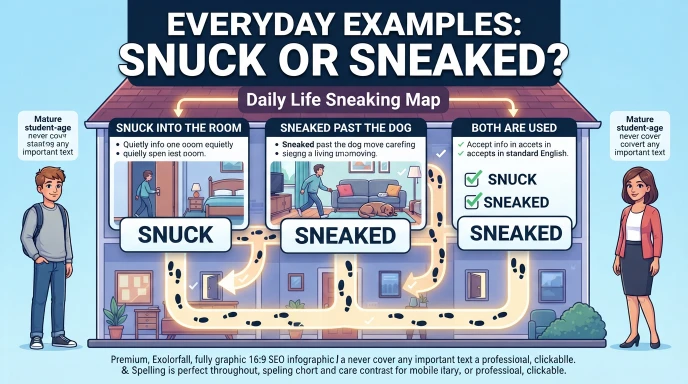
With “Snuck”
He snuck into the kitchen.
She snuck away before anyone noticed.
I snuck a quick look at the clock.
They snuck out after the meeting.
With “Sneaked”
He sneaked into the kitchen.
She sneaked away quietly.
I sneaked a quick look at the clock.
They sneaked out after the meeting.
Notice that the meaning remains the same.
Snuck or Sneaked in Formal Writing
Both forms can be grammatically correct, but your choice may depend on your audience.
For formal or international writing, sneaked can be a straightforward choice because it follows the regular past-tense pattern.
However, snuck is not grammatically incorrect simply because it is more common in informal American English.
Always consider your publication’s style guide if one is provided.
Is Snuck More American Than Sneaked?
Yes. Snuck is particularly common in American English.
American speakers frequently use sentences such as:
He snuck out of the office.
She snuck into the room.
Sneaked is also used in American English, but snuck is a very familiar choice.
In British English, sneaked has traditionally been preferred more often.
Google Trends and Modern Usage
Search interest in snuck and sneaked often comes from people checking if snuck is grammatically correct or wondering about the past tense of sneak.
Modern English accepts both forms, although their frequency can differ by region.
Exact search-volume or Google Trends figures can change over time and by location, so it is best to check current Google Trends data directly rather than use invented statistics.
For content, useful related searches include “snuck or sneaked,” “is snuck a word,” “past tense of sneak,” and “sneaked vs snuck.”
Quick Comparison: Snuck vs Sneaked
| Snuck | Sneaked |
| Correct | Correct |
| Irregular past tense | Regular past tense |
| Very common in American English | Traditional and widely understood |
| Same meaning | Same meaning |
| “He snuck away.” | “He sneaked away.” |
Key Takeaways
- Snuck is correct.
- Sneaked is also correct.
- Both are past-tense forms of sneak.
- Snuck is especially common in American English.
- Sneaked is the regular past-tense form.
- British English has traditionally favored sneaked more strongly.
- Both forms have the same basic meaning.
- Choose the form that fits your audience and writing style.
- Do not assume that snuck is a mistake.
People Also Ask: Snuck or Sneaked
1. Is snuck or sneaked correct?
Both snuck and sneaked are correct past-tense forms of sneak.
2. Is snuck a real word?
Yes. Snuck is a recognized and widely used irregular past-tense form of sneak.
3. Is sneaked grammatically correct?
Yes. Sneaked is the regular past-tense form of sneak.
4. What is the past tense of sneak?
Both snuck and sneaked can be used as the past tense of sneak.
5. Is snuck American English?
Snuck is especially common in American English, although it is also used elsewhere.
6. Is sneaked British English?
Sneaked has traditionally been more common in British English, but it is also used in American English.
7. Which is more correct, snuck or sneaked?
Neither is more grammatically correct. Both are accepted, although regional preferences differ.
8. Can I use snuck in formal writing?
Yes, snuck is grammatically valid. However, some formal or traditional writing may prefer sneaked.
9. What is the difference between snuck and sneaked?
The main difference is form and regional preference. Snuck is irregular, while sneaked follows the regular -ed pattern.
10. Should I say “I snuck out” or “I sneaked out”?
Both are correct. I snuck out is especially natural in American English, while I sneaked out is also fully acceptable.
Final Verdict: Snuck or Sneaked?
Both “snuck” and “sneaked” are correct. They are two accepted past-tense forms of the verb sneak, and they have the same basic meaning.
Sneaked is the regular form, while snuck is an irregular form that became especially common in American English. British English has traditionally used sneaked more often, although snuck is also recognized.
If you are writing for an American audience, snuck will usually sound natural. If you prefer the traditional regular form or are writing for a broad international audience, sneaked is a safe choice.
The important point is simple: you do not need to treat “snuck” as a mistake. Both forms are correct.
DISOVER MORE ARTICLE HERE!
- Preform or Perform: Which Word Is Correct?(2026)
- Drier or Dryer: Which Is Correct?
- Quite or Quiet: Which Is Correct?

I’m Orin Blake, a writer with a passion for making English grammar simple, practical, and easy to understand. I enjoy breaking down confusing words, spelling differences, and everyday language questions into clear, reader-friendly guides. My goal is to help students, professionals, and curious learners write with greater confidence and accuracy.