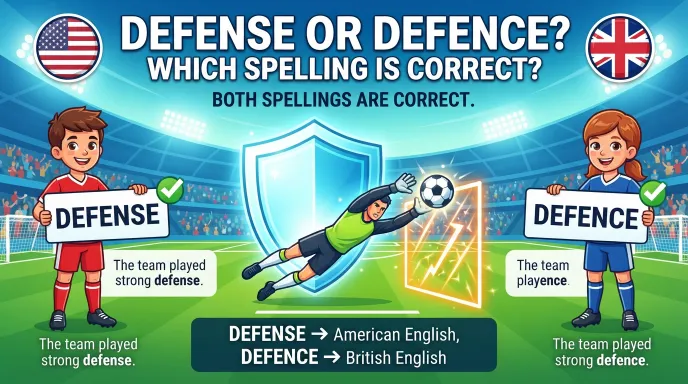
Both “defense” and “defence” are correct; “defense” is American English, while “defence” is British English.Have you ever wondered if the correct spelling is defense or defence? Both spellings are correct, but the preferred form depends on the variety of English you are using.
This is a common spelling question because American and British English often use different endings for words with -ense and -ence.
Defense is the standard spelling in American English, while defence is the standard spelling in British English and many Commonwealth varieties.
Both words have the same meaning. They can refer to protection from harm, a legal argument made to support someone, or the act of protecting a team in sports.
For example, an American writer may say, “The team has a strong defense,” while a British writer would usually write, “The team has a strong defence.”
Neither spelling is wrong. The key is to choose the form that matches your audience and use it consistently.
Defense or Defence : Quick Answer
Both spellings are correct:
- Defense ✅ — American English
- Defence ✅ — British English
Examples
American English:
The team has a strong defense.
British English:
The team has a strong defence.
Quick Tip
Defense = American English
Defence = British English
The Origin of Defense or Defence
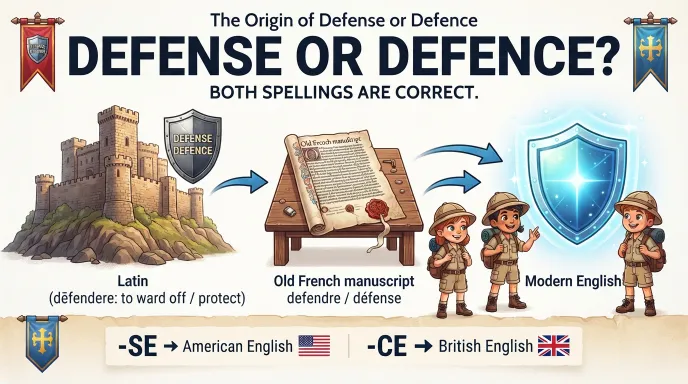
The word defense/defence comes from Old French and ultimately from Latin defendere, meaning to protect or ward off.
As English developed different spelling traditions, the two forms became associated with different regional varieties.
American English generally adopted defense, following the -ense spelling.
British English generally uses defence, following the -ence spelling.
The meaning remains the same.
British English vs American English Spelling
| Feature | British English | American English |
| Preferred spelling | Defence | Defense |
| Meaning | Protection | Protection |
| Legal use | Defence | Defense |
| Sports use | Defence | Defense |
British English
The team needs to improve its defence.
American English
The team needs to improve its defense.
Which Spelling Should You Use?
Choose the spelling that matches your audience.
Use “Defense” for American English
Use defense when writing in American English.
Examples:
- national defense
- defense system
- defense attorney
- strong defense
Use “Defence” for British English
Use defence when writing in British English.
Examples:
- national defence
- defence system
- defence lawyer
- strong defence
For Global Websites
If your website targets American readers, use defense. If it targets British or Commonwealth readers, use defence.
The most important thing is to remain consistent.
Common Mistakes with Defense or Defence
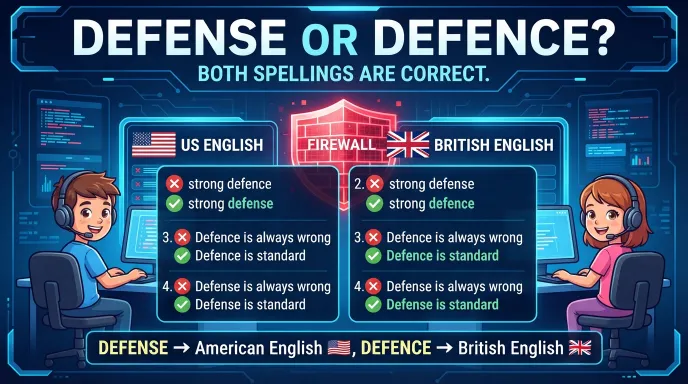
Mistake 1: Treating One Form as Always Wrong
❌ Defence is always incorrect.
❌ Defense is always incorrect.
Both are correct regional spellings.
Mistake 2: Mixing English Styles
Avoid switching between defense and defence without a reason.
Choose one spelling based on your target audience.
Mistake 3: Forgetting Related Words
The same difference appears in some related forms:
- defensive — same spelling in both
- defensively — same spelling in both
- defence/defense
Not every related word changes between British and American English.
Defense or Defence in Everyday Examples
American:
The company has improved its data defense.
British:
The company has improved its data defence.
News
American:
The government announced a new defense policy.
British:
The government announced a new defence policy.
Sports
American:
The team’s defense played well.
British:
The team’s defence played well.
Formal Writing
American:
The report examines national defense policy.
British:
The report examines national defence policy.
Defense or Defence : Google Trends & Usage Data
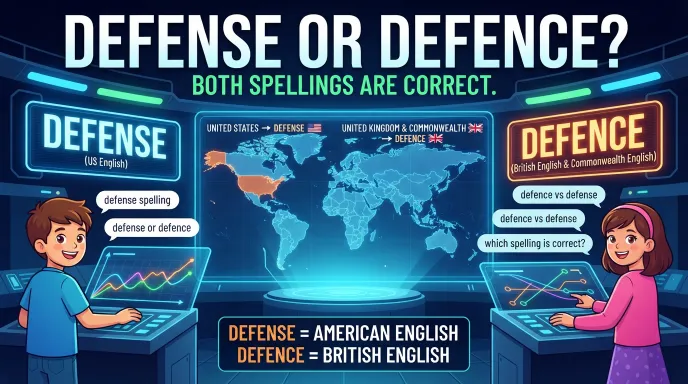
Searches for “defense or defence” are common because both forms appear frequently across English-speaking countries.
Generally:
- Defense is strongly associated with American English.
- Defence is strongly associated with British English.
- Defence is also common in many Commonwealth varieties.
Search popularity varies by country and time, so exact Google Trends results depend on the selected region and date range.
Comparison Table
| Word | British English | American English | Meaning |
| Defence | ✅ Preferred | Less common | Protection |
| Defense | Less common | ✅ Preferred | Protection |
| Defensive | ✅ | ✅ | Protecting |
| Defensively | ✅ | ✅ | In a defensive way |
FAQs
Is defense or defence correct?
Both are correct. Defense is the American English spelling, while defence is the British English spelling.
Is defence British English?
Yes. Defence is the standard British English spelling.
Is defense American English?
Yes. Defense is the standard American English spelling.
Do defense and defence mean the same thing?
Yes. They have the same meaning and pronunciation.
Which spelling should I use for a US audience?
Use defense.
Which spelling should I use for a UK audience?
Use defence.
Is “defence” used in Commonwealth English?
Yes. Defence is widely used in countries that follow British English spelling conventions.
Conclusion
Both defense and defence are correct spellings. The difference is mainly regional: defense is the standard American English form, while defence is the standard British English form and is also common in many Commonwealth varieties.
The words have the same meaning and are used in similar contexts, including protection, law, government, and sports.
If you are writing for an American audience, choose defense. If you are writing for a British or Commonwealth audience, choose defence.
For content, knowing both forms can help you address readers from different English-speaking regions.
However, consistency is important. Choose the spelling that fits your target audience and use it throughout your article. The easiest rule is: defense = American English; defence = British English.
DISCOVER MORE ARTICLE HERE!
- Judgement or Judgment? Which Spelling Is Correct?
- Canceled or Cancelled? Which Spelling Is Correct?
- Affect or Effect? Which Word Is Correct?

I’m Orin Blake, a writer with a passion for making English grammar simple, practical, and easy to understand. I enjoy breaking down confusing words, spelling differences, and everyday language questions into clear, reader-friendly guides. My goal is to help students, professionals, and curious learners write with greater confidence and accuracy.