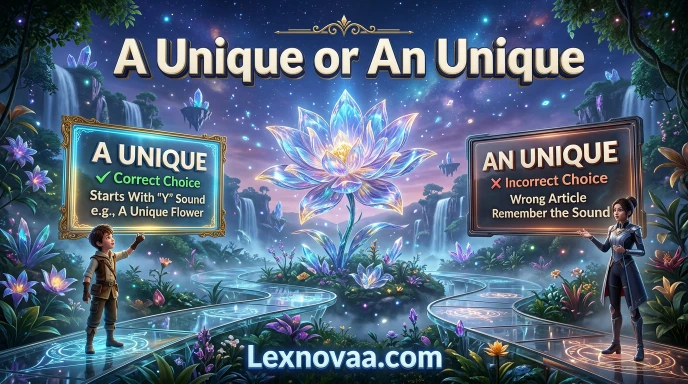
“A unique” is correct in standard modern English, while “an unique” is generally incorrect. The reason is simple: we choose a or an based on the sound at the beginning of the next word, not just its first letter.
The word unique begins with a “yoo” sound, like the word you. This is a consonant sound, so it takes a instead of an.
For example, you should write “She has a unique idea,” not “She has an unique idea.” The same rule applies to phrases such as “a unique opportunity,” “a unique style,” and “a unique experience.”
Many people feel unsure about this rule because unique begins with the vowel letter u. However, English articles depend on pronunciation. Words such as umbrella begin with a vowel sound and use an, while university and unique begin with a “yoo” sound and use a.
In this guide, you will learn the correct form, the grammar rule behind it, common mistakes, and easy examples you can use in everyday writing.
A Unique or An Unique : Quick Answer
Use “a unique,” not “an unique,” in standard modern English.
- Correct: This is a unique idea.
- Incorrect in standard usage: This is an unique idea.
The reason is pronunciation. Unique begins with the consonant-like “y” sound in “yoo,” so it takes a.
Easy rule: Choose a before a consonant sound and an before a vowel sound.
Definition and Meaning of A Unique
The word unique is an adjective. It means one of a kind, unlike others, or special in some way.
Examples:
- She has a unique talent.
- This shop offers a unique experience.
- Every person has a unique story.
- He found a unique way to solve the problem.
In each sentence, unique describes a noun. The article a comes before the adjective because the adjective begins with a “yoo” sound.
Why Do We Say A Unique?
We say a unique because the first sound in unique is /j/, the same sound heard at the start of yes and you. This is a consonant sound.
Compare these examples:
| Phrase | Correct? | Reason |
| A unique idea | Yes | Begins with a “yoo” sound |
| An unique idea | No, in standard usage | The first sound is not a vowel |
| A university | Yes | Begins with a “yoo” sound |
| An umbrella | Yes | Begins with a vowel sound |
| An unusual event | Yes | Begins with a vowel sound |
The first letter alone does not decide if you use a or an. The sound does.
The Origin of A Unique and An Unique
The word unique entered English through French and ultimately comes from the Latin word unicus, meaning “only one” or “single.” Its meaning still relates to being one of a kind or unlike anything else.
The use of a and an developed around pronunciation. Historically, an was used before words beginning with vowel sounds, while a was used before consonant sounds. This pattern remains part of modern English grammar.
Because unique begins with a “yoo” sound, it follows the same pattern as university and uniform. The spelling starts with the letter u, but the pronunciation starts with a consonant sound.
British English vs American English Spelling
British and American English follow the same rule for a unique. The correct form does not change between these varieties.
| English variety | Correct phrase | Example |
| American English | A unique | It is a unique opportunity. |
| British English | A unique | She has a unique style. |
| Canadian English | A unique | This is a unique design. |
| Australian English | A unique | They found a unique solution. |
The rule is based on pronunciation, not regional spelling. In standard English, “a unique” is the correct choice in all these varieties.
Which Form Should You Use?
Use a unique whenever unique describes a singular countable noun and needs an indefinite article.
Use A Unique in These Sentences
- We had a unique chance to meet the author.
- She created a unique design.
- This city has a unique history.
- He shared a unique perspective.
- It was a unique experience.
Each example uses a because unique starts with a “yoo” sound.
Why An Unique Is Usually Wrong
The phrase an unique treats the letter u as if it automatically requires an. But English grammar follows the first sound, not the first letter.
Incorrect: He came up with an unique solution.
Correct: He came up with a unique solution.
The same principle applies to other words beginning with a pronounced “yoo” sound, such as user, useful, and usual.
A vs. An: The Simple Rule
Use this rule to choose the correct article:
- Use a before a consonant sound: a unique idea, a useful tool, a European city.
- Use an before a vowel sound: an apple, an hour, an unusual event.
Notice that hour begins with a vowel sound because its h is silent. By contrast, unique begins with a consonant sound even though it starts with a vowel letter.
Common Mistakes with A Unique and An Unique
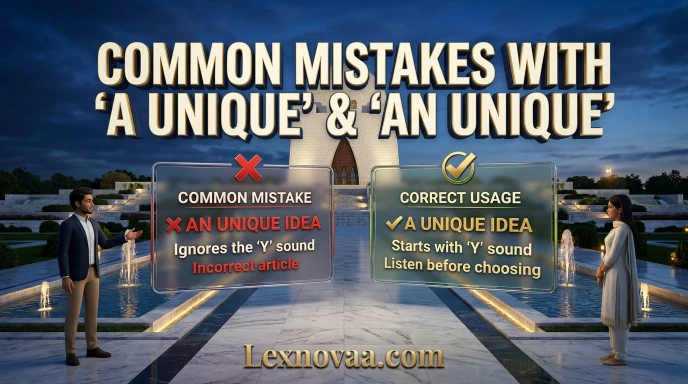
Mistake 1: Choosing by the First Letter
Incorrect: This is an unique book.
Correct: This is a unique book.
Why? The word starts with a “yoo” sound, so a is correct.
Mistake 2: Thinking Every Word Starting With U Uses An
Incorrect: She is an university student.
Correct: She is a university student.
The word university begins with the same “yoo” sound as unique.
Mistake 3: Forgetting That Pronunciation Matters
Correct: It was an unusual event.
Correct: It was a unique event.
Although unusual and unique both begin with u, they start with different sounds. Unusual begins with a vowel sound, while unique begins with a consonant sound.
Mistake 4: Using An Unique in Formal Writing
In standard modern English, write a unique in essays, articles, emails, and professional documents. This form is widely accepted and grammatically correct.
Everyday Examples of A Unique
Here are simple examples showing how to use the correct phrase.
At School
- She wrote a unique story.
- This is a unique science project.
At Work
- Our team developed a unique plan.
- He offered a unique solution to the problem.
Daily Life
- That restaurant has a unique menu.
- I saw a unique bird in the garden.
Travel and Culture
- The village has a unique tradition.
- We visited a unique place during our trip.
Online Writing
- This article shares a unique perspective.
- She created a unique website design.
every example, a unique is correct because unique starts with a “yoo” sound.
A Unique or An Unique: Quick Comparison

| Feature | A Unique | An Unique |
| Standard grammar | Correct | Generally incorrect |
| Pronunciation rule | Starts with a consonant sound | Treats the word as starting with a vowel sound |
| Example | A unique opportunity | An unique opportunity |
| Best for formal writing | Yes | No |
The answer is clear: use “a unique” in standard English.
Google Trends and Modern Usage
People may search for “a unique or an unique” because the word begins with the vowel letter u. However, the correct article depends on the first sound of the word.
The phrase a unique is used in everyday conversation, schoolwork, professional writing, and online articles. It follows the same pronunciation rule as a university, a user, and a useful tool.
No live Google Trends data has been verified for this article, so exact search volumes or popularity figures should not be assumed. You can explore current search interest through Google Trends.
For clear and correct writing, remember that English articles depend on sound rather than spelling alone. Once you understand this rule, choosing between a and an becomes much easier.
FAQs
1. Is it a unique or an unique?
A unique is correct in standard modern English. The word unique begins with a “yoo” sound, which is a consonant sound.
2. Why do we say a unique instead of an unique?
We say a unique because the first sound is /j/, like the sound at the start of you. Use a before consonant sounds.
3. Is “an unique” ever correct?
It is generally considered incorrect in standard modern English. For formal writing, always use a unique.
4. Is unique a vowel or a consonant sound?
The first sound in unique is a consonant sound, even though the word begins with the vowel letter u.
5. Is it a unique idea or an unique idea?
The correct phrase is a unique idea.
6. Is it a unique experience or an unique experience?
The standard form is a unique experience because unique starts with a “yoo” sound.
7. Is it a university or an university?
The correct phrase is a university. The word begins with a “yoo” sound, just like unique.
8. Is it an unusual or a unusual event?
The correct phrase is an unusual event because unusual begins with a vowel sound.
9. Does British English use “an unique”?
No. Standard British English uses a unique, just like standard American English.
10. What is the easiest way to remember a unique vs. an unique?
Say the word aloud. Since unique begins with the sound “yoo,” use a. Remember: the sound matters more than the first letter.
Key Takeaways
- A unique is the correct form in standard modern English.
- An unique is generally incorrect.
- The word unique starts with a “yoo” consonant sound.
- Choose a or an based on pronunciation, not just spelling.
- British and American English follow the same rule.
Conclusion
The correct phrase is “a unique,” not “an unique,” in standard modern English. Even though unique begins with the vowel letter u, its first sound is “yoo,” which works like a consonant sound. That is why we say “a unique idea,” “a unique experience,” and “a unique opportunity.”
The main rule is simple: use a before consonant sounds and an before vowel sounds. This rule also explains why we say “a university” but “an unusual event.” The spelling may look similar, but the pronunciation determines which article is correct.
Once you learn to listen for the first sound, you can avoid this common grammar mistake in school assignments, emails, articles, and everyday conversations.
For more clear grammar explanations, spelling comparisons, and practical examples, visit Lexnovaa.com.
DISCOVER MORE ARTICLE CLICK HERE NOW!
- Worse Case or Worst Case: Meaning, Rules, and Examples
- Rhythm or Rythm:Meaning, Rules, and Examples
- Apart or A Part: Which Is Correct? Meaning, Rules, and Examples

I’m Orin Blake, a writer with a passion for making English grammar simple, practical, and easy to understand. I enjoy breaking down confusing words, spelling differences, and everyday language questions into clear, reader-friendly guides. My goal is to help students, professionals, and curious learners write with greater confidence and accuracy.