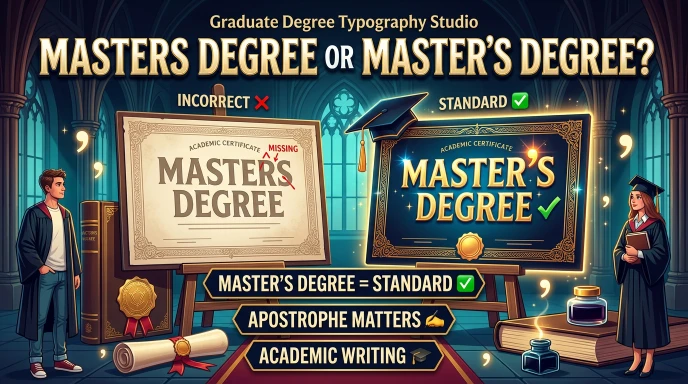
Master’s degree is the correct standard form when referring to a postgraduate qualification. Masters degree is generally incorrect because it leaves out the apostrophe. If you are writing about a university qualification, use master’s degree in standard English.
Many people search for “masters degree or master’s degree” because the apostrophe can be easy to miss. Both forms look similar, and people often type the phrase quickly when writing emails, applications, resumes, or academic documents. However, the apostrophe matters.
A master’s degree is a qualification awarded after completing a postgraduate course of study. For example, a person might earn a master’s degree in English, business, education, or computer science.
The word master’s is possessive in form. The apostrophe shows the traditional grammatical relationship between the word master and the degree. The plural word masters does not serve the same grammatical role in this phrase.
In this guide, you will learn the correct spelling, meaning, origin, British and American usage, common mistakes, and everyday examples. You will also discover when to capitalize master’s degree and how to write the phrase correctly in academic and professional documents.
Masters Degree or Master’s Degree : Quick Answer
Master’s degree is the standard spelling. Use the apostrophe before the s.
- ✅ Master’s degree — correct
- ❌ Masters degree — nonstandard in formal writing
- ❌ Masters’ degree — not the standard form for one qualification
Example:
She earned a master’s degree in English.
The same spelling is used in standard American English and British English.
Definition and Meaning of Masters Degree or Master’s Degree
What Does Master’s Degree Mean?
A master’s degree is a postgraduate academic qualification. Students usually earn it after completing a bachelor’s degree or another accepted qualification and meeting the requirements of a university program.
Examples include:
- Master’s degree in English
- Master’s degree in Business Administration
- Master’s degree in Education
- Master’s degree in Computer Science
The exact entry requirements, course length, and qualification title depend on the university and country.
What Does Masters Degree Mean?
Masters degree is a common spelling mistake when referring to the academic qualification. In standard writing, the apostrophe should appear in master’s degree.
The difference is small, but the correct punctuation makes the phrase grammatically standard.
What Is the Difference Between Masters and Master’s?
Master’s is the possessive form used in the name of the qualification. Masters is a plural form of master in other contexts.
For example:
- Correct: She has a master’s degree.
- Different meaning: The story describes several masters of their craft.
When referring to the academic qualification, use master’s degree.
The Origin of Masters Degree or Master’s Degree
The word master has a long history in English. It has been used to describe a person with authority, skill, or advanced knowledge.
Over time, universities adopted the word in the names of academic qualifications. A master’s degree became a qualification awarded to students who complete an advanced course of study beyond the undergraduate level.
The apostrophe in master’s degree follows the traditional possessive form. It connects the word master with the qualification being described.
The spelling masters degree is often used because writers may overlook the apostrophe or assume that masters is simply a plural word. However, the standard written form remains master’s degree.
British English vs American English: Masters Degree or Master’s Degree

There is no major British-American spelling difference in this phrase. Both varieties of English use master’s degree as the standard form.
| English Variety | Correct Form | Example |
| American English | Master’s degree | He earned a master’s degree. |
| British English | Master’s degree | She completed a master’s degree. |
| Canadian English | Master’s degree | I am applying for a master’s degree. |
| Australian English | Master’s degree | She holds a master’s degree. |
| International English | Master’s degree | He plans to pursue a master’s degree. |
The name of a specific qualification may differ by institution or country. For example, universities may award a Master of Arts (MA) or a Master of Science (MSc). These official titles should follow the institution’s capitalization and naming conventions.
However, when using the general phrase, master’s degree is the standard choice.
Which Version Should You Use: Masters Degree or Master’s Degree?
Use master’s degree in essays, applications, emails, resumes, reports, and professional documents.
In American English
She plans to earn a master’s degree in psychology.
In British English
He completed his master’s degree at a London university.
In Academic Writing
The research was conducted as part of a master’s degree program.
In Business Writing
The applicant holds a master’s degree in business administration.
In a Resume or CV
Master’s Degree in English Literature
For a resume or CV, follow the style used for other education entries. Capitalization may vary by formatting style, but the apostrophe should remain.
In Casual Writing
I want to get a master’s degree after college.
In every example, the standard form is master’s degree.
Common Mistakes with Masters Degree or Master’s Degree
Mistake 1: Leaving Out the Apostrophe
Incorrect: She has a masters degree in education.
Correct: She has a master’s degree in education.
Why? The standard phrase uses the possessive form master’s.
Mistake 2: Putting the Apostrophe After the S
Incorrect: He earned a masters’ degree.
Correct: He earned a master’s degree.
Why? The standard name of the qualification uses master’s, with the apostrophe before the s.
Mistake 3: Capitalizing Every Word
Less suitable in ordinary prose: She earned a Master’s Degree in history.
Standard in ordinary prose: She earned a master’s degree in history.
The general phrase is usually lowercase unless it begins a sentence or appears in a heading or title. Official qualification names may follow different capitalization rules.
Mistake 4: Confusing Master’s Degree With Master’s Program
Both can be correct, depending on what you mean.
- Master’s degree = the qualification
- Master’s program = the course or program of study
Example:
She enrolled in a master’s program and hopes to earn a master’s degree.
Mistake 5: Forgetting the Apostrophe in Online Forms
Incorrect: Highest education: Masters degree
Correct: Highest education: Master’s degree
When filling out an application, use the correct form whenever you can enter your own text. If a form provides fixed options, choose the option that best matches your qualification.
Master’s Degree or Masters Degree in Everyday Examples
In Emails
I am interested in applying for a master’s degree in English.
In University Applications
My goal is to complete a master’s degree in computer science.
In a Resume
Education: Master’s degree in Business Administration
In a Cover Letter
My master’s degree helped me develop advanced research skills.
In Academic Writing
The study was completed as part of a master’s degree requirement.
In Social Media
I finally completed my master’s degree!
In Conversation
Are you planning to get a master’s degree?
In Professional Documents
Candidates should hold a master’s degree or an equivalent qualification.
Is Master’s Degree Capitalized?
The general phrase master’s degree is usually written in lowercase in the middle of a sentence.
Example:
She earned a master’s degree in history.
Capitalize it when it begins a sentence or appears in a heading that uses title case.
Example heading:
Master’s Degree or Masters Degree: Which Is Correct?
Official degree titles may use capitalization according to the institution’s style.
Example:
Master of Arts in English
Notice the difference between the general phrase master’s degree and the official title Master of Arts.
Is Master’s Degree Hyphenated?
No. Master’s degree is written without a hyphen.
Correct: master’s degree
Incorrect: master’s-degree
The phrase consists of a possessive noun and another noun, so a hyphen is not normally needed.
Should You Write a Master’s Degree or an Master’s Degree?
Use a master’s degree.
Example:
She wants to earn a master’s degree in education.
The word master’s begins with a consonant sound, so the article a is correct, not an.
Master’s Degree vs Bachelor’s Degree
Both phrases use an apostrophe before the s.
| Qualification | Correct Form | Example |
| Undergraduate qualification | Bachelor’s degree | He earned a bachelor’s degree. |
| Postgraduate qualification | Master’s degree | She earned a master’s degree. |
| Doctoral qualification | Doctoral degree or doctorate | He completed a doctoral degree. |
A bachelor’s degree is commonly an undergraduate qualification, while a master’s degree is usually a postgraduate qualification. Exact academic pathways vary between education systems.
Google Trends and Usage Data for Masters Degree or Master’s Degree

People search for masters degree or master’s degree because the apostrophe is easy to overlook when typing. The unpunctuated form can appear in searches, informal messages, and online content.
However, a search query does not determine the correct spelling. The standard form in edited English is master’s degree.
When preparing articles, university applications, academic assignments, resumes, or professional emails, use the apostrophe. There is no need to choose a different spelling for British or American readers.
Specific search-volume figures should only be included when supported by current keyword research data. No exact search-volume numbers are claimed here.
Masters Degree or Master’s Degree?
Master’s degree is the correct standard form for the postgraduate academic qualification. Masters degree is generally nonstandard because it omits the apostrophe. Both British English and American English use master’s degree.
Quick answer:
- Correct: master’s degree
- Incorrect in standard usage: masters degree
- Example: She earned a master’s degree in education.
Remember to place the apostrophe before the s.
People Also Ask About Masters Degree or Master’s Degree
1. Is it masters degree or master’s degree?
Master’s degree is the correct standard form. Use an apostrophe before the s.
2. Why does master’s degree have an apostrophe?
The apostrophe is part of the traditional possessive form used in the name of the qualification.
3. Is masters degree ever correct?
It may appear in informal writing or search queries, but master’s degree is the standard form in edited English.
4. Is master’s degree British or American?
It is standard in both British English and American English.
5. Should master’s degree be capitalized?
Usually, no. Write master’s degree in lowercase in ordinary sentences, but capitalize it when required by a heading, sentence position, or official title.
6. Is master’s degree one word or two?
It is two words: master’s degree.
7. Is master’s degree hyphenated?
No. The standard form has no hyphen.
8. Is it masters’ degree or master’s degree?
Master’s degree is the standard form. The apostrophe goes before the s.
9. How do you write master’s degree on a resume?
You can write Master’s Degree in English or use the official qualification title, such as Master of Arts in English, following your resume style.
10. What is the difference between a master’s degree and a bachelor’s degree?
A bachelor’s degree is commonly an undergraduate qualification. A master’s degree is usually a postgraduate qualification completed after a bachelor’s degree or another accepted entry route.
Key Takeaways: Masters Degree or Master’s Degree
- Master’s degree is the correct standard form.
- Masters degree is generally incorrect in formal writing.
- Put the apostrophe before the s.
- Use the same standard spelling in British and American English.
- Write the general phrase in lowercase in ordinary sentences.
- Do not add a hyphen.
- Use official qualification titles when required.
- Remember the correct pattern: bachelor’s degree and master’s degree.
Conclusion
When choosing between masters degree or master’s degree, use master’s degree. The apostrophe is an important part of the standard spelling, and the correct form is used in both British English and American English.
A master’s degree is a postgraduate academic qualification that people earn after completing an approved program of advanced study.
You may see the phrase in university applications, resumes, academic assignments, business documents, and professional emails. In all these contexts, the apostrophe should appear before the s.
Remember that master’s degree is the general phrase, while official qualifications such as Master of Arts or Master of Science may use their own capitalization. The phrase is not hyphenated, and it is normally lowercase in ordinary sentences.
The easiest way to remember the spelling is to compare it with bachelor’s degree. Both use an apostrophe before the s.
Whenever you write about this postgraduate qualification, choose master’s degree to keep your English clear, correct, and professional.
DISCOVER MORE ARTICLE HERE!
- Ofcourse or Of Course? Which Spelling Is Correct?
- Free Rein or Free Reign? Which Spelling Is Correct?
- Other Than or Other Then: Which Is Correct?

I’m Orin Blake, a writer with a passion for making English grammar simple, practical, and easy to understand. I enjoy breaking down confusing words, spelling differences, and everyday language questions into clear, reader-friendly guides. My goal is to help students, professionals, and curious learners write with greater confidence and accuracy.