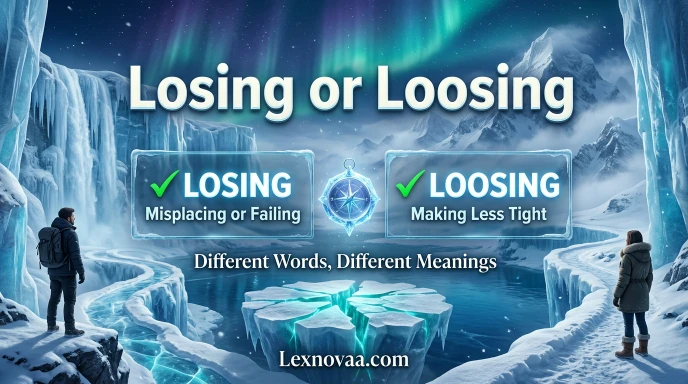
“Losing” and “loosing” are both real words, but they have different meanings. “Losing” is the correct word when you mean failing to win, misplacing something, or no longer having something. “Loosing” means making something loose or setting something free. It is much less common in everyday English.
People often confuse these words because they look almost the same. The extra “o” in “loosing” can make the choice tricky. However, using the wrong word can change the meaning of your sentence.
For example, if your team does not win a game, you are losing, not loosing. If someone releases an animal from a rope or lets it go free, loosing may fit, although “releasing” is often more natural today.
The good news is that the rule is easy to learn. Once you understand what each word means, you can choose the right spelling with confidence. This guide explains the difference between losing and loosing, gives simple examples, covers common mistakes, and answers questions that English learners often ask.
Losing or Loosing : Quick Answer
Use “losing” when something is being lost. Use “loosing” when something is being made loose or set free.
- Losing: Failing to win, misplacing something, or having less of something.
- Loosing: Making something loose or releasing it. This form is uncommon in everyday writing.
Examples:
- Correct: “I am losing my keys.”
- Correct: “Our team is losing the game.”
- Correct but uncommon: “The hunter is loosing the arrow.”
A simple trick is to remember that lose becomes losing, with one “o” in “losing.” Do not add an extra “o” when you mean that you cannot find something or that you did not win.
Definition and Meaning
What Does “Losing” Mean?
“Losing” is the -ing form of the verb “lose.” It can describe failing to win, misplacing an item, or no longer keeping something.
Examples:
- “I am losing patience.”
- “She is losing her phone again.”
- “Our team is losing the match.”
- “He is losing interest in the game.”
- “They are losing money.”
In each sentence, something is being lost or reduced. This is the meaning you will need most often in everyday writing.
What Does “Loosing” Mean?
“Loosing” is the -ing form of the verb “loose.” As a verb, “loose” can mean to release something or make it free from a tight hold. This use is uncommon today.
Examples:
- “The archer is loosing an arrow.”
- “The old story tells of loosing the prisoners.”
- “The rope is loosing its grip.”
The last example is unusual and may sound awkward to many readers. In modern English, people often choose clearer words such as “releasing,” “freeing,” or “slackening,” depending on the meaning.
What Is the Main Difference Between Losing and Loosing?
The main difference is the base verb:
- Lose → Losing: To fail to keep, find, or win something.
- Loose → Loosing: To release something or make it less tight.
For example, “I am losing the rope” means you are no longer keeping it. “Loosing the rope” could mean releasing it or making it less tight.
The Origin of Losing and Loosing

“Losing” comes from the verb “lose,” an old English word linked to loss and failure to keep something. Over time, “lose” developed the familiar meanings we use today, such as losing a game, losing a key, or losing trust.
“Loosing” comes from “loose,” which is linked to the idea of being free, untied, or not tight. The verb “to loose” developed the meaning of releasing something or setting it free.
Although the words look similar, they come from different base forms and serve different purposes. “Lose” is common in everyday English, while the verb “loose” is less common than the adjective “loose,” as in “a loose shirt” or “a loose screw.”
This history helps explain why the words should not be swapped. Their spellings are close, but their meanings are not the same.
British English vs American English Usage
There is no major British and American spelling difference between “losing” and “loosing.” Both forms follow the same rules in both varieties of English.
| Meaning | American English | British English |
| Failing to win | Losing | Losing |
| Misplacing something | Losing | Losing |
| Making something less tight | Loosing | Loosing |
| Releasing something | Loosing, though uncommon | Loosing, though uncommon |
Both British and American writers normally use “losing” for everyday situations involving loss. The verb “loosing” is possible, but it is rare and can sound old-fashioned.
Which Spelling Should You Use?
Choose the word that matches the action you want to describe.
Use “Losing” for Loss or Failure
Use “losing” when you are talking about losing a game, misplacing an item, or no longer having something.
Examples:
- “I keep losing my glasses.”
- “Our school is losing the competition.”
- “She is losing hope.”
- “He is losing weight.”
- “They are losing time.”
Use “Loosing” for Releasing or Making Loose
Use “loosing” only when you mean releasing something or making it less tight. Since this verb is uncommon, a simpler word may be clearer.
Examples:
- “The archer is loosing an arrow.”
- “The guards are loosing the captives.”
In everyday writing, “firing an arrow” or “releasing the captives” may sound more natural, depending on the context.
A Simple Memory Trick
Remember these two pairs:
- Lose → Losing: You lose something.
- Loose → Loosing: You make something loose or set it free.
If you mean that you cannot find your phone, write “I am losing my phone,” not “I am loosing my phone.”
Common Mistakes With Losing and Loosing

These words are easy to mix up because they differ by only one letter. Here are some common errors and their corrections.
| Incorrect | Correct | Reason |
| I am loosing my keys. | I am losing my keys. | You cannot find the keys. |
| Our team is loosing. | Our team is losing. | The team is not winning. |
| She is loosing patience. | She is losing patience. | She has less patience. |
| I keep loosing my phone. | I keep losing my phone. | The phone keeps going missing. |
| He is loosing money. | He is losing money. | He is suffering a financial loss. |
Is “Loosing Weight” Correct?
No, not when you mean that your body weight is going down. The correct phrase is “losing weight.”
Example: “She is losing weight.”
“Loosing weight” would suggest making weight loose, which is not the intended meaning.
Is “Loosing an Arrow” Correct?
Yes. “Loosing an arrow” is a valid use of the verb “loose,” meaning to release or shoot an arrow. However, it is less common in modern everyday English than “shooting an arrow” or “releasing an arrow.”
Everyday Examples of Losing and Loosing
Examples of “Losing”
- “I am losing my keys again.”
- “Our team is losing the game.”
- “She is losing interest in the book.”
- “He is losing money on the project.”
- “I hate losing important files.”
- “They are losing time by waiting.”
- “The company is losing customers.”
- “You are losing your chance to win.”
- “I keep losing my phone charger.”
- “The player is losing confidence.”
Examples of “Loosing”
- “The archer is loosing an arrow.”
- “The old tale describes loosing the prisoners.”
- “The warrior is loosing his hounds.”
- “The poem speaks of loosing a bird into the sky.”
- “The story describes loosing a ship from its moorings.”
These examples show the less common verb “loose.” In many modern contexts, “releasing,” “setting free,” or “letting go” may be easier to understand.
Google Trends and Modern Usage
“Losing” is widely used in everyday English because it applies to games, objects, money, time, feelings, and many other situations. “Loosing” is much less common because its verb meaning—releasing or making loose—is used less often.
People may search for “loosing” when they intend to write “losing.” This happens because the two spellings look alike and because “loose” is a familiar word.
No live Google Trends figures are included here, so no exact search volumes or current rankings are claimed. To compare current search interest, visit Google Trends and search for “losing” and “loosing.”
Use the same region and time range, and remember that search interest does not by itself prove if a word is grammatically correct.
For most everyday sentences, “losing” will be the right choice when you mean that something is being lost.
Frequently Asked Questions
1. Is it “losing” or “loosing”?
Both are real words, but they have different meanings. “Losing” means failing to keep or win something. “Loosing” means releasing something or making it loose.
2. Is “loosing” a real word?
Yes. “Loosing” is the -ing form of “loose” used as a verb. It is correct in contexts such as “loosing an arrow,” but it is uncommon in everyday English.
3. Is “losing weight” or “loosing weight” correct?
“Losing weight” is correct. It means that a person’s body weight is going down.
4. Why do people write “loosing” instead of “losing”?
People often confuse the words because they look similar. They may also connect “loosing” with the familiar adjective “loose.” Remember that “lose” becomes “losing.”
5. Is “our team is loosing” correct?
No, not if you mean that the team is failing to win. Write “our team is losing.”
6. What does “loosing an arrow” mean?
It means releasing or shooting an arrow. This is a valid but less common use of “loosing.”
7. What is the difference between “lose” and “loose”?
“Lose” is a verb that means to misplace, fail to win, or no longer have something. “Loose” usually describes something that is not tight, but it can also be a verb meaning to release something.
8. Is “I am loosing my mind” correct?
The usual expression is “I am losing my mind.” It is an idiom used to express strong stress, confusion, or frustration.
9. Do British and American English spell “losing” differently?
No. Both use “losing” and “loosing” with the same spellings and basic meanings.
10. How can I remember the correct spelling?
Think of the base verb. “Lose” becomes “losing,” while “loose” becomes “loosing.” If you mean misplacing something or failing to win, use “losing.”
Key Takeaways
- Losing means failing to win, misplacing something, or no longer having something.
- Loosing means releasing something or making it loose.
- “Losing weight” is correct, not “loosing weight.”
- “Loosing an arrow” is correct but uncommon.
- British and American English use the same spellings.
- When in doubt, ask yourself if you mean “lose” or “loose.”
Conclusion
“Losing” and “loosing” are both correct words, but they are not interchangeable. Use “losing” when you mean that you cannot find something, are failing to win, or are no longer keeping something. For example, “I am losing my keys” and “Our team is losing the game” are correct.
Use “loosing” when you mean releasing something or making it loose. This use is much less common today, so words like “releasing” or “setting free” may be clearer in many sentences. For example, “loosing an arrow” is correct, though “shooting an arrow” is more familiar to many readers.
The easiest way to remember the difference is to look at the base word. “Lose” becomes “losing,” while “loose” becomes “loosing.” This small spelling rule can help you avoid a common mistake in emails, schoolwork, social media posts, and other writing.
For more simple spelling guides, English grammar comparisons, and clear examples, visit Lexnovaa.com.
DISCOVER MORE ARTICLE CLICK HERE NOW!
- Ordinance or Law Coverage: What It Means, Covers,Why It Matters
- Fourth or Forth: What Is the Difference and When Should
- Apart or A Part: Which Is Correct? Meaning, Rules, and Examples

I’m Orin Blake, a writer with a passion for making English grammar simple, practical, and easy to understand. I enjoy breaking down confusing words, spelling differences, and everyday language questions into clear, reader-friendly guides. My goal is to help students, professionals, and curious learners write with greater confidence and accuracy.